
RIDEV Shark Tank India Episode Review
RIDEV EV appeared on Shark Tank India Season 5, Episode 10, with founders Manish Kumar Jain (CA, business growth expert) and Siddharth Jain seeking ₹6 Crore for 3% equity (₹200 Crore valuation, called “biggest ask in Shark Tank India history” by Vineeta) and successfully closed a deal for ₹1 Crore for 3% equity + ₹5 Crore debt at 14.5% interest with Shark Kunal Bahl. The Hyderabad-based startup provides full-stack EV leasing infrastructure targeting gig economy delivery partners (Swiggy, Zomato, Zepto) with commercial-grade electric scooters (₹1.2-1.3 lakh value) requiring only ₹3,000 deposit versus ₹20,000-30,000 traditional financing.
Growing from 10 to 1,400+ vehicles in 15 months with 80+ fast-charging stations, they generated ₹82 lakh net sales and ₹50 lakh EBITDA in September 2025 alone, with ₹9,900 monthly revenue per vehicle. Their strict ₹200 weekly rent model uses IoT remote locking for non-payment, achieving 99% collection rate and 99% vehicle return quality with 60% renewal rate. While Vineeta questioned harsh remote disabling and Namita worried about capital-intensive depreciating assets, Kunal saw high-yield asset management. Operating in India’s 13 million gig workers market with ₹45,000 Crore TAM by 2030, RIDEV offers 6x fuel savings (₹0.50/km vs ₹2.5-3.0/km petrol) targeting 4.5 million active delivery riders.
RIDEV Website Information
- Website:- RIDEV
- Build on CMS WordPress
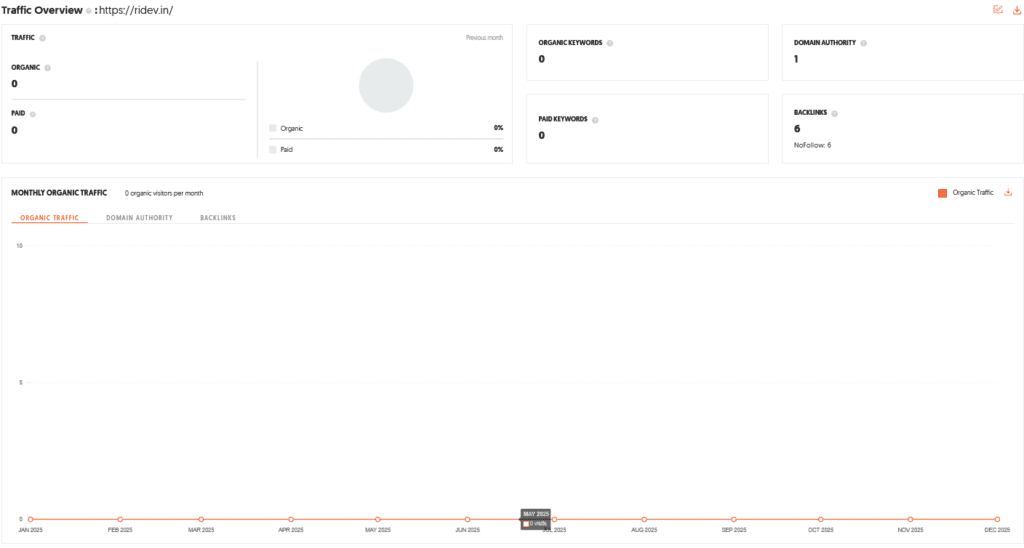
- Poor SEO Performance, SEO Improvement Needed.
- ORGANIC TRAFFIC: 0 visitor per month.
RIDEV Founders
- Manish Kumar Jain: A seasoned Chartered Accountant and entrepreneur with over a decade of experience in business growth. He is the primary visionary behind the “full-stack” EV leasing model.
- Siddharth Jain: Co-founder who oversees the operational scaling and management of the rapidly growing fleet. Together, they have grown the business from just 10 vehicles in mid-2024 to over 1,400 vehicles by late 2025.
RIDEV Brand Overview
- RIDEV Green Electric Vehicle is a Hyderabad-based startup that doesn’t just sell scooters; it provides a comprehensive infrastructure.
- brand targets the gig economy (delivery partners for Swiggy, Zomato, Zepto, etc.) who face barriers like high upfront costs, lack of documentation for loans, and high maintenance downtime.
- Their ecosystem includes a proprietary leasing platform and a network of 80+ fast-charging stations.
RIDEV Shark Tank India Appearance & Ask
- Initial Ask: ₹6 Crore for 3% Equity.
- Initial Valuation: ₹200 Crore.
- The Pitch: The founders showcased explosive growth, highlighting that their fleet generated ₹82 Lakh in net sales with a ₹50 Lakh EBITDA in the single month of September 2025.
RIDEV Season and Episode Air Date
- Season: 05
- Episode: 10
- Episode Air Date: Friday, 16 January 2026
RIDEV Product Overview
RIDEV provides branded, high-performance electric two-wheelers valued between ₹1.2 Lakh and ₹1.3 Lakh. These are “commercial-grade” scooters built for 10+ hours of daily use.
- Infrastructure: They have deployed 80+ fast-charging stations (setup cost approx. ₹70,000 each) to ensure riders have minimal “charging downtime,” which is critical for delivery professionals.
RIDEV Investor Reactions
- Vineeta Singh: Initially skeptical, she called the ₹6 Crore ask the “biggest in Shark Tank India history.” She also questioned if the “remote disabling” feature was too harsh for workers.
- Namita Thapar: Concerned about the capital-intensive nature of the business, noting that owning thousands of depreciating assets requires constant, massive infusions of cash.
- Kunal Bahl: Impressed by the unit economics—specifically that each vehicle generates roughly ₹9,900 in monthly revenue—he saw it as a high-yield asset-management play rather than just a “scooter company.”
RIDEV Customer Engagement Philosophy
RIDEV operates on a “Discipline-Driven Affordability” model:
- Accessibility: A worker can start their job with just a ₹3,000 deposit, compared to the ₹20,000–₹30,000 down payment usually required for vehicle financing.
- Strict Accountability: The ₹200 weekly rent is non-negotiable. Using IoT technology, the scooter is remotely locked if payment is missed. This ensures a 99% collection rate and maintains high vehicle quality.
RIDEV Product Highlights
- Scalability: From 10 to 1,400+ scooters in 15 months.
- Renewal Rate: 60% of riders choose to renew their lease weekly, showing high product-market fit.
- Asset Care: 99% of vehicles are returned in good condition, debunking fears of “rental abuse.”
- High Utilization: Integration with fast-charging hubs allows riders to stay on the road longer than those using standard home-charging EVs.
RIDEV Future Vision
- The founders aim to scale to tens of thousands of vehicles across major Indian metros.
- Their goal is to become the backbone of India’s carbon-free logistics sector, eventually transitioning from a leasing company to a massive data and energy infrastructure provider for the entire EV industry.
RIDEV Deal Finalized or Not
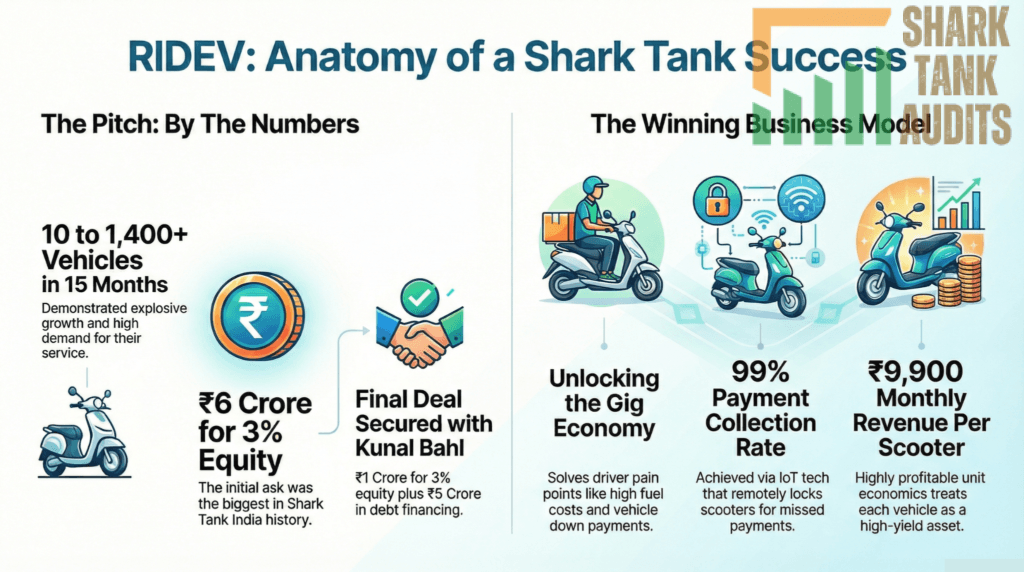
Yes, a deal was finalized. After intense debating over the high valuation and capital requirements, the founders accepted a structured offer from Shark Kunal Bahl.
- Final Deal: ₹1 Crore for 3% equity + ₹5 Crore in debt (at 14.5% interest).
- Impact: This deal provided the massive liquidity needed to purchase more assets while allowing the founders to retain more equity than a pure cash-for-equity deal would have required at a lower valuation.
| Item | Details |
|---|---|
| Website | RIDEV |
| Platform | Built on CMS WordPress |
| SEO Performance | Poor SEO performance, improvement needed |
| Organic Traffic | 0 visitors per month |
| Founder | Manish Kumar Jain |
| Co-Founder | Siddharth Jain |
| Founder Background | Chartered Accountant with 10+ years of business experience |
| Co-Founder Role | Handles operations and fleet scaling |
| Business Growth | Expanded from 10 vehicles to 1,400+ vehicles in 15 months |
| Brand Location | Hyderabad, India |
| Brand Category | Electric vehicle leasing and infrastructure |
| Business Model | Full-stack EV leasing for gig economy |
| Target Customers | Delivery partners of Swiggy, Zomato, Zepto, Amazon |
| Core Problem Solved | High upfront cost, loan access, maintenance downtime |
| Product Offering | Commercial-grade electric two-wheelers |
| Vehicle Price Range | ₹1.2–₹1.3 lakh per scooter |
| Usage Design | Built for 10+ hours of daily commercial use |
| Charging Infrastructure | 80+ fast-charging stations |
| Charging Setup Cost | Approx. ₹70,000 per station |
| Shark Tank Season | Season 05 |
| Episode Number | Episode 10 |
| Episode Air Date | Friday, 16 January 2026 |
| Initial Investment Ask | ₹6 crore for 3% equity |
| Initial Valuation | ₹200 crore |
| Pitch Highlight | ₹82 lakh net sales in September 2025 |
| EBITDA Highlight | ₹50 lakh EBITDA in September 2025 |
| Vineeta Singh Feedback | Questioned large ask and remote lock feature |
| Namita Thapar Concern | Capital-intensive asset ownership |
| Kunal Bahl View | High-yield asset management business |
| Customer Philosophy | Discipline-driven affordability |
| Entry Deposit | ₹3,000 to start working |
| Weekly Rent | ₹200 per week |
| Payment Enforcement | Remote locking via IoT |
| Collection Rate | 99% payment collection |
| Renewal Rate | 60% weekly lease renewals |
| Asset Condition Return | 99% vehicles returned in good condition |
| Monthly Revenue per Vehicle | Approx. ₹9,900 |
| Utilization Advantage | Fast charging reduces rider downtime |
| Scalability Proof | Rapid fleet expansion |
| Core Differentiator | Integrated leasing + charging ecosystem |
| Future Vision | Backbone of carbon-free logistics |
| Long-Term Goal | Transition to data and energy infrastructure |
| Deal Status | Deal finalized |
| Final Deal Structure | ₹1 crore for 3% equity |
| Debt Component | ₹5 crore debt at 14.5% interest |
| Strategic Impact | Enabled asset expansion with limited dilution |
| Gig Economy Size | 13+ million workers in India |
| Quick-Commerce Growth | 32% CAGR |
| Operating Cost Advantage | EV cost < ₹0.50 per km |
| Petrol Cost Comparison | ₹2.5–₹3.0 per km |
| Government Scheme | PM E-DRIVE replacing FAME-II |
| Government Allocation | ₹10,000+ crore for EV adoption |
| Total Addressable Market | ₹45,000 crore EV leasing market |
| Serviceable Market | 4.5 million delivery riders |
| Obtainable Market Goal | 5–10% urban delivery fleet |
| Rider Age Group | 18–45 years |
| Monthly Income Profile | ₹15,000–₹35,000 |
| Key Rider Pain Points | Fuel cost, downtime, loan rejection |
| Marketing Strategy | Hyper-local Reels and YouTube content |
| SEO Strategy | Target EV rental intent keywords |
| B2B Marketing | LinkedIn logistics case studies |
| Distribution Model | Hub-and-spoke near dark stores |
| Infrastructure Expansion | 500+ charging stations by 2027 |
| Competitive Advantage | Low deposit and strict collections |
| Major Challenge | High capital intensity |
| Technology Risk | Battery degradation |
| Risk Mitigation | A-grade batteries with warranties |
| Financial Discipline Tool | IoT-based vehicle locking |
| Diversification Plan | Multiple white-label EV models |
| Phase 1 Goal | Grow fleet to 5,000 vehicles |
| Phase 2 Goal | Launch Energy-as-a-Service |
| Phase 3 Goal | Build credit scoring using IoT data |
| Valuation Target | ₹800–₹1,000 crore Series B |
RIDEV Shark Tank India Business Plan
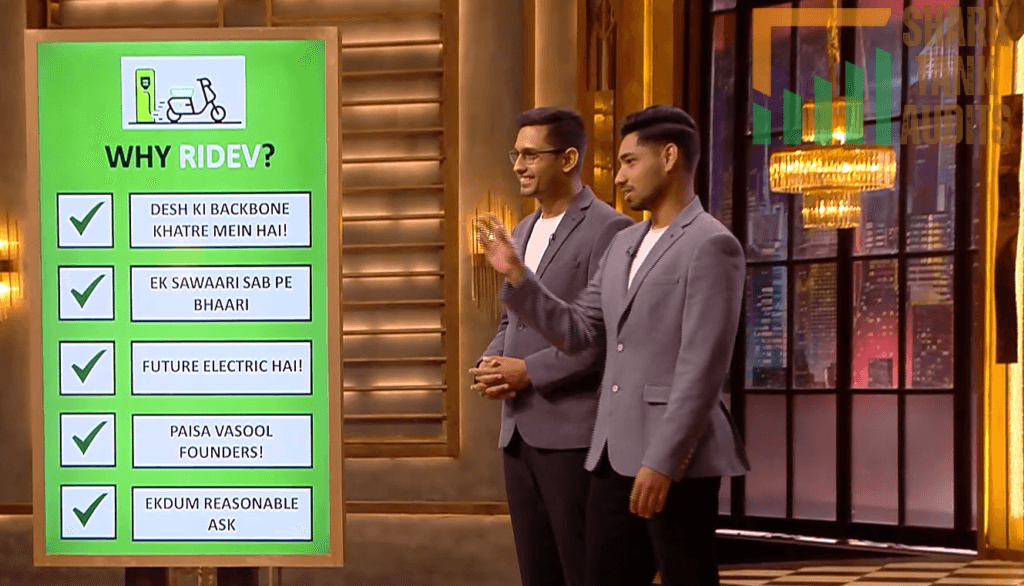
1. RIDEV Business Potential in India: Facts & Data
- The Quick-Commerce Boom: As of 2026, India’s gig economy has surpassed 13 million workers, with quick-commerce (Blinkit, Zepto, Swiggy Instamart) growing at a 32% CAGR.
- Fuel Cost Disparity: Traditional petrol scooters cost approx. ₹2.5–₹3.0 per km to operate, while RIDEV scooters operate at less than ₹0.50 per km, offering a 6x saving for high-mileage delivery partners.
- Government Support: The PM E-DRIVE scheme (replacing FAME-II) has allocated over ₹10,000 Crore specifically for commercial EV adoption and charging infrastructure, directly benefiting RIDEV’s asset-heavy model.
2. RIDEV Total Addressable Market (TAM): Facts & Data
- Total Addressable Market (TAM): Estimated at ₹45,000 Crore ($5.4 Billion) by 2030 for EV leasing in India.
- Serviceable Addressable Market (SAM): The 2-wheeler commercial delivery segment, currently comprising 4.5 million active daily riders across Tier-1 and Tier-2 cities.
- Serviceable Obtainable Market (SOM): RIDEV aims to capture 5-10% of the urban delivery fleet market (approx. 250,000–500,000 vehicles) within the next 5 years.
3. RIDEV Ideal Target Audience & Demographics
- Primary Segment: Male and Female delivery partners (Aged 18–45) working for Zepto, Zomato, Swiggy, and Amazon.
- Economic Profile: Individuals with monthly earnings between ₹15,000 and ₹35,000 who lack the credit score or documentation required for traditional bank loans.
- Pain Points: High daily petrol costs (₹200–₹300/day), vehicle maintenance downtime, and high upfront down payments (₹20,000+).
4. RIDEV Marketing & Digital Strategy
- Hyper-Local Digital Strategy: Use YouTube and Instagram Reels featuring “Day in the Life” content of delivery partners saving ₹8,000/month using RIDEV, targeting users based on location (near delivery hubs).
- Search Engine Optimization (SEO): Transition the RIDEV Shopify store from 0 organic traffic by targeting high-intent keywords like “EV scooter for rent in Hyderabad” and “Electric scooter on weekly rent.”
- B2B Content: Create LinkedIn case studies for logistics companies showing how RIDEV reduces their “Last Mile” carbon footprint and operational costs.
5. RIDEV Distribution & Infrastructure Strategy
- Hub-and-Spoke Model: Establishing RIDEV Experience Centers near major dark stores (Zepto/Blinkit warehouses) for easy vehicle pickup and maintenance.
- Energy Network: Scaling the current 80+ fast-charging stations to 500+ by 2027 to eliminate “range anxiety” for commercial riders.
6. RIDEV Advantages & Challenges
| RIDEV Advantages | RIDEV Challenges |
| Low Barrier to Entry: Only ₹3,000 deposit vs. ₹25,000 for competitors. | Capital Intensity: High cost of owning assets (₹1.2L per scooter). |
| Unit Economics: ₹9,900 monthly revenue per bike is highly lucrative. | Regulatory Shifts: Frequent changes in GST or EV subsidies. |
| Tech-Lock: Remote disabling ensures nearly 100% payment collection. | Battery Degradation: Long-term risk of high-usage battery failure. |
7. RIDEV Mitigation & Success Strategies
- Mitigation of Asset Risk: Use the ₹5 Crore debt from Shark Kunal Bahl to finance only “A-grade” battery tech with 3-year warranties.
- Financial Discipline: Maintaining the strict remote-lock feature to prevent bad debts, a strategy that has already yielded a 99% collection rate.
- Diversification: Reducing dependence on a single manufacturer by white-labeling multiple durable EV models under the RIDEV brand.
8. RIDEV Future Business Roadmap & Valuation Growth
- Phase 1 (2026): Deploy Shark Tank funds to grow from 1,400 to 5,000 vehicles in Hyderabad and Bangalore.
- Phase 2 (2027): Launch RIDEV Energy-as-a-Service, allowing non-RIDEV riders to use their fast-charging network for a fee.
- Phase 3 (2028): Transition to a Data-Driven Valuation. Use IoT data from millions of kilometers driven to provide “Credit Scoring” for delivery partners, creating a fintech layer.
- Valuation Target: By reaching a fleet size of 20,000 vehicles with 60% EBITDA margins, RIDEV can aim for a Series B valuation of ₹800–₹1,000 Crore.





RIDEV Shark Tank India Episode Review