
Paper Pro Shark Tank India Episode Review
Paper Pro appeared on Shark Tank India Season 5, Episode 14, with founder Dhruv Tomar seeking investment but left with no deal despite innovative concept. The deep-tech startup powered by MLense offers paper-based instant food adulteration testing requiring no electricity, machinery, or technical expertise through simple “resting principle” where food samples touching test paper trigger chemical reactions showing color shifts indicating contamination.
Growing from ₹5.7 lakh (last year) to ₹8.1 lakh (last quarter) with ₹6 lakh monthly sales primarily through offline B2B channels, the product targets households, street vendors, NGOs, food inspectors, and educational institutions. While Sharks engaged with the science and mission, concerns arose over product differentiation versus existing milk testing kits, scientific validation/certifications, go-to-market strategy for B2B-to-B2C transition, and unit economics/margins.
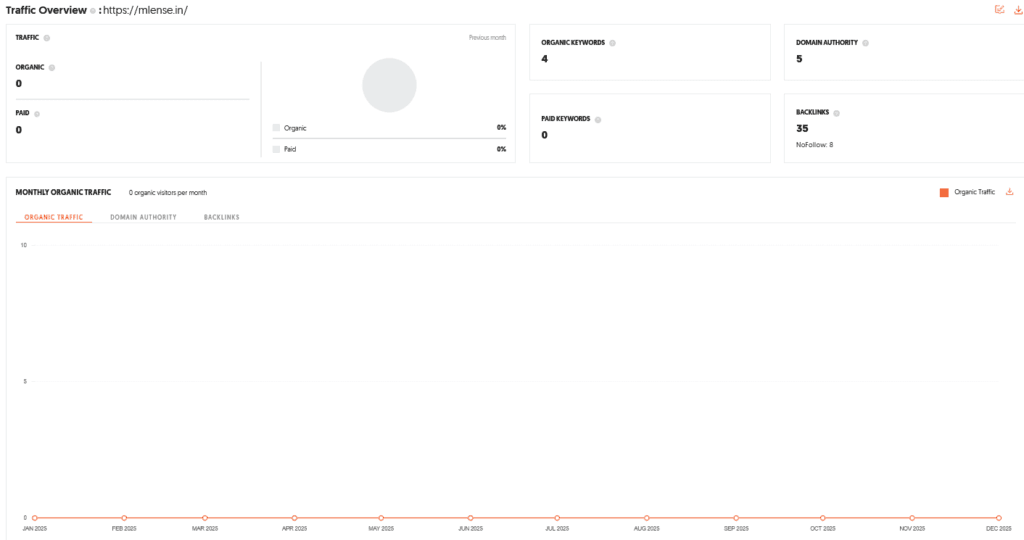
Operating with 0 monthly organic visitors requiring SEO overhaul, Paper Pro addresses India’s 100 million annual foodborne disease cases costing $15 billion in healthcare/productivity losses within food safety testing market projected at $717.9 million (2025) growing 9.8% CAGR to $1.51 billion by 2033, specifically targeting food authenticity market valued at $271.29 million (2024) expected to reach $448.71 million by 2033, as 84% of Indian consumers prioritize food safety in purchasing decisions supported by FSSAI’s “Eat Right India” initiative.
Paper Pro Website Information
- Website:- Paper Pro
- Build on CMS WordPress
- Poor SEO Performance, SEO Improvement Needed.
- ORGANIC TRAFFIC: 0 visitor per month.
Paper Pro Founder
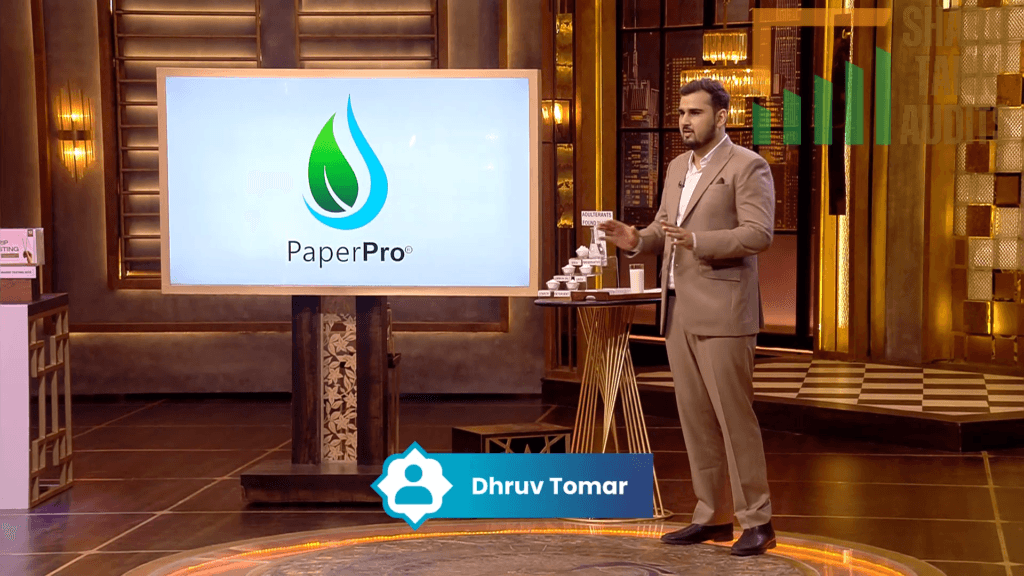
- Dhruv Tomar is the visionary entrepreneur behind Paper Pro.
- Driven by the philosophy that food safety should not be restricted to professionals or laboratories, he developed a solution aimed at democratizing food testing for the average consumer.
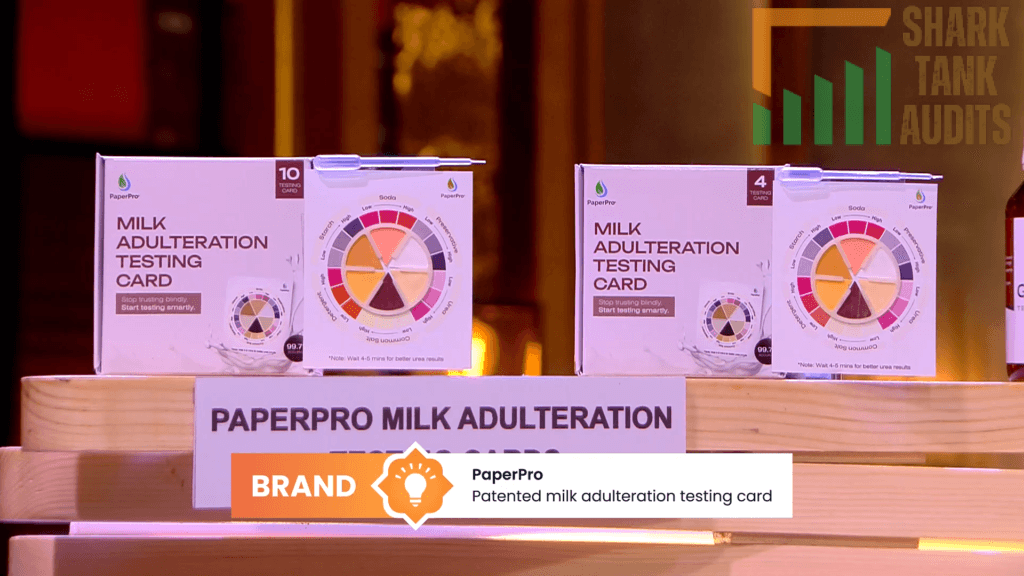
Paper Pro Brand Overview
- Paper Pro is a deep-tech startup powered by MLense.
- The brand focuses on addressing the “silent threat” of food adulteration that affects family health and safety.
- It seeks to transition food testing from complex, resource-heavy laboratory environments directly into the hands of everyday citizens, small vendors, and students.
Paper Pro Shark Tank India Appearance & Ask
Dhruv Tomar appeared on Shark Tank India Season 5 to pitch his innovative paper-based testing solution.
- The Pitch: He emphasized the need for a culture of “practical testing” to combat widespread food contamination.
- The Outcome: Despite the innovative nature of the product, the founder did not secure a deal and left the tank empty-handed.
Paper Pro Season and Episode Air Date
- Season: 05
- Episode: 14
- Episode Air Date: Thursday, 22 January 2026
Paper Pro Product Overview
- Paper Pro is a paper-based testing format designed to detect food adulteration instantly.
- It is built on the principle of simplicity, requiring no electricity, complex machinery, or technical expertise.
- Mechanism: It uses a straightforward “resting principle.” When a food sample touches the test paper, a chemical reaction occurs.
- Detection: Adulteration is identified through a clear color shift or visible indicator on the paper.
- Target Users: Ideal for households, street vendors, NGOs, food inspectors, and educational purposes.
Paper Pro Investor Reactions
The Sharks showed interest but remained skeptical regarding the business’s scalability and technical moats. Their primary concerns included:
- Product Differentiation: Whether similar milk testing kits already existed in the market.
- Scientific Validation: The accuracy levels and formal certifications of the test results.
- Go-to-Market Strategy: Questions regarding how the brand intended to transition from B2B to B2C.
- Unit Economics: Probing the margins and the channel mix of their sales.
Paper Pro Customer Engagement Philosophy
- The brand operates on the belief that “Testing fosters trust.”
- For young parents and Gen Z, the ability to test food in their own kitchen provides immediate peace of mind.
- Paper Pro’s philosophy is to move away from reactive safety to preventive food safety practices, empowering the public to make informed choices.
Paper Pro Product Highlights
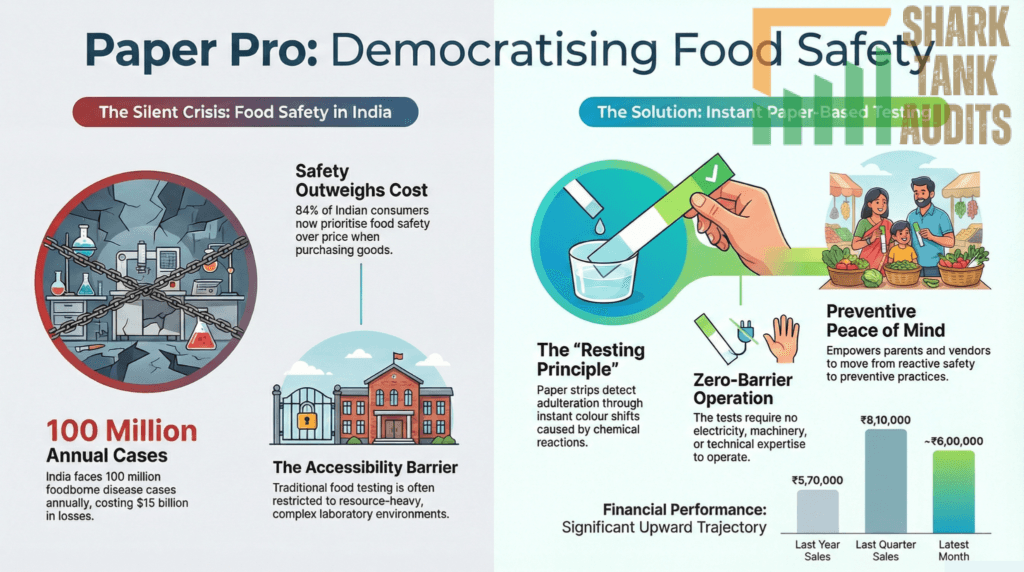
The business has shown a significant upward trajectory in its financial performance, primarily through offline and B2B channels:
| Metric | Value (Approx.) |
| Last Year Sales | ₹5,70,000 |
| Last Quarter Sales | ₹8,10,000 |
| Previous Month | ₹5,30,000 |
| Latest Month | ~₹6,00,000 |
| Key Advantage | No technical expertise or power source required |
Paper Pro Future Vision
- Paper Pro aims to become a staple in every Indian household. The vision is to solve a massive public health problem using “simple paper and clever science.”
- By making food safety accessible and affordable, the brand hopes to create a future where every consumer has the power to verify the quality of the food they consume, ultimately reducing the impact of adulteration on society.
Paper Pro Deal Finalized or Not
- No deal was finalized.
- While the Sharks engaged with the product’s science and mission, it did not result in an investment during the episode.
| Category | Parameter | Details |
|---|---|---|
| Website & Tech | Website | Paper Pro |
| CMS | WordPress | |
| SEO Performance | Poor (Improvement Needed) | |
| Monthly Organic Traffic | 0 visitors | |
| Founder | Name | Dhruv Tomar |
| Role | Founder | |
| Core Belief | Food safety should be accessible to everyone, not just labs | |
| Company Overview | Brand Type | Deep-tech food safety startup (Powered by MLense) |
| Core Problem | Food adulteration affecting public health | |
| Mission | Democratize food testing for households and small vendors | |
| Shark Tank India | Season | 05 |
| Pitch Focus | Practical, at-home food adulteration testing | |
| Deal Status | ❌ No deal | |
| Product Overview | Product Type | Paper-based food adulteration testing strips |
| Power Requirement | None | |
| Technical Skill Required | None | |
| Testing Method | Chemical reaction with visible color change | |
| Detection Format | Instant visual indicator | |
| Target Users | Households, vendors, NGOs, inspectors, students | |
| Product Highlights | Ease of Use | Extremely simple |
| Infrastructure Needed | Zero (no lab, no electricity) | |
| Portability | Fully portable | |
| Core Advantage | Instant detection without expertise | |
| Financial Performance | Last Year Sales | ₹5,70,000 |
| Last Quarter Sales | ₹8,10,000 | |
| Previous Month Sales | ₹5,30,000 | |
| Latest Month Sales | ~₹6,00,000 | |
| Investor Reactions | Overall Sentiment | Interested but skeptical |
| Key Concerns | Product differentiation | |
| Scientific Validation | Accuracy & certifications | |
| Go-To-Market | B2B → B2C scalability | |
| Unit Economics | Margins & channel mix | |
| Customer Philosophy | Core Belief | “Testing fosters trust” |
| Emotional Hook | Peace of mind for families | |
| Behavioral Shift | Preventive vs. reactive food safety | |
| Market Opportunity | Foodborne Disease Impact | ~100M cases annually in India |
| Economic Cost | ~$15B yearly loss | |
| Consumer Shift | 84% prioritize food safety (2025) | |
| Policy Tailwinds | FSSAI Eat Right India | |
| TAM / SAM / SOM | Food Safety Testing Market | $717.9M (2025) |
| Market CAGR | 9.8% | |
| Market Size (2033) | $1.51B | |
| Food Authenticity Segment | $271.29M → $448.71M | |
| Paper Pro Niche | Household & small vendor rapid kits | |
| Target Audience | Conscious Parents | Ages 25–45, Tier 1 & 2 |
| Gen Z | Health & transparency focused | |
| Small Vendors | Street food, cloud kitchens | |
| Institutions | Schools, NGOs | |
| Marketing Strategy | Core Campaign | “Purity Proof” demonstrations |
| Content Type | Reels & Shorts (live testing) | |
| Influencers | Pediatricians, mom-bloggers | |
| Education | Adulteration awareness blogs | |
| Digital Strategy | SEO Status | Non-existent |
| SEO Focus Keywords | Milk purity test, food adulteration kit | |
| Paid Ads | Parents & organic buyers | |
| Community Channel | WhatsApp safety tips | |
| Distribution Strategy | Current Strength | Offline & B2B |
| B2B Partners | Milk federations, grocery chains | |
| D2C Expansion | Website, Amazon, Blinkit | |
| Institutional Sales | Schools & education boards | |
| Advantages | Simplicity | Anyone can use |
| Cost | Much cheaper than labs | |
| Scalability | Easy mass manufacturing | |
| Challenges | Awareness | Low perceived need |
| Validation | Certification & trust | |
| Competition | Low entry barrier | |
| Success Factors | Repeat Usage | Monthly testing potential |
| Trust Builder | Certifications & endorsements | |
| Risk Mitigation | Scientific Trust | NABL + FSSAI approvals |
| Competitive Moat | Patent chemical reagents | |
| Future Roadmap | Phase 1 | SEO + D2C growth |
| Phase 2 | Pesticide detection kits | |
| Phase 3 | Southeast Asia expansion | |
| Valuation Strategy | Long-Term Shift | Product → Data platform |
| Monetization Upside | Sell adulteration insights | |
| Vision | Paper Pro in every Indian kitchen |
Paper Pro Shark Tank India Business Plan
1. Paper Pro: Business Potential in India
- Widespread Crisis: India experiences approximately 100 million foodborne disease cases annually, costing the nation an estimated $15 billion in healthcare and productivity losses.
- Consumer Shift: As of 2025, 84% of Indian consumers prioritize food safety as a vital driver in their purchasing decisions, often outweighing cost considerations.
- Government Support: The FSSAI’s “Eat Right India” initiative and the mandate for third-party testing in modern retail create a high-growth environment for Paper Pro.
2. Paper Pro: Total Addressable Market (TAM)
- Food Safety Testing Market: The Indian food safety testing market is projected to reach $717.9 million in 2025, growing at a CAGR of 9.8% to reach $1.51 billion by 2033.
- Food Authenticity Segment: Specifically, the Indian food authenticity market (focused on adulteration) is valued at $271.29 million (2024) and is expected to grow to $448.71 million by 2033.
- Paper Pro’s Niche: By targeting the household and small vendor segments—currently underserved by traditional labs—Paper Pro can capture a significant share of the rapid testing kit market.
3. Paper Pro: Ideal Target Audience & Demographics
- Conscious Parents (Ages 25–45): Residing in Tier 1 & 2 cities, focused on ensuring the purity of milk and staples for their children.
- Gen Z & Health Enthusiasts: Tech-savvy individuals who use wellness apps and seek “clean label” transparency.
- Small Food Vendors & Cloud Kitchens: Micro-entrepreneurs needing to prove quality to customers without high lab costs.
- Educational Institutions & NGOs: Schools using kits for science labs and NGOs conducting field awareness programs.
4. Paper Pro: Marketing & Content Strategy
- The “Purity Proof” Campaign: Create short-form video content (Reels/YouTube Shorts) showing Paper Pro in action—detecting adulterants in real-time in common kitchen items.
- Influencer Partnerships: Collaborate with pediatricians, fitness influencers, and “Mom-bloggers” to build credibility and trust.
- Educational Content: Blog series titled “The Silent Threat,” explaining common adulterants (urea in milk, starch in spices) and how Paper Pro detects them.
5. Paper Pro: Digital Marketing Strategy
- SEO Overhaul: Address the 0 organic visitor status by targeting high-intent keywords like “how to test milk purity at home” and “food adulteration test kit India.”
- Paid Meta/Google Ads: Run targeted ads for “New Parents” and “Organic Food Buyers” using “Fear of the Unknown” vs. “Peace of Mind” creative angles.
- Community Engagement: Use WhatsApp Marketing to provide weekly food safety tips and bulk-buy offers for housing societies.
6. Paper Pro: Distribution Strategy
- B2B Focus (Current Strength): Partner with milk federations, organic grocery chains (like Nature’s Basket), and catering services as a “Value-Add” for their customers.
- D2C Expansion: Optimize the Paper Pro WordPress website for e-commerce and launch on Amazon/Blinkit for “Instant Delivery.”
- Institutional Sales: Partner with state education boards to include Paper Pro kits in standard chemistry/biology lab supplies.
7. Paper Pro: Advantages & Challenges
- Advantages: * Simplicity: No power or technical training required.
- Cost-Effective: Significantly cheaper than lab testing.
- Scalability: Paper-based production is easily mass-manufactured.
- Challenges:
- Awareness: Consumers don’t always know they need to test.
- Validation: Overcoming Shark Tank skepticism regarding scientific certifications.
- Competition: Low barriers to entry for other paper-based chemistry firms.
8. Paper Pro: Success Factors & Mitigation
- Success Driver: High repeat-purchase potential (subscription model for monthly testing).
- Mitigation (Scientific Trust): Secure NABL-accredited lab certifications and FSSAI endorsements to silence skeptics.
- Mitigation (Market Entry): Rapidly patent the specific chemical reagents used in the Paper Pro strips to create a “technical moat.”
9. Paper Pro: Future Business & Roadmap to Valuation
- Phase 1 (Year 1): Digital transformation. Achieve 50k+ monthly website visitors and 3x revenue growth through D2C channels.
- Phase 2 (Year 2): Product Diversification. Launch Paper Pro Plus for detecting pesticides in fruits and vegetables.
- Phase 3 (Year 3): Global Expansion. Target SE Asian markets with similar food safety concerns.
- Valuation Strategy: Shift from a “Product Company” to a “Data & Safety Platform.” By collecting anonymized data on where adulteration is highest, Paper Pro can sell insights to regulators and brands, significantly increasing its valuation multiples.






Paper Pro Shark Tank India Episode Review