
Boingg Shark Tank India Episode Review
Boingg! appeared on Shark Tank India Season 5, Episode 38, with Gurugram-based founders Dhruvan Barar (IIT/IIM Kozhikode alumnus) and co-founder Neha Indoria (launched 2018, incorporated 2020 addressing lack of specialized high-quality kids furniture in India) seeking ₹2 Crore for 5% equity (₹40 Crore valuation) but left with no deal after Sharks collectively declined citing high inventory costs, capital-intensive furniture business nature, heavy logistics challenges, and perceived scaling difficulty maintaining high margins.
The D2C mid-to-premium home decor brand operates as “internet-first” with strategic physical presence targeting urban millennial parents seeking “Montessori-inspired” functional spaces promoting child independence/safety/imagination versus mass-produced plastic alternatives, offering 900+ designs (beds, bunk beds, study tables, soft furnishings, decor including mirrors/curtains/bedsheets) with flagship “Little Hut Bed” selling 900 units providing “total room solution” for cohesive children’s environment design featuring non-toxic polishes, rounded edges, smooth finishes, motor skill-developing furniture (rockers/climbers), high customization (colors/sizes/storage configurations), and eco-friendly wood-based materials with warranty/after-sales service, achieving 4,146 monthly organic visitors requiring SEO improvement but pivotal 0.02% online conversion rate jumping to 30% in physical stores creating “Physical-First” conversion philosophy stating “If we do not have a store in a city, we do not market in that city” for high-involvement furniture category where parents want touch-and-feel quality. Sharks reacted with admiration/skepticism mix praising design aesthetics and founder credentials while wary of “death by a thousand cuts” funding history (eight different small rounds suggesting constant liquidity struggles) and consistent -12% to -13% EBITDA losses indicating unit economics not improving fast enough, with one noting local carpenters as massive unorganized competitor.
Operating in Indian furniture market growing from $29.27 billion (2025) to $31.51 billion (2026) reaching $45.52 billion by 2031 (7.63% CAGR) with specialized kids’ furniture segment growing faster (13-15% CAGR) within organized $1.2-1.5 billion kids’ furniture segment and $27.27 billion overall home furniture TAM as millennial parents prioritize safety/ergonomics/developmental Montessori environments amid average 30% YoY interior spending jump (2025-2026) with parents allocating 15-20% home furnishing budget specifically to children’s rooms, Boingg! targets urban millennial parents (28-42, ₹15-20 lakh+ annual household income, Tier 1 Delhi NCR/Mumbai/Bengaluru/Pune/Hyderabad and Tier 2 growth hubs Ahmedabad/Chandigarh/Jaipur)—design-conscious, safety-obsessed, “Montessori” believers viewing furniture as child development tool versus utility—within ₹500-800 Crore obtainable market (top 10% urban households) over 5 years, having recently opened Pune/Hyderabad/Ahmedabad stores (total six) planning aggressive offline expansion establishing physical footprint in every major metro, implementing “Experience” Bridge using digital ads driving experience center footfall versus online checkouts, mommy blogger/pediatric interior designer influencer partnerships showcasing safety/”growth-with-child” aspects, weekend “Safe Play” workshops engaging parents/children simultaneously, high-quality Reels showing unboxing/stress-testing/360-degree room transformations, SEO targeting keywords (“Montessori beds India,” “Sustainable kids furniture,” “Safe bunk beds”), AR Room Visualizer enabling parents seeing Little Hut Bed fits in specific dimensions, web-to-store omnichannel model with marketplace presence (FirstCry/Pepperfry/Urban Ladder) leveraging traffic for brand awareness, geographic geofencing ads only marketing in cities with physical touchpoints capturing 30% conversion, EMI/no-cost financing making ₹40,000 beds accessible, “Growth Kits” launch modifying toddler beds into study desks as child ages capturing repeat business, just-in-time modular manufacturing reducing inventory burn optimizing logistics, high-margin decor products (curtains/sheets) with lower shipping costs increasing EBITDA neutrality, 15+ micro-stores (1,000 sq ft) Tier 2 city expansion, furniture subscription/rental model capturing 50% parents hesitating at high upfront costs, and Middle East/SE Asia global expansion where “Indianized Montessori” designs have high appeal significantly boosting valuation multiples targeting ₹100+ Crore valuation.
Website Information
- Website:- Boingg
- Build on Shopify
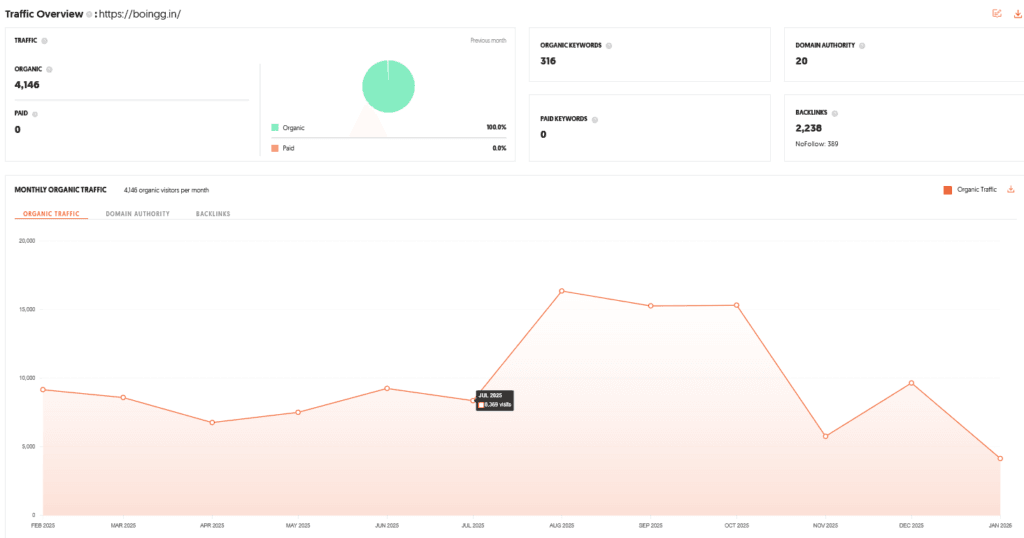
- Good SEO Performance, SEO Improvement Needed.
- ORGANIC TRAFFIC: 4146 visitors per month.
The Founders of Boingg!
- Boingg! was established by Dhruvan Barar, an alumnus of both IIT and IIM Kozhikode, and co-founder Neha Indoria.
- Combining technical expertise with a deep understanding of the children’s retail market, the founders launched the brand in 2018 (incorporated in 2020) to address the lack of specialized, high-quality furniture for kids in India.
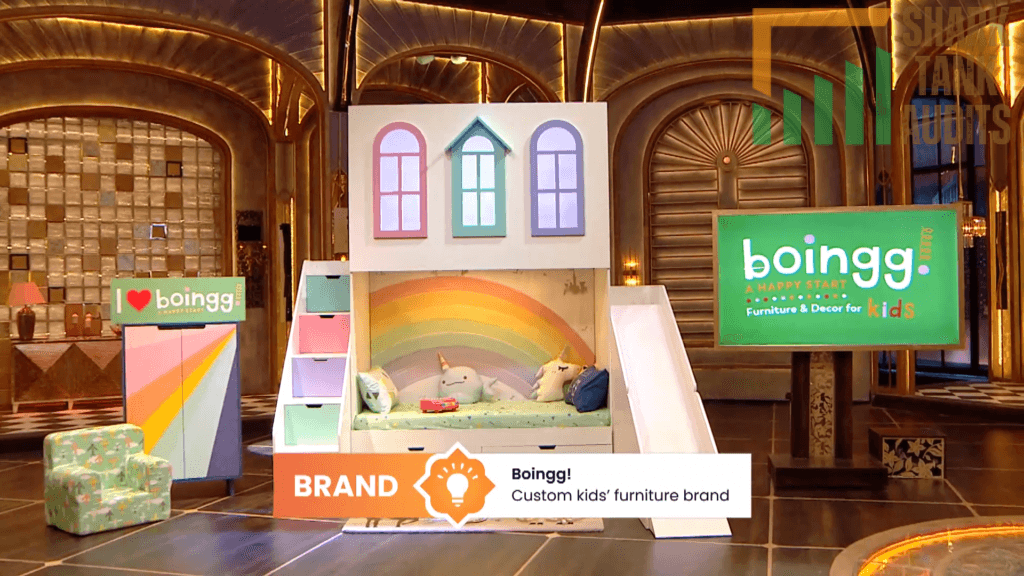
Boingg! Brand Overview
- Boingg! is a Gurugram-based D2C (Direct-to-Consumer) brand that operates in the mid-to-premium segment of the home decor market.
- The brand positions itself as an “internet-first” company but utilizes a strategic physical presence to drive sales.
- Boingg! targets urban millennial parents who seek “Montessori-inspired” functional spaces that promote a child’s independence, safety, and imagination rather than mass-produced plastic alternatives.
Boingg! Shark Tank India Appearance & Ask
- The founders of Boingg! appeared in Season 5, Episode 38, which aired on February 25, 2026.
- During the pitch, they sought an investment of ₹2 Crores for 5% equity, valuing the company at a ₹40 Crore post-money valuation.
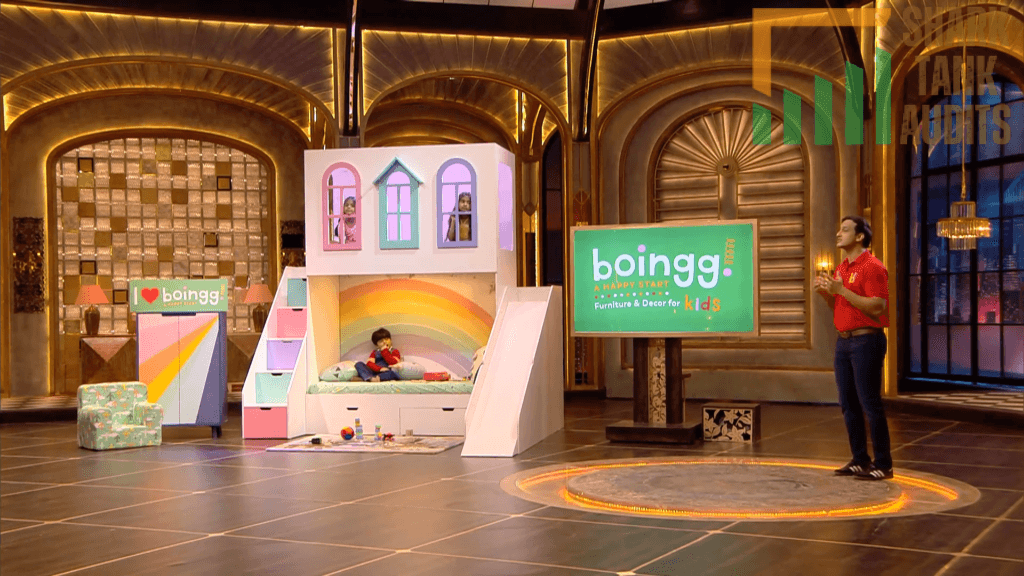
- They showcased their range of “Little Hut” beds and customization modules to demonstrate the brand’s unique appeal.
Season and Episode Air Date
- Season: 05
- Episode: 38
- Episode Air Date: Wednesday, 25 February, 2026
Boingg! Product Overview
- The Boingg! product catalog is extensive, featuring over 900 designs on their website.
- Their offerings range from foundational furniture like beds, bunk beds, and study tables to soft furnishings and decor such as mirrors, curtains, and bedsheets.
- A flagship product is the “Little Hut Bed,” which has sold nearly 900 units. The brand emphasizes a “total room solution,” allowing parents to design an entire cohesive environment for their children.
Investor Reactions to Boingg!
- The Sharks expressed a mix of admiration and skepticism toward Boingg!.
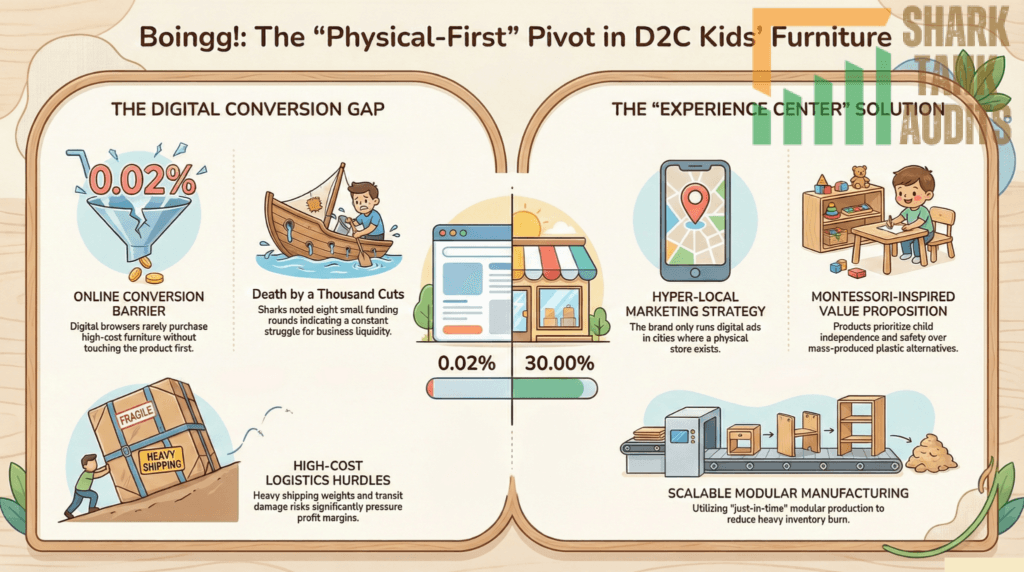
- While they praised the design aesthetics and the founders’ credentials, they were wary of the “death by a thousand cuts” funding history, noting eight different small funding rounds that suggested the business was constantly struggling for liquidity.
- One Shark pointed out that local carpenters remain a massive unorganized competitor, while others felt the EBITDA losses (consistently around -12% to -13%) indicated that the unit economics were not improving fast enough.
Boingg! Customer Engagement Philosophy
- A pivotal part of the Boingg! strategy is their “Physical-First” conversion philosophy.
- The founders revealed that while online marketing generates interest, the online conversion rate is a meager 0.02%.
- However, once a customer enters a physical Boingg! store, the conversion rate jumps to 30%. Because furniture is a “high-involvement” category where parents want to touch and feel the quality, the brand’s philosophy is: “If we do not have a store in a city, we do not market in that city.”
Boingg! Product Highlights
The core strengths of Boingg! products include:
- Safety Standards: Use of non-toxic polishes, rounded edges, and smooth finishes to ensure child safety.
- Skill Development: Furniture like rockers and climbers are designed to improve motor skills.
- Customization: High levels of personalization regarding colors, sizes, and storage configurations.
- Durability: A focus on eco-friendly, wood-based materials that offer a structured warranty and after-sales service, unlike the unorganized sector.
Future Vision for Boingg!
- The future vision for Boingg! involves aggressive offline expansion to solve the conversion gap.
- Having recently opened stores in Pune, Hyderabad, and Ahmedabad, bringing their total to six stores, the brand aims to establish a physical footprint in every major Indian metro.
- Despite past losses, the founders are focused on achieving operational break-even by scaling their “inventory-less” manufacturing model and capturing a larger share of the organized kids’ furniture market.
Boingg! Deal Finalized or Not
- No deal was finalized.
- Despite showing consistent revenue growth and a clear niche, the Sharks collectively decided not to invest.
- The primary reasons for the “no deal” verdict were concerns over high inventory costs, the capital-intensive nature of the furniture business, heavy logistics challenges, and the perceived difficulty in scaling a premium model while maintaining high margins.
| Title | Details |
|---|---|
| Brand Name | Boingg |
| Website Platform | Built on Shopify |
| SEO Performance | Good SEO performance, improvement needed |
| Organic Traffic | 4,146 visitors per month |
| Founders | Dhruvan Barar (IIT & IIM Kozhikode alumnus) and Neha Indoria |
| Founded Year | 2018 (Incorporated in 2020) |
| Headquarters | Gurugram, India |
| Business Model | D2C (Direct-to-Consumer), Internet-first with strategic physical stores |
| Segment | Mid-to-Premium Kids Furniture & Home Decor |
| Target Customers | Urban millennial parents seeking Montessori-inspired functional spaces |
| Shark Tank Appearance | Season 5, Episode 38 |
| Episode Air Date | Wednesday, 25 February 2026 |
| Investment Ask | ₹2 Crores for 5% equity |
| Valuation Asked | ₹40 Crores post-money valuation |
| Product Range | 900+ designs including beds, bunk beds, study tables, mirrors, curtains, bedsheets |
| Flagship Product | Little Hut Bed (Nearly 900 units sold) |
| Unique Proposition | Total room solution for cohesive children’s spaces |
| Online Conversion Rate | 0.02% |
| Offline Conversion Rate | 30% |
| Store Strategy | If no physical store in a city, no marketing in that city |
| Existing Stores | 6 stores (Pune, Hyderabad, Ahmedabad, etc.) |
| Funding History Concern | 8 small funding rounds indicating liquidity struggles |
| EBITDA Margin | Around -12% to -13% |
| Key Strengths | Safety standards, customization, durability, Montessori focus |
| Safety Features | Non-toxic polish, rounded edges, smooth finishes |
| Materials Used | Eco-friendly wood-based materials |
| Future Goal | Operational break-even with inventory-less manufacturing model |
| Deal Status | No Deal |
| Reasons for No Deal | High inventory costs, capital-intensive model, logistics challenges, scalability concerns |
| Indian Furniture Market Size (2026) | $31.51 Billion (Projected growth to $45.52 Billion by 2031, CAGR 7.63%) |
| Kids Furniture Growth Rate | 13–15% CAGR |
| TAM | $27.27 Billion (Indian home furniture market 2026) |
| SAM | $1.2–1.5 Billion (Organized kids furniture segment) |
| SOM | ₹500–₹800 Crores over next 5 years |
| Target Age Group | Parents aged 28–42 years |
| Income Segment | Household income above ₹15–20 Lakhs annually |
| Key Cities | Tier-1 & Tier-2 cities (Delhi NCR, Mumbai, Bengaluru, Pune, Hyderabad, Ahmedabad, etc.) |
| Marketing Focus | Experience centers, influencer partnerships, community workshops |
| Digital Strategy | Video-first content, SEO optimization, AR room visualizer |
| Distribution Model | Web-to-Store omnichannel model |
| Marketplace Presence | FirstCry, Pepperfry, Urban Ladder |
| Advantages | Kids specialization, safety compliance, strong founder pedigree |
| Challenges | Logistics costs, high CAC, unorganized carpenter competition |
| Success Strategy | Experience centers, EMI financing, growth kits, JIT manufacturing |
| Phase 1 Goal | Achieve EBITDA neutrality |
| Phase 2 Goal | Expand to 15+ micro-stores, introduce subscription model |
| Phase 3 Goal | Global expansion (Middle East & SE Asia) |
Boingg Shark Tank India Business Plan
1. Boingg! Business Potential in India: Facts and Data
The Indian furniture market is witnessing a paradigm shift from unorganized to organized retail, driven by urbanization and the rise of nuclear families.
- Market Growth: The Indian furniture market is projected to grow from $29.27 billion in 2025 to $31.51 billion in 2026, reaching $45.52 billion by 2031 (CAGR of 7.63%).
- The “Kids” Catalyst: The specialized kids’ furniture segment is growing at a faster clip (approx. 13-15% CAGR) as millennial parents prioritize safety, ergonomics, and developmental “Montessori” environments.
- Spending Trends: Average interior spending for 2BHK/3BHK homes in metros has seen a 30% YoY jump in 2025-2026, with parents increasingly allocating 15-20% of their home furnishing budget specifically to children’s rooms.
2. Boingg! Total Addressable Market (TAM): Facts and Data
- TAM (Total Addressable Market): The overall Indian home furniture market is valued at $27.27 billion (2026).
- SAM (Serviceable Addressable Market): The organized kids’ furniture segment in India is estimated at $1.2 – $1.5 billion.
- SOM (Serviceable Obtainable Market): Targeting the top 10% of urban households in Tier-1 and Tier-2 cities, Boingg! has an immediate obtainable market of ₹500 – ₹800 Crores over the next 5 years.
3. Boingg! Ideal Target Audience and Demographics
Boingg! serves a niche yet high-value demographic:
- Primary Persona: Urban Millennial Parents (Ages 28–42).
- Income Bracket: High-income and Upper-middle-class (Household Income > ₹15-20 Lakhs per annum).
- Geography: Residents of Tier-1 (Delhi NCR, Mumbai, Bengaluru, Pune, Hyderabad) and Tier-2 “Growth Hubs” (Ahmedabad, Chandigarh, Jaipur).
- Psychographics: Design-conscious, safety-obsessed, and “Montessori” believers who view furniture as a tool for child development rather than just a utility.
4. Boingg! Marketing Strategy
The Boingg! marketing engine must bridge the gap between “scrolling” and “stepping into the store.”
- The “Experience” Bridge: Use digital ads to drive footfall to experience centers rather than just online checkouts.
- Influencer Partnerships: Collaborate with “Mommy Bloggers” and pediatric interior designers to showcase the safety and “growth-with-child” aspects of Boingg! products.
- Community Building: Host weekend “Safe Play” workshops in Boingg! stores to engage parents and children simultaneously.
5. Boingg! Content and Digital Marketing Strategy
Given the 0.02% online conversion, the digital strategy for Boingg! shifts from “Sale” to “Trust.”
- Video First: High-quality Reels showing “unboxing,” “stress testing” for safety, and “360-degree room transformations” using Boingg! furniture.
- SEO Optimization: Targeted keywords around “Montessori beds India,” “Sustainable kids furniture,” and “Safe bunk beds” to improve the current 4,146 monthly organic visitors.
- Interactive Tools: Implement an AR (Augmented Reality) “Room Visualizer” on the Boingg! Shopify site to allow parents to see how a “Little Hut Bed” fits in their specific room dimensions.
6. Boingg! Distribution Strategy
Boingg! employs a “Web-to-Store” or Omnichannel distribution model:
- Experience Centers: 6 existing stores (Pune, Hyderabad, Ahmedabad, etc.) acting as conversion hubs.
- Marketplace Presence: Strategic listings on FirstCry, Pepperfry, and Urban Ladder to leverage their massive traffic for brand awareness.
- Hyper-Local Marketing: Geographic geofencing of ads; only marketing Boingg! in cities where a physical touchpoint exists to ensure the 30% conversion rate is captured.
7. Boingg! Advantages and Challenges
Boingg! Advantages
- Specialization: Unlike IKEA, Boingg! focuses 100% on the kids’ niche.
- Safety Compliance: Established non-toxic and injury-preventative standards give it an edge over local carpenters.
- Founder Pedigree: Strong IIT/IIM leadership providing analytical and operational depth.
Boingg! Challenges
- Logistics Costs: High “dead-weight” shipping costs and risk of damage during transit.
- Customer Acquisition Cost (CAC): High competition in the digital ad space for “parenting” keywords.
- The Carpenter Factor: Price sensitivity due to the unorganized sector offering cheaper, albeit lower-quality, alternatives.
8. Boingg! Success Factors and Mitigation Strategies
| Reason for Boingg! Success | Boingg! Mitigation Strategy |
| High Trust Category | Scaling “Experience Centers” to provide physical validation. |
| Premium Demand | Offering “EMI” and “No-Cost Financing” to make ₹40k beds accessible. |
| Repeat Business | Launching “Growth Kits” to modify toddler beds into study desks as the child ages. |
| Supply Chain Efficiency | Transitioning to a “Just-in-Time” modular manufacturing to reduce inventory burn. |
9. Boingg! Future Business Roadmap to Increase Valuation
To reach the ₹100 Crore+ valuation and beyond, Boingg! must focus on:
- Phase 1 (Year 1): Achieve EBITDA neutrality by optimizing logistics and increasing the share of high-margin “Decor” products (curtains, sheets) which have lower shipping costs.
- Phase 2 (Year 2-3): Expand to 15+ “Micro-Stores” (1,000 sq. ft.) in Tier-2 cities. Introduce a “Furniture Subscription/Rental” model to capture the 50% of parents who hesitate at high upfront costs.
- Phase 3 (Year 4-5): Global expansion into the Middle East and SE Asia markets where “Indianized Montessori” designs have high appeal. This diversification will significantly boost Boingg!‘s valuation multiples.

Boingg Shark Tank India Episode Review