
Shark Tank India Season 5 Episode 40 Review
Aired on Friday, February 27, 2026, Episode 40 of Shark Tank India Season 5 served as a powerful testament to the “New India”, a blend of ancient Ayurvedic wisdom, cutting-edge neurotechnology, and innovative urban hygiene. The Tank became a laboratory for high-stakes problem-solving, featuring a “swallow-safe” toothpaste from Kerala, a brain-controlled robotic glove for stroke recovery, and an automated sanitization pod for the millions of helmet-wearing commuters.
The Sharks—Namita Thapar, Aman Gupta, Anupam Mittal, Mohit Yadav, and Ritesh Agarwal, were forced to balance their clinical curiosity with commercial realism. The episode highlighted a significant shift toward Deep-Tech and Health-Tech, where “Made in India” hardware is now competing on a global stage. While some founders walked away with life-changing partnerships, others faced a sobering reality check on the difficulties of scaling capital-intensive hardware in a price-sensitive market.
Pitch 1
Edinora Shark Tank India Episode Review
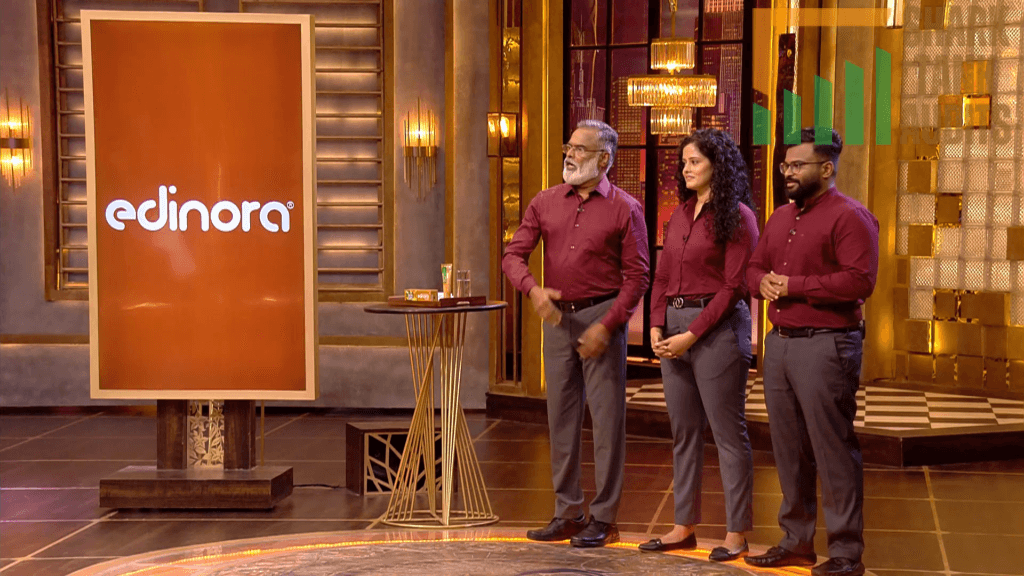
In Shark Tank India Season 5, Episode 40, which aired on February 27, 2026, the husband-and-wife duo Prabhakaran Gopinathan and Jayana Prabhakaran presented their research-driven oral care brand, Edinora. Based in Thiruvananthapuram, Kerala, Edinora is the culmination of over two decades of R&D into “Microbiome-Friendly” and “100% Edible-Grade” toothpaste. The founders, supported by their daughter-in-law Ashika Nambiar and General Manager Praveen PJ, pitched a product line that includes Edinora Prime, Sensipro for sensitive gums and diabetic care, and a specialized Kids variant. Their core value proposition is a “swallow-safe” formula made from over 20 Ayurvedic ingredients like Miswak and Forest Honey, completely free from harsh chemicals like SLS, parabens, and triclosan.
The founders entered the Tank with an initial ask of ₹2 Crores for 5% equity, valuing the company at ₹40 Crores. During the pitch, they highlighted a unique business model where 67% of their sales are driven by high-touch telecalling rather than traditional retail, resulting in exceptionally high customer retention. While the Sharks were universally impressed by the clinical validation—including cytotoxicity and oral toxicity studies—they expressed concerns about the brand’s ability to scale nationally against FMCG giants like Colgate and Patanjali. Some investors also cautioned the founders against “distracting” themselves with experimental skincare and haircare lines, advising them to stay laser-focused on the $2 billion oral care niche.
Ultimately, a deal was finalized with Aman Gupta, the co-founder of boAt, who recognized the brand’s potential to disrupt the premium “clean-label” segment. The final agreement was ₹2 Crores for 10% equity, reflecting a ₹20 Crore valuation. However, the deal featured a unique performance-based “Clawback” provision: if Edinora successfully achieves its revenue target of ₹4 Crores for the FY 25-26 period, Aman will return 2% of the equity to the founders, bringing his stake down to 8%. This strategic partnership aims to transition Edinora from a regional, telecalling-heavy model to a digital-first D2C powerhouse.
Moving forward, Edinora’s roadmap involves a total digital overhaul to address its currently low organic search traffic and a massive expansion into quick-commerce platforms like Blinkit and Zepto. With Aman Gupta’s mentorship, the brand intends to penetrate major Indian metros where awareness of oral microbiology is highest. By focusing on its “Microbiome-Friendly” USP and potentially expanding into adjacent products like mouthwash and floss, Edinora aims to reach a ₹100 Crore valuation by 2028, positioning itself as a leader in the premium, health-conscious oral care market both in India and internationally.
Pitch 2
RehabVeda Shark Tank India Episode Review
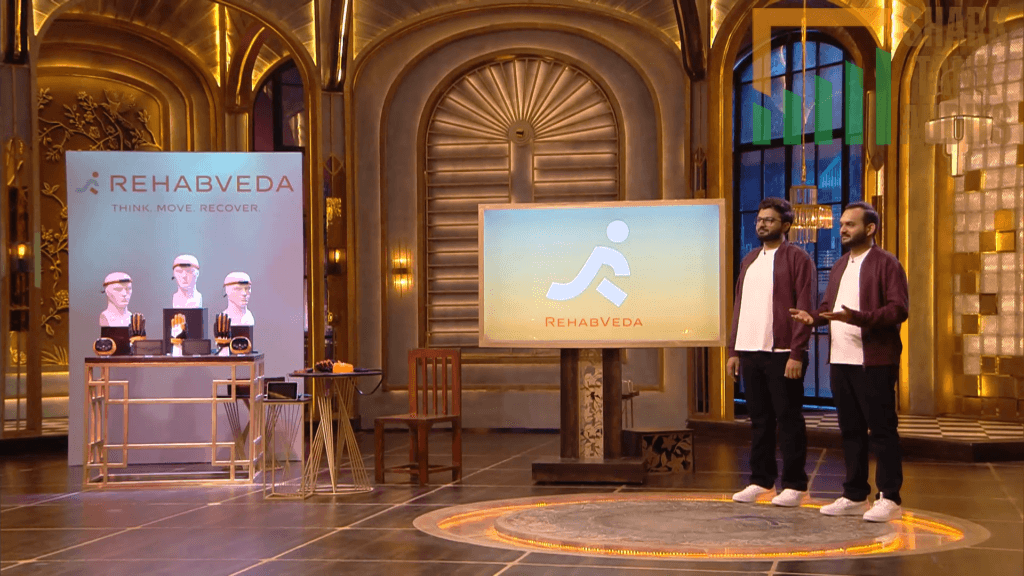
RehabVeda appeared on Shark Tank India Season 5, Episode 40, with co-founders Shyam Parmar (IIT Roorkee alumnus, lead technical visionary with AI/robotics/Brain-Computer Interface expertise) and Neel Patel (operations/product strategy manager focusing practical engineering solutions application for therapists/patients) seeking ₹1 Crore for 2.5% equity (₹40 Crore valuation) and successfully closed a deal for ₹1 Crore for 3% equity (₹33.33 Crore valuation) with Sharks Namita Thapar and Mohit Yadav after delivering compelling pitch educating Sharks on brain stroke severity with live R1 system demonstration showing real-time brain signal translation.
The deep-tech medical device startup rooted in neuroscience specializes in AI-powered neurotechnology-based rehabilitation solutions for stroke/paralysis recovery through flagship R1 System comprehensive BCI (Brain-Computer Interface) kit integrating EEG Headband (reading motor-imagery brain activity), AI Processing Unit (decoding brain signals in milliseconds), and Pneumatic Glove (physically moving patient fingers based on thoughts) designed for clinic/physiotherapist accessibility and eventual home use focusing on active intent-driven recovery utilizing brain neuroplasticity helping patients relearn movements versus traditional passive physiotherapy, achieving 80% patient improvement rate with average 8-point Fugl-Meyer Assessment increase, filed patent (Application No. 202521010955), initiated FDA 510(k) process pursuing ISO/UL certifications, developed through PIERC Startup Growth Pad Program at Parul University providing critical mentoring/investor readiness, and 50x post-Shark Tank inquiry increase with 0 organic visitors requiring SEO improvement. Sharks impressed by “Make in India” potential and technical sophistication—Namita (Emcure Pharmaceuticals) valued clinical/pharmaceutical synergy while Mohit (Minimalist) saw D2C distribution potential, noting rarity of advanced deep-tech medical devices on platform.
Operating in global stroke rehabilitation market valued at $95-143 billion (7% CAGR) with India witnessing 1.8 million annual new stroke cases (one every 40 seconds) and <20% survivor access to advanced neuro-rehabilitation creating massive gap within immediate $1.2 billion Indian addressable robotic/AI-rehab device market targeting private hospitals, premium physiotherapy chains, and high-income home-care patients, RehabVeda targets B2B (multi-specialty hospital neurology departments, physiotherapy/rehabilitation clinics, old-age homes/assisted living facilities) and B2C (stroke survivors 45-75 years, caregivers/children 25-45 tech-savvy urban metros) among middle/upper-middle-class Tier 1/2 city families prioritizing quality of life and intent-driven recovery, offering locally ma
Pitch 3
Freshpod Shark Tank India Episode Review
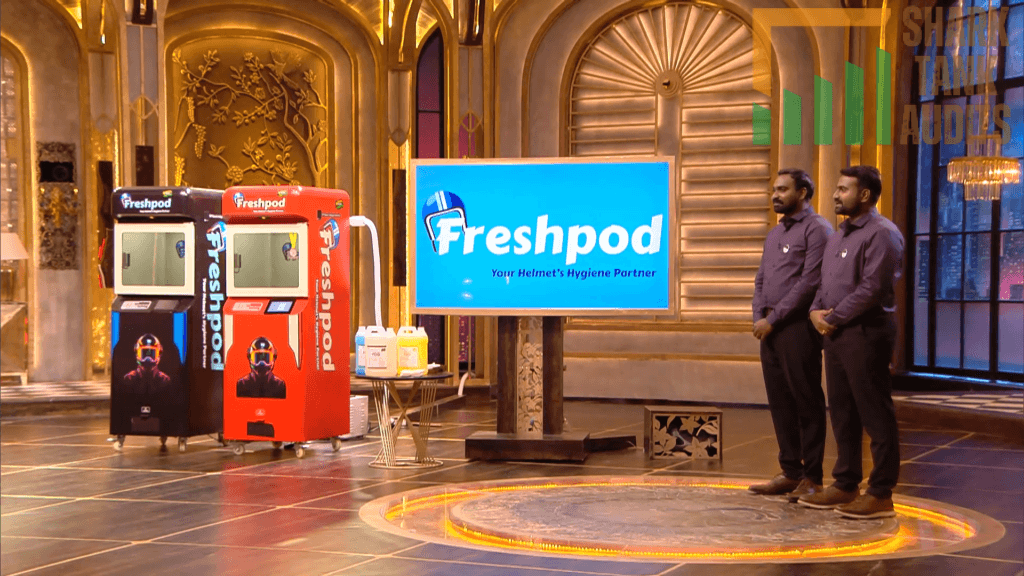
In Shark Tank India Season 5, Episode 40 (aired Friday, February 27, 2026), brothers Bhaskar Lakkoju and Dileep Kumar Lakkoju presented Freshpod, a pioneering hygiene-tech startup focused on an often-overlooked urban problem: helmet hygiene. Based in India and recognized with international innovation awards, Freshpod offers an automated, waterless kiosk that uses UV-C, Ozone, and specialized fogging technology to sanitize helmets in under three minutes. The founders sought an investment of ₹2 Crores for 6% equity, valuing the company at approximately ₹33.33 Crores. Despite a high-tech demonstration that promised to eliminate 99.9% of germs and odors for India’s 210 million two-wheeler riders, the duo walked away with no deal after failing to reach an agreement with the Sharks.
The investor panel acknowledged the technical ingenuity of the “Make in India” hardware and the genuine health concerns, such as skin infections and “helmet hair”, that the product addresses. However, the Sharks expressed significant reservations regarding the scalability of a hardware-heavy model and the speed of consumer adoption for a service that many riders might still view as a luxury rather than a necessity. The capital-intensive nature of deploying physical kiosks in high-traffic areas like fuel stations and malls appeared to be a major sticking point, leading the investors to view the business as a challenging franchise play rather than a high-growth tech venture.
Freshpod’s business potential is anchored in India’s status as the world’s largest two-wheeler market, with over 20 million new units sold annually. The brand’s primary target audience includes the rapidly expanding “gig economy” workforce—delivery partners from Swiggy, Zomato, and Zepto—who wear helmets for 8–10 hours a day and face the highest risk of hygiene-related issues. To capture this market, Freshpod’s strategy involves placing contactless, digital-payment-integrated kiosks at strategic touchpoints like metro stations and corporate parking lots, offering a “fresh-as-new” experience for a nominal fee.
Moving forward, the founders plan to refine their roadmap by transitioning from a pure hardware sales model to a Franchise-Owned Company-Operated (FOCO) structure to manage capital expenditures. Their digital strategy includes an SEO overhaul to improve their current organic traffic of 775 visitors per month, focusing on hyper-local ads and “shock factor” content that highlights the bacterial growth inside uncleaned helmets. By aiming for B2B tie-ups with delivery fleets and potentially introducing a subscription model, Freshpod seeks to turn helmet sanitization into a daily habit for the Indian commuter, eventually justifying the high valuation they sought in the Tank.
The Episode Verdicts
Episode 40 was a “High-IQ” session, defined by complex technical demonstrations and intense discussions on clinical validation and unit economics.
| Pitch | Brand | Ask | Deal Status | Shark(s) Involved |
| Pitch 1 | Edinora | ₹2 Cr for 5% | ₹2 Crore for 10% | Aman Gupta (with 2% Clawback provision) |
| Pitch 2 | RehabVeda | ₹1 Cr for 2.5% | ₹1 Crore for 3% | Namita Thapar & Mohit Yadav |
| Pitch 3 | Freshpod | ₹2 Cr for 6% | No Deal | Sharks cited scaling and high CAPEX concerns. |
Key Highlights
- The Microbiome Disruptor: Edinora impressed the panel with their 20-year R&D journey into edible-grade oral care. Aman Gupta’s “Clawback” deal was a strategic highlight, rewarding the founders with equity if they hit their ₹4 Crore revenue target, essentially betting on their transition from a telecalling model to a D2C powerhouse.
- Brain-Computer Innovation: RehabVeda delivered perhaps the most sophisticated tech demo of the season. Their R1 System, which allows stroke patients to move a robotic glove using only their thoughts, represents the peak of Indian “Deep-Tech.” Namita Thapar’s pharmaceutical expertise and Mohit Yadav’s D2C vision created a dream team for this neuroscience startup.
- The “Helmet Hair” Problem: Freshpod addressed a massive pain point for India’s 210 million riders. While the Sharks loved the “shock factor” of helmet bacteria, they weren’t ready to fund the heavy hardware deployment required to scale. The “No Deal” verdict underscored the challenge of turning a hardware kiosk into a venture-scale business.
Leave feedback about this
You must be logged in to post a comment.