
Booon Shark Tank India Episode Review
Booon appeared on Shark Tank India Season 5, Episode 30, with founder Arun Kumar (robust professional background at Myntra/Raymond, IIM Calcutta/NIFT academic pedigree operating under Piku Mike Ecommerce India Private Limited) seeking ₹1 Crore for 2% equity (₹50 Crore valuation) but left with no deal after all Sharks declined citing various concerns.
The innovative fashion quick-commerce platform challenges traditional 2-3 day delivery offering curated outfits/accessories within 2-hour window through hyperlocal model with mobile-optimized minimal seamless interface, limited high-velocity inventory from nearby fulfillment centers, and ₹4 lakh GMV (Sep 25) with 1,521 monthly organic visitors requiring SEO improvement. Sharks reacted cautiously—Namita questioned differentiation noting “curation” alone might not create moat against established players, Viraj opted out calling business too early-stage with financials not justifying ₹50 Crore valuation, Varun declined citing lack of structured core team creating high execution risk, Kunal appreciated concept but passed due to portfolio company conflict, and Vineeta loved “fabulous” idea but feared “funding battle” once giants like Myntra enter 2-hour delivery within year.
Operating in Indian quick-commerce market valued at $3.65 billion (2026) projected to reach $6.64 billion by 2031 (12.74% CAGR) with non-grocery categories growing 1.6x faster and fashion orders surging 340% year-on-year within $160 billion e-retail market (350 million online shoppers) where fashion commands 31.67% (largest single category) and ₹64,000+ Crore GMV Q-commerce sector expected to triple by 2028, Booon targets “Instant Generation” Gen Z/millennials (18-35) in Tier 1 metros (Mumbai/Delhi-NCR/Bengaluru/Kolkata)—middle to affluent class with $13-$45+ daily spend capacity including professionals with hectic lifestyles, students with spontaneous plans, and last-minute gifters (76.42% shopping exclusively via smartphones during work breaks/commutes)—within India’s $5.2 trillion projected GDP (2026), $3.2 trillion private consumption, and $249 billion lifestyle retail market, planning dark store network expansion, high-velocity trending SKU focus versus vast catalog, gig-fleet integration (Shadowfax/Borzo), private label launch increasing gross margins from 30% to 55%, and AR/AI virtual try-ons reducing 25-30% fashion return rates by 40%.
Website Information
- Website:- Booon
- Build on JavaScript libraries jQuery 3.6.0 core-js 3.32.2
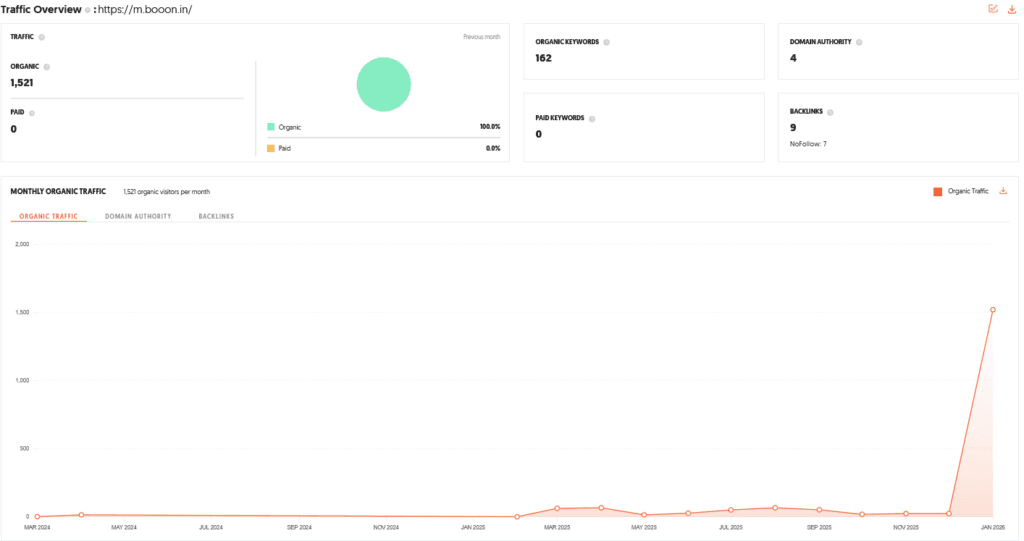
- Average SEO Performance, SEO Improvement is Needed.
- ORGANIC TRAFFIC: 1521 visitors per month.
The Booon Founder
- Arun Kumar is the visionary behind Booon.
- With a robust professional background featuring stints at industry giants like Myntra and Raymond, and an academic pedigree from IIM Calcutta and NIFT, he brings deep domain expertise to the venture.
- Under his entity, Piku Mike Ecommerce India Private Limited, he aims to solve the “fashion emergency” problem for urban consumers.
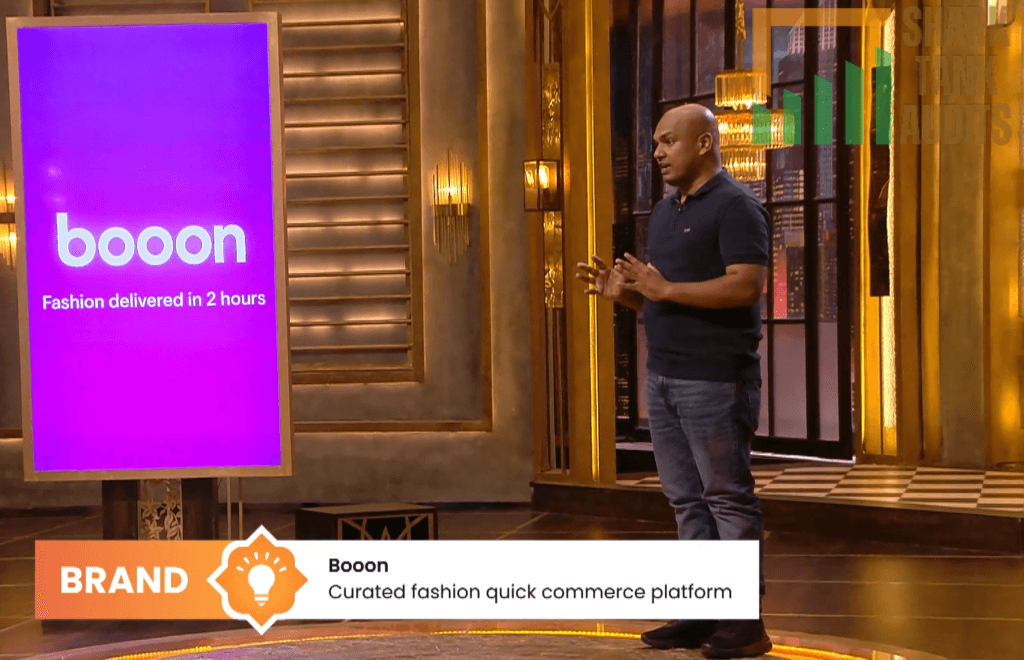
Booon Brand Overview
- Booon is an innovative fashion quick-commerce platform that challenges the traditional 2-3 day delivery cycle of e-commerce.
- By merging fashion with a hyperlocal delivery model, the brand offers a curated selection of outfits and accessories delivered within a two-hour window.
- It positions itself as a disruptive force in the digital age, catering specifically to the “instant gratification” needs of modern, fast-paced urban lifestyles.
Booon Shark Tank India Appearance & Ask
- During the pitch, the founder of Booon presented a bold vision for the future of apparel shopping.
- He entered the tank seeking an investment of Rs 1 Crore for 2% equity, which placed the company at a post-money valuation of Rs 50 Crores.
- The pitch focused on the brand’s ability to execute ultra-fast delivery in a category—fashion—that has traditionally been resistant to the quick-commerce model.
Season and Episode Air Date
- Season: 05
- Episode: 30
- Episode Air Date: Friday, 13 February, 2026
Booon Product Overview
- The Booon product catalog is not an exhaustive marketplace but a curated collection of trending styles, daily wardrobe essentials, and lifestyle pieces.
- The platform is optimized for mobile users with a minimal, seamless interface designed for speed.
- By focusing on a limited, high-velocity inventory, the brand ensures that items are always in stock and ready for immediate dispatch from nearby fulfillment centers.
Booon Investor Reactions
The Sharks had mixed but ultimately cautious reactions to the Booon pitch:
- Namita Thapar: Questioned the differentiation, noting that “curation” alone might not be a strong enough moat against established players.
- Viraj Bahl: Opted out because the business was at a very early stage with financial metrics (Sep ’25 GMV of Rs 4 Lakhs) that did not yet justify a Rs 50 Crore valuation.
- Varun Alagh: Declined due to the lack of a structured core team, believing the execution risk was too high without more leadership support.
- Kunal Bahl: Appreciated the concept but passed due to a conflict of interest, as he already has a portfolio company in a similar space.
- Vineeta Singh: Loved the “fabulous” idea but feared a “funding battle” once giants like Myntra enter the 2-hour delivery space within the next year.
Booon Customer Engagement Philosophy
- The Booon philosophy centers on immediacy and stress-free shopping.
- The brand views fashion through the lens of a “service” rather than just a “product.”
- By targeting “fashion emergencies”—such as last-minute party invites or urgent business meetings—the brand builds trust through reliability and speed, aligning itself with the spontaneous culture of college students and young professionals.
Booon Product Highlights
| Feature | Description |
| Delivery Speed | Guaranteed delivery within 2 hours. |
| Model | Hyperlocal fulfillment via nearby hubs. |
| Curation | Focus on trending, “occasion-first” apparel. |
| Technology | Real-time inventory tracking and rapid dispatch system. |
| Inventory | High-velocity, limited stock to prevent logistics lag. |
Booon Future Vision
- The future vision for Booon is to turn instant fashion access into a mainstream consumer habit.
- While currently expanding in cities like Kolkata and Mumbai, the brand aims to scale its specialized supply chain to all major Indian metros.
- By proving that apparel can be handled with the same efficiency as groceries, the brand seeks to lead the “Quick-Fashion” revolution in India.
Booon Deal Finalized or Not
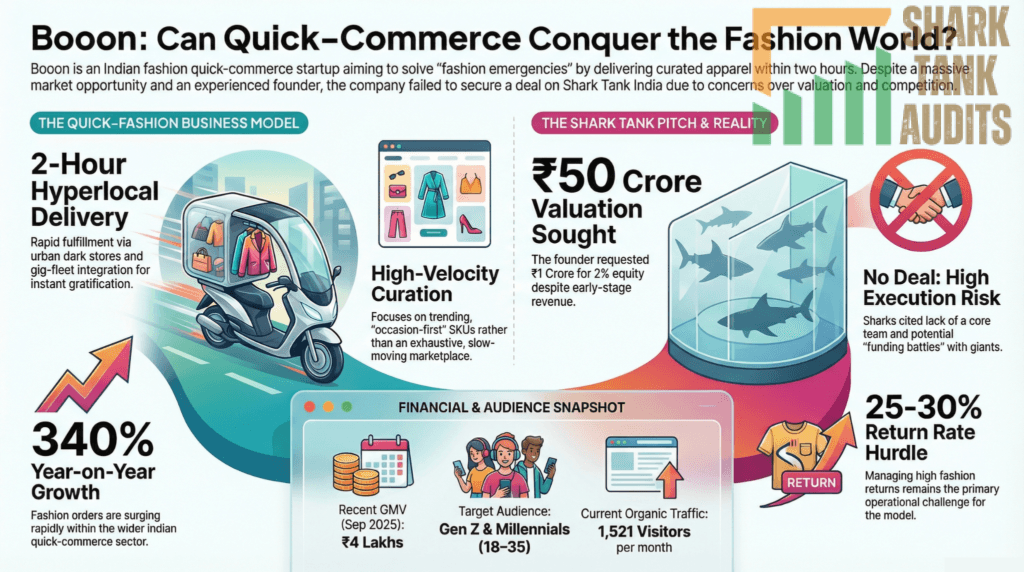
- No deal was finalized.
- Despite the unique concept and the founder’s impressive credentials, Booon left the tank without an investment.
- The Sharks expressed various concerns ranging from the early stage of the business to the intense competitive landscape it faces.
| Parameter | Details |
|---|---|
| Website | Booon |
| Platform | JavaScript (jQuery 3.6.0, core-js 3.32.2) |
| SEO Performance | Average (Improvement Needed) |
| Organic Traffic | 1,521 visitors per month |
| Founder | Arun Kumar |
| Founder Background | IIM Calcutta, NIFT; Ex-Myntra & Raymond |
| Company Entity | Piku Mike Ecommerce India Pvt. Ltd. |
| Headquarters | India (Operating in Kolkata & Mumbai) |
| Industry | Fashion Quick-Commerce |
| Business Model | Hyperlocal 2-Hour Fashion Delivery |
| Core Problem Solved | “Fashion Emergency” (Last-minute outfit needs) |
| Shark Tank Season | Season 05 |
| Episode Number | Episode 30 |
| Episode Air Date | Friday, 13 February, 2026 |
| Initial Ask | ₹1 Crore for 2% Equity |
| Valuation Sought | ₹50 Crore |
| Latest GMV (Sep 2025) | ₹4 Lakhs |
| Deal Status | No Deal |
| Product Model | Curated, High-Velocity Fashion SKUs |
| Delivery Promise | Within 2 Hours |
| Platform Type | Mobile-Optimized Interface |
| Inventory Strategy | Limited Stock, High Turnover |
| Fulfillment Model | Hyperlocal Dark Stores |
| Target Cities | Tier-I & Tier-II Metros |
| Primary Audience | Gen Z & Millennials (18–35 years) |
| Income Profile | Middle to Affluent Urban Consumers |
| Psychographic Focus | Instant Gratification, Spontaneous Lifestyle |
| User Behavior | 76.42% Smartphone Shoppers |
| Key Differentiator | Pure Fashion Q-Commerce Focus |
| Average Order Value Target | ₹1,500+ |
| Shark Concern 1 | Weak Differentiation vs Myntra |
| Shark Concern 2 | Early Stage (Low GMV vs ₹50 Cr Valuation) |
| Shark Concern 3 | No Strong Core Leadership Team |
| Shark Concern 4 | Competition from Myntra & Blinkit |
| Shark Concern 5 | Funding Battle Risk |
| Market Trend | 340% YoY surge in Fashion Q-Commerce orders |
| Quick-Commerce Market Size | $3.65B (2026) → $6.64B (2031) |
| E-Retail Market Size | $160B by 2026 |
| Fashion Share of E-Commerce | 31.67% (Largest Category) |
| Q-Commerce GMV India | ₹64,000 Crore+ |
| TAM Focus | Urban Premium Online Shoppers (270M+) |
| Marketing Strategy | Geo-fenced Ads + Occasion-First Content |
| SEO Strategy | Target “2-hour dress delivery” keywords |
| Influencer Strategy | Hyperlocal Micro-Influencers |
| Content Focus | “Get Ready in 120 Minutes” Reels |
| Distribution Backbone | Dark Stores in High-Density Zones |
| Last-Mile Partners | Gig Delivery Fleets |
| Operational Goal | Dispatch within 15 minutes |
| Key Advantage 1 | High Fashion Margins vs Grocery |
| Key Advantage 2 | First-Mover in Pure Fashion Q-Comm |
| Key Advantage 3 | Founder’s Deep Industry Expertise |
| Major Challenge 1 | 25–30% Return Rates in Fashion |
| Major Challenge 2 | Size Management Complexity |
| Major Challenge 3 | Entry of Large Funded Competitors |
| Return Mitigation Strategy | 10-Minute Doorstep Trial Model |
| Competition Mitigation | Exclusive Curated Drops |
| Private Label Plan | Increase Gross Margin 30% → 55% |
| Phase 1 Goal | ₹50 Lakhs Monthly GMV |
| Phase 2 Goal | Build Core Leadership Team |
| Phase 3 Goal | Launch Private Labels |
| Phase 4 Goal | AR/AI Virtual Try-On |
| Long-Term Vision | Lead India’s “Quick-Fashion” Revolution |
| Valuation Growth Target | Sustain ₹50Cr+ with Strong Unit Economics |
Booon Shark Tank India Buisness Plan
Booon Business Potential in India
The Indian retail landscape is currently undergoing a “quick-commerce” revolution.
- Rapid Growth: The India quick-commerce market is valued at $3.65 billion in 2026 and is projected to reach $6.64 billion by 2031, growing at a CAGR of 12.74%.
- The “Fashion” Pivot: While grocery initially dominated, non-grocery categories (like fashion) are now growing 1.6 times faster. In early 2026, fashion orders on quick-commerce platforms saw a massive 340% year-on-year surge.
- Economic Shift: India’s GDP is projected to hit $5.2 trillion by 2026, with private consumption reaching $3.2 trillion. Booon is perfectly positioned to capture the “lifestyle retail” segment, which is expected to be a $249 billion market by the end of this year.
Booon Total Addressable Market (TAM)
Booon operates at the intersection of E-commerce, Quick Commerce, and Fashion.
- E-retail Scale: The total e-retail market in India is expected to exceed $160 billion by 2026, with 350 million online shoppers.
- Fashion TAM: Fashion and apparel command 31.67% of the total e-commerce market—the largest single category.
- Quick Commerce Reach: With a current GMV of over ₹64,000 crore, the Q-commerce sector is expected to triple by 2028. Booon targets the urban premium segment within this, specifically the 270 million+ active online shoppers in Tier-I and Tier-II cities.
Booon Ideal Target Audience & Demographics
Booon serves the “Instant Generation” that prioritizes time over price.
- Primary Segment: Gen Z and Millennials (Ages 18–35) residing in Tier-I metros (Mumbai, Delhi-NCR, Bengaluru, Kolkata).
- Income Profile: Middle to Affluent class with an individual daily spend capacity of $13–$45+.
- Psychographics: Professionals with “Hectic Lifestyles,” students with “Spontaneous Plans,” and “Last-minute Gifters.”
- User Behavior: 76.42% of these users shop exclusively via smartphones, primarily during work breaks or commutes.
Booon Marketing & Digital Strategy
To improve its current organic traffic of 1,521 visitors/month, Booon must shift from a passive to an aggressive digital stance.
- SEO Overhaul: Upgrade JavaScript libraries to improve crawling; target high-intent keywords like “2-hour dress delivery Mumbai” or “instant party wear.”
- Influencer Integration: Partner with “Micro-influencers” in specific neighborhoods (hyperlocal) to showcase the “Unboxing in 2 Hours” experience.
- Content Strategy: Create “Occasion-First” content—e.g., “How to get ready for a date in 120 minutes”—using short-form video (Reels/YouTube Shorts).
- Performance Marketing: Run geo-fenced ads within a 5-10km radius of dark stores to ensure the “2-hour promise” is only shown to reachable users.
Booon Distribution & Operations Strategy
The backbone of Booon is its Hyperlocal Model.
- Dark Store Network: Utilizing small, high-density warehouses in urban clusters (e.g., Bandra in Mumbai or Koramangala in Bengaluru).
- Inventory Logic: Instead of a vast catalog, Booon maintains high-velocity SKUs (trending items) to reduce deadstock and ensure 100% availability.
- Last-Mile Logistics: Integration with gig-fleet partners (like Shadowfax or Borzo) to maintain an average dispatch time of under 15 minutes from order placement.
Booon Advantages & Challenges
| Booon Advantages | Booon Challenges |
| First Mover in Pure Fashion Q-Comm: Unique positioning vs. grocery players. | High Return Rates: Fashion typically sees 25-30% returns, which is lethal for Q-comm. |
| High Margins: Fashion items offer better unit economics than milk/vegetables. | Competitive Giants: Myntra (M-Now) and Blinkit are entering the 2-hour space. |
| Expert Leadership: Founder’s NIFT/IIM/Myntra background. | Inventory Complexity: Managing sizes (S/M/L/XL) across dark stores is difficult. |
Booon Success Reasons & Mitigation Strategies
- Why it can succeed: High ticket sizes (AOV of ₹1,500+ vs. grocery’s ₹460) allow for higher delivery costs and sustainable margins.
- Mitigation for Returns: Implement “Try Before You Buy” or “10-minute trial” at the doorstep where the rider waits (pioneered by brands like Slikk).
- Mitigation for Competition: Focus on Exclusivity. While Myntra sells everything, Booon should sell “Curated Drops” that aren’t available anywhere else.
Booon Future Business & Roadmap to Valuation
To reach and exceed the ₹50 Crore valuation presented on Shark Tank, Booon must hit these milestones:
- Phase 1 (Month 1-6): Scale GMV from ₹4 Lakhs to ₹50 Lakhs/month by dominating one city (Kolkata or Mumbai) to prove unit economics.
- Phase 2 (Month 6-12): Form a “Core Leadership Team” (addressing Shark Varun’s concern) including a Head of Logistics and a Creative Director.
- Phase 3 (Year 2): Launch Booon Private Labels to increase gross margins from 30% to 55%.
- Phase 4 (Year 3): Integrate AR/AI Virtual Try-ons to reduce return rates by 40%, significantly boosting EBITDA and investor appeal.






Booon Shark Tank India Episode Review