
Green Avartan Shark Tank India Episode Review
Green Avartan appeared on Shark Tank India Season 5, Episode 51, with Indore-based co-founder duo Pankaj Pandey (CEO, highly qualified professional with IIT Bombay Executive General Management degree previously holding significant roles at EKI Energy Services/FRECON Electric notably walking away from lucrative ₹1 Crore annual salary focusing environmental sustainability) and Kiran Pandey seeking ₹1 Crore for 5% equity (₹20 Crore valuation) but left with no deal after Hardik Kothiya showed genuine interest extending ₹1 Crore for 15% equity offer (later revised to 12%) though Pankaj remained firm on valuation countering with maximum 6% equity ultimately choosing walking away citing Sharks’ expectations/valuations too low compared to company potential with pitch taking unconventional turn when Pankaj confident in business model suggested Shark Hardik (Rayzon Solar Founder) should consider buying entire company keeping him as CEO.
The solid waste recycling company dedicated to creating “green legacy” transitioning Indian circular economy from unorganized to organized sector specializes in scrap material (waste tires/aluminum) collection/sorting/processing converting typically considered “trash” into high-value industrial resources with core lying in industrial recycling capabilities focusing materials (tire rubber/aluminum scrap) producing raw materials reintegrable into manufacturing supply chains designed profitable while solving massive Indian waste management logistical challenge featuring ₹77 lakh (FY 2024-25) to ₹5.6 Crore Year-to-Date impressive growth proven revenue, 14-15% healthy EBITDA maintaining proving “green” business can be profitable efficiency, and industrial waste (tires) short lifespan leveraging ensuring consistent recurring raw material supply business model scalability with 0 organic visitors requiring SEO improvement. Sharks reacted mixed—Anupam/Kunal both opting out due to low gross margins/unorganized sector competing complexity, Namita praising mission though feeling sector not “investor-friendly” because difficult margin profile, Aman impressed by founder confidence/sales famously telling Pankaj “Aap alag ho” (You are different) though staying out viewing as “cash and connection” heavy industry, and Hardik as solar/green energy space veteran seeing value though requiring higher equity stake offsetting risks.
Operating in Indian waste management/recycling sector, Green Avartan targets manufacturers through Extended Producer Responsibility (EPR) philosophy centering where Pankaj believes supply chain integrating Green Avartan can become vital partner for legally/ethically product recycling-obligated manufacturers with approach not just selling product but providing sustainable society/”Planet Earth” service projecting massive ₹13.5 Crore (2025-26) revenue leap reaching ₹50 Crore following year with ultimate 5-year goal scaling company into ₹1,000 Crore revenue giant fully integrating recycling sector through technology/organized logistics aiming to transition from unorganized to organized circular economy sector leadership.
Website Information
- Website:- Green Avartan
- Build on JavaScript frameworks React Router 6 React
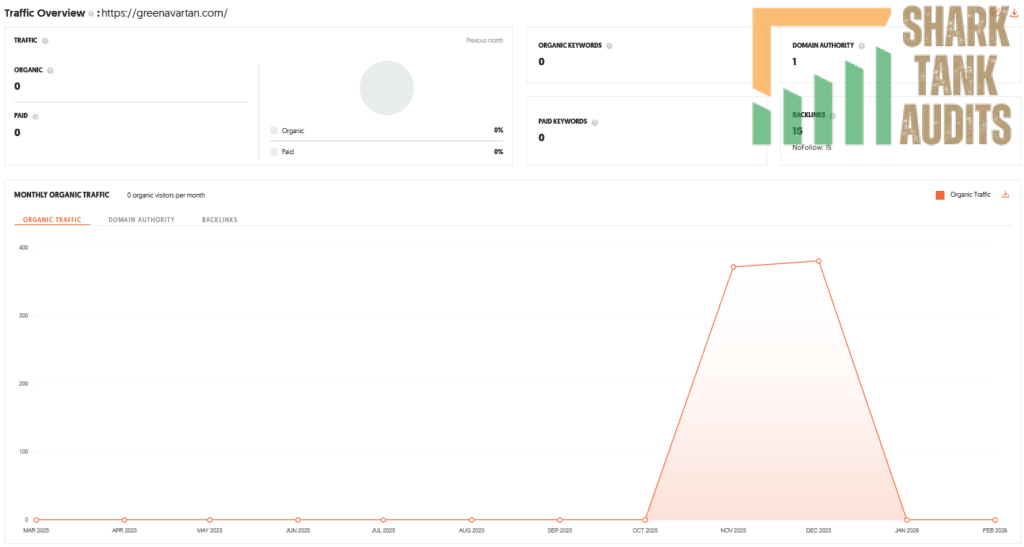
- Poor SEO Performance, SEO Improvement Needed.
- ORGANIC TRAFFIC: 0 visitors per month.
Founder of Green Avartan
- Pankaj Pandey and Kiran Pandey are the driving forces behind this Indore-based startup. Pankaj, who serves as the CEO, is a highly qualified professional with an Executive General Management degree from IIT Bombay.
- Before embarking on his entrepreneurial journey, he held significant roles at EKI Energy Services and FRECON Electric, notably walking away from a lucrative Rs 1 crore annual salary to focus on environmental sustainability.
Green Avartan Brand Overview
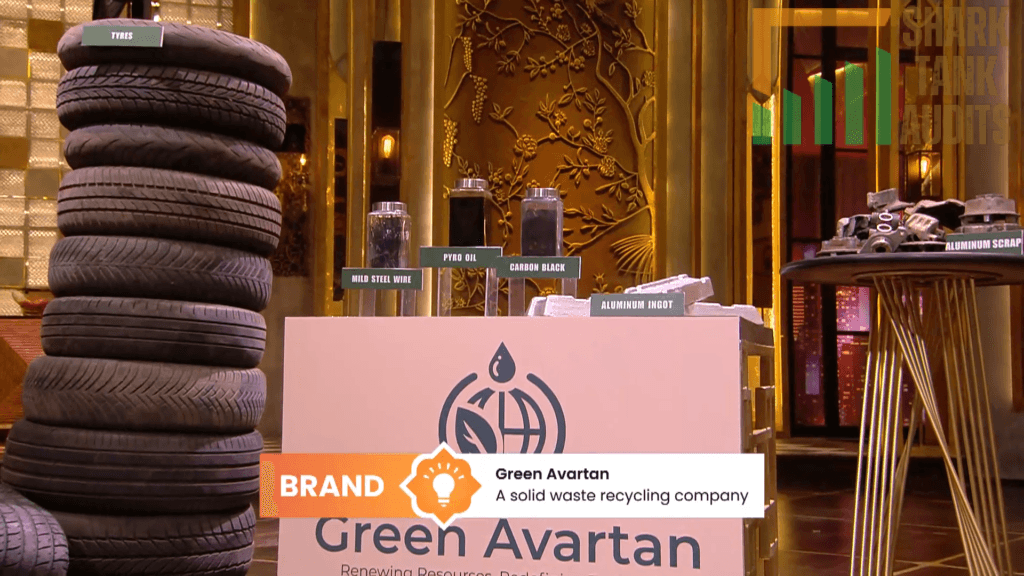
- Green Avartan is a solid waste recycling company dedicated to creating a “green legacy” by transitioning the Indian circular economy from the unorganized sector to an organized one.
- The brand specializes in the collection, sorting, and processing of scrap materials, specifically waste tires and aluminum, converting what is typically considered “trash” into high-value industrial resources.
Shark Tank India Appearance & Ask for Green Avartan
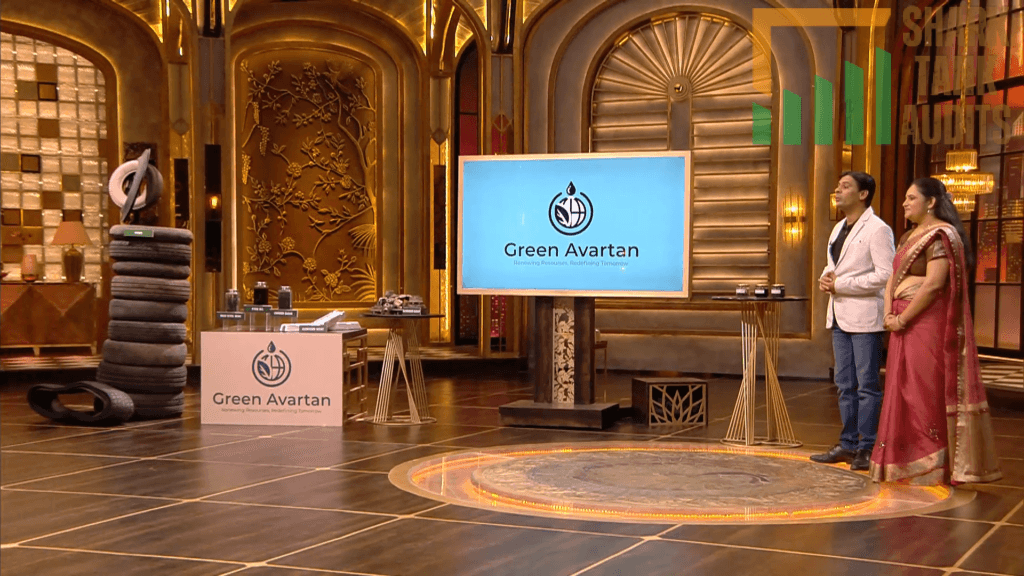
- During their appearance on Shark Tank India Season 5, the founders sought an investment of Rs 1 crore for 5% equity, which placed the company at a Rs 20 crore valuation.
- The pitch took an unconventional turn when Pankaj, confident in his business model, suggested that Shark Hardik Kothiya (Founder of Rayzon Solar) should consider buying the entire company and keeping him on as the CEO.
Season and Episode Air Date
- Season: 05
- Episode: 51
- Episode Air Date: Monday, 16 March, 2026
Product Overview of Green Avartan
- The core of Green Avartan lies in its industrial recycling capabilities.
- By focusing on materials like rubber from tires and aluminum scrap, the company produces raw materials that can be reintegrated into manufacturing supply chains.
- Their process is designed to be profitable while solving the massive logistical challenge of waste management in India.
Investor Reactions to Green Avartan
The Sharks had mixed reactions to the pitch:
- Anupam Mittal & Kunal Bahl: Both opted out due to the low gross margins and the complexity of competing with the unorganized sector.
- Namita Thapar: While she praised the mission, she felt the sector was not “investor-friendly” because of the difficult margin profile.
- Aman Gupta: He was impressed by the founder’s confidence and sales, famously telling Pankaj, “Aap alag ho” (You are different), but stayed out because he viewed it as a “cash and connection” heavy industry.
- Hardik Kothiya: As a veteran in the solar and green energy space, he saw the value but required a higher equity stake to offset the risks.
Customer Engagement Philosophy of Green Avartan
- The brand operates with a philosophy centered on Extended Producer Responsibility (EPR).
- Pankaj believes that by integrating the supply chain, Green Avartan can become a vital partner for manufacturers who are legally and ethically obligated to recycle their products.
- Their approach is not just about selling a product, but about providing a sustainable service to society and “Planet Earth.”
Product Highlights of Green Avartan
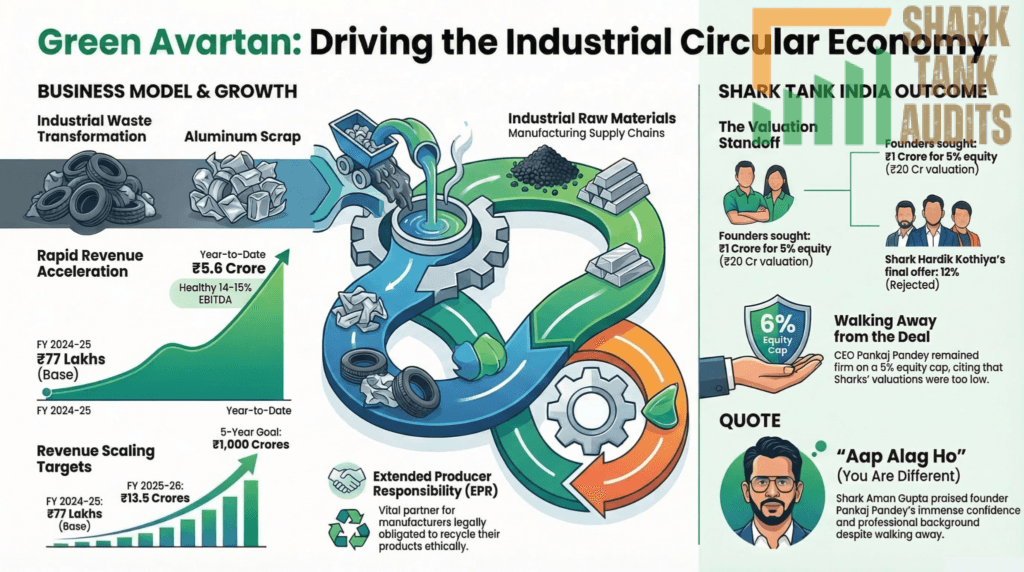
- Proven Revenue: The company demonstrated impressive growth, moving from Rs 77 lakhs in FY 2024-25 to Rs 5.6 crores Year to Date.
- Efficiency: They maintain a healthy EBITDA of 14-15%, proving that “green” businesses can be profitable.
- Scalability: The business model leverages the short lifespan of industrial waste (like tires) to ensure a consistent, recurring supply of raw materials.
Future Vision for Green Avartan
- The future for Green Avartan is highly ambitious.
- Pankaj projected a massive revenue leap to Rs 13.5 crores in 2025-26, reaching Rs 50 crores the following year.
- His ultimate five-year goal is to scale the company into a Rs 1,000 crore revenue giant, fully integrating the recycling sector through technology and organized logistics.
Deal Finalized or Not for Green Avartan
- No deal was finalized.
- Although Hardik Kothiya showed genuine interest and extended an offer of Rs 1 crore for 15% equity (later revised to 12%), Pankaj remained firm on his valuation. He countered with a maximum of 6% equity.
- Ultimately, the founder chose to walk away, citing that the Sharks’ expectations and valuations were too low compared to the company’s potential.
| Heading | Content |
|---|---|
| Brand | Green Avartan |
| Tech Stack | Built on React Router 6 React |
| SEO Status | Poor SEO performance, improvement needed |
| Organic Traffic | 0 visitors per month |
| Founders | Pankaj Pandey and Kiran Pandey |
| Founder Background | Indore-based founders with strong industrial and sustainability focus |
| CEO Qualification | Executive General Management from IIT Bombay |
| Previous Experience | Worked at EKI Energy Services and FRECON Electric |
| Career Decision | Left ₹1 crore salary to pursue sustainability |
| Brand Overview | Solid waste recycling company |
| Core Focus | Recycling waste tires and aluminum |
| Mission | Organize circular economy and create green legacy |
| Business Model | Convert scrap into high-value industrial raw materials |
| Shark Tank Season | Season 5 |
| Shark Tank Episode | Episode 51 |
| Episode Air Date | Monday, 16 March 2026 |
| Investment Ask | ₹1 crore for 5% equity |
| Valuation Ask | ₹20 crores |
| Pitch Highlight | Suggested acquisition to Hardik Kothiya |
| Core Product | Industrial recycling solutions |
| Material Focus | Rubber from tires and aluminum scrap |
| Value Proposition | Profitable recycling and waste management |
| Investor Reaction Summary | Mixed reactions due to margins and industry complexity |
| Anupam Mittal Feedback | Declined due to low margins |
| Kunal Bahl Feedback | Declined due to unorganized competition |
| Namita Thapar Feedback | Not investor-friendly sector |
| Aman Gupta Feedback | Appreciated founder but declined |
| Hardik Kothiya Feedback | Interested but wanted higher equity |
| Customer Philosophy | Based on Extended Producer Responsibility (EPR) |
| Value Approach | Sustainable service for businesses and environment |
| Target Customers | Manufacturers needing recycling compliance |
| Product Highlight 1 | Revenue growth from ₹77 lakhs to ₹5.6 crores |
| Product Highlight 2 | EBITDA margin of 14–15% |
| Product Highlight 3 | Recurring raw material supply |
| Future Vision | Scale to ₹1000 crore revenue |
| Revenue Projection | ₹13.5 crores then ₹50 crores next year |
| Deal Status | No deal |
| Final Offer | ₹1 crore for 15% (later 12%) by Hardik |
| Founder Decision | Rejected and walked away |
| Reason for No Deal | Valuation mismatch |
| Industry Opportunity | Large waste management gap in India |
| Waste Data | 65 million tonnes annually |
| Recycling Rate | Only 20–25% processed |
| Tire Waste Data | 275,000 tires discarded daily |
| TAM | $15 billion waste management market |
| SAM | $1.2 billion tire recycling market |
| SOM | 5–7% market capture in 5 years |
| Primary Audience | Industrial manufacturers |
| Secondary Audience | Corporate compliance officers |
| Additional Audience | Scrap aggregators |
| Marketing Strategy | SEO and LinkedIn thought leadership |
| Content Strategy | Whitepapers on sustainability ROI |
| Digital Strategy | Impact dashboard for clients |
| SEO Plan | Target EPR and recycling keywords |
| Distribution Strategy | Local collection hubs |
| Supply Strategy | Tech-enabled sourcing app |
| Sales Strategy | Direct-to-factory supply |
| Advantage 1 | Strong founder expertise |
| Advantage 2 | High revenue growth |
| Challenge 1 | Low margins |
| Challenge 2 | Unorganized sector competition |
| Success Factor | Shift to organized recycling sector |
| Mitigation Strategy 1 | Invest in advanced recycling tech |
| Mitigation Strategy 2 | Asset-light operations |
| Phase 1 Plan | Improve SEO and hit ₹13.5 crore revenue |
| Phase 2 Plan | Expand to multiple states |
| Phase 3 Plan | Enter e-waste and battery recycling |
| Long-Term Vision | ₹1000 crore business |
| Valuation Strategy | Become data-driven sustainability partner |
Green Avartan Shark Tank India Business Plan
1. Green Avartan Business Potential in India: Facts & Data
- The Circular Opportunity for Green Avartan: India generates approximately 65 million tonnes of waste annually. Only about 20-25% is currently processed or recycled, leaving a massive gap for Green Avartan to organize.
- Government Catalysts for Green Avartan: The EPR (Extended Producer Responsibility) mandates by the Ministry of Environment make it legally binding for tire and metal producers to ensure recycling, directly fueling Green Avartan’s B2B demand.
- Scrap Tire Volume for Green Avartan: India is the second-largest producer of waste tires globally, discarding roughly 275,000 tires per day, providing a virtually endless raw material supply for Green Avartan.
2. Green Avartan Total Addressable Market (TAM): Stats & Figures
- Total Addressable Market (TAM) for Green Avartan: The Indian waste management market is projected to reach $15 billion by 2027. Green Avartan sits at the intersection of the rubber and aluminum scrap segments.
- Serviceable Addressable Market (SAM) for Green Avartan: The tire recycling market specifically is valued at over $1.2 billion in India, growing at a CAGR of 9%.
- Serviceable Obtainable Market (SOM) for Green Avartan: By targeting organized manufacturing hubs in Western and Central India, Green Avartan can realistically capture 5-7% of the organized recycling market within 5 years.
3. Green Avartan Ideal Target Audience & Demographics
- B2B Industrial Buyers for Green Avartan: Manufacturing plants in the automotive, construction, and footwear sectors looking for high-quality recycled rubber crumbs and aluminum ingots.
- Corporate Compliance Officers for Green Avartan: Sustainability heads at Fortune 500 companies in India who need Green Avartan’s EPR certificates to meet regulatory quotas.
- Waste Aggregators for Green Avartan: Unorganized scrap dealers (Kabadiwalas) who require an organized, tech-enabled platform like Green Avartan to sell bulk inventory at fair market prices.
4. Green Avartan Content & Digital Marketing Strategy
- SEO Overhaul for Green Avartan: The website must transition from 0 organic traffic to a lead-generation engine. This involves targeting long-tail keywords like “Certified EPR Partners in India” or “Bulk recycled aluminum suppliers.”
- LinkedIn Thought Leadership for Green Avartan: Regular technical whitepapers authored by Pankaj Pandey on the “ROI of Sustainability” to attract high-ticket B2B industrial clients.
- Interactive Impact Dashboard for Green Avartan: A digital tool on the Green Avartan website where clients can track how many kilograms of CO2 they saved by using recycled materials versus virgin materials.
5. Green Avartan Distribution & Supply Chain Strategy
- Hyper-Local Collection Hubs for Green Avartan: Establishing “Avartan Collection Centers” near industrial clusters to reduce the high logistics costs of transporting bulky tire waste.
- Tech-Driven Sourcing for Green Avartan: Implementing a mobile app for scrap aggregators to book pick-ups, ensuring a steady, predictable inflow of raw materials for Green Avartan.
- Direct-to-Factory Supply for Green Avartan: Bypassing middlemen to supply refined resources directly to manufacturing assembly lines, protecting the 14-15% EBITDA margins.
6. Green Avartan Advantages & Challenges
- The Green Avartan Advantage: Deep technical expertise of the founder (IIT Bombay background) and a proven revenue jump from Rs 77 lakhs to Rs 5.6 crores in a single year.
- The Green Avartan Challenge: Low gross margins in the recycling sector and intense competition from the unorganized “cash-only” economy which evades taxes and regulations.
7. Green Avartan Success Factors & Mitigation Strategies
- Reason for Success for Green Avartan: The shift from unorganized to organized markets is inevitable due to stricter GST enforcement and EPR laws; Green Avartan is an early mover.
- Mitigation Strategy for Green Avartan (Margin Risks): To counter low margins, Green Avartan must invest in advanced pyrolysis or smelting technology to produce higher-purity outputs that command premium pricing.
- Mitigation Strategy for Green Avartan (Capital Intensity): Utilizing “Asset-Light” models by leasing processing machinery or partnering with existing small-scale plants under the Green Avartan quality umbrella.
8. Green Avartan Future Business & Roadmap to Increase Valuation
- Phase 1 (Year 1-2): Operational Excellence for Green Avartan: Fix the React-based website for SEO, automate the sourcing app, and hit the Rs 13.5 crore revenue target.
- Phase 2 (Year 3-4): Geographic Expansion for Green Avartan: Scale operations from Indore to 5 major industrial states, aiming for the Rs 50 crore revenue milestone.
- Phase 3 (Year 5+): The Billion-Dollar Vision for Green Avartan: Diversify into Lithium-ion battery recycling and electronic waste (e-waste) to reach the Rs 1,000 crore revenue goal.
- Valuation Driver for Green Avartan: Moving from a “commodity recycler” to a “data-driven sustainability partner” allows Green Avartan to command tech-startup multiples rather than traditional industrial multiples.








Green Avartan Shark Tank India Episode Review