
Kalakrit Shark Tank India Episode Review
Kalakrit appeared on Shark Tank India Season 5, Episode 36, with founder Sehaj Kohli (self-described formerly “below-average student” relying on hard work/salesmanship who gained early startup experience at 16-17 working for precursor to OYO providing couple-friendly hotel rooms with high-energy sales/boots-on-the-ground hustle background) seeking ₹1 Crore for 10% equity (₹10 Crore valuation) but left with no deal after all five Sharks opted out in one of season’s most critical pitches.
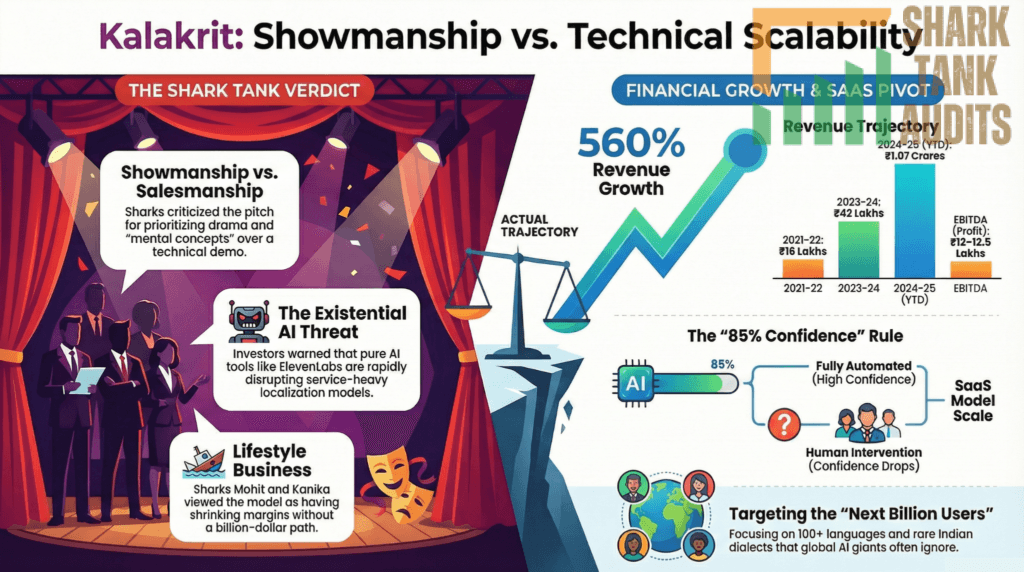
Founded 2021, the content localization platform recreates/adapts content into local languages using “human-in-the-loop” model combining AI-assisted translation/recreation with human oversight servicing 100+ languages, remaining profitable since inception growing from ₹16 lakh revenue/₹3 lakh EBITDA (2021-22) to ₹42 lakh/₹8 lakh EBITDA (2023-24) and ₹1.07 Crore/₹12-12.5 lakh EBITDA (2024-25 YTD) but achieving only 94 monthly organic visitors requiring SEO improvement, though high-energy “entertaining” pitch initially charmed Sharks before mood shifted during technical defensibility probing. Sharks reacted among season’s harshest—Anupam heavily criticized pitch as “showmanship versus salesmanship” yelling at founder for wasting massive national TV opportunity choosing drama over technical demo, Aman referred to pitch as “flop picture” after promising “trailer” noting industry moving too fast to risk capital on buzzword-heavy business, Kunal felt founder selling “mental concept” versus tangible scalable reality, while Mohit/Kanika viewed as “lifestyle business” with shrinking margins and no billion-dollar path, all citing concerns over business model, founder’s over-reliance on showmanship, and existential AI advancement threat warning “bus has already left the station.”
Operating in global language services market projected at $81.45 billion (2026) with India content services platform at $22.2 billion by 2030 (19.9% CAGR) within India’s ₹3,500+ Crore creator economy (4+ million active creators), $5 billion Indian digital advertising market (₹42,000 Crore, 2026) with significant localized persona-driven creative allocation, and creative sector supporting 10 million livelihoods by 2026 end amid 65%+ Indian audiences preferring native language content (regional cinema outperforming Hindi releases 2025 signaling hyper-local shift), Kalakrit targets ₹1,000+ Crore MSME/individual creator segment requiring high-quality culturally nuanced dubbing pure AI struggles perfecting—ed-tech platforms translating technical courses into 22+ official Indian languages for Tier 2/3 students, regional influencers (18-35) “Pan-Indianizing” content increasing cross-linguistic follower bases, D2C brands targeting “Next Billion Users” engaging primarily with non-English video, and OTT/production houses needing human-in-the-loop quality subtitles/dubbing without Hollywood pricing—planning “Before vs After” comparison videos showing Flat AI Translation versus Kalakrit Culturally Localized Content difference, SEO targeting long-tail keywords (“Marathi Video Dubbing Business,” “Bengali Content Localization Services”), B2B LinkedIn thought leadership series on “Ethics of AI in Localization,” Meta performance marketing targeting MSMEs during festive Q4 season (30%+ annual digital ad spend), API-first development integrating directly into video editing software/CMS platforms (WordPress/Shopify), digital marketing agency partnerships lacking in-house localization, freemium model offering first 60 seconds free reducing “trust barrier,” service-to-SaaS platform transition where humans only intervene when AI confidence score falls below 85% mitigating disruption from rapidly improving tools (OpenAI Sora, ElevenLabs) lowering DIY localization barriers, proprietary linguistic dataset building for rare Indian dialects global giants haven’t prioritized creating moat through cultural context (slang/idioms/tone) complexity too advanced for current global AI, dashboard-driven platform transformation reaching ₹5 Crore revenue targeting booming MSME digital spend, Global South expansion (Africa/SE Asia) entering similar linguistic fragmentation markets, Kalakrit-Voice-Vault proprietary AI-cloned regional voices library with “Human Emotion Tags” IP creation, and 8% EBITDA service-to-30% margin SaaS model shift targeting 5x-10x revenue multiple achieving ₹50-100 Crore valuation by 2028.
Website Information
- Website:- Kalakrit
- Build on JavaScript libraries jQuery 3.5.1 Swiper
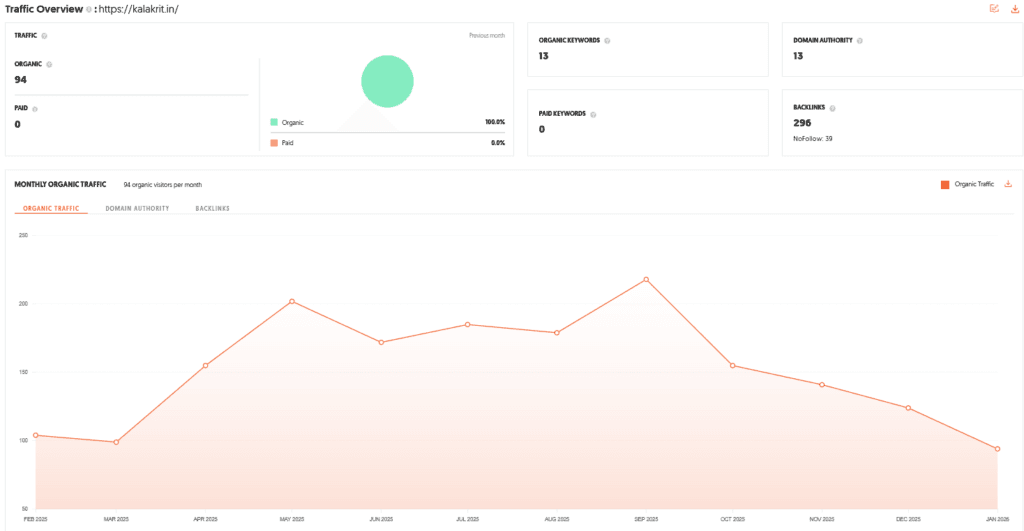
- Poor SEO Performance, SEO Improvement Needed.
- ORGANIC TRAFFIC: 94 visitors per month.
The Founder of Kalakrit
- The brand was represented by Sehaj Kohli, an entrepreneur who described himself as a formerly “below-average student” who relied on hard work and salesmanship to succeed.
- Before founding Kalakrit, Kohli gained early experience in the startup ecosystem at the age of 16 or 17 by working for a company that provided couple-friendly hotel rooms, a precursor to the OYO model.
- His background is rooted in high-energy sales and boots-on-the-ground hustle.
Kalakrit Brand Overview
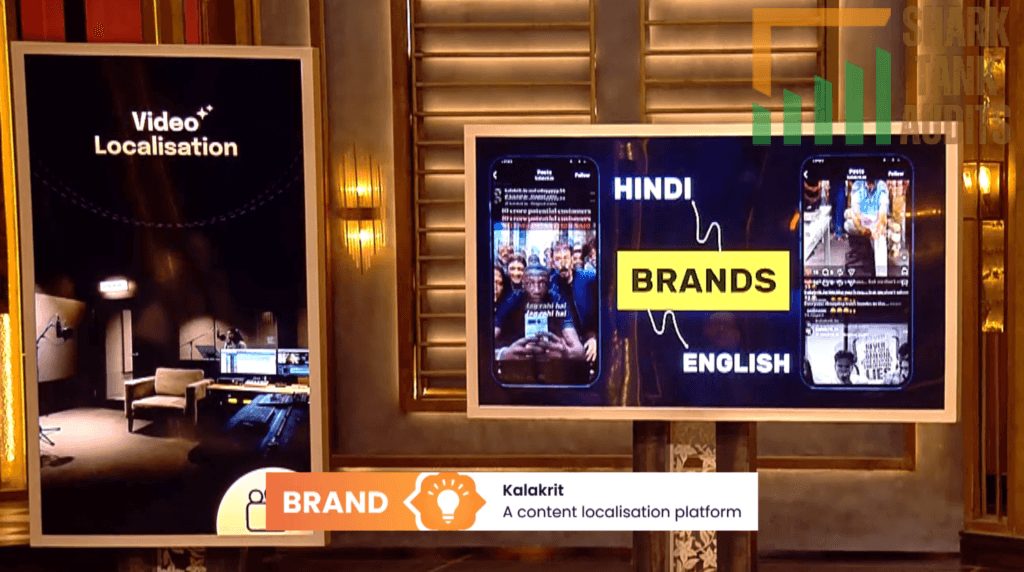
- Founded in 2021, Kalakrit is a content localization platform designed to recreate and adapt content into local languages for diverse consumer bases.
- The brand operates on a “human-in-the-loop” model, utilizing artificial intelligence to assist in the translation and recreation process while maintaining human oversight.
- To date, Kalakrit has provided services in over 100 different languages.
Kalakrit Shark Tank India Appearance & Ask
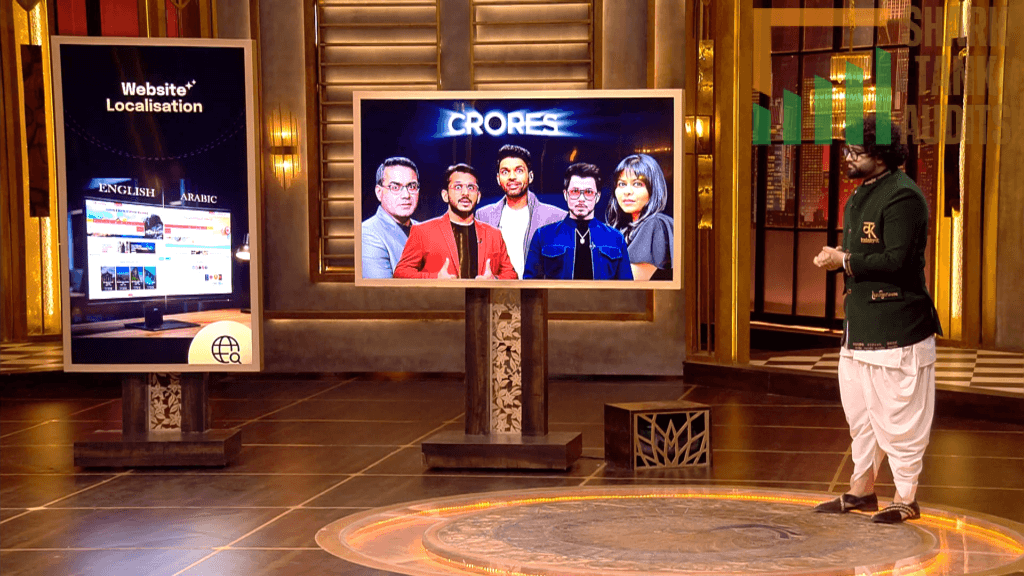
- Sehaj Kohli entered the Tank with a high-energy, “entertaining” pitch that initially charmed the Sharks.
- He sought an investment of Rs 1 crore in exchange for 10% equity, giving Kalakrit an implied valuation of Rs 10 crore.
- While the intro was met with humor and praise for his personality, the mood shifted once the Sharks began probing the business’s technical defensibility against evolving AI.
Season and Episode Air Date
- Season: 05
- Episode: 36
- Episode Air Date: Monday, 23 February, 2026
Kalakrit Product Overview
- The Kalakrit service offering focuses on localized content creation.
- By combining AI-driven cloning and translation with human editors, the platform aims to bridge the gap between global content and local audiences.
- However, the Sharks pointed out that the current product relies heavily on a “service layer” that is being rapidly disrupted by direct AI-to-consumer video and voice cloning tools.
Kalakrit Investor Reactions
The reactions to Kalakrit were among the most critical of the season:
- Anupam Mittal: Heavily criticized the pitch as “showmanship” rather than “salesmanship.” He yelled at the founder for wasting a massive opportunity on national television by choosing drama over a technical demo.
- Aman Gupta: Referred to the pitch as a “flop picture” after a promising “trailer,” noting that the industry is moving too fast to risk capital on a buzzword-heavy business.
- Kunal Bahl: Felt the founder was selling a “mental concept” rather than a tangible, scalable reality.
- Mohit Yadav & Kanika Tekriwal: Both viewed Kalakrit as a “lifestyle business” with shrinking margins and no clear path to becoming a billion-dollar company.
Kalakrit Customer Engagement Philosophy
- The Kalakrit philosophy centers on “content for the locals.”
- The brand believes that for content to truly resonate, it must go beyond simple translation; it requires recreation that feels native to the viewer.
- This is why the founder insists on a “human cost” to ensure quality, though the Sharks argued this philosophy makes the business slow and inefficient compared to pure AI competitors.
Kalakrit Product Highlights
Despite the harsh feedback, the Kalakrit pitch highlighted several business milestones:
- Language Reach: Capability to handle over 100 languages.
- Profitability: The business has remained profitable since inception.
- Revenue Growth:
- 2021-22: Rs 16 lakhs (Rs 3 lakhs EBITDA).
- 2023-24: Rs 42 lakhs (Rs 8 lakhs EBITDA).
- 2024-25 (YTD): Rs 1.07 crores (Rs 12-12.5 lakhs EBITDA).
Kalakrit Future Vision
- The Kalakrit vision is to remain a dominant player in the content localization space by merging human creativity with AI efficiency.
- However, the Sharks warned that the “bus has already left the station.”
- For Kalakrit to survive the future, the Sharks suggested the brand must move away from being a service-heavy agency and instead become a deep-tech platform that can withstand the “AI replacement” predicted by Aman Gupta.
Kalakrit Deal Finalized or Not
- No deal was finalized.
- The founder of Kalakrit left the Tank without an investment.
- All five Sharks—Anupam Mittal, Aman Gupta, Kunal Bahl, Mohit Yadav, and Kanika Tekriwal—opted out, citing concerns over the business model, the founder’s over-reliance on showmanship, and the existential threat posed by rapid advancements in AI.
| Category | Details |
|---|---|
| Brand Name | Kalakrit |
| Founded | 2021 |
| Founder | Sehaj Kohli |
| Website Tech | Built using JavaScript libraries (jQuery 3.5.1, Swiper) |
| SEO Performance | Poor SEO; improvement needed |
| Organic Traffic | 94 visitors/month |
| Business Model | Content localization platform (Human-in-the-loop AI model) |
| Core Offering | AI-assisted translation, dubbing & recreation with human oversight |
| Languages Supported | 100+ languages |
| Shark Tank Season | Season 05 |
| Episode | Episode 36 |
| Air Date | Monday, 23 February 2026 |
| Ask | ₹1 Crore for 10% equity |
| Implied Valuation | ₹10 Crores |
| Pitch Style | High-energy, entertaining but criticized for lack of technical depth |
| Investor Reactions | Showmanship over substance, AI disruption risk, service-heavy model, scalability concerns |
| Deal Status | ❌ No Deal |
| Revenue 2021-22 | ₹16 Lakhs (₹3 Lakhs EBITDA) |
| Revenue 2023-24 | ₹42 Lakhs (₹8 Lakhs EBITDA) |
| Revenue 2024-25 (YTD) | ₹1.07 Crores (₹12–12.5 Lakhs EBITDA) |
| Business Potential (India) | Growing creator economy (₹3,500+ Crores), 65% regional content preference |
| TAM (Global) | $81.45 Billion (Language Services Market, 2026) |
| SAM (India) | $22.2 Billion by 2030 (19.9% CAGR) |
| SOM Target | ₹1,000+ Crore MSME & creator segment |
| Target Audience | EdTech platforms, regional influencers (18–35), D2C brands, OTT & production houses |
| Marketing Strategy | Long-tail SEO, LinkedIn B2B leadership, Festive Meta ads, AI vs Human comparison content |
| Distribution Strategy | API-first model, agency partnerships, freemium 60-second trial |
| Key Advantages | Human nuance, profitability, multilingual scale |
| Major Challenges | AI disruption, low entry barriers, scalability limitations |
| Mitigation Strategy | SaaS transition, AI confidence scoring, proprietary linguistic datasets |
| 3-Year Roadmap | Year 1: SaaS platform (₹5 Cr target) Year 2: Global South expansion Year 3: AI Voice Vault launch |
| Valuation Goal (2028) | ₹50–₹100 Crores (via SaaS margin expansion to 30%) |
Kalakrit Shark Tank India Business Plan
1. Kalakrit Business Potential in India: Stats & Facts
- India’s Creator Economy: As of 2026, India’s creator economy is valued at over ₹3,500 crores with more than 4 million active creators.
- Regional Dominance: Over 65% of Indian audiences prefer consuming content in their native language. Regional cinema (Telugu, Malayalam, Gujarati) outperformed Hindi releases in 2025, signaling a massive shift toward hyper-local content.
- Digital Ad Spend: The Indian digital advertising market is projected to reach $5 billion (approx. ₹42,000 crores) in 2026, with a significant portion allocated to localized, persona-driven creatives.
- The “Orange Economy”: India’s creative sector is expected to support 10 million livelihoods by the end of 2026, making localized content services a primary driver of service-sector growth.
2. Kalakrit Total Addressable Market (TAM): Data-Driven Analysis
- TAM (Global Language Services): Projected to reach $81.45 billion in 2026.
- SAM (India Content Services): The India content services platform market is estimated to reach $22.2 billion by 2030, growing at a 19.9% CAGR.
- SOM (Serviceable Obtainable Market): Kalakrit can realistically target the ₹1,000 crore+ segment of MSMEs and individual creators who require high-quality, culturally nuanced dubbing that pure AI still struggles to perfect.
3. Kalakrit Ideal Target Audience & Demographics
- Ed-Tech Platforms: National platforms needing to translate technical courses into 22+ official Indian languages for Tier 2/3 students.
- Regional Influencers: Creators (Ages 18–35) looking to “Pan-Indianize” their content to increase follower bases across linguistic borders.
- D2C Brands: Companies targeting the “Next Billion Users” who primarily engage with video content in non-English formats.
- OTT & Production Houses: Smaller production units needing “Human-in-the-loop” quality for subtitles and dubbing without the Hollywood-level price tag.
4. Kalakrit Marketing & Digital Strategy
- Content Strategy: Create “Before vs. After” comparison videos showing the difference between Flat AI Translation and Kalakrit Culturally Localized Content.
- SEO Improvement: Focus on long-tail keywords like “Marathi Video Dubbing for Business” or “Bengali Content Localization Services” to improve on the current low organic traffic (94 visitors/month).
- B2B LinkedIn Engine: Use Sehaj Kohli’s high-energy sales persona to lead a “thought leadership” series on the “Ethics of AI in Localization.”
- Performance Marketing: Target MSMEs on Meta platforms during the festive season (Q4), which accounts for over 30% of annual digital ad spend in India.
5. Kalakrit Distribution Strategy
- API-First Approach: Develop a Kalakrit API that can be integrated directly into video editing software or CMS platforms (like WordPress or Shopify).
- Partnership Model: Tie up with digital marketing agencies that lack in-house localization departments.
- Freemium Model: Offer the first 60 seconds of localized content for free to reduce the “trust barrier” for new clients.
6. Kalakrit Advantages & Challenges
- Advantages:
- Human Nuance: Superior “Human-in-the-loop” quality that avoids the “uncanny valley” of pure AI.
- Profitability: A proven, EBITDA-positive track record since 2021.
- Multilingual Scale: Immediate access to 100+ languages.
- Challenges:
- AI Disruption: Rapidly improving tools (OpenAI Sora, ElevenLabs) that lower the barrier for DIY localization.
- Low Barriers to Entry: Numerous “service-layer” competitors entering the market.
- Scalability: High “human cost” can limit the speed of delivery compared to pure-play tech rivals.
7. Kalakrit Success Drivers & Mitigation Strategies
- Reason for Success: India’s linguistic diversity is too complex for current “Global AI” to handle perfectly. Cultural context (slang, idioms, tone) remains a human-led moat.
- Mitigation (Against AI): Transition from a “Service Agency” to a SaaS Platform where humans only intervene when the AI confidence score falls below 85%.
- Mitigation (Against Competition): Build proprietary “Linguistic Datasets” for rare Indian dialects that global giants like Google or Meta haven’t prioritized yet.
8. Kalakrit Future Vision & Roadmap to Valuation
- Year 1 (Productization): Transform Kalakrit from a manual service into a dashboard-driven platform. Reach ₹5 crore revenue by targeting the booming MSME digital spend.
- Year 2 (Expansion): Enter the Global South (Africa/SE Asia) markets where linguistic fragmentation is similar to India.
- Year 3 (IP Creation): Launch Kalakrit-Voice-Vault, a proprietary library of AI-cloned regional voices with “Human Emotion Tags.”
- Valuation Target: By shifting from an 8% EBITDA service model to a 30% margin SaaS model, Kalakrit can aim for a 5x–10x Revenue Multiple, potentially reaching a ₹50 crore – ₹100 crore valuation by 2028.






Kalakrit Shark Tank India Episode Review