
Misfits Shark Tank India Episode Review
Misfits appeared on Shark Tank India Season 5, Episode 37, with Delhi NCR-based founders, four IIT Kanpur alumni friends Shashwat Narhatiyar, Shashwat Kar, Saurabh Sharma, and Chaitanya Dhawan (established 2024, chose tackling social problem versus purely software-based despite technical pedigree), seeking ₹1 Crore for 1.25% equity (₹80 Crore valuation) and successfully closed a deal for ₹1 Crore for 3% equity (₹33.3 Crore valuation) with Shark Kanika Tekriwal taking “leap of faith” after brief negotiation where founders initially counter-offered 2.5%.
The offline meetup platform combats growing loneliness epidemic serving as community-building tool encouraging users stepping away from screens engaging in physical activities primarily centered around sports/local events functioning as marketplace for community-led events allowing users joining various “clubs”/activities hosted by verified “club leaders” (150+ with rigorous verification including background checks) facilitating logistics from venue discovery to participant coordination ensuring digital-to-physical social interaction transition, achieving 4,000 meetups for 20,000 paid members without traditional paid marketing spending, ₹20-22 lakh monthly Gross Booking Value with 700 monthly meetups (₹270 average booking value, ₹60 platform commission per attendee) but ₹23 lakh monthly loss with 650 organic visitors requiring SEO improvement. Sharks reacted mostly critically—Anupam stated business “makes no sense” because users would eventually migrate to WhatsApp once group formed bypassing platform, Aman shocked by high burn rate questioning why four IITians needed 24 employees for occasional-usage platform, Kunal pointed out lack of “liquidity” between leaders/venues/users suggesting event-planning tool versus scalable marketplace, while Kanika believed in founders’ flexibility and importance solving “loneliness” problem despite current product skepticism.
Operating amid India’s shifting social fabric where 37% urban Indians report loneliness (2026) creating massive psychological “tribe” building demand with 15.1% CAGR growth in platforms facilitating offline face-to-face connections as digital saturation peaks and India’s sports sector projected at $130 billion by 2030 providing “hero category” (sports driving 40% meetups) within 655 million sports/hobby enthusiasts TAM and 95 million urban Gen Z/millennials (Tier 1 cities using social discovery apps) SAM, Misfits targets Gen Z/young millennials (18-34)—working professionals recently relocating to new cities (Delhi/Bangalore/Mumbai) and students seeking beyond-academics community who are “digitally exhausted” but “socially hungry” valuing experiences over material goods—aiming 5 million active monthly users across top 10 metros by 2028 representing ₹300+ Crore annual platform revenue potential, planning User Generated Content filming raw emotional meetup highlights showing before-awkwardness/after-friendships, micro-influencer collaborations with local “Club Leaders” having niche sports/arts authority, SEO targeting high-intent keywords (“Football groups near me,” “How to meet new people Delhi”), leader-led model where Misfits provides infrastructure with 150+ verified leaders as distribution nodes, venue partnerships (turfs/cafes/community halls) becoming “Misfit-verified” hubs creating physical presence without real-estate overhead, Membership/Loyalty Program introduction providing perks (turf discounts, exclusive events) available only for in-app transactions mitigating platform leakage to WhatsApp, React-based framework automating leader-onboarding reducing 24-person headcount achieving unit profitability, geo-expansion to Bangalore/Mumbai using Kanika’s investment, “Leader Economy” monetization offering premium community management tools, brand partnerships integrating sports/beverage brands (Decathlon) for on-ground meetup sampling, and 40% repeat booking rate focus proving value over WhatsApp while reducing CAC/increasing platform fee through “Premium Tribes” plus user interest data utilization providing hyper-targeted sports/lifestyle recommendations making ecosystem indispensable for urban lifestyle brands targeting ₹80+ Crore valuation return.
Website Information
- Website:- Misfits
- Build on JavaScript frameworks React
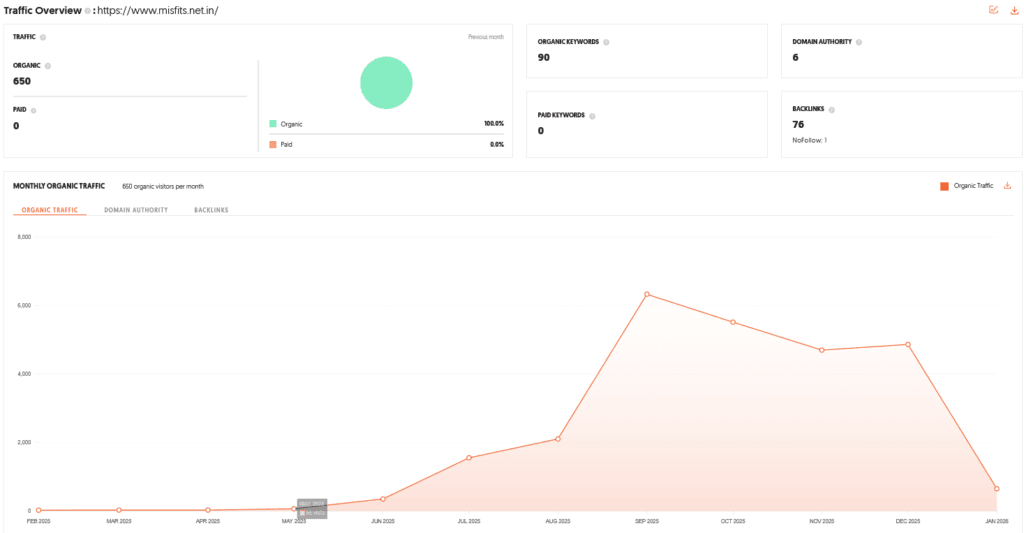
- Average SEO Performance, SEO Improvement Needed.
- ORGANIC TRAFFIC: 650 visitors per month.
The Founders of Misfits
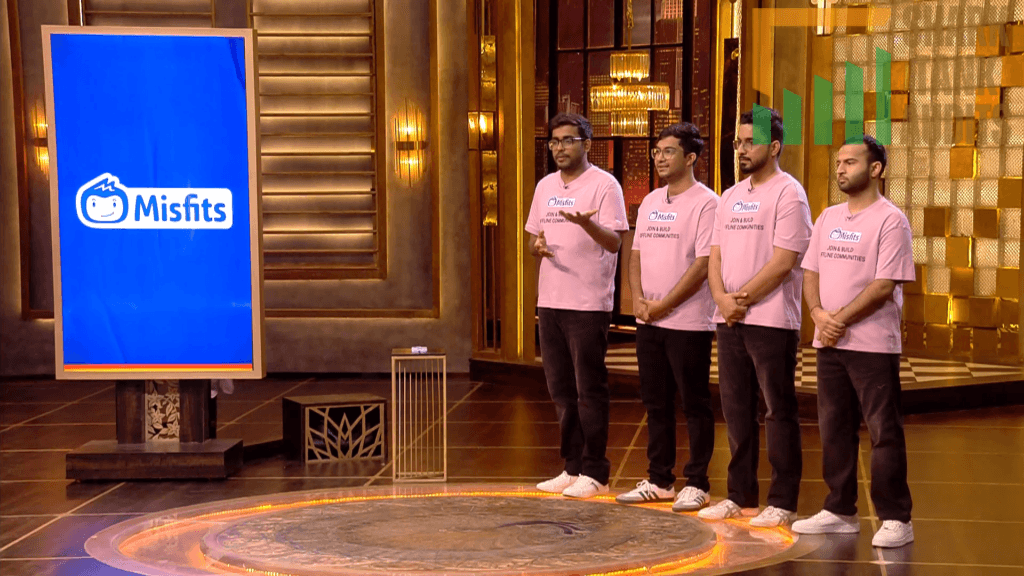
- The brand was founded in 2024 by a team of four highly qualified friends and alumni from IIT Kanpur: Shashwat Narhatiyar, Shashwat Kar, Saurabh Sharma, and Chaitanya Dhawan.
- Despite their technical pedigree, the founders chose to tackle a social problem rather than a purely software-based one.
Brand Overview of Misfits
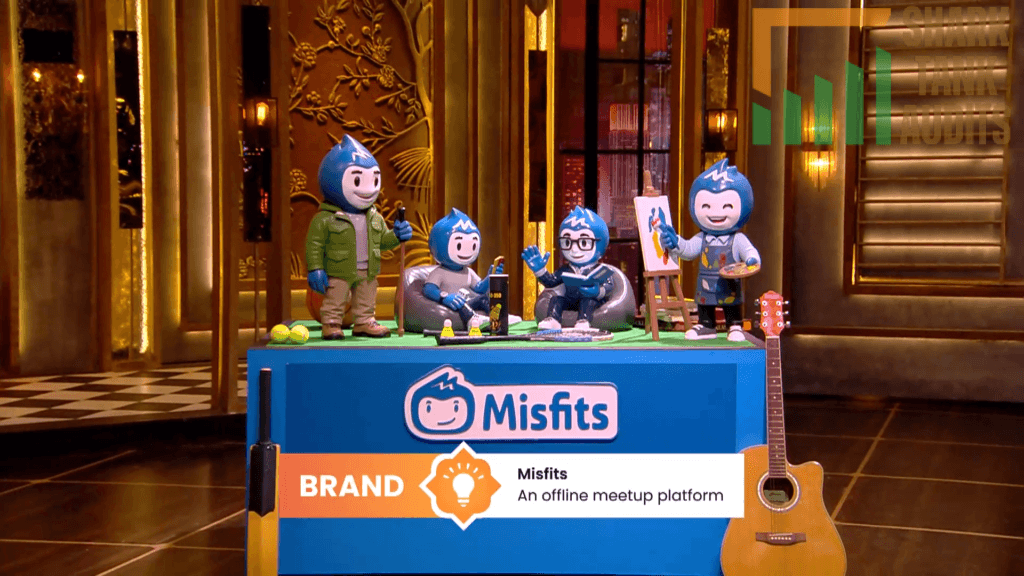
- Misfits is an offline meetup platform designed to combat the growing epidemic of loneliness.
- It serves as a community-building tool that encourages users to step away from their screens and engage in physical activities, primarily centered around sports and local events.
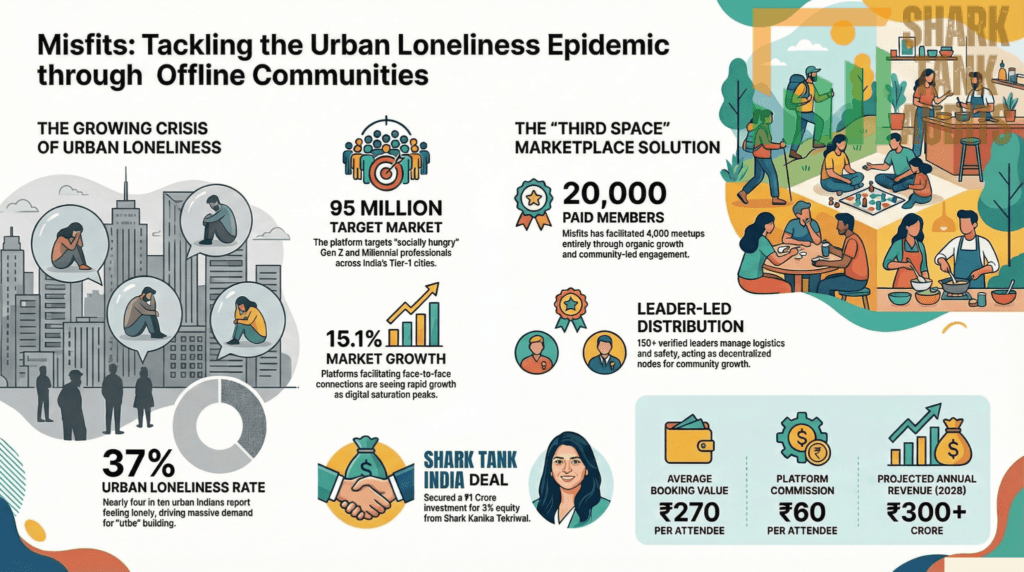
- Based in Delhi NCR, the brand has already facilitated 4,000 meetups for approximately 20,000 paid members without spending on traditional paid marketing.
Shark Tank India Appearance and Ask for Misfits
- The founders appeared on the show seeking an investment of Rs 1 crore in exchange for 1.25% equity, which placed the company’s valuation at Rs 80 crores.
- They presented their vision of creating “tribes” where people can find like-minded individuals for consistent offline engagement.
Season and Episode Air Date
- Season: 05
- Episode: 37
- Episode Air Date: Tuesday, 24 February, 2026
Product Overview of Misfits
- The Misfits platform functions as a marketplace for community-led events.
- It allows users to join various “clubs” or activities hosted by verified “club leaders.” The product aims to facilitate the logistics of meeting up, from venue discovery to participant coordination, ensuring that social interactions move from digital chats to physical presence.
Investor Reactions to Misfits
The reaction from the majority of the panel was largely critical:
- Anupam Mittal: Stated the business “makes no sense” because users would eventually migrate to WhatsApp once a group is formed, bypassing the platform.
- Aman Gupta: Was shocked by the high “burn rate” (Rs 23 lakhs loss per month) and questioned why a team of four IITians needed 24 employees for a platform with occasional usage.
- Kunal: Pointed out a lack of “liquidity” between leaders, venues, and users, suggesting it might remain an event-planning tool rather than a scalable marketplace.
- Kanika Tekriwal: While skeptical of the current product, she believed in the founders’ flexibility and the importance of solving the “loneliness” problem.
Customer Engagement Philosophy of Misfits
- The Misfits philosophy is rooted in the belief that real human experiences are diminishing in a hyper-digital world.
- Their strategy focuses on organic growth and “club leader” ownership, where community members take the lead in organizing events, thereby creating a self-sustaining ecosystem of engagement.
Product Highlights of Misfits
- Safety First: Includes a dedicated help section and a rigorous verification process for all club leaders, including background checks.
- Proven Traction: Successfully executed 4,000 meetups with a base of 20,000 paying users.
- Niche Communities: Focuses on specific interests (like sports) to ensure high-quality matches between members.
Future Vision for Misfits
- The founders of Misfits aim to scale their platform to solve the modern crisis of shallow digital relationships.
- By securing Kanika Tekriwal’s investment, they plan to refine their business model, address safety concerns for female users, and prove that an offline-first community platform can thrive in a market dominated by digital giants like WhatsApp.
Deal Finalized or Not for Misfits
- Yes, a deal was finalized. While most Sharks were skeptical, Kanika Tekriwal decided to take a “leap of faith.”
- After a brief negotiation where the founders initially counter-offered 2.5% equity, they eventually settled on a deal of Rs 1 crore for 3% equity, valuing the company at approximately Rs 33.3 crores.
| Category | Details |
|---|---|
| Website | Misfits |
| Built On | JavaScript Framework – React |
| SEO Performance | Average SEO Performance, Improvement Needed |
| Organic Traffic | 650 visitors per month |
| Founders | Shashwat Narhatiyar, Shashwat Kar, Saurabh Sharma, Chaitanya Dhawan (IIT Kanpur alumni) |
| Founded In | 2024 |
| Headquarters | Delhi NCR, India |
| Business Type | Offline meetup & community-building platform |
| Core Problem | Solving loneliness through real-world engagement |
| Meetups Conducted | 4,000 meetups |
| Paid Members | 20,000 users |
| Shark Tank Season | Season 05 |
| Episode Number | Episode 37 |
| Episode Air Date | Tuesday, 24 February 2026 |
| Initial Ask | ₹1 Crore for 1.25% equity |
| Initial Valuation | ₹80 Crores |
| Final Deal | ₹1 Crore for 3% equity |
| Final Valuation | ₹33.3 Crores (approx.) |
| Revenue Model | Transaction-based (₹270 average booking value, ₹60 platform fee per attendee) |
| Monthly GBV | ₹20–22 Lakhs |
| Monthly Meetups | 700 meetups (Delhi NCR) |
| Monthly Burn | ₹23 Lakhs loss |
| Target Audience | Gen Z & Young Millennials (18–34 years), urban working professionals & students |
| TAM | 655 million sports & hobby enthusiasts |
| SAM | 95 million urban Gen Z & Millennials |
| SOM Target | 5 million active monthly users by 2028 |
| Revenue Potential (SOM) | ₹300+ Crores annually |
| Growth Strategy | Leader-led model, hyper-local venue partnerships, UGC content marketing |
| Key Strength | High trust, IIT founding team, first-mover advantage |
| Key Challenges | Platform leakage to WhatsApp, high burn rate, liquidity balance |
| Future Expansion | Bangalore & Mumbai (2026), Leader Economy monetization (2027), Brand partnerships (2028) |
| Valuation Growth Plan | Improve retention (40% repeat rate), achieve unit profitability, leverage user data for targeted partnerships |
Misfits Shark Tank India Episode Review
1. Detailed Logical Business Plan for Misfits
The Misfits business model is built on the “Third Space” concept—creating a social environment between home and work.
- Revenue Model: Primarily transaction-based. Misfits charges an average booking value of ₹270 per meetup, with a platform fee (commission) of roughly ₹60 per attendee.
- Operational Scale: Currently clocking ₹20–22 Lakhs in monthly Gross Booking Value (GBV) with 700 meetups per month in Delhi NCR.
- Resource Allocation: Transitioning from a high-burn model (₹23 Lakhs monthly loss) to a leaner, leader-led structure to achieve unit profitability.
2. Business Potential in India for Misfits
The potential for Misfits is rooted in India’s shifting social fabric:
- The Loneliness Epidemic: Reports in 2026 indicate that nearly 37% of urban Indians report feeling lonely, creating a massive psychological demand for “tribe” building.
- Post-Digital Fatigue: As digital saturation peaks, there is a 15.1% CAGR growth in platforms that facilitate offline, face-to-face “real-world” connections.
- Sports Economy: India’s sports sector is projected to hit $130 Billion by 2030, providing Misfits a massive “hero category” (sports currently drive 40% of their meetups).
3. Total Addressable Market (TAM) for Misfits
- TAM (Total Addressable Market): Approximately 655 million sports and hobby enthusiasts in India who seek interactive engagement.
- SAM (Serviceable Addressable Market): The 95 million urban Gen Z and Millennials in Tier-1 cities who currently use social discovery apps.
- SOM (Serviceable Obtainable Market): A target of 5 million active monthly users across top 10 Indian metros by 2028, representing a platform revenue potential of ₹300+ Crores annually.
4. Ideal Target Audience and Demographics for Misfits
The Misfits “Tribe” is characterized by:
- Primary Segment: Gen Z and Young Millennials (Ages 18–34).
- Persona: Working professionals who have recently moved to new cities (Delhi, Bangalore, Mumbai) and students seeking community beyond academics.
- Psychographics: Individuals feeling “digitally exhausted” but “socially hungry,” valuing experiences over material goods.
5. Marketing and Digital Strategy for Misfits
Since Misfits has grown largely through organic means, the 2026 strategy involves:
- Content Strategy: Leveraging “User Generated Content” (UGC) by filming raw, emotional highlights of real meetups—showing the “before” (awkwardness) and “after” (new friendships).
- Digital Marketing: Micro-influencer collaborations with local “Club Leaders” who have niche authority in sports or arts.
- SEO Improvement: Targeting high-intent keywords like “Football groups near me” or “How to meet new people in Delhi” to boost their current 650 monthly organic visitors.
6. Distribution Strategy for Misfits
- The “Leader-Led” Model: Misfits acts as the infrastructure, while 150+ verified “Club Leaders” act as the distribution nodes.
- Hyper-local Nodes: Partnering with physical venues (turfs, cafes, community halls) to become “Misfit-verified” hubs, creating a physical presence without real-estate overhead.
7. Advantages and Challenges for Misfits
| Advantages of Misfits | Challenges for Misfits |
| High Trust: Rigorous leader verification and background checks. | Platform Leakage: Users moving to WhatsApp once a group is formed. |
| First-Mover: Early entrant in the “organized” offline social space. | High Burn Rate: Current monthly losses of ₹23 Lakhs. |
| Founding Team: Four IIT Kanpur alumni with high technical execution capability. | Liquidity: Balancing the number of events with the number of interested users. |
8. Success Reasons and Mitigation Strategies for Misfits
- Why it can succeed: Misfits solves a “pain” (loneliness) rather than just a “vitamin” (entertainment).
- Mitigation for Leakage: Introduce a Misfits Membership/Loyalty Program that provides perks (discounts on turfs, exclusive events) available only if transactions stay on the app.
- Mitigation for High Burn: Automate the leader-onboarding process using their React-based framework to reduce the 24-person headcount to a leaner core team.
9. Future Business Roadmap for Misfits
- Phase 1 (2026): Geo-expansion to Bangalore and Mumbai using Kanika Tekriwal’s investment.
- Phase 2 (2027): Monetizing the “Leader Economy”—offering premium tools for leaders to manage their own sub-communities.
- Phase 3 (2028): Brand Partnerships—integrating sports brands (like Decathlon) or beverage brands for on-ground sampling at meetups.
10. Roadmap to Increase Valuation of Misfits
To return to and exceed their original ₹80 Crore valuation ask:
- Retention Metrics: Shift focus from “App Downloads” to “Repeat Booking Rate.” A 40% repeat rate proves the platform’s value over WhatsApp.
- Unit Profitability: Reduce the cost per acquisition (CAC) and increase the platform fee through “Premium Tribes.”
- Data Play: Utilize user interest data to provide hyper-targeted sports and lifestyle recommendations, making the Misfits ecosystem indispensable for urban lifestyle brands.






Misfits Shark Tank India Episode Review