
Shark Tank India Season 5 Episode 14 Review
Episode 14 of Shark Tank India Season 5 showcased entrepreneurship tackling India’s fundamental infrastructure challenges—from housing and food safety to emergency healthcare—demonstrating how innovation addresses basic human needs at scale. The episode featured businesses reimagining centuries-old industries through modern technology: modular construction bringing “Lego-like” assembly to buildings, paper-based chemistry detecting food contamination without electricity, and tech-enabled healthcare delivering 10-minute emergency response to gated communities.
With a live crane demonstration assembling a building pod in minutes, deep-tech food testing requiring no machinery, and ambulances stationed within residential societies, Episode 14 proved that the most impactful entrepreneurship often solves unglamorous problems affecting millions daily. The episode raised critical questions about government revenue dependency, product differentiation in crowded markets, and the “Golden Hour” crisis in Indian emergency response, ultimately investing ₹3 crore across innovative solutions to housing shortage, food adulteration, and healthcare access gaps.
Episode Summary
Total Pitches: 3
Successful Deals: 2
Total Investment Made: ₹2 Crore equity + ₹1 Crore debt (₹3 Crore total capital)
Featured Sharks: Kunal Bahl, Anupam Mittal, Kanika Tekriwal, and others
Pitch 1
Uprear Build Shark Tank India Episode Review
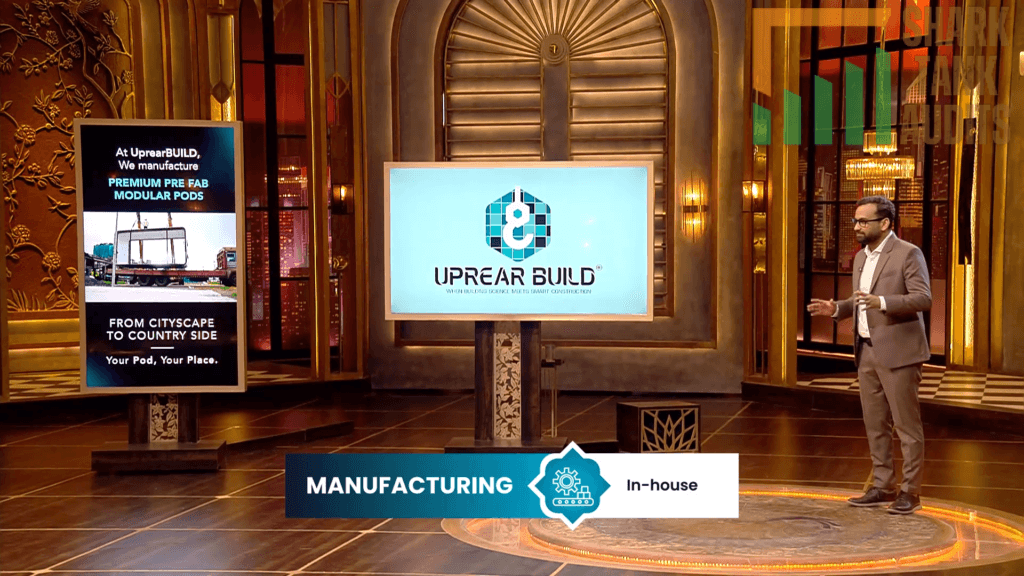
Uprear Build appeared on Shark Tank India Season 5, Episode 14, with founder Shrikant Shah from Surat seeking ₹2 Crore for 2.5% equity (₹80 Crore valuation) and successfully closed a deal for ₹1 Crore for 2% equity + ₹1 Crore debt at 10% interest for 3 years (₹50 Crore valuation) with Shark Kunal Bahl.
Founded in 2020, the modular construction firm uses factory-to-site “Lego-like” assembly approach with foldable, building-code-compliant smart pods installing 330 sq. ft. studios in 1 hour with 15-20 day delivery, growing from ₹1.5 Crore (FY 22-23, 6 months) to ₹6.2 Crore (FY 24-25) with projected ₹25 Crore (FY 25-26), maintaining strong 34% gross margin and 28% EBITDA. Demonstrating live crane-assisted pod installation, Shrikant impressed Sharks despite 70% government Anganwadi revenue dependency, with Kunal seeing “Indicorn” potential (profitable, sustainable growth) and private sector scalability in digital-first branding making construction “cool and fashionable.”
Operating with 9 monthly organic visitors requiring SEO overhaul, Uprear targets Indian construction market growing from $0.79 trillion (2026) to $1.10 trillion by 2031 (6.87% CAGR) within modular construction market valued at $3.92 billion (2025) projected to reach $8.32 billion by 2033 (9.9% CAGR), targeting Gen Z/millennials (22-40, 70% planning home purchases), eco-conscious homeowners, B2B commercial clients, and hospitality developers seeking rapid, sustainable, low-waste housing versus traditional 12-month construction.
Pitch 2
Paper Pro Shark Tank India Episode Review
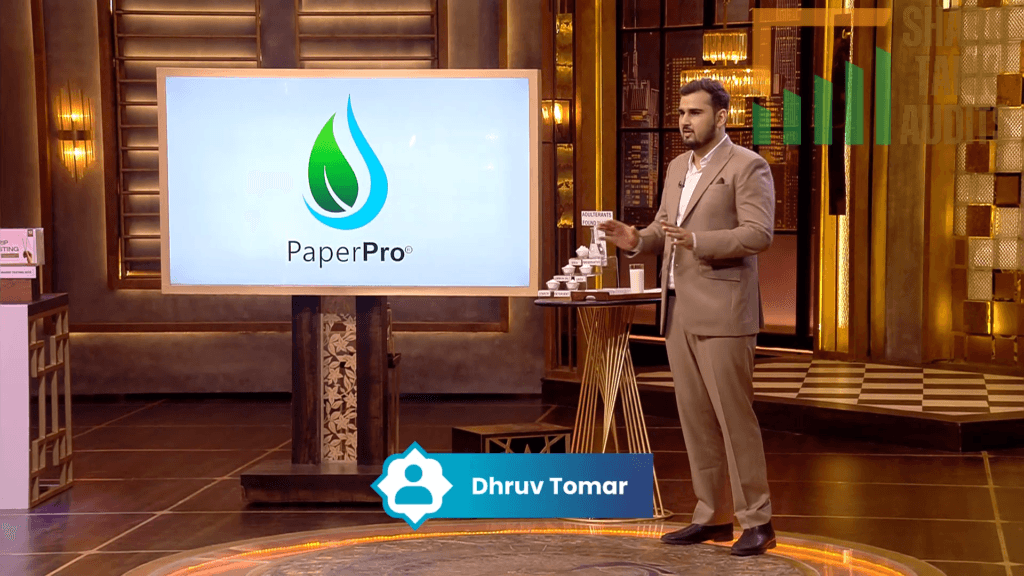
Paper Pro appeared on Shark Tank India Season 5, Episode 14, with founder Dhruv Tomar seeking investment but left with no deal despite innovative concept. The deep-tech startup powered by MLense offers paper-based instant food adulteration testing requiring no electricity, machinery, or technical expertise through simple “resting principle” where food samples touching test paper trigger chemical reactions showing color shifts indicating contamination.
Growing from ₹5.7 lakh (last year) to ₹8.1 lakh (last quarter) with ₹6 lakh monthly sales primarily through offline B2B channels, the product targets households, street vendors, NGOs, food inspectors, and educational institutions. While Sharks engaged with the science and mission, concerns arose over product differentiation versus existing milk testing kits, scientific validation/certifications, go-to-market strategy for B2B-to-B2C transition, and unit economics/margins.
Operating with 0 monthly organic visitors requiring SEO overhaul, Paper Pro addresses India’s 100 million annual foodborne disease cases costing $15 billion in healthcare/productivity losses within food safety testing market projected at $717.9 million (2025) growing 9.8% CAGR to $1.51 billion by 2033, specifically targeting food authenticity market valued at $271.29 million (2024) expected to reach $448.71 million by 2033, as 84% of Indian consumers prioritize food safety in purchasing decisions supported by FSSAI’s “Eat Right India” initiative.
Pitch 3
Cosmo Health Shark Tank India Episode Review
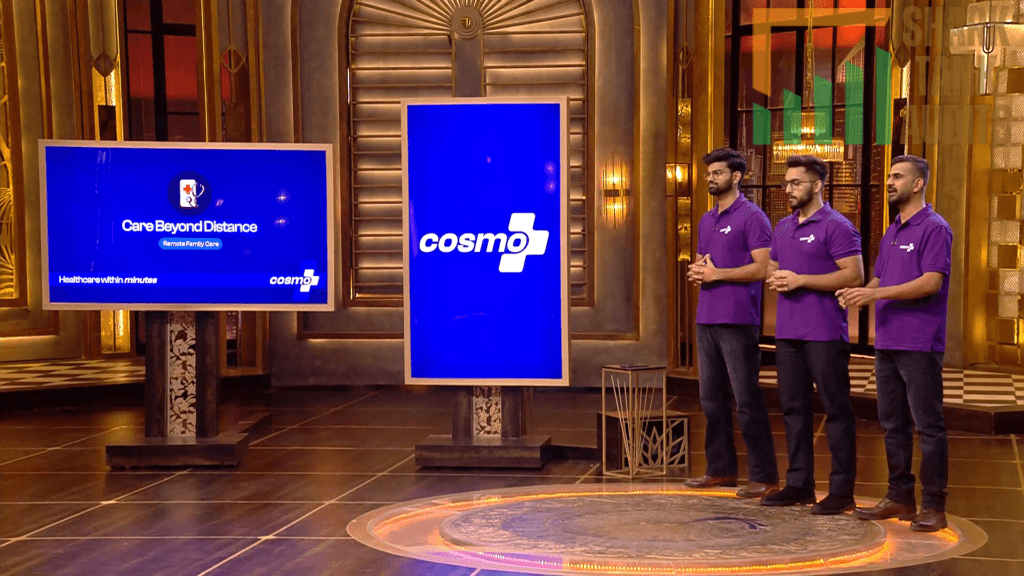
Cosmo Health appeared on Shark Tank India Season 5, Episode 14, with founders Dr. Shivansh Bhalla (medical vision), Atul Jain (strategic leadership), and Himanshu Mewara (execution strategy) seeking ₹1 Crore for 4% equity (₹25 Crore valuation) and successfully closed a deal for ₹1 Crore for 9% equity (₹11.11 Crore valuation) with Sharks Anupam Mittal, Kanika Tekriwal, and Kunal Bahl after intense negotiations with multiple competing offers.
The technology-driven healthcare startup provides 10-minute emergency response services for gated communities through integrated ambulances, 24/7 doctor support, first aid, and home nursing, with Cosmo Plus digital platform storing unified medical history and health data. Having served 7,000 families across residential societies with ₹70,000 ambulance setup and ₹95,000 nursing/operations costs per society, they address India’s “Golden Hour” crisis where Bengaluru’s average 10km travel takes 34 minutes amid 480,000 annual road accidents.
Operating with 270 monthly organic visitors requiring SEO improvement, Cosmo Health targets Indian healthcare market growing from $180 billion (2023) to $320 billion by FY 2028 (12% CAGR) within ambulance services market valued at $5.20 billion (2024) projected to reach $9.70 billion by 2033 (6.4% CAGR) and home healthcare market at $14.0 billion (2024) expected to explode to $64.4 billion by 2033 serving 2.5 lakh gated communities and India’s aging population (194 million seniors projected by 2031).
Episode Highlights:
- Live construction demo: First-ever crane assembly of building pod on Shark Tank stage
- Infrastructure focus: All three pitches solving fundamental India challenges (housing, food, healthcare)
- Hybrid financing returns: Second equity+debt deal this season (after RIDEV, Cinefai)
- Kanika Tekriwal active: Healthcare-focused Shark returning to invest in emergency response
- “Indicorn” concept: Kunal’s term for profitable sustainable growth vs. unicorn-chasing
- Government dependency debate: 70% Anganwadi revenue raising private sector scalability concerns
- Deep-tech rejection: Paper-based chemistry innovation failing despite social impact
- Three-Shark collaboration: Anupam, Kanika, Kunal partnering on healthcare emergency response
Key Lessons:
- Live demonstrations create powerful pitch moments—seeing pod assembled convinced Kunal
- Government revenue can both validate (proves product works) and concern (dependency risk)
- Deep-tech + social impact insufficient without clear differentiation and go-to-market path
- Emergency response timing (10 minutes vs. 34 minutes) creates compelling value proposition
- Capital-light models (₹70K ambulance + ₹95K operations per society) enable fast scaling
- Modular/factory construction can achieve premium margins (34% gross, 28% EBITDA)
- SEO epidemic continues (9, 0, 270 monthly visitors) but doesn’t prevent deals with fundamentals
- “Cool and fashionable” positioning can transform industrial categories (construction) for millennials
Deal Structure Analysis:
Uprear Build:
- Asked: ₹2 Cr for 2.5% (₹80 Cr valuation)
- Got: ₹1 Cr equity for 2% + ₹1 Cr debt at 10% for 3 years (₹50 Cr equity valuation)
- Structure: Hybrid equity+debt providing full ₹2 Cr capital while reducing equity dilution
- Rationale: Capital-intensive construction business with proven cash flows justifies debt component
Paper Pro:
- Asked: Investment (amount/equity not specified in provided info)
- Got: No deal
- Rationale: Differentiation unclear, scientific validation concerns, go-to-market strategy questions
Cosmo Health:
- Asked: ₹1 Cr for 4% (₹25 Cr valuation)
- Got: ₹1 Cr for 9% (₹11.11 Cr valuation)
- Equity increase: 2.25x (from 4% to 9%)
- Rationale: Early stage + capital needs for expansion + three-Shark collaboration = higher equity
Strategic Patterns:
- Debt for Assets: Capital-intensive businesses (construction, earlier EV leasing) get hybrid structures
- Infrastructure Premium: Basic needs (housing, healthcare) attract investment despite execution risks
- Government Revenue Double-Edged: Validates product but raises dependency concerns
- Response Time Matters: 10-minute vs. 34-minute ambulance response creates clear competitive moat
- Community Focus: Hyperlocal positioning (gated societies) beats citywide competition
Market Context:
- Construction: $0.79T (2026) → $1.10T (2031) at 6.87% CAGR
- Modular Construction: $3.92B (2025) → $8.32B (2033) at 9.9% CAGR
- Food Safety Testing: $717.9M (2025) → $1.51B (2033) at 9.8% CAGR
- Food Authenticity Testing: $271.29M (2024) → $448.71M (2033)
- Healthcare Market: $180B (2023) → $320B (2028) at 12% CAGR
- Ambulance Services: $5.20B (2024) → $9.70B (2033) at 6.4% CAGR
- Home Healthcare: $14.0B (2024) → $64.4B (2033) explosive growth
- Gated Communities: 2.5 lakh across India
- Senior Population: 194M projected by 2031
Government Dependency Debate:
Uprear Build’s 70% Anganwadi revenue sparked critical discussion:
Pro (Why it’s positive):
- Government validates product quality/compliance
- Large-scale, predictable orders enable factory efficiency
- Proof of concept for private sector adoption
- Social impact (childcare centers) aligns with nation-building
Con (Why it’s concerning):
- Policy changes could devastate revenue overnight
- Government payment delays hurt cash flow
- Limits pricing power and margin expansion
- Signals potential private sector adoption challenges
Kunal’s bet: Government revenue proves product works; digital branding will unlock private sector at higher margins.
The “Indicorn” Philosophy:
Kunal Bahl introduced “Indicorn” concept—profitable, sustainable growth businesses versus unicorn-chasing:
Indicorn Characteristics (Uprear Build):
- 28% EBITDA (already profitable)
- 34% gross margin (healthy unit economics)
- Organic growth trajectory (₹1.5 Cr → ₹6.2 Cr → ₹25 Cr projected)
- Real market need (housing shortage)
- Sustainable model (not burning cash for growth)
Unicorn Characteristics (opposite):
- Negative margins, burning investor capital
- Growth-at-any-cost mentality
- Chasing valuations over profitability
- Often unsustainable business models
Kunal’s thesis: Indian market needs more Indicorns (profitable, sustainable) versus Unicorns (hyped, unprofitable).
Deep-Tech Rejection Analysis:
Paper Pro’s failure despite innovation revealed critical gaps:
What they had:
- Innovative technology (paper-based testing)
- Social impact (100M foodborne cases annually)
- Growing revenue (₹5.7L → ₹8.1L quarterly)
- Massive market ($717.9M → $1.51B)
- Strong consumer demand (84% prioritize food safety)
What they lacked:
- Clear differentiation vs. existing milk testing kits
- Scientific validation/certifications for credibility
- B2C go-to-market strategy (stuck in B2B)
- Compelling unit economics/margins
- Defensibility against competitors
Lesson: Innovation + impact < differentiation + path to profitability in investor decisions.
Emergency Response Innovation:
Cosmo Health’s 10-minute promise vs. Bengaluru’s 34-minute reality created compelling moat:
Traditional Model (citywide ambulances):
- Dispersed fleet across city
- Traffic delays (10km = 34 minutes)
- No patient history/context
- Generic emergency response
Cosmo Model (community-based):
- Ambulance stationed in society
- 10-minute maximum response (proximity)
- Digital health records (Cosmo Plus)
- Integrated care (doctor support, nursing)
Result: 3.4x faster response during “Golden Hour” when every minute determines survival.
Episode Thematic Coherence:
All three pitches addressed infrastructure gaps:
- Uprear: Housing shortage (rapid construction)
- Paper Pro: Food safety crisis (accessible testing)
- Cosmo: Healthcare access (emergency response)
Success pattern: Tangible solutions with clear metrics (1-hour assembly, 10-minute response) beat abstract benefits (food safety awareness).
SEO Crisis Continues:
Episode 14 maintained season’s SEO weakness trend:
- Uprear: 9 monthly visitors
- Paper Pro: 0 monthly visitors
- Cosmo: 270 monthly visitors
Yet 2/3 secured funding, proving offline execution, B2B channels, and unit economics matter more than digital presence for infrastructure businesses—though all will need digital transformation post-investment.
Comparative Episode Analysis:
Episode 14’s 67% deal rate and ₹3 Cr total capital ranks solidly:
- Matches Episodes 2, 6, 10, 12 for success rate
- Total capital tied for third (with Episode 12) after Episodes 3 (₹6 Cr) and 10 (₹7 Cr)
- Features third equity+debt hybrid deal (after RIDEV Episode 10, Cinefai Episode 12)
- Infrastructure focus unique—housing, food, healthcare solving basic needs
Shark Collaboration Patterns:
- Kunal Solo: Betting on modular construction with debt protection
- Anupam + Kanika + Kunal: Healthcare trio bringing complementary expertise
- Kanika’s Healthcare Focus: Aviation entrepreneur investing in emergency response (operational excellence crossover)
Live Demonstration Power:
Uprear’s crane assembly demonstration showcased pitch innovation:
- Visual proof of concept (seeing = believing)
- Timing demonstration (1-hour assembly claim verified)
- Emotional impact (Sharks watching building constructed live)
- Differentiation (only pitch with physical large-scale demo)
Result: Kunal’s investment likely influenced by tangible visualization versus abstract promises.
Future Implications:
- Modular Construction Legitimized: Uprear’s success may encourage proptech/construction-tech pitches
- Government B2B Acceptable: 70% government revenue didn’t prevent deal; execution matters more
- Emergency Response Platforms: Cosmo’s model may inspire hyperlocal healthcare startups
- Deep-Tech Needs More: Innovation alone insufficient without differentiation/validation
- Infrastructure Investing: Sharks willing to back basic needs (housing, food, healthcare) despite challenges
Episode Significance:
Episode 14 will be remembered for validating infrastructure entrepreneurship—businesses solving unglamorous but critical challenges like housing shortage, food adulteration, and emergency response. The live construction demonstration, hybrid debt financing, and three-Shark healthcare collaboration showed that Indian investors recognize the massive opportunity in fixing fundamental infrastructure gaps affecting hundreds of millions. Uprear’s “Indicorn” designation and Cosmo’s 10-minute Golden Hour promise both exemplified how focusing on sustainable profitability and measurable impact can attract investment even in capital-intensive, operationally complex industries. The episode proved that the most valuable entrepreneurship often addresses basic human needs—shelter, food safety, health—rather than chasing glamorous consumer tech opportunities.
Closing Reflection:
Episode 14 taught that infrastructure entrepreneurship—often overlooked in favor of consumer apps and D2C brands—can achieve both profit and impact when executed with innovation. Uprear’s Lego-like construction achieving 28% EBITDA, Paper Pro’s electricity-free testing democratizing food safety, and Cosmo’s community-based ambulances cutting response time by 3.4x all demonstrated how reimagining traditional industries creates massive value. The episode’s success stories shared common thread: they didn’t invent new needs but rather innovated delivery mechanisms for eternal requirements (housing, safety, health). Uprear’s “cool and fashionable” construction and Cosmo’s “Golden Hour” promise proved that even industrial categories can achieve premium positioning through brand-building and metric-driven differentiation. The lesson: India’s next wave of valuable businesses may not be the flashiest consumer tech but rather the infrastructure platforms solving century-old problems through modern innovation.
Leave feedback about this
You must be logged in to post a comment.