
Shark Tank India Season 5 Episode 51 Review
Episodes 51 of Shark Tank India Season 5, themed as “Pitches for the Planet,” brought a wave of environmental consciousness to the boardroom. The episodes featured a diverse set of founders tackling some of India’s most pressing sustainability challenges, from plastic-infused construction and industrial tire recycling to scientific afforestation.
With a panel featuring Anupam Mittal, Namita Thapar, Aman Gupta, Kunal Bahl, and Hardik Kothiya, the discussion shifted from typical consumer metrics to long-term climate impact, circular economy logistics, and the viability of “green” business models in a price-sensitive market.
Pitch 1
Circato Shark Tank India Episode Review

Circato appeared on Shark Tank India Season 5, Episode 51, with Bengaluru-based three-visionary-entrepreneur team T Paul Koshy, Sushma Joseph, and Praveen Crasta combining expertise addressing environmental crisis caused by traditional construction methods focusing “ecopreneurship” bridging India’s infrastructure boom/net-zero climate goals gap seeking ₹90 lakh for 3% equity (₹30 Crore valuation) and successfully closed a deal for ₹90 lakh for 10% equity (₹9 Crore valuation) with Shark Anupam Mittal subject to technical due diligence including one-year operations funding contract despite founders attempted counter-offer while Anupam remained firm with deal finalized in “Ecopreneurs in the Tank” episode presenting compelling sustainable building case as scalable business versus niche luxury emphasizing while construction accounts for 22% India’s CO2 emissions Circato offers faster/cheaper building without structural integrity sacrifice.
The innovative sustainable construction firm dedicated to transforming building sector into greener resource-efficient industry has brand name derived from “Circular Economy” reflecting core waste-minimizing/resource efficiency-maximizing philosophy operating at infrastructure/climate intervention intersection providing scientifically developed alternatives to energy-intensive materials (cement/clay bricks) specializing in advanced wall/façade systems incorporating recycled plastic waste with primary product showcased as sustainable façade designed replacing traditional glass/brick through modular prefabricated systems allowing significantly faster on-site assembly versus traditional brick-and-mortar methods featuring ₹650/sq ft Circato façade versus ₹1,200-1,500/sq ft traditional glass alternatives cost leadership, recycled plastic waste use reducing building “embodied carbon” eco-friendly materials, prefabricated components drastically reducing construction timelines/on-site material wastage efficiency, and India’s 2070 net-zero emission achievement goal directly supporting climate alignment. Sharks reacted mixed primarily centered on pre-revenue startup/fragmented industry-associated risks—Aman backing out due to Product-Market Fit lack/no sales, Namita not seeing clear cost-saving strategy opting out, Kunal feeling brand yet identifying “Price-Performance Point,” Hardik doubting use-case expressing pre-revenue status concern, though Anupam seeing long-term potential offering first operational execution year-supporting deal.
Operating in Indian construction/sustainable building sector, Circato targets individual homeowners to large-scale developers/government bodies through sustainable building shifting from high-end specialized projects to mainstream residential/commercial development philosophy aiming engaging customers by proving “green” building more economical over structure lifecycle due to energy savings/durability planning technical due diligence clearing finalizing investment, circular economy model scaling meeting high government initiative (PM Awas Yojana/Smart Cities Mission) demand, and urban development body primary partner becoming providing affordable net-zero building systems tackling global plastic pollution crisis transitioning from pre-revenue phase to active project execution aiming to become sustainable construction sector leader.
Pitch 2
Green Avartan Shark Tank India Episode Review
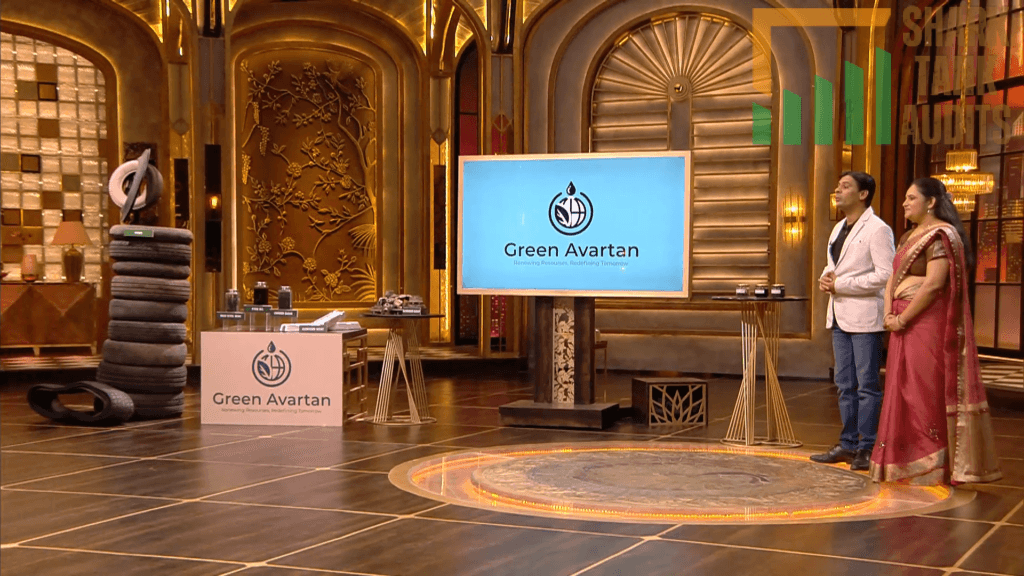
Green Avartan appeared on Shark Tank India Season 5, Episode 51, with Indore-based co-founder duo Pankaj Pandey (CEO, highly qualified professional with IIT Bombay Executive General Management degree previously holding significant roles at EKI Energy Services/FRECON Electric notably walking away from lucrative ₹1 Crore annual salary focusing environmental sustainability) and Kiran Pandey seeking ₹1 Crore for 5% equity (₹20 Crore valuation) but left with no deal after Hardik Kothiya showed genuine interest extending ₹1 Crore for 15% equity offer (later revised to 12%) though Pankaj remained firm on valuation countering with maximum 6% equity ultimately choosing walking away citing Sharks’ expectations/valuations too low compared to company potential with pitch taking unconventional turn when Pankaj confident in business model suggested Shark Hardik (Rayzon Solar Founder) should consider buying entire company keeping him as CEO.
The solid waste recycling company dedicated to creating “green legacy” transitioning Indian circular economy from unorganized to organized sector specializes in scrap material (waste tires/aluminum) collection/sorting/processing converting typically considered “trash” into high-value industrial resources with core lying in industrial recycling capabilities focusing materials (tire rubber/aluminum scrap) producing raw materials reintegrable into manufacturing supply chains designed profitable while solving massive Indian waste management logistical challenge featuring ₹77 lakh (FY 2024-25) to ₹5.6 Crore Year-to-Date impressive growth proven revenue, 14-15% healthy EBITDA maintaining proving “green” business can be profitable efficiency, and industrial waste (tires) short lifespan leveraging ensuring consistent recurring raw material supply business model scalability with 0 organic visitors requiring SEO improvement. Sharks reacted mixed—Anupam/Kunal both opting out due to low gross margins/unorganized sector competing complexity, Namita praising mission though feeling sector not “investor-friendly” because difficult margin profile, Aman impressed by founder confidence/sales famously telling Pankaj “Aap alag ho” (You are different) though staying out viewing as “cash and connection” heavy industry, and Hardik as solar/green energy space veteran seeing value though requiring higher equity stake offsetting risks.
Operating in Indian waste management/recycling sector, Green Avartan targets manufacturers through Extended Producer Responsibility (EPR) philosophy centering where Pankaj believes supply chain integrating Green Avartan can become vital partner for legally/ethically product recycling-obligated manufacturers with approach not just selling product but providing sustainable society/”Planet Earth” service projecting massive ₹13.5 Crore (2025-26) revenue leap reaching ₹50 Crore following year with ultimate 5-year goal scaling company into ₹1,000 Crore revenue giant fully integrating recycling sector through technology/organized logistics aiming to transition from unorganized to organized circular economy sector leadership.
Pitch 3
Dharti Amrit Shark Tank India Episode Review
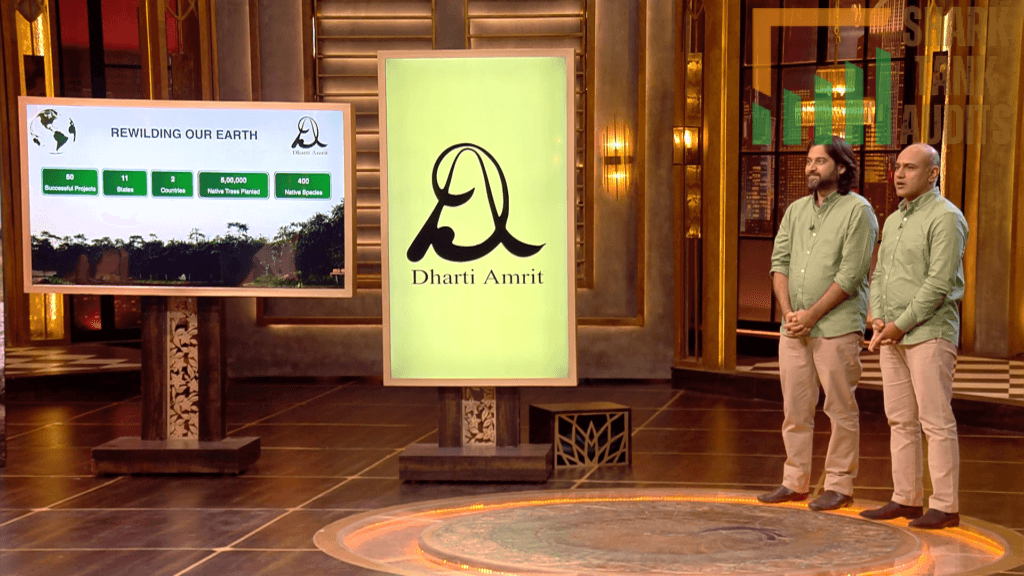
Dharti Amrit appeared on Shark Tank India Season 5, Episode 51, with Jaipur-based co-founders Manvendra Singh Inaniya (engineering dropout with organic farming/mountainous region forest restoration background receiving global fellowship) and Onkar Singh Shekhawat (retired Marine Commando joining Indian Navy 2001, retiring 2016 deciding dedicating life to environmental defense, duo meeting 2018 during forest creation workshop where Manvendra was trainer and Onkar was host) seeking ₹1.5 Crore for 5% equity (₹30 Crore valuation) but left with no deal while Sharks expressed deep founder mission/Onkar military service respect though ultimately deciding not investing citing primary reasons as service-oriented business nature, current Indian market limited scalability, and high current profits-relative valuation in “Pitches For The Planet” titled episode.
The specialized afforestation solutions company unlike traditional nurseries/gardening services focuses on building high-biodiversity ecosystems mimicking natural forests emphasizing while humans often plant mono-cultures (single species) nature thrives on variety scientifically analyzing eco-regions aiming making forest creation professional/scalable/profitable global sector bridging human life/natural biodiversity gap offering “scientific forest creation” core service providing turnkey solution (Eco-Region Analysis identifying local geography-specific native species Western Ghats vs Rajasthan, Mixed Plantation Model designing forests using four layers shrubs/sub-trees/trees/canopy species, Rapid Growth using scientific intervention developing 10-year forest naturally taking 100 years forming, and Maintenance comprehensive 2-year plan ensuring sapling survival forming self-sustaining ecosystem) featuring 170+ acre successfully created forest scalability, 400+ different species planted across various projects biodiversity, cited 6-acre industrial project where 21,400 saplings of 102 species planted transforming land into biodiversity hub proven results, and Jaipur project (2 acres) successfully attracting 30-35 bird species/even local leopards demonstrating real ecological restoration wildlife integration with 0 organic visitors requiring SEO improvement based on industries/corporates/governments-serving green business model vision valuation. Sharks had business model mixed views though cause unanimous praise, Namita highlighting Japanese Shinrin-yoku (forest bathing) concept though feeling Indian market too small/HNI-dependent, Anupam viewing as “services business” suggesting wealthy individual targeting for “private forests” versus seeking venture capital, Kunal expressing competitive landscape concern noting many service providers already handling factory statutory green requirements, Aman questioning ₹30 Crore valuation against small ₹3 lakh profit stating business lacked visible scalability, and Hardik declining investment though offering outside-tank connecting exploring project-basis working together.
Operating in afforestation/environmental restoration sector, Dharti Amrit targets industries/governments/High-Net-Worth Individuals through coexistence philosophy centering engaging customers—primarily industries/governments/HNIs—by shifting “planting trees” to “building planet assets” perspective educating clients on biodiversity importance proving professionally managed forest requires less long-term maintenance than traditional garden providing genuine ecological benefits (local wildlife/bird return) aiming to become global professional afforestation sector leader with goal proving environmental restoration can be profitable/sustainable business expanding “private forest” concept for farmhouses/large estates while continuing helping industries meeting green mandates through scientifically backed high-impact restoration versus simple low-impact plantations.
Episode Summary: Ecopreneur Special Highlights
The table below summarizes the outcomes for the featured sustainable ventures. While the mission-driven nature of these startups earned high praise, the “Sharks” remained focused on the difficult unit economics and scalability inherent in the green sector.
| Startup | Sector | Founders | Ask | Result |
| Circato | Sustainable Construction | T Paul Koshy, Sushma Joseph & Praveen Crasta | ₹90 Lakh for 3% Equity | Deal with Anupam Mittal (₹90 Lakh for 10% Equity*) |
| Green Avartan | Waste Recycling | Pankaj & Kiran Pandey | ₹1 Cr for 5% Equity | No Deal (Founder walked away) |
| Dharti Amrit | Afforestation | Manvendra Singh & Onkar Singh | ₹1.5 Cr for 5% Equity | No Deal |
Key Insight: The “Pragmatic Ecopreneur” Standard
The shared insight across Circato, Green Avartan, and Dharti Amrit is the shift from “Doing Good” to “Doing Green at a Discount.”
- The Price-Efficiency Moat: The reason Circato secured a deal while the others didn’t was its ability to prove that being “green” was actually cheaper and faster than the traditional alternative (₹650 vs ₹1,200/sq ft). In a developing economy like India, sustainability cannot carry a “luxury tax”; it must offer immediate operational or financial incentives to be venture-scalable.
- Founder Over-Confidence vs. Shark Conservatism: Both Green Avartan and Dharti Amrit featured highly qualified, mission-driven founders (IIT alumni and ex-Marine Commandos). However, their pitches highlighted a disconnect: the founders viewed their environmental mission as an inherent multiplier of their company’s value, while the Sharks viewed them through the cold lens of gross margins and service-sector limitations.
- The Service vs. Product Trap: The Sharks consistently pushed back against “service-heavy” green models (like scientific afforestation or unorganized scrap collection). They prioritized productized sustainability—solutions that can be manufactured, modularized, and sold without a massive, labor-intensive workforce.


Leave feedback about this
You must be logged in to post a comment.