
Shark Tank India Season 5 Episode 10 Review
Episode 10 of Shark Tank India Season 5 delivered the season’s most dramatic financial episode, featuring the largest equity ask in show history and showcasing businesses operating at vastly different scales—from capital-intensive EV leasing infrastructure to innovative protein snacks and Instagram-native fashion commerce. The episode demonstrated the full spectrum of modern Indian entrepreneurship: traditional asset-heavy businesses being reimagined with technology, consumer products solving genuine pain points through innovation, and creator economy businesses challenging conventional retail models. With valuations ranging from ₹22 crore to ₹200 crore and a historic ₹6 crore debt component, Episode 10 pushed the boundaries of deal structuring on Shark Tank India. The episode also highlighted evolving tensions around business models—from harsh IoT-enabled payment enforcement to algorithm-dependent creator businesses—forcing Sharks to evaluate not just financial metrics but the ethical and structural sustainability of new-age ventures.
Episode Summary
Total Pitches: 3
Successful Deals: 2
Total Investment Made: ₹2 Crore equity + ₹5 Crore debt (₹7 Crore total capital deployed)
Featured Sharks: Kunal Bahl, Vineeta Singh, Namita Thapar, Varun Alagh, Viraj Bahl
Pitch 1
RIDEV Shark Tank India Episode Review
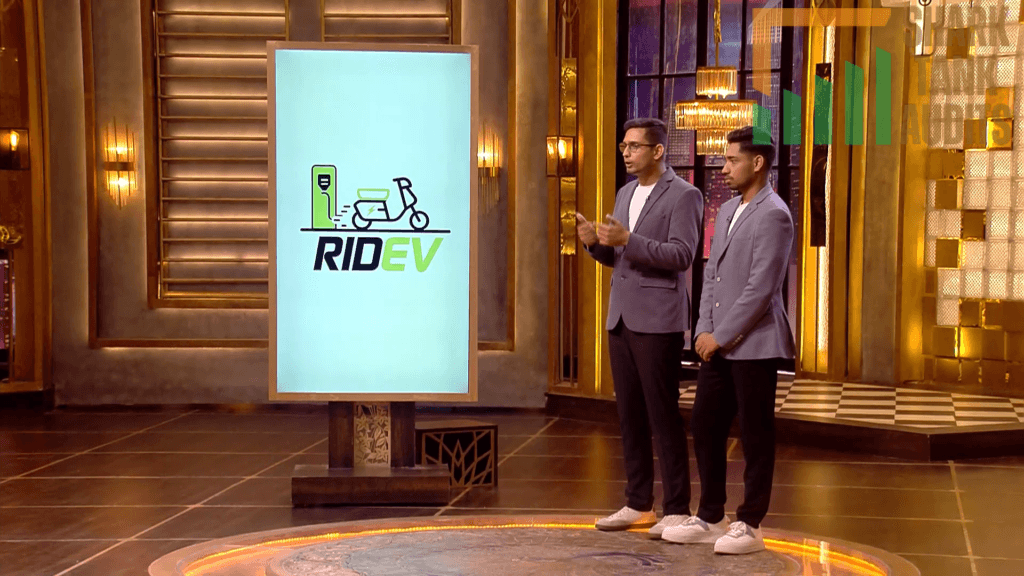
RIDEV EV appeared on Shark Tank India Season 5, Episode 10, with founders Manish Kumar Jain (CA, business growth expert) and Siddharth Jain seeking ₹6 Crore for 3% equity (₹200 Crore valuation, called “biggest ask in Shark Tank India history” by Vineeta) and successfully closed a deal for ₹1 Crore for 3% equity + ₹5 Crore debt at 14.5% interest with Shark Kunal Bahl. The Hyderabad-based startup provides full-stack EV leasing infrastructure targeting gig economy delivery partners (Swiggy, Zomato, Zepto) with commercial-grade electric scooters (₹1.2-1.3 lakh value) requiring only ₹3,000 deposit versus ₹20,000-30,000 traditional financing.
Growing from 10 to 1,400+ vehicles in 15 months with 80+ fast-charging stations, they generated ₹82 lakh net sales and ₹50 lakh EBITDA in September 2025 alone, with ₹9,900 monthly revenue per vehicle. Their strict ₹200 weekly rent model uses IoT remote locking for non-payment, achieving 99% collection rate and 99% vehicle return quality with 60% renewal rate. While Vineeta questioned harsh remote disabling and Namita worried about capital-intensive depreciating assets, Kunal saw high-yield asset management. Operating in India’s 13 million gig workers market with ₹45,000 Crore TAM by 2030, RIDEV offers 6x fuel savings (₹0.50/km vs ₹2.5-3.0/km petrol) targeting 4.5 million active delivery riders.
Pitch 2
Stroom Shark Tank India Episode Review

Stroom appeared on Shark Tank India Season 5, Episode 10, with founders Rohan Shah, Darshan Gattani, and Shiven Chaturvedi (friends from Australia who launched in 2023 after 2021 research) seeking ₹1 Crore for 2% equity (₹50 Crore valuation) and successfully closed a deal for ₹1 Crore for 2.5% equity + 2% advisory equity (₹40 Crore valuation) with Sharks Vineeta Singh and Kunal Bahl.
The Bangalore-based startup created Asia’s first center-filled energy bars, disrupting India’s protein snack market by solving the “dry, chalky” texture problem with liquid-filled cores combining milk protein, plant-based ingredients, and natural flavors. Offering protein bars, wafers, assorted gift boxes, and planning Protein Soda and Protein Pops, they position protein as a tasty everyday snack versus bodybuilder supplement. Despite poor SEO (185 monthly visitors), they capitalized on the “healthy indulgence” trend in India’s healthy snack market projected at $10.5 billion (8.21% CAGR) with protein bar segment at $124 million growing 13.74% annually. Targeting millennials and Gen Z (18-35) in Tier-1 cities with 40-60% sales through quick-commerce platforms, Stroom addresses 70% protein deficiency in India’s population where 84% actively seek healthier food choices in 2026.
Pitch 3
TBFO Shark Tank India Episode Review
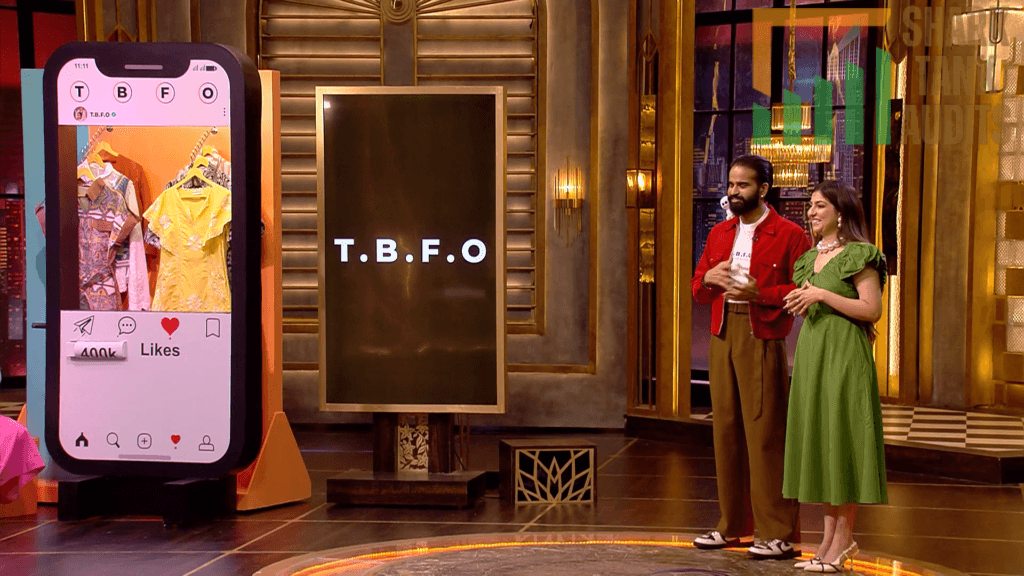
TBFO (The Branded Factory Outlet) appeared on Shark Tank India Season 5, Episode 10, with founders Yashika Gyanchandani (content creator/model) and Avnish Sharma (husband, Creative Director from construction background) seeking ₹1 Crore for 4.5% equity (₹22.2 Crore valuation) but left with no deal despite impressive metrics. The Bhopal-based luxury-accessible women’s fashion brand grew from a single-room try-on video operation to 360,000+ social media followers with zero performance marketing spend, doubling revenue year-on-year and achieving exceptional 4% return rate (vs. 25-30% industry average).
Pioneering Instagram Live commerce in India, they target women aged 25-35 (60% of customers) seeking modest yet stylish western wear with Korean-inspired outfits and elegant dresses. While Kunal praised low returns and live commerce adoption, Vineeta feared Instagram algorithm dependency, Namita highlighted “Key Woman Risk” with over-reliance on Yashika’s personal brand, Varun questioned scalability without paid marketing, and Viraj advised staying independent, even offering Yashika a brand endorsement for his own brand Viva. Operating in India’s $60 billion apparel market with D2C brands growing at 40% CAGR and live commerce projected at $5 billion by 2025, TBFO focuses on $10-12 billion women’s western wear segment with 298 monthly organic visitors requiring SEO improvement.
Episode Highlights:
- Historic ask: ₹200 crore valuation—largest in Shark Tank India history
- Innovative deal structure: First significant debt component (₹5 Cr at 14.5%) alongside equity
- Total capital deployment: ₹7 crore—highest single-episode investment this season
- Creator economy dilemma: First time Shark offered endorsement instead of investment
- IoT enforcement debate: Ethical questions around remotely disabling delivery workers’ vehicles
- Algorithm dependency risk: Platform-dependent businesses facing structural concerns
- Key Person Risk: Over-reliance on founder’s personal brand preventing investment
- Asia’s first innovation: Center-filled protein bars solving texture problem
Key Lessons:
- Debt financing can bridge valuation gaps while preserving founder equity ownership
- Asset-light businesses (creator economy) face different risks than asset-heavy (EV leasing)
- Platform dependency (Instagram algorithm) is major red flag even with impressive metrics
- Personal brand businesses struggle to separate founder from enterprise value
- Collection rates (99%) and operational excellence can justify capital-intensive models
- Product innovation (center-filled bars) solving genuine pain points (chalky texture) attracts investment
- Zero marketing spend growth impressive but raises scalability questions
- Exceptional metrics (4% returns vs 25-30% industry) don’t guarantee investment if structure flawed
Deal Structure Innovation:
RIDEV’s ₹1 Cr equity + ₹5 Cr debt structure represents sophisticated financing:
- Founder benefit: Maintained higher valuation perception (₹33.3 Cr vs ₹20 Cr if all equity)
- Investor benefit: 14.5% interest on debt provides downside protection
- Strategic alignment: Debt appropriate for asset-heavy business with predictable cash flows
- Precedent setting: Opens door for more creative deal structures on show
Valuation Analysis: Episode 10 featured wide valuation spectrum:
- RIDEV: ₹200 Cr ask → ₹33.3 Cr effective (debt structure creative solution)
- Stroom: ₹50 Cr → ₹40 Cr (minor adjustment with advisory equity addition)
- TBFO: ₹22.2 Cr (no deal despite reasonable valuation—structural issues paramount)
TBFO’s rejection despite lowest valuation demonstrates that structural soundness matters more than absolute numbers.
Strategic Patterns:
- Asset type matters: Heavy assets (EVs) get debt, light assets (protein bars) get equity
- Platform risk increasing: Algorithm dependency now major concern (Instagram, SEO issues)
- Personal brand paradox: Strength (360K followers) becomes weakness (key person risk)
- Innovation premium: Solving genuine problems (chalky bars, gig worker access) commands investment
- Collection infrastructure: IoT remote locking enabling 99% collection despite ethical questions
Market Context:
- Gig Economy: 13M workers, ₹45,000 Cr TAM by 2030, 4.5M active delivery riders
- EV Economics: 6x fuel savings (₹0.50/km vs ₹2.5-3.0/km petrol)
- Healthy Snacks: $10.5B market at 8.21% CAGR; protein bars $124M at 13.74% growth
- Protein Deficiency: 70% of Indians deficient, yet 84% seeking healthier choices
- Apparel D2C: $60B market, D2C growing 40% CAGR, live commerce $5B by 2025
- Women’s Western Wear: $10-12B segment with Korean fashion influence trending
Ethical Debates:
Episode 10 forced uncomfortable conversations:
- Remote Vehicle Disabling: Is IoT-enabled enforcement empowering (ensures affordability) or exploitative (strands workers)?
- Algorithm Dependency: Should businesses built on platform features (Instagram Live) be investable when platforms control fate?
- Personal Brand Extraction: Can you invest in a business that is inseparable from founder’s face/personality?
- Debt vs Equity: Is 14.5% interest rate fair for infrastructure financing or extractive?
Episode Narrative Arc:
Episode 10’s structure created fascinating contrast between scale and intimacy. RIDEV’s infrastructure play operates at systematic level—1,400 vehicles, IoT systems, 80 charging stations—removing individual human element through technology. Stroom’s consumer innovation sits in middle—personal enough (taste, texture) but scalable through manufacturing. TBFO brings it back to pure personal connection—Yashika’s face, personality, and presence driving every sale. The episode’s journey from depersonalized infrastructure to hyper-personalized creator business revealed different risk profiles: technology risk (RIDEV), execution risk (Stroom), and key person risk (TBFO).
Comparative Episode Analysis:
Episode 10’s 67% deal rate and ₹7 crore total deployment ranks among season’s most successful:
- Matches Episode 3’s ₹6 crore (but Episode 10 includes debt, making total higher)
- Second-highest capital deployment after Episode 3
- Creative deal structures (debt, advisory equity) showing Shark sophistication
Shark Behavior Patterns:
- Kunal Bahl: Emerges as infrastructure/tech investor (SaveSage, RIDEV, Stroom)
- Vineeta Singh: Consistently identifies platform/algorithm risks (TBFO Instagram dependency)
- Namita Thapar: Focuses on key person risk and business sustainability
- Viraj Bahl: Willing to offer alternative value (endorsement) when investment doesn’t fit
- Varun Alagh: Questions scalability mechanics of organic-only growth
Future Implications:
- Debt Components: RIDEV precedent may enable more asset-heavy businesses to pitch with debt expectations
- Creator Economy Caution: Platform-dependent businesses will face increased scrutiny post-TBFO
- Advisory Equity Norm: Stroom’s structure may become standard for hands-on Shark involvement
- Valuation Anchoring: ₹200 Cr ask, while rejected, shifts perception of what’s possible
Episode Significance:
Episode 10 will be remembered for pushing Shark Tank India into new financing territory. The debt component introduction, combined with advisory equity structures and the unprecedented brand endorsement offer, showed the show’s evolution from simple equity deals to sophisticated financial instruments matching business model requirements. The episode also crystallized emerging investment thesis around platform risk—businesses built on algorithms they don’t control (Instagram, Google SEO) face structural skepticism regardless of current performance.
TBFO’s Unique Outcome:
Yashika’s journey—receiving five “no” votes but a brand endorsement offer from Viraj—represents a new category of Shark Tank outcome: validation without investment. Viraj’s acknowledgment of her influence while declining investment due to structural concerns suggests a middle ground where founders gain industry recognition and business opportunities even without securing deals. This “soft success” outcome may become more common as Sharks recognize value in founder capabilities separate from their current business structures.
Leave feedback about this
You must be logged in to post a comment.