
Shark Tank India Season 5 Episode 11 Review
Episode 11 of Shark Tank India Season 5 delivered one of the most emotionally charged and thematically diverse episodes of the season, featuring the youngest founder yet alongside passionate dreamers and bootstrapped performance marketing masters. From a 13-year-old building AI diagnostic tools to a wrestling superfan creating immersive fan experiences, and Ayurvedic entrepreneurs generating ₹51.5 crore revenue from credit cards, this episode showcased the extreme spectrum of Indian entrepreneurship—raw talent meeting opportunity, passion seeking viability, and execution facing scrutiny despite impressive numbers.
The episode forced difficult conversations about what constitutes an investable business: Is technical brilliance at 13 years old enough? Can pure passion without proven business traction justify investment? Do impressive revenues built on performance marketing alone create sustainable brands? Episode 11 proved that age, passion, and even massive revenue don’t guarantee Shark investment—each requires the right combination of market fit, business fundamentals, and scalability beyond founder capabilities or marketing spend.
Episode Summary
Total Pitches: 3
Successful Deals: 1
Total Investment Made: ₹60 Lakh
Featured Sharks: Aman Gupta, Kunal Bahl, Vineeta Singh, Namita Thapar, Ritesh Agarwal
Pitch 1
Neurapex AI Shark Tank India Episode Review

Neurapex AI appeared on Shark Tank India Season 5, Episode 11, with 13-year-old founder Jayvardhan Tyagi (DPS Ghaziabad student, self-taught in programming, chess, rocket science) seeking ₹60 lakh for 5% equity (₹12 Crore valuation) and successfully closed a deal for ₹60 lakh for 5% equity with Shark Aman Gupta. The assistive MedTech platform offers multimodal AI diagnostic tools analyzing MRI scans, lab reports, and skin images to generate actionable medical reports in minutes via smartphone at zero cost.
With two key modules—Alzmind (neurology: brain health, dementia, stroke) and Deepdown (dermatology: skin disorders, cancers)—the platform segments brain tissues and processes 3D MRI files with 95%+ accuracy, providing specialist-grade preliminary diagnosis to address India’s massive gap of only ~15,000 radiologists for 1.4 billion people with 10-17% misdiagnosis rates. Sharks were stunned by the founder’s age and technical maturity, with Aman comparing him to typical 13-year-olds playing video games, while Kunal praised his journey from building social media platforms to rocket experiments at age 10. Operating in India’s AI medical diagnostics market projected at $2.45 billion by 2031 (29.5% CAGR) within $197 billion healthcare market by 2030, Neurapex targets 900 million smartphone users and leverages Ayushman Bharat Digital Mission for AI health-tech integration.
Pitch 2
WrestleFanent Shark Tank India Episode Review
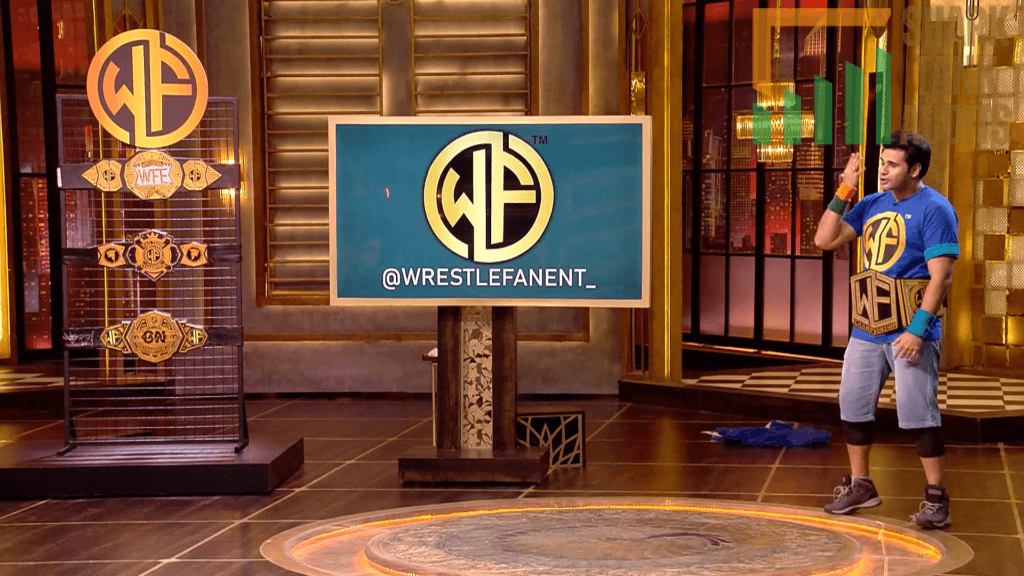
WrestleFanent appeared on Shark Tank India Season 5, Episode 11, with 32-year-old founder Nikunj Walia from Delhi (architecture, modeling, acting background, lifelong wrestling fan) seeking ₹75 lakh for 10% equity (₹7.5 Crore valuation) but left with no deal despite passionate pitch. The Delhi-based fan engagement platform offers immersive wrestling experiences (Wrestleverse fan festivals, gaming leagues, celebrity meet-and-greets) targeting India’s 335 million WWE viewers—the world’s second-largest wrestling audience with 20% of sports viewership.
Nikunj, rejected for four consecutive seasons before this appearance, positions himself as India’s Vince McMahon focusing on business/ownership versus in-ring performance, using John Cena catchphrases to emphasize readiness. While Sharks appreciated his “child-like innocence” and passion, Aman noted passion must convert to investable business, Vineeta highlighted “gap between imagination and reality” with insufficient ticket sales, and Ritesh advised dropping B2B content “crutch” to focus on live events proving product-market fit. Operating in India’s $130 billion sports economy by 2030 with 60-80 million hardcore wrestling fans and 30-40% event repeat rate, WrestleFanent targets Gen Z/millennials (15-32) in metros seeking “participation over observation” through safe, non-physical superstar experiences including entrance music and signature poses.
Pitch 3
Ayuvya & Imfresh Shark Tank India Episode Review
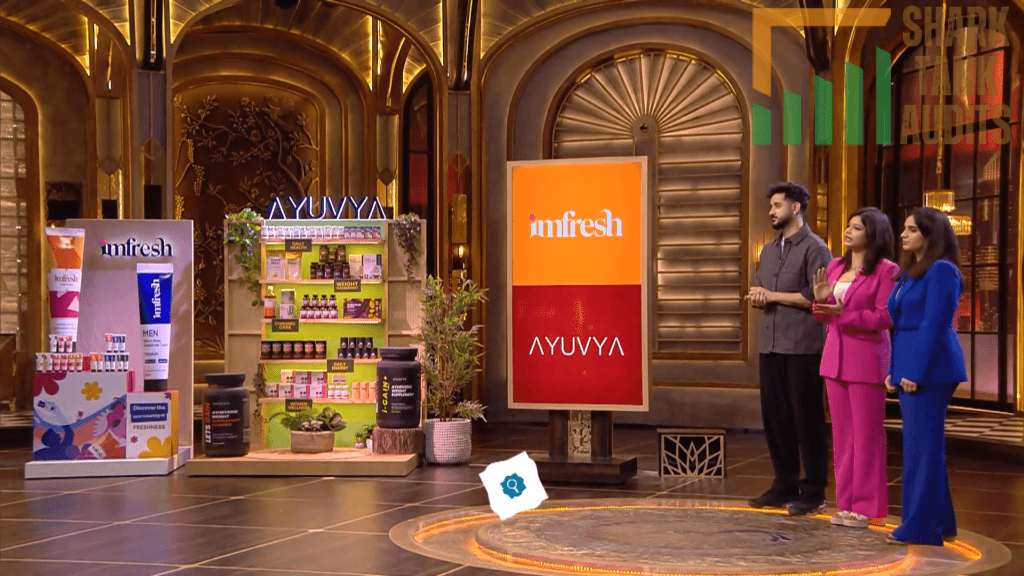
Ayuvya & Imfresh appeared on Shark Tank India Season 5, Episode 11, with founders Astha Jain (PEC engineer from Bhind, MP), Pawanjot Kaur (PEC graduate from Jalandhar, Punjab, inspired after Ayurveda cured her eczema), and Tanishk Pandey (UP, creative copywriter, married to Astha) seeking ₹1 Crore for 0.5% equity (₹200 Crore valuation) but left with no deal despite impressive ₹51.5 Crore revenue bootstrapped from credit cards in 3 years.
Operating dual brands—Ayuvya (modernized Ayurveda health supplements specializing in weight gain with iGain Plus/Legs Gain using Ashwagandha, Safed Musli, generating 75% revenue) and Imfresh (India’s first full-body deodorant cream)—they achieved 75-77% gross margins with AYUSH certification and 80% sales from Tier 3/4 towns via 40 UGC video ads daily on Meta. While Sharks praised financial discipline and ₹70 Crore revenue projection, Aman/Vineeta deemed it “performance marketing/trading play” versus sustainable brand, Kunal/Ritesh raised concerns over lack of third-party clinical trials for formulations (only individual ingredients tested), Vineeta questioned unclear annual repeat rates suggesting over-reliance on new customers versus retention, and Namita exited due to Ayurvedic space conflict. Operating in India’s Ayurveda market growing 21.5% CAGR to $35 billion by 2030 and $31.2 billion beauty/personal care market, targeting rural men (18-35, 80% male) seeking weight gain for confidence/military fitness with 3.38x ROAS on Meta.
Episode Highlights:
- Youngest founder yet: 13-year-old building AI medical diagnostics with 95%+ accuracy
- Most persistent founder: Nikunj’s four-season rejection streak before finally pitching
- Highest bootstrapped revenue: ₹51.5 Cr from credit cards in 3 years (rejected anyway)
- Performance marketing debate: When does revenue-at-scale become “just marketing” not a brand?
- Clinical trial concerns: First time Sharks demanded third-party formulation testing
- Age paradox: 13-year-old getting funded while 32-year-old passion rejected
- Brand vs. trading: Sharks distinguishing sustainable brands from marketing-dependent revenue
Key Lessons:
- Technical brilliance at any age can secure investment if solving real problems with proven tech
- Passion and persistence alone insufficient—market validation through sales essential
- ₹50+ crore revenue doesn’t guarantee investment if built purely on performance marketing
- Clinical validation critical for health products—ingredient testing ≠ formulation testing
- Low repeat rates (even unstated) raise major red flags about product-market fit
- Youth can be advantage (mentorship opportunity) not disadvantage with right technical foundation
- Four seasons of rejection signals need to pivot approach, not just persist
- Performance marketing ROI (3.38x ROAS) impressive but doesn’t prove brand equity
Deal Structure Analysis:
Neurapex AI’s clean ₹60 lakh for 5% at asking valuation reflects:
- Youth premium: Aman willing to mentor 13-year-old through business development
- Impact potential: AI democratizing medical diagnostics addressing critical shortage
- Technical validation: 95%+ accuracy demonstrating genuine capability
- Risk acceptance: Understanding early stage requires patience and guidance
Valuation Analysis:
Episode 11 featured extreme valuation spectrum:
- Neurapex AI: ₹12 Cr (deal at asking) – Youth + impact + tech = maintained valuation
- WrestleFanent: ₹7.5 Cr (no deal) – Reasonable valuation but no traction = irrelevant
- Ayuvya & Imfresh: ₹200 Cr (no deal) – Aggressive but justified by ₹51.5 Cr revenue, rejected for quality-of-revenue concerns
Ayuvya’s rejection despite highest revenue-to-valuation ratio proves revenue quality matters more than quantity.
Strategic Patterns:
- Age irrelevant if competent: 13-year-old with proven tech beats 32-year-old with passion
- Revenue quality > quantity: ₹51.5 Cr performance-marketing revenue < ₹0 organic brand equity
- Persistence needs pivot: Four-season rejection = wrong approach, not insufficient effort
- Clinical rigor required: Health claims need formulation testing, not just ingredient validation
- Repeat rates critical: Customer retention metrics matter more than acquisition at scale
Market Context:
- AI Medical Diagnostics: $2.45B by 2031 (29.5% CAGR) in $197B healthcare market
- Radiologist Shortage: ~15,000 for 1.4B people = 10-17% misdiagnosis rates
- Wrestling Viewership: 335M WWE viewers (world’s #2 audience, 20% sports viewership)
- Sports Economy: $130B by 2030 with 60-80M hardcore wrestling fans
- Ayurveda Market: $35B by 2030 (21.5% CAGR) + $31.2B beauty/personal care
- Smartphone Penetration: 900M users enabling health-tech democratization
Ethical & Business Debates:
Episode 11 raised critical questions:
- Performance Marketing vs. Brand: When does marketing-driven revenue become unsustainable trading?
- Clinical Validation: Should ayurvedic products require same testing rigor as pharmaceutical drugs?
- Youth Entrepreneurship: Is 13 too young for business ownership despite technical capability?
- Passion vs. Profit: Should authentic love for industry (wrestling) influence investment decisions?
- Repeat Rate Disclosure: Are founders obligated to volunteer concerning retention metrics?
Episode Philosophical Themes:
The Age Paradox: 13-year-old Jayvardhan securing investment while 32-year-old Nikunj getting rejected inverted conventional wisdom. The episode demonstrated that business maturity matters more than biological age—technical competence and proven capability trump years of life experience. Jayvardhan’s AI platform with 95%+ accuracy represented more investable opportunity than Nikunj’s four seasons of trying without traction.
The Revenue Paradox: Ayuvya & Imfresh’s ₹51.5 crore rejection despite being the highest bootstrapped revenue pitch this season revealed a fundamental tension: revenue alone doesn’t constitute a business if it’s purely marketing-dependent. The Sharks distinguished between “building a brand” and “buying customers,” suggesting that sustainable businesses require organic demand, customer retention, and brand equity beyond paid advertising efficiency.
The Persistence Paradox: Nikunj’s four-season journey highlighted the difference between productive persistence (iterating approach based on feedback) and stubborn persistence (repeating same pitch hoping for different outcome). His eventual pitch opportunity came with the same fundamental problem—imagination exceeding execution—suggesting persistence without adaptation leads nowhere.
Episode Narrative Arc:
Episode 11’s structure created a thematic journey through different validation types. Neurapex demonstrated technical validation (95%+ accuracy), representing how objective proof can overcome skepticism about youth. WrestleFanent showed validation absence despite passion intensity, illustrating how subjective belief cannot substitute market evidence. Ayuvya & Imfresh presented financial validation (₹51.5 Cr revenue) that proved insufficient without quality validation (clinical trials, repeat rates), revealing that not all revenues are created equal.
Comparative Episode Analysis:
Episode 11’s 33% deal rate matches Episodes 4 and 9 for season’s lowest, but rejection types differ:
- Episode 4: Delusion (Planyt), unit economics (Avishkaar)
- Episode 9: Too futuristic (Meta Fashion), ethical objection (some on Japam)
- Episode 11: Market validation gap (WrestleFanent), revenue quality concerns (Ayuvya)
Episode 11’s rejections stemmed from execution/validation gaps rather than category misalignment or ethical concerns.
Shark Behavior Patterns:
- Aman Gupta: Willing to mentor young technical talent (Neurapex); demands passion convert to business (WrestleFanent)
- Vineeta Singh: Focuses on marketing sustainability; distinguishes brand equity from ad efficiency
- Kunal Bahl: Raises clinical rigor standards for health claims
- Ritesh Agarwal: Advises focus and product-market fit proof over diversification
- Namita Thapar: Maintains category conflict discipline (Ayurvedic space)
Future Implications:
- Youth Entrepreneurship Legitimized: Jayvardhan’s success may encourage more teen founders
- Clinical Standards Rising: Health products may face increased scrutiny post-Ayuvya rejection
- Performance Marketing Skepticism: D2C brands relying primarily on paid ads will face harder questions
- Repeat Rate Disclosure: Founders may proactively share retention metrics to prevent red flags
- Traction Over Passion: Future founders may prioritize proven sales over storytelling
Episode Significance:
Episode 11 will be remembered for its stark contrasts—the season’s youngest successful founder versus highest-revenue rejection, passion meeting skepticism, and technical capability trumping business experience. The episode crystallized emerging Shark Tank India investment thesis: technical validation, market traction, and business quality matter infinitely more than founder age, persistence duration, or absolute revenue numbers. Jayvardhan’s success signals that Indian investors are willing to bet on youth when backed by competence, while Ayuvya’s rejection despite ₹51.5 crore revenue signals that the era of celebrating growth-at-any-cost may be ending in favor of sustainable, quality-driven business building.
Most Memorable Moments:
- 13-year-old’s technical maturity: Sharks visibly stunned by Jayvardhan’s capability
- Four-season rejection reveal: Nikunj’s persistence both admirable and concerning
- ₹51.5 Cr bootstrap shock: Highest revenue founder getting rejected anyway
- Clinical trial challenge: Sharks demanding formulation testing not just ingredients
- “Trading play” designation: Aman/Vineeta dismissing massive revenue as mere marketing efficiency
Closing Reflection:
Episode 11 taught perhaps the season’s most important lesson: there is no single path to investment success, but there are definite paths to rejection. Youth doesn’t disqualify (Neurapex proved it), but traction absence does (WrestleFanent). Revenue doesn’t guarantee success (Ayuvya showed), but quality revenue helps. Passion doesn’t persuade (WrestleFanent again), but competence does (Neurapex). The episode demolished several entrepreneurial myths while reinforcing the fundamental truth: solve real problems with proven solutions, demonstrate market validation through genuine traction, and build businesses designed for sustainability beyond marketing spend. Everything else—age, persistence, storytelling—is secondary to these core requirements.
Leave feedback about this
You must be logged in to post a comment.