
Shark Tank India Season 5 Episode 12 Review
Episode 12 of Shark Tank India Season 5 delivered a masterclass in experiential entrepreneurship, featuring businesses that prioritize customer experience, creative innovation, and technological solutions to everyday problems. From a boutique cafe embracing Japanese Omakase philosophy to an AI-powered filmmaking studio democratizing content creation, and a privacy-first QR ecosystem solving urban inconveniences, this episode showcased how Indian entrepreneurs are moving beyond transactional businesses toward experience-driven ventures.
With two young brothers achieving remarkable unit economics in Mumbai’s competitive food scene, AI natives building cinematic tools for creators, and founders addressing parking chaos through smart technology, Episode 12 demonstrated that modern businesses increasingly compete on experience quality and technological enablement rather than just product features or pricing. The episode raised critical questions about scalability of soul-driven ventures, the viability of AI in creative industries, and whether solving everyday annoyances constitutes compelling business opportunities.
Episode Summary
Total Pitches: 3
Successful Deals: 2
Total Investment Made: ₹2.5 Crore equity + ₹50 Lakh debt (₹3 Crore total capital)
Featured Sharks: Aman Gupta, Ritesh Agarwal, Vineeta Singh, Namita Thapar, Kunal Bahl
Pitch 1
Every Morning Cartel Shark Tank India Episode Review
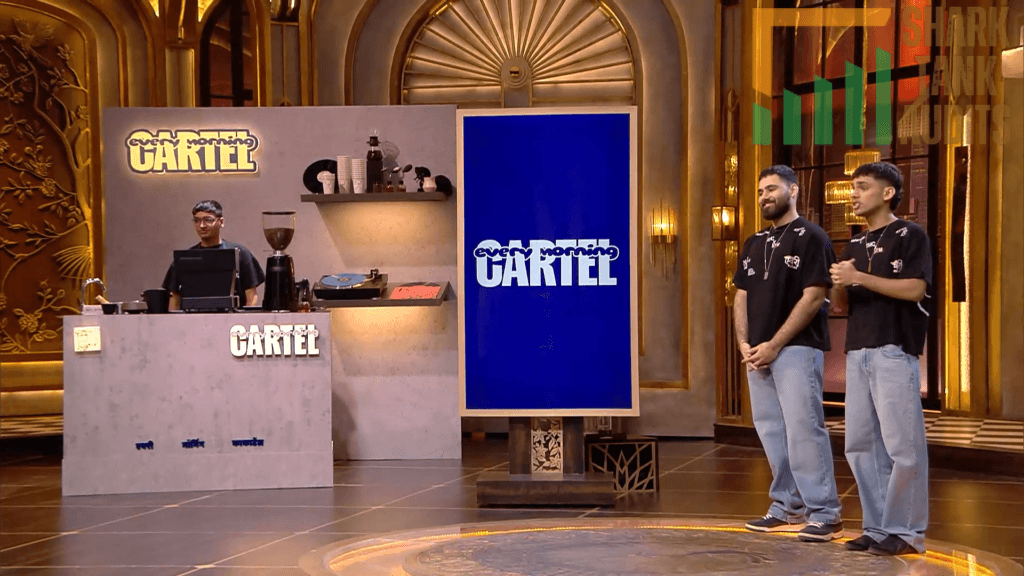
Every Morning Cartel (EMC) appeared on Shark Tank India Season 5, Episode 12, with brothers Neel Kanwarjani (23, culinary trained, inspired by father’s cafe) and Rishiraj Kanwarjani (19, design student) from Mumbai seeking ₹2 Crore for 5% equity (₹40 Crore valuation) and successfully closed a deal for ₹2 Crore for 12% equity (negotiated from 14%) with Sharks Aman Gupta and Ritesh Agarwal.
The boutique Kandivali cafe operates on Japanese Omakase concept where customers trust chef’s menu selection entirely, achieving ₹1.14 Crore revenue in 7 months (FY 2025-26) with impressive 32.2% EBITDA (projected 39.9%), 4.7 Google rating, and 17-month capital recovery—completely bootstrapped. Sharks praised “Masterchef-level” food quality and unit economics, though Vineeta/Namita questioned scalability of “soul-driven” culinary business with high real estate costs, and Kunal doubted standardization of boutique processes. Operating in India’s foodservice market growing from $114.40 billion (2025) to $230 billion by 2032 (10.53% CAGR) within $20.51 billion cafes/bars market, EMC targets Gen Z/millennials (18-40) in Tier-1 cities prioritizing experiential dining over standardized menus with $22-45 monthly leisure spend, positioned in premium boutique cafes segment growing 12.78% CAGR despite 0 organic traffic requiring SEO overhaul from Wix platform.
Pitch 2
Cinefai Studios Shark Tank India Episode Review
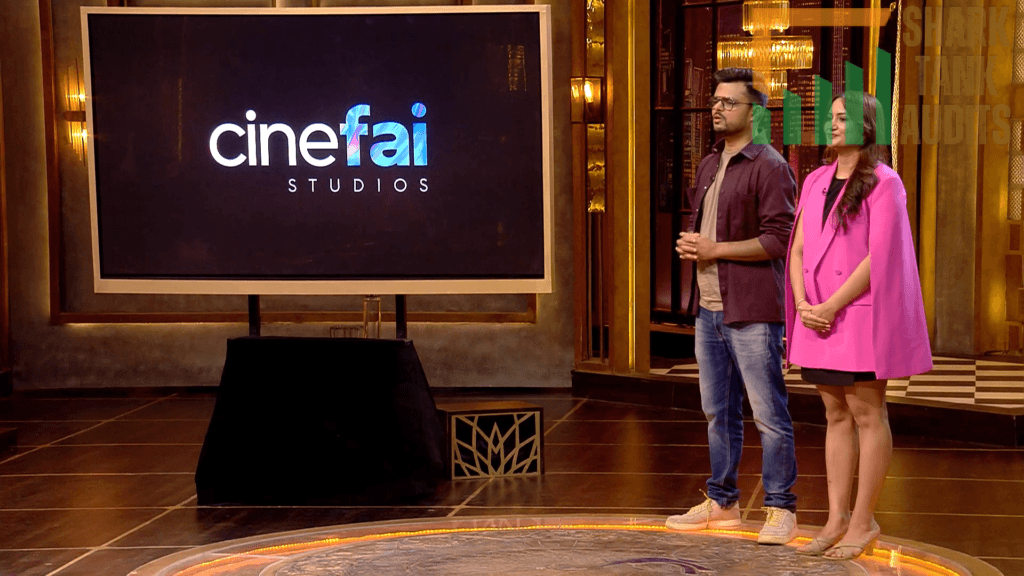
Cinefai Studios appeared on Shark Tank India Season 5, Episode 12, with co-founders Shivam Sharma and Akanksha Dubey from Mumbai (established 2023) seeking ₹1 Crore for 5% equity (₹20 Crore valuation) and successfully closed a deal for ₹50 lakh for 5% equity + ₹50 lakh debt at 9% interest for 5 years with Shark Ritesh Agarwal.
The AI-native production house offers an end-to-end filmmaking pipeline from “concept to screen” for movies, advertisements, and TV shows, empowering Gen Z creators and digital storytellers to produce cinematic-grade content without extensive technical expertise through automated script assistance, visual planning, and high-speed automation. Despite 1 monthly organic visitor requiring SEO improvement, they achieved impressive 70% EBITDA with consistent ₹10 lakh monthly revenue over 3 months and ₹50 lakh lifetime revenue.
While most Sharks exited early, Ritesh saw potential in merging AI with creator economy. Operating in India’s generative AI market growing 42% CAGR to $23 billion by 2033 and creator economy valued at $2.5 billion (2025) expected to cross $5 billion by 2027, Cinefai targets 100 million+ nano/micro-creators and 500+ digital-first D2C brands within India’s ₹4,500 Crore influencer marketing market where 65% of mobile internet traffic is video-based.
Pitch 3
Sampark Shark Tank India Episode Review

Sampark appeared on Shark Tank India Season 5, Episode 12, with co-founders Almas Rizvi and Rahul Jha seeking ₹1 Crore for 2% equity (₹50 Crore valuation) but left with no deal despite innovative concept. The tech-lifestyle brand offers Smart Safety Solutions using “Scan, Connect, and Solve” QR-based ecosystem with parking contact tags (for blocked cars) and QR video door tags (for home visitors), enabling privacy-first communication without exchanging phone numbers or requiring scanner apps.
Growing from ₹3 lakh (FY 21-22) to projected ₹2.7 Crore (FY 24-25) and ₹3.5 Crore (FY 25-26), they address urban India where 40% of roads face daily parking blockages with 4.3 million passenger vehicles sold in FY 2024-25 and smart home market projected at $6.4 billion by 2025 (55% security segment). While Sharks appreciated creativity, Namita Thapar stated she was “not convinced” of compelling consumer need, leading to no investment. Operating with 295 monthly organic visitors requiring SEO improvement, Sampark targets Gen Z/millennials (18-44) in metros valuing privacy (80% post-pandemic concern) within TAM of 300 million vehicles and households, aiming to capture 2% of urban parking/doorbell market (₹100 Crore+ potential) through D2C, quick-commerce, and B2B partnerships with car dealerships and gated communities.
Episode Highlights:
- Boutique excellence: ₹1.14 Cr revenue in 7 months with 32.2% EBITDA in restaurant business
- 17-month payback: Fastest capital recovery in food business this season
- AI filmmaking debut: First AI-native production house pitch democratizing content creation
- Hybrid financing: Equity + debt structure (₹50L + ₹50L at 9%) for creator economy bet
- Privacy-first innovation: QR ecosystem enabling anonymous communication for blocked cars
- Scalability debate: Can soul-driven culinary experiences expand without losing essence?
- Creator economy validation: Ritesh betting on AI empowering 100M+ nano/micro-creators
- Compelling need gap: Innovation solving annoyances ≠ must-have product
Key Lessons:
- Exceptional unit economics (32.2% EBITDA) can overcome scalability concerns in experiential businesses
- Bootstrapped profitability (17-month recovery) demonstrates capital efficiency Sharks value
- AI democratization of creative industries attracts investment despite minimal organic traffic
- Debt financing appropriate for businesses with proven revenue consistency (₹10L/month × 3 months)
- Privacy-focused solutions need urgent compelling need, not just convenience improvement
- Omakase/experiential dining concepts can achieve premium margins in Indian market
- 70% EBITDA in AI services business signals strong economics despite early stage
- SEO weakness consistent across episode (0, 1, and 295 monthly visitors) but doesn’t prevent deals with strong fundamentals
Deal Structure Analysis:
Every Morning Cartel:
- Asked: ₹2 Cr for 5% (₹40 Cr valuation)
- Got: ₹2 Cr for 12% (₹16.67 Cr valuation, negotiated from 14%)
- Equity increase: 2.4x (from 5% to 12%)
- Rationale: Scalability concerns + high real estate risk = valuation compression
Cinefai Studios:
- Asked: ₹1 Cr for 5% equity (₹20 Cr valuation)
- Got: ₹50L equity for 5% + ₹50L debt at 9% for 5 years (₹10 Cr equity valuation)
- Equity increase: None on percentage, but valuation halved
- Rationale: Early stage + competition risk = debt component for downside protection
Sampark:
- Asked: ₹1 Cr for 2% equity (₹50 Cr valuation)
- Got: No deal
- Rationale: Not compelling enough consumer need despite real problems addressed
Strategic Patterns:
- Experiential Premium: Soul-driven, experience-focused businesses (EMC) command investment despite scalability questions
- AI Enablement Thesis: Platforms empowering creators (Cinefai) attractive despite competition concerns
- Debt for Proven Revenue: Businesses showing consistent monthly revenue get debt options
- Urgency Requirement: Convenience solutions without urgency (Sampark) struggle regardless of TAM
- Unit Economics Trump Scale: Strong single-location performance (32.2% EBITDA) outweighs multi-location concerns
Market Context:
- Foodservice Industry: $114.40B (2025) → $230B (2032) at 10.53% CAGR
- Cafes/Bars Segment: $20.51B with premium boutique growing 12.78% CAGR
- Generative AI: 42% CAGR to $23B by 2033 in India
- Creator Economy: $2.5B (2025) → $5B+ (2027) with 100M+ nano/micro-creators
- Influencer Marketing: ₹4,500 Cr market with 65% video-based mobile internet traffic
- Smart Home Market: $6.4B by 2025 with 55% security segment
- Urban Vehicles: 300M TAM with 4.3M passenger vehicles sold FY 2024-25
- Parking Issues: 40% of roads face daily blockages in urban India
Scalability vs. Soul Debate:
EMC’s pitch crystallized a fundamental tension in modern entrepreneurship: Can soul-driven, experience-focused businesses scale without losing their essence? The Omakase concept depends on:
- Chef’s creativity and judgment (not standardizable)
- Customer trust relationship (built individually)
- Boutique atmosphere (diluted at scale)
- High real estate costs (limits profitability at expansion)
Sharks split on resolution:
- Vineeta/Namita/Kunal: Skeptical—soul businesses don’t scale, become “just another cafe” when standardized
- Aman/Ritesh: Optimistic—exceptional unit economics prove model viability; can maintain quality through careful expansion
This debate represents broader question facing experiential businesses: growth vs. authenticity.
AI in Creative Industries:
Cinefai’s pitch tested Sharks’ belief in AI democratizing creative work:
Bull Case (Ritesh):
- 100M+ creators need accessible production tools
- AI removes technical barriers to cinematic quality
- Creator economy exploding (2x growth in 2 years)
- 65% video-based internet traffic = massive demand
Bear Case (Other Sharks):
- Established AI tools (ChatGPT, Midjourney) provide competition
- Traditional production houses have relationships + expertise
- Unclear defensibility of AI capabilities
- Early stage with minimal traction (1 organic visitor)
Ritesh’s debt+equity structure hedged both perspectives—believing in vision while protecting downside.
Privacy-First Innovation Gap:
Sampark’s rejection revealed that privacy-focused solutions face chicken-egg problem:
- Real problem: 40% roads blocked daily, 80% value privacy post-pandemic
- Missing urgency: Not painful enough for active seeking behavior
- Behavior change required: Users must adopt new QR-scanning habit
- Weak network effects: Value doesn’t increase dramatically with more users
Result: Nice-to-have ≠ investable without must-have urgency.
Episode Thematic Arc:
Episode 12’s three pitches explored different dimensions of modern entrepreneurship:
- EMC: Soul + craft meeting business discipline (experience-driven)
- Cinefai: Technology democratizing creative expression (enablement-driven)
- Sampark: Smart solutions to everyday annoyances (convenience-driven)
Success pattern emerged: Passion + Exceptional Economics (EMC) and Enablement + Large TAM (Cinefai) beat Innovation + Convenience (Sampark) when urgency missing.
Comparative Episode Analysis:
Episode 12’s 67% deal rate and ₹3 Cr total capital ranks among season’s stronger episodes:
- Matches Episodes 2, 6, and 10 for success rate
- Total capital third-highest after Episodes 3 (₹6 Cr) and 10 (₹7 Cr)
- Features second debt+equity hybrid deal (after RIDEV in Episode 10)
- SEO weakness epidemic continues (0, 1, 295 monthly visitors across all pitches)
Shark Collaboration Patterns:
- Aman + Ritesh: Partnering on experiential food business (EMC)—complementary expertise in youth marketing (Aman) and hospitality/consumer (Ritesh)
- Ritesh Solo: Betting on creator economy (Cinefai)—aligning with OYO’s platform business thinking
- Others Out: Vineeta/Namita skeptical of scalability; Kunal concerned about standardization
SEO Crisis Observation:
Every Episode 12 pitch showed severe SEO weakness:
- EMC: 0 organic visitors
- Cinefai: 1 organic visitor
- Sampark: 295 organic visitors
Yet two secured deals, proving that strong business fundamentals (unit economics, revenue consistency) matter more than digital presence—though all will need SEO overhaul post-investment.
Future Implications:
- Experiential Business Model Validation: EMC’s success may encourage more soul-driven culinary ventures
- AI Creator Tools Momentum: Cinefai’s funding signals Shark appetite for democratization platforms
- Debt Financing Normalization: Second hybrid deal suggests growing acceptance of creative structures
- Privacy Solutions Need More: Sampark rejection shows privacy angle alone insufficient without urgency
- Offline-First Acceptable: Zero organic traffic (EMC) not disqualifying with strong offline proof
Episode Significance:
Episode 12 will be remembered for validating that exceptional execution in traditional categories (food) can outweigh scalability concerns, and that enabling technologies (AI for creators) can attract investment despite intense competition and minimal current traction. The episode demonstrated Sharks’ willingness to back both old-school craft (Omakase café) and cutting-edge technology (AI filmmaking)—united by exceptional unit economics (32.2% and 70% EBITDA respectively). Sampark’s rejection reinforced that solving real problems isn’t enough; the problem must be urgent enough to drive consistent purchasing behavior and behavior change.
Closing Reflection:
Episode 12 taught nuanced lessons about modern investing: Soul and scale aren’t necessarily incompatible if unit economics are exceptional. Technology democratization attracts capital even when facing tech giants if targeting underserved creators. Privacy and convenience innovations need urgency beyond mere improvement. The episode’s success stories (EMC and Cinefai) shared common thread—they weren’t trying to compete on lowest price or widest distribution but rather on quality of experience (culinary excellence) and quality of enablement (creative democratization). In contrast, Sampark offered quality of convenience—solving annoyances rather than fulfilling ambitions—proving that entrepreneurship increasingly rewards businesses that help customers achieve aspirations or create exceptional moments over those that merely remove minor friction points.

Leave feedback about this
You must be logged in to post a comment.