
Shark Tank India Season 5 Episode 16 Review
Episode 16 of Shark Tank India Season 5 delivered one of the most contentious and debate-heavy episodes of the season, featuring businesses that challenged conventional product categories, sparked fierce disagreements among Sharks, and raised critical questions about marketing transparency, pricing justification, and scalability in education technology.
From Ayurvedic-infused cakes triggering passionate defenses and harsh criticisms, to a celebrity-founded natural deodorant commanding unprecedented ₹180 crore valuation amid transparency concerns, and immersive VR education labs facing skepticism about school system adoption, this episode showcased entrepreneurship at its most polarizing.
With heated post-deal criticisms, royalty structures reaching 3x investment recovery, and technology praised yet rejected, Episode 16 proved that even impressive founders and innovative products can divide expert investors when execution details, marketing claims, or business model assumptions come under scrutiny.
Episode Summary
Total Pitches: 3
Successful Deals: 2
Total Investment Made: ₹4.6 Crore equity (with 5% royalty on one deal until 3x recovery)
Featured Sharks: Namita Thapar, Ritesh Agarwal, Aman Gupta, Anupam Mittal, Amit Jain
Pitch 1
Awsum Shark Tank India Episode Review
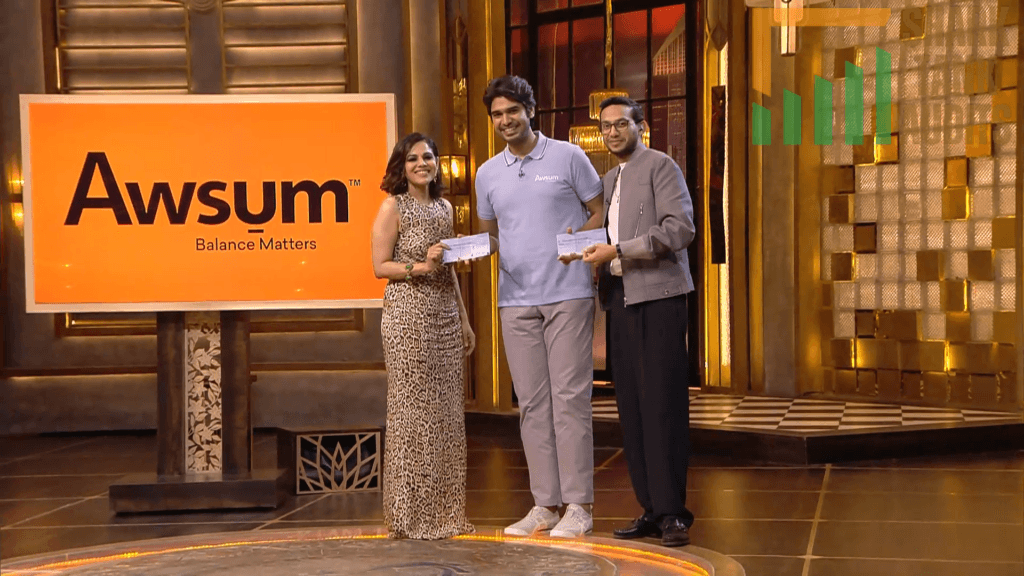
Awsum appeared on Shark Tank India Season 5, Episode 16, with founder Pranav Sharma (ex-FMCG professional who launched Paushtic trail mixes/quinoa puffs in 2016, shut down due to COVID) seeking ₹1 Crore for 1% equity (₹100 Crore valuation) and successfully closed a deal for ₹1 Crore for 1.33% equity (~₹75 Crore valuation) with Sharks Namita Thapar and Ritesh Agarwal after heated negotiations.
The Delhi-based wellness brand pioneered Ayurvedic-infused functional confectionery offering eggless cakes without maida, palm oil, or refined sugar, using real fruits, honey, jaggery, and botanicals like Brahmi, Ashwagandha, and Ginseng for stress relief, sleep, immunity, and digestion benefits. Growing from ₹4.9 Crore (FY 24-25, ₹3 lakh PAT) to projected ₹16-17 Crore (FY 25-26) with 12,000 cakes daily capacity.
416 monthly organic visitors, and prior ₹3 Crore seed funding (₹1.6 Crore August 2025), they sparked polarized Shark reactions—Namita branded herself “Brahmi Ashwagandha Queen,” Ritesh offered hotel distribution, while Aman criticized “awful crammed” packaging calling taste “bakwaas” after losing deal, and Amit cited “misleading marketing” concerns. Operating in India’s functional foods market valued at $10.27 billion (2024) projected to exceed $22 billion by 2033 within fastest-growing health food market globally (20% CAGR, triple global average) projected $30 billion by 2026, Awsum targets Gen Z/millennials (18-40, 70% prefer multiple small snacks) in Tier 1/2 cities as 83% of Indian snackers read nutrition labels seeking “clean-label” products.
Pitch 2
Phitku Shark Tank India Episode Review
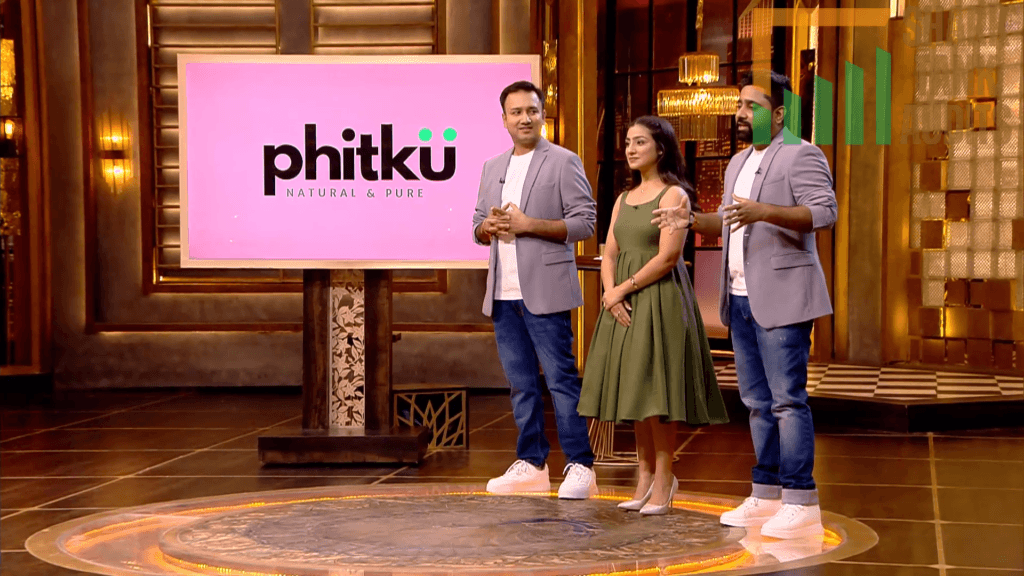
In the Shark Tank India Season 5 (Episode 16), the natural personal care brand Phitku—founded by television actress Neha Marda alongside co-founders Sumit Marda and Rahul Dokania, pitched their innovative alum-based underarm roll-on. Seeking an investment of ₹1.8 crores for 1% equity at a high valuation of ₹180 crores, the founders initially faced heavy scrutiny regarding their pricing (₹999 per unit) and transparency issues related to financial disclosures.Despite the criticism, they successfully secured a deal with Anupam Mittal and Aman Gupta, who jointly invested ₹3.6 crores (split equally) for 1% equity, along with a 5% royalty on sales until 3x of the investment (₹10.8 crores) is recouped.
Phitku is a clean beauty startup that offers toxin-free, fragrance-free deodorants made from refined alum stone, designed to provide 24-hour odor protection while addressing skin pigmentation, a solution born out of Neha Marda’s own postpartum personal care struggles.
Pitch 3
9DXR Labs Shark Tank India Episode Review

In the Shark Tank India Season 5 (Episode 16), 9DXR Labs, an immersive EdTech startup founded by Ajay Jain and Amit Shrivastava, presented their vision for the future of education. The founders sought an investment of ₹1 Crore for 4% equity to scale their “Extended Reality” (XR) platform, which uses VR headsets and advanced hand-tracking technology to provide hands-on science labs for K–12 schools. Despite a high-tech pitch featuring Meta Quest 3 devices, the startup did not secure a deal.
The Sharks, including Namita Thapar and Amit Jain, expressed significant concerns regarding the difficulty of scaling within the Indian school system, the high cost of implementation (₹31 lakh per school), and the lack of proprietary data proving improved student outcomes. Ultimately, while the technology was praised, the business model was deemed too niche for a mass-market investment.
Episode Highlights:
- Highest funded valuation: Phitku at ₹180 Cr (with protective royalty)
- Most aggressive royalty: 5% until 3x recovery (₹10.8 Cr total)
- Post-deal criticism: Aman calling Awsum packaging “awful” and taste “bakwaas” after losing
- Celebrity founder: TV actress Neha Marda’s first major entrepreneurial pitch
- Transparency scrutiny: Financial disclosure concerns dominating Phitku negotiations
- Technology praised, rejected: 9DXR’s VR innovation acknowledged but unfundable
- Polarized reactions: Awsum creating “Brahmi Ashwagandha Queen” (Namita) vs. “bakwaas” (Aman)
- Functional confectionery: Ayurvedic cakes bridging indulgence and wellness
Key Lessons:
- Post-deal criticism from rejected Sharks can be harsh and public (precedent-setting moment)
- Celebrity status provides brand recognition but doesn’t eliminate due diligence scrutiny
- Transparency concerns trigger protective mechanisms (aggressive royalty structures)
- Impressive technology (VR labs) insufficient without clear path to profitable scale
- ₹31 lakh per school = non-starter for mass Indian education market
- Functional foods can command premium valuations when growth trajectory validates demand
- Natural/clean beauty products facing intense pricing justification requirements
- Polarized Shark reactions signal either brilliant or risky—Awsum proved divisive
Deal Structure Analysis:
Awsum:
- Asked: ₹1 Cr for 1% (₹100 Cr valuation)
- Got: ₹1 Cr for 1.33% (~₹75 Cr valuation)
- Equity increase: 33% (1% to 1.33%)
- Outcome: Minor adjustment maintaining premium valuation
- Post-deal: Harsh criticism from rejected Sharks (Aman, Amit)
Phitku:
- Asked: ₹1.8 Cr for 1% (₹180 Cr valuation)
- Got: ₹3.6 Cr for 1% + 5% royalty until 3x recovery (₹180 Cr valuation maintained)
- Investment doubled: ₹1.8 Cr → ₹3.6 Cr (Anupam + Aman ₹1.8 Cr each)
- Protective mechanism: 5% royalty until ₹10.8 Cr recovered
- Rationale: Transparency concerns requiring downside protection
9DXR Labs:
- Asked: ₹1 Cr for 4% (₹25 Cr valuation)
- Got: No deal
- Concerns: ₹31L per school economics, scalability, outcome data, defensibility
Strategic Patterns:
- Royalty Protection: Transparency doubts trigger aggressive royalty structures (5% until 3x)
- Celebrity Scrutiny: Famous founders face same rigor; personal brand doesn’t waive due diligence
- EdTech Scaling Wall: Technology innovation hits reality of school economics and adoption barriers
- Functional Food Premium: Ayurvedic wellness positioning commands ₹75-100 Cr valuations with growth
- Post-Deal Attacks: New precedent of rejected Sharks publicly criticizing winning deals
Market Context:
- Functional Foods: $10.27B (2024) → $22B+ (2033) in India
- Health Food Market: 20% CAGR (3x global average), $30B by 2026
- Clean Label Demand: 83% Indian snackers read nutrition labels
- Small Snacking Trend: 70% Gen Z/millennials prefer multiple small snacks
- Natural Personal Care: Growing segment as consumers avoid aluminum, parabens
- EdTech Market: Large but price-sensitive; ₹31L per school = barrier
- VR in Education: Global potential but adoption challenges in infrastructure-poor markets
The Post-Deal Criticism Phenomenon:
Awsum’s deal triggered unprecedented public criticism:
Aman’s Attack:
- “Awful crammed” packaging criticism
- “Bakwaas” (garbage) taste comment
- Publicly disparaging competitor’s successful deal
Amit’s Concern:
- “Misleading marketing” accusation
- Questioning functional claims credibility
Why This Matters:
- Previous rejections were polite (“not for me,” “I’m out”)
- Episode 16 marked first aggressive post-deal attacks
- Signals deeper Shark disagreement on category viability
- Creates awkward precedent—should rejected investors criticize winners?
Interpretation: Either (a) Aman/Amit genuinely concerned about consumer harm from “misleading” products, or (b) sour grapes from losing bidding war. Likely combination—disagreement on functional foods category plus frustration at losing deal.
Transparency vs. Valuation Trade-off:
Phitku’s deal structure revealed pricing for disclosure concerns:
What Happened:
- Sharks questioned financial transparency
- Concerns about complete revenue/cost picture
- Doubts about ₹999 pricing sustainability
How Sharks Protected Themselves:
- Doubled investment (₹1.8 Cr → ₹3.6 Cr) for same 1% equity
- Added aggressive 5% royalty until 3x recovery
- Essentially requiring ₹10.8 Cr in royalty payments before it ends
The Math:
- Investment: ₹3.6 Cr
- Royalty recovery target: ₹10.8 Cr (3x)
- Total Shark returns before royalty ends: ₹10.8 Cr + equity value
- If business fails: At least royalty provides revenue participation
Message: We’ll invest at your valuation, but we’re protecting downside because we don’t fully trust the numbers.
EdTech Reality Check:
9DXR Labs exposed the gap between innovation and implementation:
Technology Strengths:
- Meta Quest 3 hardware (proven)
- Hand-tracking immersion (engaging)
- Virtual labs (safe, repeatable experiments)
- Educational potential (acknowledged by Sharks)
Business Model Weaknesses:
- Economics: ₹31L per school (unaffordable for 90%+ schools)
- Outcomes: No proprietary data proving learning improvement
- Competition: Defensibility unclear vs. international players
- Adoption: Teacher training, curriculum integration barriers
- Market Fit: Assumes schools have VR budget when most lack basic labs
The Harsh Truth: Even if VR improves learning 50% (hypothetically), Indian schools can’t afford ₹31 lakh when annual budgets barely cover salaries. Technology must match market’s ability to pay.
Lesson: EdTech must solve for India’s constraints (low budgets, large scale, minimal infrastructure) not just replicate Western premium solutions.
Functional Foods Polarization:
Awsum’s Ayurvedic cakes divided Sharks sharply:
Believers (Namita, Ritesh):
- Functional wellness is mega-trend
- Ayurvedic ingredients have scientific backing
- Indulgence + health = consumer sweet spot
- Growth trajectory validates demand (₹4.9 Cr → ₹16-17 Cr)
Skeptics (Aman, Amit):
- “Misleading marketing” if benefits unproven
- Packaging “crammed” with claims = red flag
- Taste quality questionable (“bakwaas”)
- Functional claims may not deliver as advertised
The Fundamental Question: Are Brahmi/Ashwagandha/Ginseng in cake formulations effective at promised benefits (stress relief, sleep, immunity), or is this wellness-washing leveraging Ayurvedic trend?
Answer Depends On:
- Ingredient dosage (sufficient for effects?)
- Bioavailability in cake format
- Clinical evidence for specific formulations
- Regulatory compliance (FSSAI health claims)
Reality: Probably somewhere between pure placebo and pharmaceutical-grade efficacy—enough benefit for consumer satisfaction but not medical-grade results.
Celebrity Founder Dynamics:
Neha Marda’s involvement in Phitku tested celebrity entrepreneurship:
Advantages:
- Built-in brand recognition
- Social media reach for marketing
- Credibility from personal story (postpartum struggles)
- Influencer partnerships easier
Scrutiny Applied:
- Zero special treatment on financials
- Pricing justification demanded
- Transparency concerns raised aggressively
- Royalty protection mechanisms enforced
Outcome: Celebrity status helps brand building but doesn’t waive investor due diligence. If anything, high-profile founders face MORE scrutiny because Sharks don’t want public association with failed ventures.
Episode Thematic Arc:
Episode 16 explored trust and transparency:
- Awsum: Marketing claims credibility (functional benefits real?)
- Phitku: Financial transparency (are we seeing complete picture?)
- 9DXR: Technology promises (will VR deliver claimed outcomes?)
All three faced trust questions—just in different domains (product efficacy, financial honesty, educational impact).
Comparative Episode Analysis:
Episode 16’s 67% deal rate and ₹4.6 Cr equity ranks highly:
- Matches Episodes 2, 6, 10, 12, 14, 15 for success rate
- Total equity fourth-highest (after Episodes 3, 8, 10)
- Features season’s most aggressive royalty structure
- First episode with harsh post-deal public criticism
Shark Behavior Evolution:
Episode 16 marked turning point in Shark dynamics:
- Previous norm: Polite disagreement, respect for different opinions
- New precedent: Public criticism of competitor’s deals (“bakwaas” packaging)
- Implication: Sharks no longer maintaining unified front post-show
This could signal:
- Growing confidence to disagree publicly
- Genuine concern about consumer harm
- Competitive tension among Sharks
- Personal investment in being “right” about rejections
Future Implications:
- Royalty Structures Normalized: Phitku’s 3x recovery may become template for risky deals
- Celebrity Founders Expected: Neha Marda’s pitch may encourage more famous entrepreneurs
- EdTech Scaling Scrutiny: VR/AR education faces higher bar on economics and outcomes
- Functional Foods Battle: Awsum’s divisiveness signals ongoing debate on wellness claims
- Transparency Premium: Financial disclosure clarity increasingly critical for high valuations
Episode Significance:
Episode 16 will be remembered for exposing fault lines in Shark Tank India’s investment philosophy—passionate disagreements about functional foods efficacy, transparency concerns requiring protective royalties, and the harsh reality that impressive technology (VR education) cannot overcome fundamental market economics. The post-deal criticism of Awsum marked a precedent where rejected Sharks publicly attacked winning deals, suggesting either growing concern about consumer protection or competitive tension among investors. Phitku’s ₹180 crore valuation with 3x royalty recovery showed that Sharks will fund high valuations but with aggressive downside protection when trust questions emerge. The episode demonstrated that at Season 5’s midpoint, investors have become simultaneously more willing to deploy large capital (₹4.6 crore) and more skeptical about execution (royalties, public criticism), creating a more adversarial but potentially more rigorous investment environment.
Closing Reflection:
Episode 16 taught that trust—in product claims, financial disclosures, and technology promises—has become the ultimate investment currency. Awsum’s functional benefits, Phitku’s pricing justification, and 9DXR’s learning outcomes all faced credibility questions that financial metrics alone couldn’t answer. The episode revealed an uncomfortable truth: as Indian entrepreneurship matures, the gap between marketing claims and validated results increasingly determines funding success. Namita’s “Brahmi Ashwagandha Queen” enthusiasm and Aman’s “bakwaas” criticism represented opposing views on whether to trust founder vision or demand proof—with both approaches finding investors willing to deploy capital. The lesson: in India’s evolving startup ecosystem, founders can secure funding through either conviction (Awsum, Phitku) or evidence (9DXR tried but failed), but transparency concerns will always trigger protective mechanisms regardless of celebrity status, growth rates, or technological sophistication. The new normal: big checks come with big insurance policies.

Leave feedback about this
You must be logged in to post a comment.