
F2 Fintech Shark Tank India Episode Review
F2 Fintech appeared on Shark Tank India Season 5, Episode 43, with Bareilly, Uttar Pradesh-based co-founders Harpreet Singh (CEO) and Abhinav Awal (both initially pursuing Chartered Accountancy before pivoting to MBAs, Harpreet lauded by Sharks for exceptional energy/persuasive salesmanship while Abhinav brings structured business approach graduating from IIT Delhi startup bootcamp) seeking ₹1 Crore for 3% equity (₹33.33 Crore valuation) but left with no deal despite impressive sales skills and revenue generation without initial external capital as Sharks collectively passed not fitting venture-scalable business criteria.
Originally operating as “Financial Freedom,” the company underwent strategic rebranding to F2 Fintech projecting modern tech-forward global identity positioning as digital loan marketplace bridging gap between traditional borrowers and financial institutions with 120-employee team across five geographical locations earning industry recognition including “Entrepreneur of the Year” award (2022 MSME India Business Awards), operating as AI-powered digital lending aggregator functioning as marketplace where users compare various loan products from banks/NBFCs with core innovation claimed as AI bot guiding users toward best loan options modernizing process traditionally dominated by manual paperwork/aggressive telecalling, achieving ₹3.5 Crore revenue reaching 3,000+ customers without burning external investor money but only 3 monthly organic visitors requiring SEO improvement delivering pitch characterized by high energy/significant Shark flattery particularly toward Namita with Harpreet drawing career path parallels calling her “one in a hundred” personality. Sharks reacted with personal admiration/professional skepticism mix—Kunal appreciated sales energy but felt business essentially “commission agent” model lacking unique competitive advantage labeling “not venture fundable business,” Varun expressed concern over voice calling automation fearing significant sector job losses predicting founders would personally succeed buying dream cars but declining investment, Namita flattered by founders impressed by salesmanship but felt EBITDA profit margins too low for business scale, and Viraj noted while business would flourish generating founder profits it lacked outside investor “exit” strategy, with Sharks respecting hustle but consensus viewing as “lifestyle business” (generating good owner profit but not fundable).
Operating in Indian digital lending market projected at $2.45 billion by 2030 (31.5% CAGR 2025-2030) with $830 billion (₹69.3 trillion) addressable MSME sector credit demand and $240-300 billion current shortfall within $35.58 billion alternative lending sector TAM (2026) and ₹4.3 lakh crore projected personal loan volumes (2025) online aggregator segment spike amid 1.3+ billion Aadhaar IDs and massive UPI penetration leveraging alternative data for Tier 2/3 city credit assessment as part of 1.93+ lakh Indian startups (51% emerging from Tier 2/3 cities like Bareilly), F2 Fintech targets “Bharat” segment—digitally savvy but valuing human-assisted financial decisions—specifically salaried/self-employed individuals (25-45 in Tier 2/3 cities Bareilly/Indore/Coimbatore accounting for 64% new loan applications) who are value-conscious borrowers seeking “Financial Therapy,” comparison-based transparency, and quick turnaround times including micro-entrepreneurs (MSME owners needing working capital with 24.6% YoY growth) and young professionals (Gen Z/millennials under 35 seeking small-ticket sub-₹1 lakh personal loans for gadgets/travel/weddings), aiming to capture unorganized DSA (Direct Selling Agent) market handling significant portion of India’s offline loan originations, planning educational “Financial Therapy” long-form blogs/YouTube videos explaining CIBIL improvement/hidden loan charges, video testimonials from local Bareilly/UP-based F2 Fintech-funded businesses, hyper-local SEO ranking for keywords (“Best business loan Bareilly,” “Personal loan aggregator UP”), WhatsApp Marketing AI bots providing instant loan eligibility checks/document collection, Shark Tank India appearance leveraging establishing credibility with conservative rural borrowers, “Phygital” distribution model with mobile-first “Business in Pocket” app for 120+ employee network and “Financial Therapists” sourcing business remotely, B2B2C model partnering local Kirana stores/small CA firms as lead generators, major NBFC/bank backend integration offering real-time lender competition, SaaS “Lending-as-a-Service” (LaaS) transition for smaller NBFCs shifting from commission-only model addressing “unfundable” label, proprietary lead data monetization providing pre-qualified applicants to banks increasing “Success Fee” reducing tele-calling need, AI Bot full automation handling 80% initial queries reducing 120-person calling team reliance, “Financial Therapist” program scaling to 1,000+ North India micro-entrepreneurs, insurance/investment product diversification (Gold Loans, Mutual Fund-backed credit) increasing ARPU, and ₹1+ Crore EBITDA target (FY26) attracting profit-focused PE/VC investors favoring sustainable fintech models proving Sharks wrong through “simplifying complex financial landscape for average borrower” philosophy emphasizing speed/transparency/technology moving from Financial Freedom to streamlined F2 Fintech identity with high-touch salesmanship combined AI-driven interface ensuring customers find most affordable credit options without traditional banking friction aiming to dominate digital lending space by scaling tech stack handling higher loan disbursement volumes across India totally replacing traditional manual telecalling with sophisticated AI solutions automating commission-based lending industry.
Website Information
- Website:- F2 Fintech
- Build on JavaScript frameworks React Router 6 Emotion React
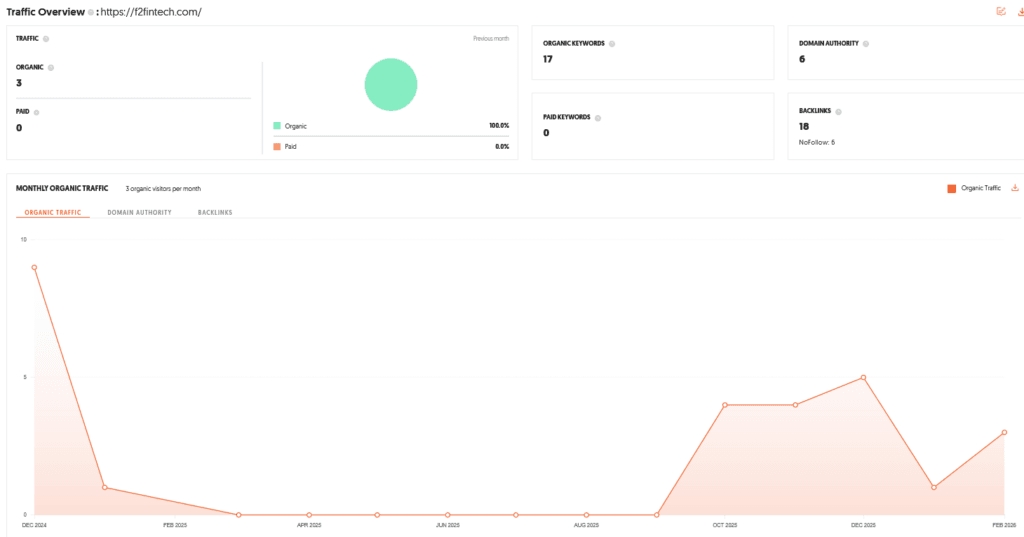
- Poor SEO Performance, SEO Improvement Needed.
- ORGANIC TRAFFIC: 3 visitors per month.
The Founders of F2 Fintech
- F2 Fintech was established by the entrepreneurial duo Harpreet Singh (CEO) and Abhinav Awal (Co-Founder).
- Based in Bareilly, Uttar Pradesh, the founders share a unique academic background; both initially pursued Chartered Accountancy (CA) before pivoting to earn their MBAs.
- Harpreet Singh, in particular, was lauded by the Sharks for his exceptional energy and persuasive salesmanship, while Abhinav brings a structured business approach, having graduated from an IIT Delhi startup bootcamp.
F2 Fintech Brand Overview
- Originally operating under the name “Financial Freedom,” the company underwent a strategic rebranding to F2 Fintech to project a more modern, tech-forward, and global identity.
- The brand positions itself as a digital loan marketplace that bridges the gap between traditional borrowers and financial institutions.
- With a team of approximately 120 employees and a presence across five geographical locations, the brand has already earned industry recognition, including the “Entrepreneur of the Year” award at the 2022 MSME India Business Awards.
F2 Fintech Shark Tank India Appearance & Ask
- The founders of F2 Fintech appeared on Shark Tank India Season 5, delivering a pitch characterized by high energy and significant flattery toward the Sharks, particularly Namita Thapar.
- They sought an investment of Rs 1 crore in exchange for 3% equity, which placed the company’s post-money valuation at Rs 33.33 crores.
- During the presentation, Harpreet Singh charmed the panel by drawing parallels between his career path and Namita’s, calling her a “one in a hundred” personality.
Season and Episode Air Date
- Season: 05
- Episode: 43
- Episode Air Date: Wednesday, 04 March, 2026
F2 Fintech Product Overview
- F2 Fintech operates as an AI-powered digital lending aggregator.
- The platform functions as a marketplace where users can compare various loan products from banks and Non-Banking Financial Companies (NBFCs).
- The core innovation claimed by the founders is an AI bot designed to guide users toward the best possible loan options, aiming to modernize a process that has traditionally been dominated by manual paperwork and aggressive telecalling.
Investor Reactions to F2 Fintech
The Sharks’ reactions to F2 Fintech were a mix of personal admiration and professional skepticism:
- Kunal Bahl: Appreciated the sales energy but felt the business was essentially a “commission agent” model that lacked a unique competitive advantage. He labeled it “not a venture fundable business.”
- Varun Alagh: Expressed concern over the automation of voice calling, fearing significant job losses in the sector. He predicted the founders would personally succeed and buy their dream cars, but declined to invest.
- Namita Thapar: While flattered by the founders and impressed by their salesmanship, she felt the profit margins (EBITDA) were too low for the scale of the business.
- Viraj Bahl: Noted that while the business would flourish and generate profits for the founders, it lacked an “exit” strategy for an outside investor.
F2 Fintech Customer Engagement Philosophy
- The philosophy of F2 Fintech centers on simplifying the complex financial landscape for the average borrower.
- By moving away from “Financial Freedom” to the more streamlined F2 Fintech identity, the company emphasizes speed, transparency, and technology.
- Their engagement strategy relies on high-touch salesmanship combined with an AI-driven interface to ensure customers find the most affordable credit options without the friction of traditional banking.
F2 Fintech Product Highlights
- AI-Powered Comparison: Uses a digital bot to filter and suggest the most suitable loan products.
- Aggregator Model: Connects over 3,000 customers with a vast network of banks and NBFCs.
- Zero-Capital Growth: A significant highlight was the founders’ ability to build a multi-crore business (reaching Rs 3.5 crore in revenue) without burning external investor money.
- Operational Scale: Employs a large team of 120 to manage the transition from offline lead generation to digital fulfillment.
Future Vision for F2 Fintech
- The future vision for F2 Fintech involves the total replacement of traditional, manual telecalling efforts with sophisticated AI solutions.
- The founders aim to dominate the digital lending space by scaling their tech stack to handle higher volumes of loan disbursements across India.
- Although the Sharks viewed it as a “lifestyle business” (one that generates good profit for owners but isn’t “fundable”), the founders remain committed to their goal of automating the commission-based lending industry.
F2 Fintech: Deal Finalized or Not?
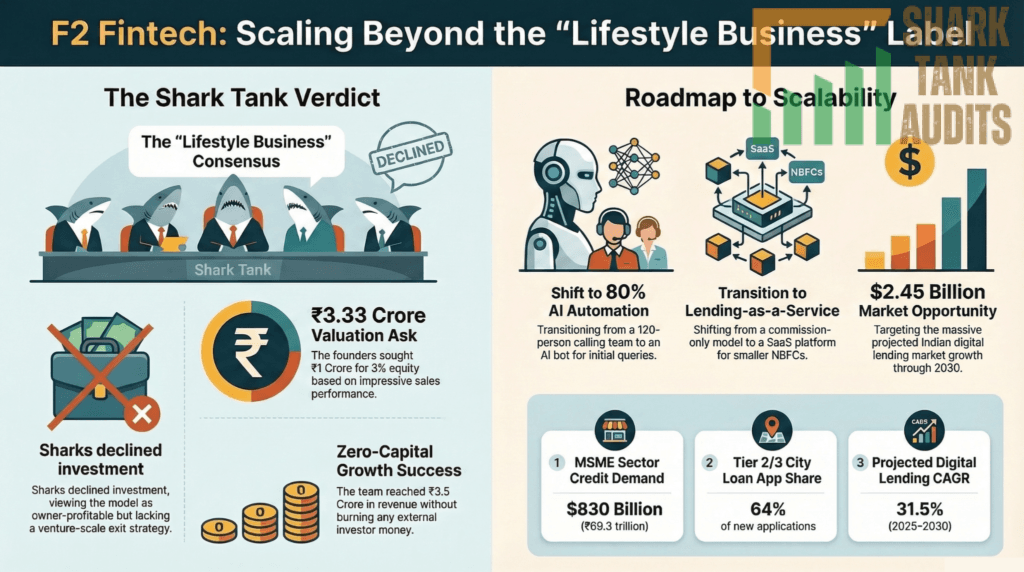
- No deal was finalized.
- Despite the founders’ impressive sales skills and the business’s ability to generate revenue without initial external capital, the Sharks collectively decided to pass.
- While they respected the founders’ hustle, the consensus among the investors was that F2 Fintech did not fit the criteria for a venture-scalable business.
| Title | Details |
|---|---|
| Brand Name | F2 Fintech |
| Website | F2 Fintech |
| Website Technology | Built on JavaScript frameworks React Router 6 and Emotion React |
| SEO Performance | Poor SEO performance, SEO improvement needed |
| Organic Traffic | 3 visitors per month |
| Founders | Harpreet Singh and Abhinav Awal |
| Founder Background | Both founders initially pursued Chartered Accountancy and later completed their MBAs |
| Founder Location | Bareilly, Uttar Pradesh, India |
| Founder Strength | Harpreet Singh known for strong salesmanship and energy |
| Co-Founder Expertise | Abhinav Awal brings structured business strategy and attended an IIT Delhi startup bootcamp |
| Original Brand Name | Financial Freedom |
| Rebranding Strategy | Renamed to F2 Fintech to present a modern fintech identity |
| Business Type | Digital loan marketplace and lending aggregator |
| Company Team Size | Approximately 120 employees |
| Geographic Presence | Operations across five locations in India |
| Awards | Entrepreneur of the Year at 2022 MSME India Business Awards |
| Shark Tank Appearance | Shark Tank India Season 5 |
| Episode Number | Episode 43 |
| Episode Air Date | Wednesday, 04 March 2026 |
| Investment Ask | ₹1 Crore for 3% equity |
| Company Valuation | ₹33.33 Crores |
| Pitch Style | High-energy pitch with strong sales approach |
| Shark Panel | Namita Thapar, Kunal Bahl, Varun Alagh, Viraj Bahl |
| Product Type | AI-powered digital lending aggregator platform |
| Platform Function | Allows users to compare loan offers from banks and NBFCs |
| Core Technology | AI bot recommending suitable loan options |
| Industry Focus | Retail and SME digital lending |
| Customer Value Proposition | Simplifies loan comparison and credit access |
| Product Highlight 1 | AI-powered loan comparison engine |
| Product Highlight 2 | Marketplace connecting customers with banks and NBFCs |
| Product Highlight 3 | Zero external capital growth model |
| Product Highlight 4 | Operational scale with 120 employees |
| Current Revenue Highlight | Reached ₹3.5 Crores revenue without external funding |
| Customer Engagement Philosophy | Simplifying financial decisions through technology and human assistance |
| Brand Positioning | Speed, transparency and accessible credit |
| Investor Reaction Summary | Mixed reactions with appreciation for sales skills but doubts about scalability |
| Kunal Bahl Reaction | Considered it a commission-agent business lacking strong differentiation |
| Varun Alagh Reaction | Concerned AI automation may reduce jobs in telecalling sector |
| Namita Thapar Reaction | Felt EBITDA margins were too low for venture investment |
| Viraj Bahl Reaction | Noted lack of exit opportunity for venture investors |
| Deal Outcome | No deal finalized |
| Reason for No Deal | Considered a lifestyle business rather than venture-scalable |
| Future Vision | Replace manual telecalling with AI automation |
| Industry Target | Scale digital lending disbursement across India |
| Market Trend | Increasing adoption of phygital fintech models |
| Digital Lending Market Size | Projected to reach $2.45 Billion by 2030 |
| Market Growth Rate | 31.5% CAGR from 2025–2030 |
| MSME Credit Gap | $830 Billion demand with $240–300 Billion shortfall |
| Technology Advantage | Use of Aadhaar and UPI data for alternative credit scoring |
| Startup Ecosystem Insight | Over 1.93 lakh startups in India with many emerging from Tier-2 cities |
| Total Addressable Market | $35.58 Billion alternative lending market by 2026 |
| Serviceable Market | Online loan aggregator market |
| Personal Loan Volume Projection | ₹4.3 Lakh Crores by 2025 |
| Serviceable Obtainable Market | Unorganized Direct Selling Agent (DSA) loan origination market |
| Primary Target Audience | Salaried and self-employed individuals aged 25–45 |
| Geographic Target | Tier-2 and Tier-3 cities such as Bareilly, Indore and Coimbatore |
| Borrower Psychographics | Value-conscious borrowers seeking transparency and quick approvals |
| User Persona 1 | Micro-entrepreneurs seeking working capital |
| User Persona 2 | Young professionals needing small-ticket personal loans |
| Content Marketing Strategy | Educational blogs and YouTube content on credit awareness |
| SEO Strategy | Hyper-local SEO for keywords like best business loan in Bareilly |
| Digital Marketing Strategy | WhatsApp AI bots for loan eligibility checks |
| Trust Strategy | Use Shark Tank appearance for credibility |
| Distribution Model | Phygital model combining digital tools and human advisors |
| Internal App | Business in Pocket mobile platform for employees |
| Lead Generation | B2B2C partnerships with Kirana stores and CA firms |
| Bank Integration | Direct backend integration with banks and NBFCs |
| Key Advantage | High sales efficiency without external funding |
| Operational Advantage | Remote-first infrastructure with low overhead |
| Competitive Advantage | Early AI-based loan guidance in Tier-3 markets |
| Major Competition | Paisabazaar and BankBazaar |
| Main Challenge | Scalability concerns due to manual sales dependency |
| Operational Risk | Potential disruption from automation replacing telecalling |
| Market Competition | High competition in fintech aggregator space |
| Success Factor | Strong sales-driven founders building customer trust |
| Strategic Shift | Move toward Lending-as-a-Service platform |
| Data Strategy | Monetize customer lead data for banks |
| Phase 1 Roadmap | Automate 80% of queries using AI bot |
| Phase 2 Roadmap | Expand Financial Therapist network to 1000+ advisors |
| Phase 3 Roadmap | Add insurance and investment financial products |
| Phase 4 Roadmap | Achieve ₹1 Crore EBITDA by FY26 |
| Long-Term Goal | Increase valuation beyond ₹33.33 Crores and attract PE/VC investors |
F2 Fintech Shark Tank India Business Plan
1. F2 Fintech Business Potential in India: Facts and Data
The Indian fintech landscape is undergoing a massive shift towards “Phygital” (Physical + Digital) models, which aligns perfectly with F2 Fintech.
- Market Growth: The Indian digital lending market is projected to reach $2.45 billion by 2030, growing at a staggering CAGR of 31.5% (2025–2030).
- Credit Gap: There is an addressable credit demand of $830 billion (₹69.3 trillion) in the MSME sector alone, with a current shortfall of $240–$300 billion.
- Alternative Scoring: With over 1.3 billion Aadhaar IDs and massive UPI penetration, F2 Fintech can leverage alternative data for credit assessment in Tier-2 and Tier-3 cities.
- Startup Ecosystem: F2 Fintech is part of a growing wave of 1.93 lakh+ startups in India, with 51% emerging from Tier-2 and Tier-3 cities like Bareilly.
2. F2 Fintech Total Addressable Market (TAM): Facts and Data
F2 Fintech operates at the intersection of retail and SME lending.
- Total Addressable Market (TAM): Estimated at $35.58 billion by 2026 for the alternative lending sector in India.
- Serviceable Addressable Market (SAM): The online loan aggregator segment, currently seeing a spike in personal loan volumes (projected at ₹4.3 lakh crore by 2025).
- Serviceable Obtainable Market (SOM): F2 Fintech aims to capture the unorganized DSA (Direct Selling Agent) market, which still handles a significant portion of India’s offline loan originations.
3. F2 Fintech Ideal Target Audience and Demographics
F2 Fintech targets the “Bharat” segment—users who are digitally savvy but still value human-assisted financial decisions.
- Primary Demographic: Salaried and Self-employed individuals aged 25–45.
- Geography: Primarily Tier-2 and Tier-3 cities (e.g., Bareilly, Indore, Coimbatore) which now account for 64% of new loan applications.
- Psychographics: Value-conscious borrowers looking for “Financial Therapy,” comparison-based transparency, and quick turnaround times (TAT).
- User Personas:
- The Micro-Entrepreneur: MSME owners needing working capital (24.6% YoY growth in this segment).
- The Young Professional: Gen Z and Millennials (under 35) looking for small-ticket personal loans (under ₹1 lakh) for gadgets, travel, or weddings.
4. F2 Fintech Marketing and Digital Strategy
The F2 Fintech strategy focuses on trust-building and localized outreach.
- Content Strategy:
- Educational “Financial Therapy”: Long-form blogs and YouTube videos explaining “How to improve CIBIL” and “Hidden charges in loans.”
- Success Stories: Video testimonials from local Bareilly and UP-based businesses funded through F2 Fintech.
- Digital Marketing Strategy:
- Hyper-Local SEO: Ranking for keywords like “Best business loan in Bareilly” or “Personal loan aggregator UP.”
- WhatsApp Marketing: Using AI bots to provide instant loan eligibility checks and document collection.
- Social Proofing: Leveraging the “Shark Tank India” appearance to establish credibility with conservative rural borrowers.
5. F2 Fintech Distribution Strategy
F2 Fintech utilizes a “Phygital” distribution model to maximize reach and minimize infrastructure costs.
- “Business in Pocket” App: A mobile-first platform for its 120+ employees and network of “Financial Therapists” to source business remotely.
- B2B2C Model: Partnering with local Kirana stores or small CA firms to act as lead generators.
- Direct-to-Bank Integration: Backend integration with major NBFCs and Banks to offer real-time competition amongst lenders.
6. F2 Fintech Advantages and Challenges
| Advantages of F2 Fintech | Challenges for F2 Fintech |
| High Sales Efficiency: Built a ₹3 Cr+ business without external capital. | Scalability Concerns: Sharks labeled it “unfundable” due to reliance on manual sales. |
| Low Overheads: Remote-first “Business in Pocket” model reduces fixed costs. | Disruption Risk: AI replacing tele-callers could lead to job losses or operational friction. |
| First-Mover in Tier-3 AI: Using AI bots for loan guidance in unorganized markets. | Intense Competition: Competing with giants like Paisabazaar and BankBazaar. |
7. F2 Fintech Success Factors and Mitigation Strategies
- Reason for Success: The founders are “Best Salesmen.” In a credit-hungry nation like India, high-touch sales combined with a digital aggregator tool creates a “sticky” customer base that automated apps struggle to capture.
- Mitigation Strategy for “Unfundable” Label: * Shift to SaaS: Transition from a commission-only model to a “Lending-as-a-Service” (LaaS) platform for smaller NBFCs.
- Data Monetization: Use proprietary lead data to provide pre-qualified applicants to banks, increasing the “Success Fee” and reducing the need for tele-calling.
8. F2 Fintech Future Business and Roadmap to Valuation
To increase its valuation from the current ₹33.33 Crores and prove the Sharks wrong, F2 Fintech must follow this roadmap:
- Phase 1 (Product Evolution): Fully automate the “AI Bot” to handle 80% of initial queries, reducing reliance on the 120-person calling team.
- Phase 2 (Expansion): Scale the “Financial Therapist” program to 1,000+ micro-entrepreneurs across North India.
- Phase 3 (Diversification): Introduce Insurance and Investment products (Gold Loans, Mutual Fund-backed credit) to increase Average Revenue Per User (ARPU).
- Phase 4 (Valuation Spike): Target an EBITDA of ₹1 Cr+ by FY26 to attract “Profit-focused” PE/VC investors who are currently favoring sustainable fintech models.







F2 Fintech Shark Tank India Episode Review