
Stubb Shark Tank India Episode Review
Stubb appeared on Shark Tank India Season 5, Episode 45, with Dharamshala-based founder Nihal Raheja (occasional smoker whose inspiration born during Japan trip deeply moved by local personal responsibility culture where citizens carry own waste versus littering seeking to replicate mindset in Indian context) seeking ₹25 lakh for 5% equity (₹5 Crore valuation) but left with no deal after all five Sharks opted out with consensus viewing as “passion project”/”hobby” versus scalable venture-backed business despite founder’s clear communication/noble intentions.
Launched January 2026, the sustainability-focused brand specializes in pocket ashtray production serving as environmental consciousness/smoker habit bridge with core mission reducing cigarette butt environmental impact as major non-biodegradable litter source particularly in ecologically sensitive mountain areas offering flagship ₹349 portable pocket ashtray designed for pocket/bag carrying allowing smokers extinguishing/storing cigarette butts until finding proper trash receptacle though Shark Anupam Mittal pointed out contradiction—Stubb device itself made of plastic and non-biodegradable—with only 7 monthly organic visitors requiring SEO improvement. Sharks provided blunt critical viability feedback—Namita strongly advised “shut down” business stating India lacks “sensibility” for such product comparing to low disposable period pad cover adoption, Varun acknowledged Nihal’s intelligence/articulation but told him “wasting time” on specific venture, Vineeta argued ₹350 product cannot solve deep-seated Indian market behavioral/awareness issues, and Anupam labeled venture “hobby” versus business.
Operating amid India as second-largest global tobacco consumer (100+ billion annual cigarette stick consumption with significant portion ending street litter) with government tightening Extended Producer Responsibility (EPR) norms and Swachh Bharat Abhiyan 2.0 increasing corporate/individual waste management pressure and eco-sensitive Himachal Pradesh zones (Nihal’s base) local littering bans creating “forced” portable disposal solution demand within 120 million Indian smokers (targeting top 10% urban premium smokers creating 12 million TAM) and 3 million SAM (Tier 1/2 city urban dwellers traveling to eco-sensitive mountain/beach regions), Stubb targets “Conscious Trekker” (21-40, metros Delhi/Mumbai/Bangalore, frequently traveling Himalayas/coastal areas) and “Corporate Professional” (smokers in high-end office complexes where designated smoking zones distant or lacking aesthetic disposal units) among individuals valuing “Social Currency” wanting to be seen as responsible/”refined” versus average litterer aiming 1% SAM capture (30,000 units, ₹1.04 Crore revenue at ₹349 price) within 2 years through “Individual Responsibility” philosophy attempting customer engagement appealing to civic duty/environmental conscience providing convenient tool encouraging social habit shift from flicking cigarette butts onto ground, planning “Don’t Litter” to “Smoke Responsibly” guilt-free messaging highlighting single butt damage to mountain soil/water, “Leave No Trace” trekking influencer/sustainable lifestyle vlogger Instagram/YouTube partnerships, high-production “Japanese vs Indian Street” comparison Reels evoking national pride/civic duty, SEO targeting high-intent keywords (“Eco-friendly smoker gifts,” “Portable ashtray India,” “Trekking essentials checklist”), interest-based Meta Ads targeting Patagonia/Wildcraft/The Souled Store brand followers, Facebook Pixel retargeting abandoned carts offering “Buy 2, Get 1 Free” bundles driving per-unit price down, B2B mountain cafe/hostel (Zostel/Hosteller)/trekking agency partnerships selling as “essential rental”/”mandatory gear,” Amazon/Flipkart/niche sustainable marketplace (Better India/Brown Living) e-commerce expansion beyond WordPress, music festival (NH7 Weekender/Echoes of Earth) event pop-up stalls concentrating target demographic, plastic-to-recycled aluminum/biodegradable bamboo composite pivot addressing non-biodegradable criticism, ₹49 “Stubb Lite” cardboard/disposable version launch for mass events increasing brand penetration mitigating ₹349 high single-purpose item price point, eco-material product redesign with website SEO optimization, 50+ Himalayan cafe/hostel B2B partnerships with Amazon India launch, “Stubb Disposal Kits” (biodegradable pouches)/”Stubb Air Purifiers” (smoking rooms) product diversification, and subscription model (monthly biodegradable liners) shift with tobacco company Corporate Social Responsibility (CSR) tie-ups moving from product to waste management platform valuation significantly increasing multiple aiming “Litter-Free India” promoting preserving tourist destination (Dharamshala) beauty though facing significant cultural consumer behavior barrier/high perceived value price point challenges despite first-mover niche category advantage, low manufacturing cost versus high perceived value, strong founder story/”Made in Dharamshala” branding amid increasing Gen Z/millennial “Eco-Anxiety” making them willing to pay for environmental guilt-alleviating products targeting cigarette filters as most littered global item through Japanese cleanliness standard-inspired design-led compact portability.
Website Information
- Website:- Stubb
- Build on WordPress
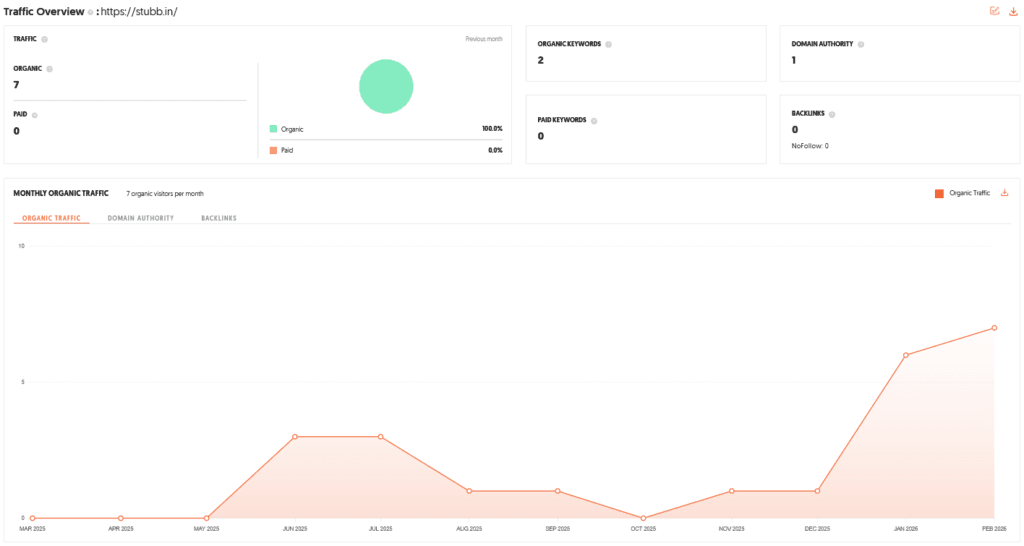
- Poor SEO Performance, SEO Improvement Needed.
- ORGANIC TRAFFIC: 7 visitors per month.
The Founder of Stubb
- Nihal Raheja, an entrepreneur based in Dharamshala, is the visionary behind the brand.
- As an occasional smoker himself, Nihal’s inspiration for Stubb was born during a trip to Japan.
- He was deeply moved by the local culture of personal responsibility, where citizens carry their own waste rather than littering, and he sought to replicate that mindset in the Indian context.
Stubb Brand Overview
- Stubb is a sustainability-focused brand that specializes in the production of pocket ashtrays.
- Launched in January 2026, the brand serves as a bridge between environmental consciousness and smoker habits.
- The core mission of Stubb is to reduce the environmental impact of cigarette butts, which are a major source of non-biodegradable litter, particularly in ecologically sensitive areas like the mountains.
Shark Tank India Appearance & Ask for Stubb
- Nihal appeared on Season 5 (Episode 45) of Shark Tank India to present his solution for a cleaner India.
- During his pitch for Stubb, he requested an investment of ₹25 lakh in exchange for 5% equity in the company.
- He showcased the product as a portable, sleek solution for responsible disposal on the go.
Season and Episode Air Date
- Season: 05
- Episode: 45
- Episode Air Date: Friday, 06 March, 2026
Product Overview of Stubb
- The flagship product of Stubb is a portable pocket ashtray priced at ₹349.
- Designed to be carried in a pocket or bag, it allows smokers to extinguish and store cigarette butts until they find a proper trash receptacle.
- While the intent is eco-friendly, Shark Anupam Mittal pointed out a contradiction: the Stubb device itself is made of plastic and is not biodegradable.
Investor Reactions to Stubb
The Sharks provided blunt and critical feedback regarding the viability of Stubb:
- Namita Thapar: Strongly advised Nihal to “shut down” the business, stating that India lacks the “sensibility” for such a product, comparing it to the low adoption of disposable period pad covers.
- Varun Alagh: Acknowledged Nihal’s intelligence and articulation but told him he was “wasting time” on this specific venture.
- Vineeta Singh: Argued that a ₹350 product cannot solve deep-seated behavioral and awareness issues in the Indian market.
- Anupam Mittal: Labeled the venture a “hobby” rather than a business.
Customer Engagement Philosophy of Stubb
- The philosophy behind Stubb is rooted in “Individual Responsibility.”
- The brand attempts to engage customers by appealing to their civic duty and environmental conscience.
- Nihal’s approach with Stubb assumes that by providing a convenient tool, he can encourage a shift in the social habit of flicking cigarette butts onto the ground.
Product Highlights of Stubb
- Portability: Compact enough to fit in any pocket or small compartment.
- Targeted Solution: Specifically addresses the most littered item globally—cigarette filters.
- Design-Led: Inspired by international standards of cleanliness (specifically Japanese culture).
Future Vision for Stubb
- The future vision for Stubb was to scale the product across India to promote a “Litter-Free India” and preserve the beauty of tourist destinations like Dharamshala.
- However, following the Sharks’ advice, the brand faces a significant challenge in overcoming the cultural barrier of consumer behavior and the high price point relative to the perceived value in the Indian market.
Deal Finalized or Not for Stubb
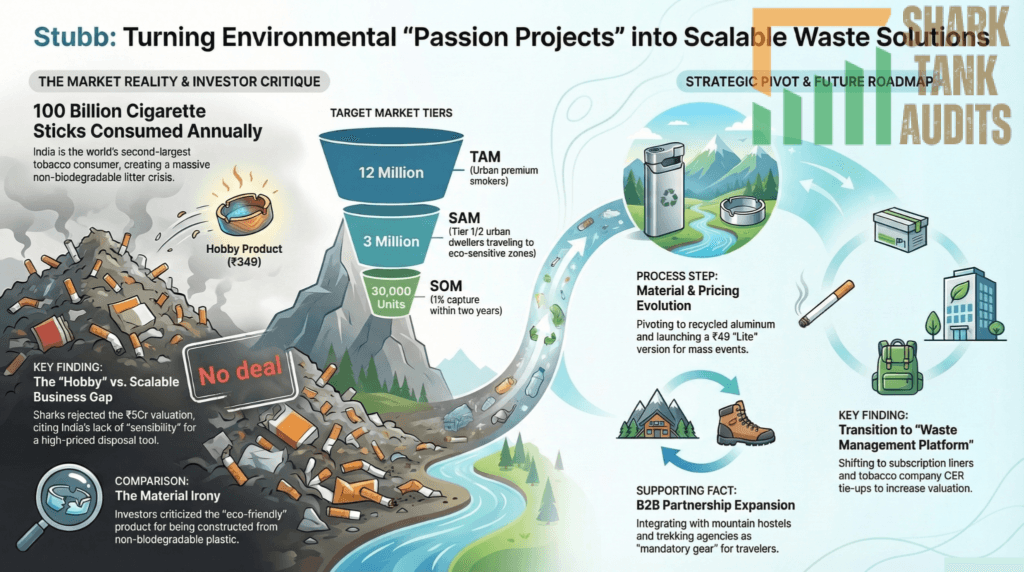
- No deal was finalized. Despite the founder’s clear communication and noble intentions, all five Sharks opted out of the investment.
- The consensus among the investors was that Stubb functioned more as a “passion project” or a hobby rather than a scalable, venture-backed business.
| Title | Details |
|---|---|
| Brand Name | Stubb |
| Website Platform | Built on WordPress |
| SEO Performance | Poor SEO performance, SEO improvement needed |
| Organic Traffic | 7 visitors per month |
| Founder | Nihal Raheja |
| Founder Location | Dharamshala, India |
| Founder Inspiration | Inspired by Japanese culture of personal responsibility for waste |
| Founder Motivation | Reduce cigarette litter and promote responsible smoking |
| Company Founded | January 2026 |
| Business Type | Sustainability focused lifestyle product brand |
| Core Product Category | Pocket ashtrays for cigarette waste disposal |
| Brand Mission | Reduce environmental damage caused by cigarette butts |
| Environmental Focus | Prevent non biodegradable cigarette filter pollution |
| Geographic Concern | Ecologically sensitive mountain regions |
| Shark Tank Appearance | Shark Tank India Season 5 |
| Episode Number | Episode 45 |
| Episode Air Date | Friday, 06 March 2026 |
| Investment Ask | ₹25 Lakhs for 5% equity |
| Implied Valuation | ₹5 Crores |
| Product Name | Portable pocket ashtray |
| Product Price | ₹349 |
| Product Function | Store and extinguish cigarette butts until proper disposal |
| Product Feature | Compact and portable design |
| Product Carry Option | Fits in pocket or small bag |
| Product Inspiration | Cleanliness practices inspired by Japan |
| Material Concern | Product made from plastic |
| Sustainability Criticism | Plastic material questioned by investors |
| Investor Reaction | Mostly negative feedback from sharks |
| Shark Feedback 1 | Namita Thapar advised shutting down the business |
| Shark Feedback 2 | Varun Alagh said founder may be wasting time on this venture |
| Shark Feedback 3 | Vineeta Singh questioned ability to change consumer behavior |
| Shark Feedback 4 | Anupam Mittal called the venture a hobby |
| Deal Outcome | No deal finalized |
| Reason for No Deal | Investors did not see scalability potential |
| Customer Philosophy | Promote individual responsibility among smokers |
| Brand Message | Encourage smokers to dispose of cigarette waste responsibly |
| Behavioral Goal | Reduce habit of throwing cigarette butts on streets |
| Tobacco Consumption Insight | India consumes around 100 billion cigarette sticks annually |
| Environmental Problem | Cigarette filters are major non biodegradable waste |
| Government Initiative | Swachh Bharat Abhiyan promoting waste management |
| Regulatory Trend | Extended Producer Responsibility waste rules |
| Tourism Opportunity | Demand for waste solutions in eco sensitive tourist regions |
| Total Addressable Market | Around 120 million smokers in India |
| Serviceable Addressable Market | Urban smokers traveling to eco sensitive areas |
| Estimated Target Users | Around 3 million potential users |
| Serviceable Obtainable Market | 1 percent of SAM equals around 30,000 customers |
| Potential Revenue | Around ₹1.04 Crores at ₹349 product price |
| Primary Target Audience | Smokers aged 21 to 40 |
| Persona Example | Conscious trekkers and travelers |
| Secondary Audience | Corporate professionals who smoke in urban offices |
| Consumer Psychology | People who want to appear socially responsible |
| Marketing Strategy | Promote smoke responsibly messaging |
| Environmental Campaign | Highlight environmental damage from cigarette waste |
| Influencer Strategy | Collaborate with trekking and sustainability influencers |
| Content Strategy | Comparison videos of Japanese vs Indian street cleanliness |
| SEO Strategy | Target keywords like portable ashtray India |
| Digital Advertising | Interest based ads targeting sustainability audiences |
| Retargeting Strategy | Facebook Pixel retargeting with bundle offers |
| Distribution Strategy | Focus on B2B partnerships |
| B2B Sales Channels | Mountain cafes, trekking agencies and hostels |
| Hostel Partnership Example | Zostel |
| E Commerce Expansion | Sell products on Amazon and Flipkart |
| Sustainable Marketplace | Sell through eco marketplaces like Better India store |
| Event Marketing | Pop up stalls at music festivals |
| Event Example | NH7 Weekender |
| Competitive Advantage | First mover in portable ashtray category in India |
| Branding Advantage | Strong story of Made in Dharamshala |
| Manufacturing Advantage | Low manufacturing cost compared to retail price |
| Key Challenge | Changing consumer behavior toward waste disposal |
| Price Barrier | ₹349 perceived expensive for single use product |
| Material Criticism | Plastic construction contradicts eco message |
| Success Factor | Growing environmental awareness among Gen Z |
| Material Improvement Plan | Use recycled aluminum or bamboo composite materials |
| Pricing Strategy | Launch lower cost disposable version |
| New Product Idea | Stubb Lite cardboard version priced at ₹49 |
| Phase 1 Plan | Redesign product with eco friendly materials |
| Phase 2 Plan | Build partnerships with 50 plus Himalayan cafes |
| Marketplace Expansion | Launch product on Amazon India |
| Phase 3 Plan | Diversify into cigarette disposal kits |
| Product Expansion | Launch air purifiers for smoking rooms |
| Long Term Strategy | Build waste management ecosystem for smokers |
| Revenue Model Expansion | Subscription model for biodegradable liners |
| Corporate Partnership Opportunity | CSR collaborations with tobacco companies |
| Valuation Strategy | Transition from product brand to waste management platform |
Stubb Shark Tank India Business Plan
1. The Business Potential of Stubb in India
- Stubb’s Market Context: India is the second-largest consumer of tobacco globally. Approximately 100 billion cigarette sticks are consumed annually in India, with a significant portion ending up as street litter.
- Stubb’s Regulatory Tailwind: With the Indian government’s tightening “Extended Producer Responsibility” (EPR) norms and the “Swachh Bharat Abhiyan” 2.0, there is increasing pressure on both corporations and individuals to manage waste.
- Stubb’s Tourism Edge: In eco-sensitive zones like Himachal Pradesh (Nihal’s base), local bans on littering create a “forced” demand for portable disposal solutions.
2. Total Addressable Market (TAM) for Stubb
- Stubb’s TAM (Total Addressable Market): There are roughly 120 million smokers in India. If Stubb targets just the top 10% (urban, premium smokers), the TAM is 12 million users.
- Stubb’s SAM (Serviceable Addressable Market): Focusing on urban dwellers in Tier 1 and Tier 2 cities who travel to eco-sensitive regions (mountains/beaches), estimated at 3 million individuals.
- Stubb’s SOM (Serviceable Obtainable Market): Capturing 1% of the SAM in the first 2 years would equate to 30,000 units sold, generating approximately ₹1.04 Crore in revenue at the ₹349 price point.
3. Ideal Target Audience and Demographics for Stubb
- Stubb’s Primary Persona: “The Conscious Trekker”—Ages 21–40, resides in metros (Delhi, Mumbai, Bangalore), frequently travels to the Himalayas or coastal areas.
- Stubb’s Secondary Persona: “The Corporate Professional”—Smokers working in high-end office complexes where designated smoking zones are distant or lack aesthetic disposal units.
- Stubb’s Psychological Profile: Individuals who value “Social Currency” and want to be seen as responsible or “refined” compared to the average litterer.
4. Stubb’s Marketing and Content Strategy
- Stubb’s “Guilt-Free” Messaging: Shift from “Don’t Litter” to “Smoke Responsibly.” Use content that highlights the damage caused by a single butt to mountain soil/water.
- Stubb’s Influencer Strategy: Partner with “Leave No Trace” trekking influencers and sustainable lifestyle vloggers on Instagram and YouTube.
- Stubb’s Video Content: Create high-production “Japanese vs. Indian Street” comparison reels to evoke a sense of national pride and civic duty.
5. Stubb’s Digital Marketing Strategy
- Stubb’s SEO Overhaul: Target high-intent keywords like “Eco-friendly smoker gifts,” “Portable ashtray India,” and “Trekking essentials checklist.”
- Stubb’s Meta Ads: Run “Interest-based” ads targeting followers of brands like Patagonia, Wildcraft, and The Souled Store.
- Stubb’s Retargeting: Use Facebook Pixel to retarget visitors who abandoned the cart, offering a “Buy 2, Get 1 Free” bundle to drive the price-per-unit down.
6. Stubb’s Distribution Strategy
- Stubb’s B2B Focus: Partner with mountain cafes, hostels (Zostel, Hosteller), and trekking agencies to sell Stubb as an “essential rental” or “mandatory gear.”
- Stubb’s E-commerce Presence: Expand beyond the WordPress site to Amazon, Flipkart, and niche sustainable marketplaces like Better India or Brown Living.
- Stubb’s Event Pop-ups: Stalls at music festivals (NH7 Weekender, Echoes of Earth) where the target demographic is concentrated.
7. Advantages and Challenges for Stubb
- Stubb’s Advantages: First-mover advantage in a niche category; low manufacturing cost vs. high perceived value; strong founder story and “Made in Dharamshala” branding.
- Stubb’s Challenges: The “Habit Barrier”—changing how Indians discard waste; the high price point (₹349) for a single-purpose item; the plastic construction irony pointed out by Anupam Mittal.
8. Stubb’s Success & Mitigation Strategies
- Success Reason: Increasing “Eco-Anxiety” among Gen Z and Millennials makes them willing to pay for products that alleviate environmental guilt.
- Stubb’s Mitigation (Material): Pivot from plastic to recycled aluminum or biodegradable bamboo composites to address the “non-biodegradable” criticism.
- Stubb’s Mitigation (Pricing): Launch a “Stubb Lite” cardboard/disposable version at ₹49 for mass events to increase brand penetration.
9. Stubb’s Future Business Roadmap & Valuation
- Phase 1 (0-6 Months): Product redesign to eco-materials; SEO optimization of the website.
- Phase 2 (6-12 Months): B2B partnerships with 50+ Himalayan cafes/hostels; launch on Amazon India.
- Phase 3 (1-2 Years): Product diversification into “Stubb Disposal Kits” (biodegradable pouches) and “Stubb Air Purifiers” for smoking rooms.
- Stubb’s Valuation Strategy: By shifting to a subscription model (monthly biodegradable liners) and securing Corporate Social Responsibility (CSR) tie-ups with tobacco companies, Stubb can move from a “product” valuation to a “waste management platform” valuation, significantly increasing its multiple.






Stubb Shark Tank India Episode Review