
Shark Tank India Season 5 Episode 46 Review
Aired on Monday, March 09, 2026, Episode 46 of Shark Tank India Season 5, titled “The Transit & Turnaround Special”, focused on the modern consumer’s obsession with speed and space efficiency. From a service delivering professional reels in 10 minutes to two competing visions of Japanese-style capsule hotels, the Tank explored whether “ultra-compact” and “ultra-fast” models can truly scale in the complex Indian landscape.
The Shark panel, Aman Gupta, Anupam Mittal, Namita Thapar, Vineeta Singh, and Ritesh Agarwal (with Kunal Bahl and Mohit Sadani in specific segments)—balanced admiration for high-pedigree founders against a deep-seated “physiological skepticism” regarding the claustrophobia of pod living and the labor-intensity of on-demand content.
Pitch 1
Flashoot Shark Tank India Episode Review

Flashoot appeared on Shark Tank India Season 5, Episode 46, with Hyderabad-based founding trio Voleti Karthik (Founder/CEO, Indian School of Business/CBIT alumnus who conceived idea after facing delays in content creation for family ice cream business), Manikanta Bukka (Co-Founder/Director of Expansion managing growth/initial self-funding), and Shreyak Singh (Co-Founder/CTO, engineering dropout heading platform technology/design architecture) seeking ₹1.5 Crore for 2% equity (₹75 Crore valuation) but left with no deal despite energetic pitch and clear “10-minute delivery” USP demonstration as panel intrigued by concept/current short-form content demand though high valuation and long-term quality-compromising scalability concerns led Sharks opting out.
Operating under Konchamkode Private Limited (established 2023) as digital service platform bridging gap between high-quality professional videography and rapid-fire social media demands positioning as “one-stop shop” for instant content democratizing professional-grade video production for individual influencers to large-scale startups through “Smart Video Production” assembly-line-efficiency model, offering on-demand real-time content creation service connecting users via mobile app with trained “Flashooters” arriving equipped with high-end devices (iPhone 13 Pro or newer)/professional lighting covering private functions (weddings/birthdays) to commercial brand shoots providing end-to-end solution including physical filming/immediate digital editing featuring 10-minute turnaround (fully edited ready-to-post reel delivery within 10 minutes post-shooting), studio-quality lighting/specialized camera setups/advanced editing templates professional infrastructure, skilled videographer network trained specifically in short-form storytelling, and personal celebration to corporate brand shoot/influencer collaboration service versatility with 6,509 monthly organic visitors demonstrating good SEO performance requiring improvement during “Innovation Across Industries” episode. Shark panel (Aman Gupta/Anupam Mittal/Namita Thapar/Vineeta Singh/Ritesh Agarwal) expressed mixed reactions praising founders for identifying genuine “consistency” struggle creator pain point though critique focused on labor-intensive business nature with several Sharks questioning whether startup could maintain consistent quality/rapid speed scaling across multiple cities/international markets.
Operating in Indian total video market projected to reach $18 billion by 2026 (9.5% CAGR) with 1.03+ billion internet users (2026) consuming short-form video as primary format and 5G penetration reaching 641 million connections by 2030 skyrocketing high-quality low-latency content demand within India’s influencer marketing sector projected to hit ₹3,375 Crore by 2026 (25% CAGR) at intersection of Creator Economy/Digital Advertising and ₹500+ Crore immediate Tier 1/2 city professional event/brand reel-making opportunity, Flashoot targets aspiring creators (18-25 Gen-Z metro Mumbai/Bangalore/Hyderabad users looking to go viral lacking professional gear), digital entrepreneurs (25-40 small business owners—cafes/boutiques/gyms—needing consistent “always-on” Instagram/LinkedIn content), and event hosts (families/couples hosting weddings/anniversaries wanting “instant memories” for social sharing versus months-long traditional film waiting) among 100+ million nano/micro-influencer SMEs lacking in-house production teams through speed/accessibility/immediate gratification philosophy prioritizing 10-15-minute delivery window engaging customers needing fast-paced Instagram/TikTok “viral” culture relevance removing technical editing/lighting barriers allowing customer focus entirely on personal branding/creativity, achieving 2025 ₹220 million valuation with successful seed funding rounds already expanding from Hyderabad to Mumbai/Bangalore establishing UAE/USA presence aiming to democratize videography using technology further streamlining editing process expanding “Flashooter” network to every major global creator hub, planning “Behind-the-Scenes” (BTS) focus content strategy showcasing “Raw to Reel in 10 Minutes” transition building speed claim trust, SEO improvement targeting high-intent keywords (“Professional Reel Maker near me,” “Instant Wedding Reels”) from 6,500+ organic visitors, Shark Tank India alumni partnerships creating collaborative reels utilizing TV appearance halo effect social proof, hub-and-spoke physical distribution model with centralized high-traffic area (malls/business parks) “Smart Studios” Flashoot Hubs and mobile app-dispatched on-demand “Flashooters” (ride-sharing-similar model) Flashoot Go built on Framer Motion/JavaScript ensuring fluid high-tech user experience mirroring brand “instant” promise, “Flashoot Academy” implementation certifying every videographer before going live ensuring quality control, AI-assisted editing template development reducing human editing time from 5 minutes to 1 minute addressing scalability, brand subscription model shift ensuring recurring monthly SaaS revenue mitigating high burn rate, Tier 1 presence solidification launching 5 additional Indian Tier 2 cities, UAE/USA international expansion targeting high-budget NRI wedding/luxury brand markets, and Flashoot AI standalone software tool launch for creators auto-editing own footage using brand signature “Flashoot Style” templates transitioning from ₹75 Crore to potential ₹500 Crore Unicorn track valuation leveraging “10-Minute” moat (traditional editors taking 24-48 hours versus Flashoot assembly-line editing nearly impossible to replicate at scale without specific training), ₹1,999/hour low entry barrier (significantly cheaper than full production house hiring), and iPhone 13 Pro-or-newer hardware standard mandate ensuring entire network visual consistency operating as disruptive “Content-as-a-Service” (CaaS) platform solving professional video production bottleneck combining trained Flashooter network with high-efficiency editing suite delivering social-media-ready reels under 10 minutes at digital inflection point.
Pitch 2
NapTapGo Shark Tank India Episode Review
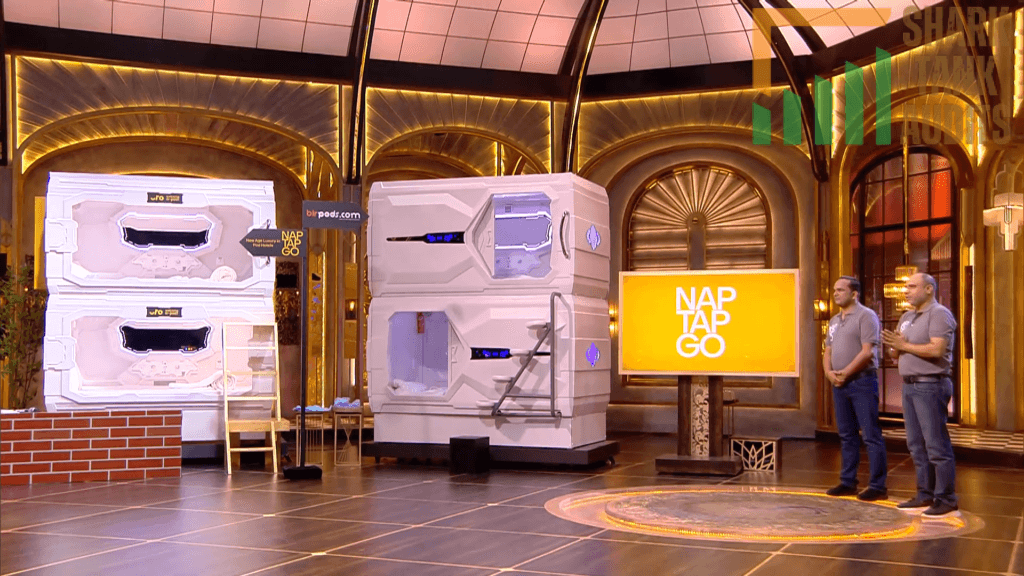
NapTapGo appeared on Shark Tank India Season 5, Episode 46, with co-founders Nitin Malhotra (electronics engineer with MBA who previously built/exited after-sales service startup for ₹45 Crore) and Himanshu Shukla (significant hospitality sector experience, longtime friends established 2023) seeking ₹2 Crore for 2.5% equity (₹80 Crore valuation) but left with no deal despite Sharks being impressed by founders’ professional backgrounds/previous successful exit as they remained unconvinced about pod concept scalability in Indian landscape concerned by high burn rate/projected losses sharing financial trajectory: ₹20 lakh revenue with ₹50 lakh loss (2023-24), ₹1.1 Crore revenue with ₹1 Crore loss (2024-25), and ₹3.5 Crore projected revenue with ₹1.5 Crore projected loss (2025-26).
The hospitality startup provides Japanese-style pod hotels designed for Indian market focusing affordable short-stay private sleeping pods specifically targeting transit hubs/hospitals/urban centers currently operational in Noida/Amritsar positioning as hygienic consistent alternative to traditional often-unpredictable franchise-led budget hotels offering compact private sleeping pods with flexible check-ins/hourly billing designed maximizing real estate efficiency while providing private tech-enabled rest environment as “middle ground” between hostel/budget hotel heavily focusing cleanliness/uniform user experience across all locations featuring flexible hourly booking transit traveler options, high hygiene core brand pillar differentiating from low-end budget hotels, integrated pod technology for modern user experience, and strategic Noida/Amritsar high-footfall area (hospitals/transit hubs) presence with 8,898 monthly organic visitors demonstrating good SEO performance requiring improvement. Sharks offered critical feedback range—Aman bluntly calling concept “useless” for personal taste noting pods felt “claustrophobic”/more like plastic-heavy hostel versus hotel, Kunal feeling business in “no man’s land” neither true budget hotel nor cost-efficient enough disrupting market, Namita comparing unfavorably to competitor BLR Pods noting NapTapGo lacked same real estate utilization/profitability level, and Anupam showing initial interest though ultimately not moving forward with offer due to business model risks.
Operating in Indian hotel market valued at $15.67 billion (2024) projected to grow to $22.41 billion by 2030 (9.32% CAGR) with global capsule hotel demand estimated at $271.4 million (2026) and Asia-Pacific region (including India) dominating market amid 43.3+ million students/massive workforce needing short-stay affordable housing near hospitals/transit hubs (Railway/Airports) at all-time high and 78% domestic cost-sensitive corporate bookings within $8 billion entire Indian budget lodging/transit accommodation market and $1.2 billion SAM (0-24 hour short-stay travelers near top 50 transit hubs/100+ major hospitals), NapTapGo targets solo business travelers (21-40 accounting for 59% India’s business travel market), patient relatives at major hospitals (Noida/Amritsar needing 4-6 hour rest periods), and middle-income professionals/Gen Z travelers (fastest-growing segment)/budget-conscious spiritual tourists (Katra pipeline) who are tech-savvy prioritizing hygiene over luxury preferring mobile-first booking (65% Indian travel bookings via mobile) aiming 5-8% urban pod market capture expanding to 15 locations targeting ₹50+ Crore revenue by 2028 through “standardized, hygienic, efficient stay model” philosophy believing traveling professionals deserve predictable standards utilizing technology/uniform design removing budget travel “guesswork” ensuring every customer receives same high cleanliness/reliability level regardless of city, planning “Visual Transparency” focus using 360-degree videos/”Day in a Pod” Reels demystifying Shark-raised claustrophobia concerns, SEO targeting long-tail keywords (“hourly stay near Noida hospital,” “budget pod hotel Amritsar”) from 8,898 monthly organic visitors, geo-fenced Google Search Ads targeting users within 5km airport/railway station radius, solo travel influencer Instagram/YouTube partnerships normalizing capsule lifestyle, Next.js 14 NapTapGo website enhancement offering “Direct Booking Discounts” bypassing OTA commissions, MakeMyTrip/Booking.com high visibility maintenance (controlling massive Indian online travel market share), SME/medical tourism agency corporate tie-ups providing employee/client “Nap-Vouchers,” Asset-Light Model shift (franchise/management contracts) reducing capital expenditure/losses mitigating scalability/burn rate challenge, “Infinite Mirrors”/better lighting/high-quality ventilation system pod interior redesign enhancing space sense addressing consumer claustrophobia perception, “Hospital-Transit” niche focus where airport-focused competitors like BLR Pods may not have stronghold, current Noida/Amritsar unit optimization achieving 70%+ occupancy reducing net losses, 15-property launch across Pune/Katra/Bangalore integrating AI-driven dynamic pricing maximizing RevPAR (Revenue Per Available Room), and ₹150+ Crore valuation target by 2028 demonstrating profitability path through Asset-Light model/ancillary revenue (in-pod vending/laundry/coworking access) aggressively expanding from current two locations to 15 hotels within next two years with upcoming Katra/Pune pipeline sites leveraging national visibility becoming leader in India’s emerging capsule hotel segment making quality budget stays accessible to wider audience offering higher revenue per square foot versus traditional hotels packing more “units” into same area with unorganized PG/local lodge-unlike “Predictable Standard” hygiene and Nitin’s tech background/Himanshu’s hospitality expertise creating “Tech-Hospitality” hybrid backed by founders’ ₹45 Crore exit track record providing institutional future funding credibility tapping into frequent working traveler service through tech-enabled standardized lodging model.
Pitch 3
Blrpods.com Shark Tank India Episode Review
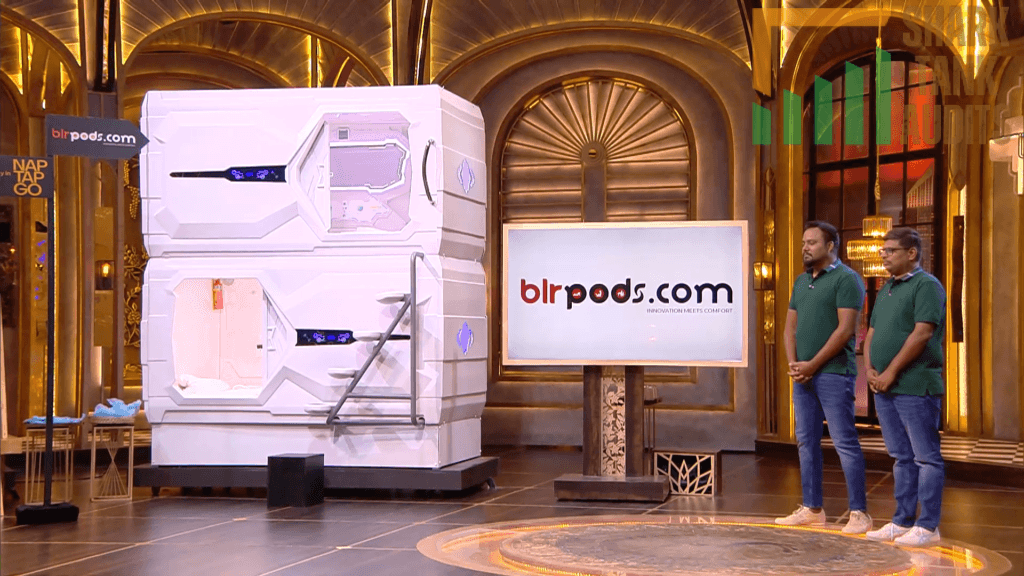
Blrpods.com appeared on Shark Tank India Season 5, Episode 46, with Bengaluru-based entrepreneurial duo Nagakarthik Doddamani (primary brand face receiving “Best Innovative Hospitality Concept of the Year, Bangalore” at Business Samrat Awards) and Aishwarya Karthik Doddamani (with Rajesh Badami noted in early stages, legally operating under Aishkar Hospitality Private Limited bringing operational expertise/vision transplanting successful Japanese capsule hotel model into Indian landscape) seeking ₹90 lakh for 1.5% equity (₹20 Crore valuation) but left with no deal despite company’s impressive profitability/high occupancy rates as Sharks collectively stepped back unable to reach consensus on long-term scalability/”Indian market fit” of capsule concept highlighting bootstrapped yet profitable entity status immediately piquing Shark interest given capital-intensive hospitality industry nature.
Positioned as Karnataka’s first capsule hotel, the Bengaluru-based hospitality startup operates as “micro-hotel” designed providing smart/compact/hygienic accommodation for modern travelers focusing optimum real estate utilization offering private sanctuary for individuals needing rest without exorbitant traditional hotel room costs targeting niche yet growing tech professional/transit traveler segment prioritizing efficiency/cleanliness over luxury, offering Japanese-inspired sleeping pod/capsule core product divided into 26 Single Pods/14 Twin Pods in Brookfield Bengaluru area designed space-efficient/private/tech-friendly featuring comfortable bedding/specialized ventilation systems, personal lighting/integrated charging ports, secure personal belonging storage, and “Sleep Wellness Program” enhancing rest quality through environmental design with ₹299 3-hour starting stays, ₹999 Single/₹1,499 Twin nightly rates, FY 24-25 ₹66 lakh earnings with ₹14 lakh EBITDA profitability, 70% steady occupancy rate, and 13,000+ completed stays achieving 10,823 monthly organic visitors demonstrating good SEO performance requiring improvement. Sharks reacted with mathematical admiration/physiological skepticism mix, Aman finding pods “claustrophobic” feeling concept might not work in India because Indians often prefer jugaad (makeshift solutions) over specialized pods, Anupam acknowledging business potential though concerned about lack of “moat”/unique differentiation fearing anyone could replicate model, Namita praising financial discipline/real estate utilization though doubting Pan-India awareness creation ability, Kunal liking business more than competitors though comparing current pod industry state to early uncertain electric two-wheeler days, and Mohit expressing discomfort regarding “household name” brand ability.
Operating in Indian hospitality market projected to reach $27.96 billion (2026) growing 14.76% CAGR at “micro-hospitality”/”tech-enabled travel” intersection amid bleisure (business-leisure) travel rise creating 9-12% projected revenue growth for short-term high-utility stay hotels and government “Gati Shakti” focus/improved airport/railway connectivity providing fertile ground capturing transit passengers at major transportation nodes within $15.67 billion overall Indian hotel market (2024) scaling toward $22 billion by 2030 and $6-7 billion budget/economy segment SAM (representing 38-40% industry) and $270 million Indian capsule market growing 7.9% annually, Blrpods.com targets tech professionals/corporate employees (21-35 visiting Bengaluru for short-term projects/interviews, 70% primary audience), solo backpackers/transit passengers at airports/railway stations/”digital nomads” (30% secondary audience), and Generation Y (millennials)/Gen Z spending 62% less on average than older peers though traveling 30% more frequently through “focused positioning”/customer loyalty philosophy treating accommodation as utility versus luxury ensuring 70% clientele (primarily tech professionals) receive seamless friction-less experience with high 50% repeat customer rate suggesting consistent hygiene/affordability valuing building “transit user” community relying on brand for 3-hour to overnight short-term stays, planning “Contextual Convenience” marketing strategy with hyper-local SEO optimizing keywords (“cheap stay near Brookfield,” “hygienic pods Bengaluru”) capturing 10,823 monthly organic visitors, Bengaluru tech park/corporate HR B2B partnerships offering Blrpods.com as standard visiting recruit transit stay option, ₹299/3-hour stay trial pricing as loss-leader introducing new users to capsule experience, Instagram Reels/YouTube Shorts “Day in the Life at Blrpods.com” visual storytelling emphasizing lack of claustrophobia through wide-angle cinematography, 13,000+ past guest user-generated content encouragement sharing “aesthetic” pod setups appealing to Gen Z travelers, JavaScript/jQuery 1.12.0 site architecture improvement enhancing mobile load speeds/conversion rates for last-minute bookings, Blrpods.com direct-to-consumer traffic driving avoiding high OTA commission building direct loyalty database, MakeMyTrip/Booking.com/Agoda aggregator integration listings capturing 42% Indian OTA-booking travelers, airport/metro station/tech park strategic hub franchise model deployment where “short-rest” demand highest offering 15.5% IRR, proprietary “Sleep Wellness” technology/smart-app pod control integration developing competitors cannot easily replicate building moat, mirror/high-ceiling design using mitigating claustrophobic feel, strict “Blrpods.com Standard Operating Procedures” implementation ensuring consistent cross-location hygiene franchise quality control, 15.5% IRR franchise model solidification signing 5 new Bengaluru/Hyderabad locations, 3 major Indian airport Blrpods.com Express launches targeting ₹5+ Crore revenue, “hotel brand” to “Prop-Tech” platform transition licensing pod design/management software, and ₹50+ Crore valuation seeking based on higher tech-enabled hospitality typical 15x-20x EBITDA multiple management-fee/franchise model moving expanding footprint near high-traffic hubs (airports/railway stations/major transit points) optimizing franchise model proving capsule hotel culture can thrive in India’s bustling urban centers leveraging ₹999/night pricing undercutting basic OYO rooms while providing better hygiene and India’s rising 85% capsule market share solo travel trend alignment through asset-light profitability (₹14 lakh EBITDA on ₹66 lakh revenue proving solid unit economics), high 50% repeat customer rate loyalty indicating strong brand satisfaction, and traditional hotel-superior revenue per square foot real estate efficiency.
The Episode Verdicts
Despite the high energy and professional backgrounds of the founders, Episode 46 was a rare “Clean Sweep” for the Sharks, as no deals were closed. The panel remained cautious about the “Indian market fit” for pods and the quality-control hurdles of scaling 10-minute content delivery.
| Pitch | Brand | Ask | Deal Status | Shark(s) Involved |
| Pitch 1 | Flashoot | ₹1.5 Cr for 2% | No Deal | Sharks feared quality-loss and high labor-intensity at scale. |
| Pitch 2 | NapTapGo | ₹2 Cr for 2.5% | No Deal | Concerns over high burn rate and “claustrophobic” product feel. |
| Pitch 3 | Blrpods.com | ₹90 Lakh for 1.5% | No Deal | Admired for profitability but doubted as a “household name” brand. |
Key Market Insight: The “Kidult” & “Transit” Shift
- The episode highlighted a massive shift in the $15.67 billion Indian hotel market, where the “short-stay” segment (0–24 hours) is becoming a $1.2 billion sub-sector.
- While Blrpods.com has the efficiency, and NapTapGo has the pedigree, the winner will be whoever solves the “Clutter vs. Comfort” psychology of the Indian traveler.
Leave feedback about this
You must be logged in to post a comment.