
CotoPay Shark Tank India Episode Review
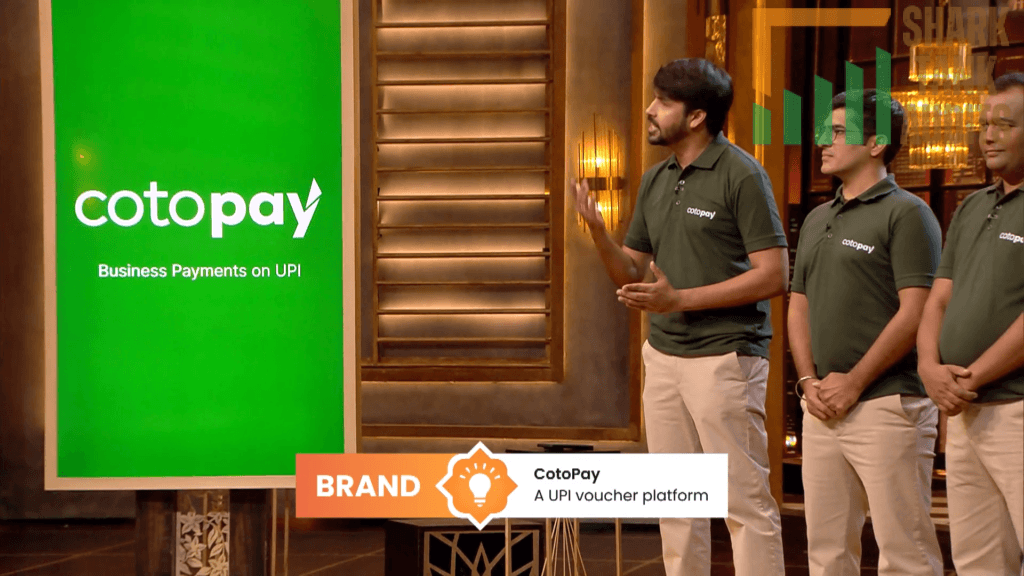
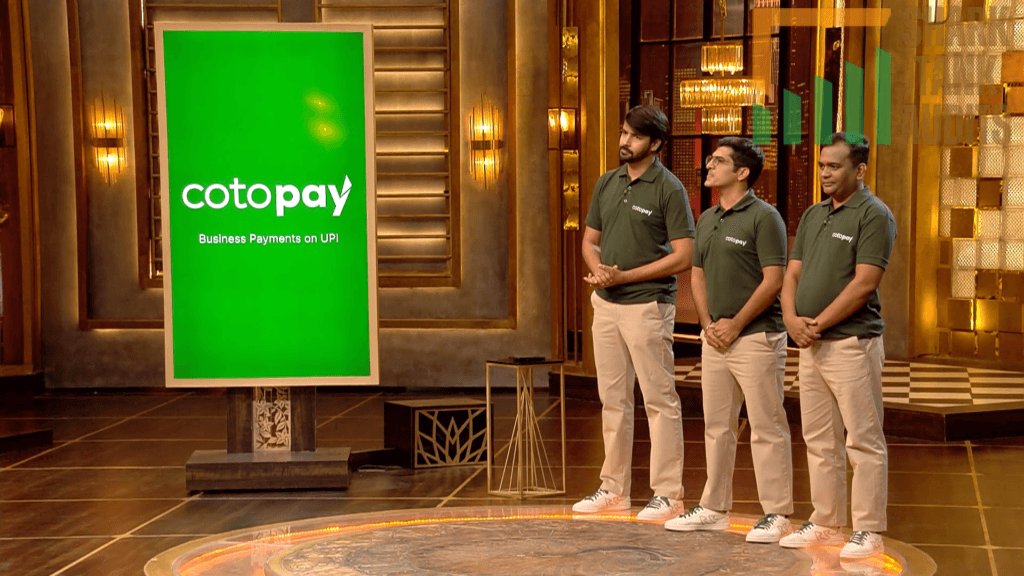
CotoPay appeared on Shark Tank India Season 5, Episode 27, with co-founders Aviral Gupta (CEO, London Business School, founding member BharatPe, National Health Authority working on CoWIN/e-RUPI framework), Vidit Sidana (CBO, IIM Ahmedabad, ex-ITC Brand Manager managing ₹7,000 Crore Sunfeast portfolio), and Uzair Syed Ahmed (CTO, 20 years experience, original Aadhaar team member, designed CoWIN architecture) seeking ₹50 lakh for 1% equity (₹50 Crore valuation) and successfully closed a deal for ₹75 lakh for 2% equity + 1% advisory (3% total) with Sharks Anupam Mittal and Kunal Bahl after intense negotiations with four Sharks making matching offers.
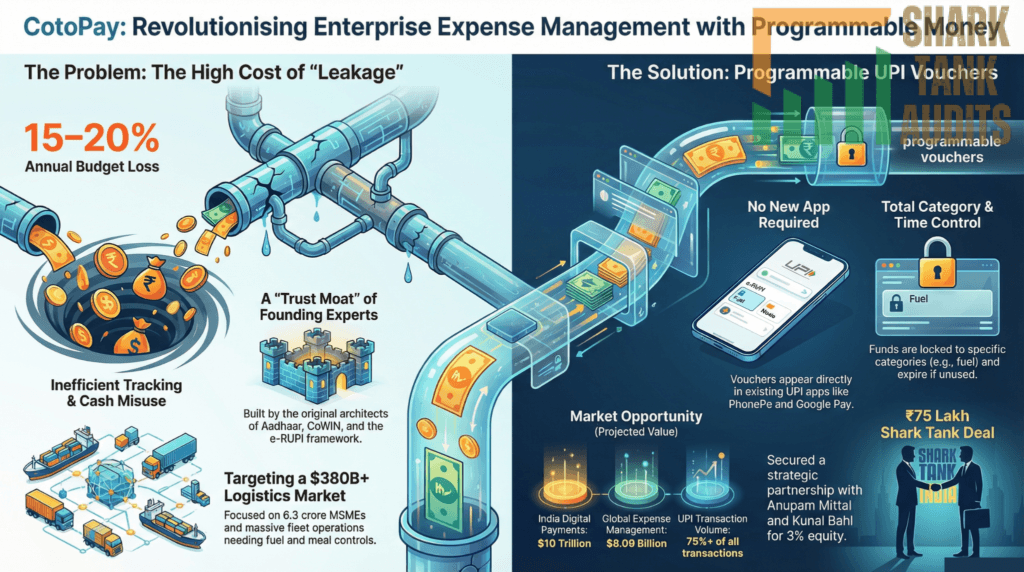
The fintech platform revolutionizes enterprise expense management using NPCI’s e-RUPI infrastructure to issue programmable digital UPI vouchers (appearing in existing Google Pay/PhonePe apps without new downloads) allowing business owners to control spending with category locking (fuel/meals/travel restrictions), time-bound expiration keeping unused funds in company account, real-time audit tracking with merchant details/digital receipts, and seamless integration with five major banks, solving “leakage” and visibility problems with 0 organic visitors requiring SEO improvement. Sharks praised founders’ “underachiever” credentials (sarcastic compliment regarding Aadhaar/CoWIN work) calling apps “well-made” and “solid assets”—Aman opted out fearing “long and painful” HR/Admin sales cycles, while Anupam/Kunal recognized massive fleet management/logistics potential seeing synergies with portfolio companies (Rapido, Zingbus).
Operating in India’s digital payments market projected at $10 trillion by 2026 (UPI 75%+ transaction volumes) within global corporate expense management valued at $9.09 billion (2026, India fastest-growing region) and India’s $380+ billion logistics market, CotoPay targets 6.3 crore registered MSMEs (top 10% digitally active) specifically fleet owners/logistics companies (50+ drivers), event management firms, and corporate finance/HR heads (30-55, Tier 1/2 hubs) addressing estimated 15-20% annual travel/field budget losses from inefficient tracking, lost receipts, and cash misuse, planning expansion into ERP integration (SAP/Oracle) for MNCs and “CotoPay Credit” offering working capital loans targeting “Soonicorn” (₹1,000+ Crore) valuation by 2028.
Website Information
- Website:- CotoPay
- Build on JavaScript libraries jQuery 3.7.1 OWL Carousel Slick Tiny Slider
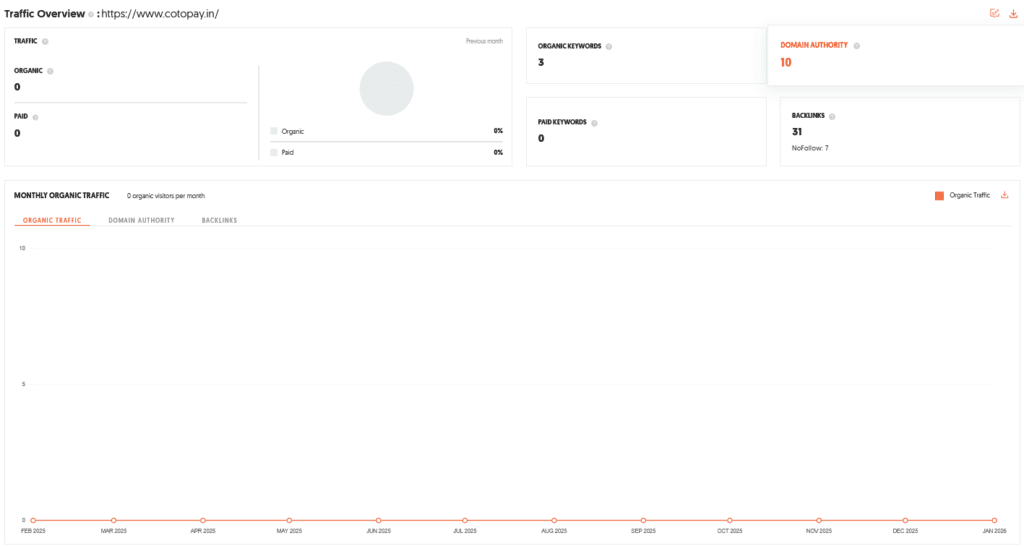
- Poor SEO Performance, SEO Improvement needed.
- ORGANIC TRAFFIC: 0 visitors per month.
CotoPay Founders
The venture was founded by a powerhouse trio with deep roots in India’s digital infrastructure:
- Aviral Gupta (CEO): An alumnus of London Business School and a founding member of BharatPe. He played a pivotal role at the National Health Authority, working on CoWIN and the initial e-RUPI framework.
- Vidit Sidana (CBO): An IIM Ahmedabad graduate and former Brand Manager at ITC, where he managed a ₹7,000 crore portfolio for Sunfeast.
- Uzair Syed Ahmed (CTO): A tech veteran with 20 years of experience who was part of the original Aadhaar team and designed the architecture for the CoWIN platform.
CotoPay Brand Overview
- CotoPay is a fintech platform designed to revolutionize expense management for Indian enterprises.
- Unlike traditional credit cards or cash-based systems, it utilizes the NPCI’s e-RUPI infrastructure to issue programmable, digital UPI vouchers.
- The brand focuses on solving the “leakage” and “visibility” problems in corporate spending by ensuring money is spent exactly where it is intended.
CotoPay Shark Tank India Appearance & Ask
- The founders appeared in Season 5, delivering a pitch that highlighted the frustrations of manual bookkeeping and lost receipts.
- Initial Ask: ₹50 lakh for 1% equity.
- Initial Valuation: ₹50 crore. The sharks were immediately impressed by the founders’ “underachiever” credentials (a sarcastic compliment regarding their work on Aadhaar and CoWIN).
Season and Episode Air Date
- Season: 05
- Episode: 27
- Episode Air Date: Tuesday, 10 February, 2026
CotoPay Product Overview
- The CotoPay solution allows business owners to issue digital vouchers directly to an employee’s phone.
- Seamless Integration: Employees do not need to download a new app; the vouchers appear in existing UPI apps like Google Pay or PhonePe.
- Control: The money stays in the company’s bank account until the moment the voucher is scanned and redeemed at a merchant.
- Usage: Employees simply scan a merchant QR code, select the voucher, and pay via UPI PIN.
CotoPay Investor Reactions
The reactions were polarized but generally respectful of the tech:
- Aman Gupta: Opted out, fearing the “long and painful” sales cycle involved in dealing with HR and Admin departments.
- Anupam Mittal & Kunal Bahl: Recognized the massive potential in “fleet management” and “logistics,” seeing immediate synergies with their existing portfolio companies like Rapido and Zingbus.
- General Sentiment: The sharks lauded the technical architecture, calling the apps “well-made” and “solid assets.”
CotoPay Customer Engagement Philosophy
- CotoPay adopts a volume-based growth strategy rather than a traditional SaaS “per-user” fee.
- Their philosophy is to remove the “tax on growth”—by not charging per head, they encourage companies to onboard their entire workforce without worrying about rising monthly subscriptions.
- They prioritize category locking (fuel, meals, travel) to build trust between employers and employees.
CotoPay Product Highlights
- Programmability: Vouchers can be restricted by category (e.g., a fuel voucher cannot be used for alcohol).
- Time-Bound: Vouchers can be set to expire after a specific duration (e.g., 3 days), with unused funds remaining in the company account.
- Real-Time Audit: Every transaction is tracked instantly on a dashboard with merchant details and digital receipts.
- Deep Integration: The platform is already integrated with five major banks to ensure funds are handled securely.
CotoPay Future Vision
- The CotoPay team aims to bridge the gap between personal UPI ease and corporate spending discipline.
- Expansion: They plan to move beyond their initial pilot clients to target massive fleet owners and event management firms.
- Market Penetration: By temporarily lowering commission barriers (as suggested by Kunal Bahl), they aim to replace legacy systems like Sodexo.
- Ecosystem Integration: Future updates include deeper integration with HRMS and ERP systems to automate accounting and compliance reporting entirely.
CotoPay Deal Finalized or Not
- Yes, a deal was finalized.
- After intense negotiations and multiple matching offers from four different sharks, the founders opted for a strategic partnership.
- Final Deal: ₹75 lakhs for 2% equity + 1% advisory equity (3% total).
- Investors: Anupam Mittal and Kunal Bahl.
| Parameter | Details |
|---|---|
| Website | CotoPay |
| Tech Stack | jQuery 3.7.1, OWL Carousel, Slick, Tiny Slider |
| SEO Status | Poor SEO Performance |
| Organic Traffic | 0 visitors per month |
| Founders | Aviral Gupta, Vidit Sidana, Uzair Syed Ahmed |
| CEO | Aviral Gupta |
| CBO | Vidit Sidana |
| CTO | Uzair Syed Ahmed |
| Founder Credentials | BharatPe founding team, Aadhaar & CoWIN architecture |
| Brand Category | Fintech / Expense Management |
| Core Concept | Programmable UPI vouchers via e-RUPI |
| Infrastructure Base | NPCI e-RUPI Framework |
| Shark Tank Season | Season 05 |
| Episode Number | Episode 27 |
| Episode Air Date | Tuesday, 10 February 2026 |
| Initial Ask | ₹50 Lakhs for 1% Equity |
| Initial Valuation | ₹50 Crores |
| Core Problem Solved | Expense leakage & lack of visibility in corporate spending |
| Product Type | Digital UPI Voucher Platform |
| App Requirement | No new app needed (Works in existing UPI apps) |
| Payment Flow | Voucher appears in Google Pay/PhonePe |
| Fund Control | Money stays in company bank until redemption |
| Usage Method | Scan merchant QR → Select voucher → Enter UPI PIN |
| Key Feature 1 | Category-based programmable vouchers |
| Key Feature 2 | Time-bound expiry controls |
| Key Feature 3 | Real-time audit dashboard |
| Key Feature 4 | Digital receipt capture |
| Bank Integration | Integrated with 5 major banks |
| Investor Reaction (Aman) | Concerned about long B2B sales cycles |
| Investor Reaction (Anupam) | Saw strong fleet/logistics synergy |
| Investor Reaction (Kunal) | Suggested lowering commission for market capture |
| Overall Shark Sentiment | Strong tech appreciation |
| Deal Status | Deal Finalized |
| Final Deal | ₹75 Lakhs for 2% Equity + 1% Advisory |
| Total Equity Given | 3% |
| Investors | Anupam Mittal & Kunal Bahl |
| Digital Payments Market | $10 Trillion by 2026 (India) |
| UPI Share | 75%+ of transaction volume |
| Leakage Problem | 15–20% expense inefficiency in Indian firms |
| TAM | 6.3 Crore registered MSMEs |
| Global Expense Mgmt Market | $9.09 Billion (2026) |
| Logistics Market | $380+ Billion (India) |
| Primary Target | Fleet & logistics companies |
| Secondary Target | Event management firms |
| Corporate Target | HR & Finance heads |
| Decision Maker Age | 30–55 years |
| Geography | Tier 1 & Tier 2 cities |
| Marketing Strategy | B2B partnerships + leakage audit tool |
| SEO Focus | e-RUPI for business, digital fuel vouchers |
| Content Strategy | LinkedIn thought leadership on programmable money |
| Distribution Channel 1 | Direct enterprise sales |
| Distribution Channel 2 | Bank white-label partnerships |
| Distribution Channel 3 | HRMS & ERP API integrations |
| Core Advantage 1 | Works within existing UPI ecosystem |
| Core Advantage 2 | Zero float risk |
| Core Advantage 3 | Purpose locking of funds |
| Key Challenge 1 | 3–6 month sales cycles |
| Key Challenge 2 | Competition from Razorpay/Sodexo |
| Key Challenge 3 | Merchant tech literacy barriers |
| Mitigation Strategy 1 | Deep exclusive banking APIs |
| Mitigation Strategy 2 | 3-month commission-free onboarding |
| Year 1 Focus | Fleet management penetration (17.8% CAGR sector) |
| Year 2 Focus | ERP integration (SAP/Oracle) |
| Year 3 Focus | Launch CotoPay Credit |
| Revenue Model | Volume-based commission (not per-user SaaS) |
| Liquidity Benefit | Funds remain in company account until use |
| Expansion Strategy | Replace legacy systems like Sodexo |
| Long-Term Vision | Bridge personal UPI ease with corporate discipline |
| Spend Automation Goal | ₹5,000 Crore annual processing |
| Take Rate Target | 1% |
| Valuation Target | ₹1,000+ Crore (Soonicorn by 2028) |
CotoPay Shark Tank India Business Plan
1. CotoPay Business Potential in India
- Digital Dominance: India’s digital payments market is projected to reach $10 trillion by 2026, with UPI accounting for over 75% of transaction volumes. CotoPay sits at the intersection of this explosion.
- The “Leakage” Gap: Indian businesses lose an estimated 15–20% of their travel and field budgets due to inefficient tracking, lost receipts, and cash misuse. CotoPay solves this at the root.
- Government Backing: With the government pushing e-RUPI for direct benefit transfers, CotoPay is the first mover in repurposing this sovereign tech for the private B2B sector.
2. CotoPay Total Addressable Market (TAM)
- The MSME Sector: India has over 6.3 crore registered MSMEs as of 2026. CotoPay can realistically target the top 10% that are digitally active.
- Corporate Expense Management: The global market is valued at $9.09 billion in 2026, with India being the fastest-growing region.
- Fleet & Logistics: India’s logistics market is a $380+ billion opportunity. CotoPay targets the specific “fuel and driver allowance” segment within this, worth billions in annual processing volume.
3. CotoPay Ideal Target Audience and Demographics
- Fleet Owners & Logistics Companies: Managing 50+ drivers who need fuel and food allowances without cash risks.
- Event Management Firms: Companies handling large temporary staff/contractors for weddings and corporate events.
- Corporate Finance/HR Heads: Professionals in IT, Manufacturing, and BFSI sectors looking to automate “per-diem” and meal allowance disbursements.
- Demographics: Decision-makers aged 30–55, residing in Tier-1 and Tier-2 hubs like Delhi-NCR, Bengaluru, and Mumbai.
4. CotoPay Marketing Strategy
- B2B Partnership Program: Collaborate with corporate travel agencies and fuel companies (HPCL, BPCL) to offer CotoPay as a value-added service.
- Lead Magnets: Offer a “Leakage Audit Tool” on the CotoPay website where CFOs can calculate how much they lose to manual expense tracking.
- Shark Tank Leverage: Use the “As Seen on Shark Tank India” badge across all marketing collateral to build instant trust with traditional business owners.
5. CotoPay Content & Digital Marketing Strategy
- SEO Overhaul: Pivot from “0 visitors” by targeting high-intent keywords like “e-RUPI for business,” “digital fuel vouchers,” and “tax-free meal allowances India.”
- LinkedIn Thought Leadership: Founders (Aviral, Vidit, Uzair) should publish weekly insights on the “Programmable Money” revolution to position CotoPay as a tech pioneer.
- Video Case Studies: Create short, 60-second reels showing a driver paying for fuel via CotoPay versus the old “torn bill” struggle to humanize the brand.
6. CotoPay Distribution Strategy
- Direct Sales Force: High-touch sales teams targeting large enterprises for custom integrations.
- Bank Partnerships: White-label or co-branded CotoPay solutions sold through the existing relationship managers of the 5 integrated partner banks.
- API-First Approach: Allow HRMS platforms (like Darwinbox or GreytHR) to plug into CotoPay directly, making it a “one-click” activation for their clients.
7. CotoPay Advantages
- No New App Needed: Unlike competitors, CotoPay works inside the UPI apps employees already love (PhonePe/Google Pay).
- Zero Float Risk: Money stays in the company’s bank account until the very second of redemption—a massive liquidity advantage for CotoPay clients.
- Purpose Locking: Total control over spending categories, preventing the “fuel money spent on movies” syndrome.
8. CotoPay Challenges
- Long Sales Cycles: Selling to HR/Admin departments can take 3–6 months.
- Competition: Tech giants like Razorpay or Sodexo could potentially pivot into the e-RUPI space.
- Tech Literacy: Small-scale merchants in rural areas may need education on accepting e-RUPI vouchers via CotoPay.
9. CotoPay Success Factors & Mitigation Strategies
- Credential Power: The founders’ Aadhaar/CoWIN background acts as a “trust moat” that competitors cannot easily replicate.
- Mitigation for Competition: Build deep, exclusive banking API integrations that create high switching costs for CotoPay users.
- Mitigation for Adoption: Offer the first 3 months “Commission Free” to allow companies to see the 15% savings before they start paying.
10. CotoPay Future Business & Roadmap to Valuation
- Phase 1 (Year 1): Focus on the 17.8% CAGR fleet management market to stabilize cash flow.
- Phase 2 (Year 2): Integrate with global ERPs (SAP/Oracle) to target MNCs, significantly increasing CotoPay’s enterprise valuation.
- Phase 3 (Year 3): Launch “CotoPay Credit”—using transaction data to offer working capital loans to the SMEs using the platform.
- Valuation Target: By automating ₹5,000 crore in annual spends at a 1% take rate, CotoPay can aim for a “Soonicorn” (₹1,000+ crore) valuation by 2028.








CotoPay Shark Tank India Episode Review