
Eight Times Eight Shark Tank India Episode Review
Eight Times Eight appeared on Shark Tank India Season 5, Episode 28, with six childhood friends and international chess players—Athul Krishna S (CEO), Abhijith Mohan (Director), Arijith Mohan (COO), Adesh Joshi (Chief Sales Officer), Manu Manikandan, and Chandar Raju—seeking investment but left with no deal after all five Sharks opted out citing business defensibility and leadership structure concerns.
Founded 2021-2022 in Cochin, Kerala, the online global chess academy EdTech platform for children ages 5-15 offers structured cognitive development through group classes (6 students, ₹7,000 for 3 months) and one-on-one coaching (₹24,000 for 27 classes) moving away from memorization toward strategic application, growing from ₹18 lakh (FY 21-22) to projected ₹2.7 Crore (FY 25-26) with presence in 30+ countries (71% India, 29% international) and 571 monthly organic visitors requiring SEO improvement. Sharks reacted cautiously—Varun declined based on EdTech sector volatility/survival rates experience, Anupam expressed concerns over online-only model and AI-driven chess engine/competitor threats, Vineeta couldn’t identify “unique element” differentiating cognitive training from other platforms, Namita advised hiring co-founder with stronger business expertise citing lack of confidence in current team’s acumen, and Kunal raised scalability concerns for niche chess-focused platform in shifting market.
Operating in global online chess instruction market valued at $270 million (2026) projected to reach $860 million by 2035 (13.13% CAGR) within Indian EdTech sector expected at $33.31 billion by 2034 (K-12 segment 43%) and 10 million kids registered on major chess platforms globally (1.5-2 million paid learners in premium instruction SOM), Eight Times Eight targets progressive educator parents (30-45, urban/metro cities, ₹1 lakh+ monthly household income), NRI parents (US/UK/Middle East seeking affordable Indian chess expertise), and children (5-15) preferring indoor/high-focus activities within India’s 580 million youth demographic (5-24 age bracket) and 900 million internet users amid rising middle-class prioritizing holistic development over rote academics and “Praggnanandhaa Effect” making chess aspirational “mind sport,” planning school partnerships B2B2C integration, AI-driven analytics tracking child focus/reasoning providing “human + AI” insights, proprietary tournament platform hosting global inter-school championships, and ₹50 Crore+ Series A valuation by 2028.
Website Information
- Website:- Eight Times Eight
- Build on JavaScript libraries jQuery 3.7.0 SweetAlert2 11 OWL Carousel Tiny Slider core-js 3.32.2 Isotope Masonry
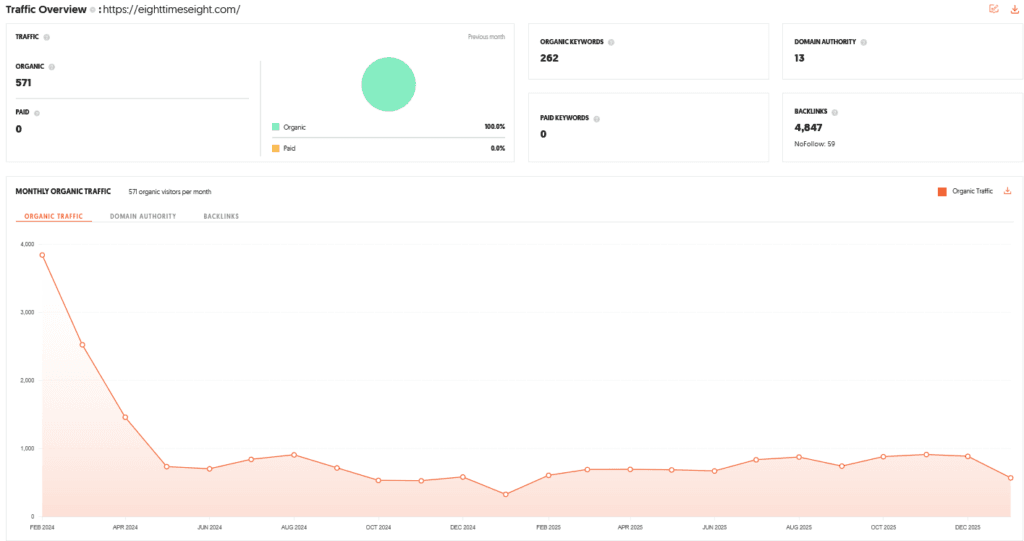
- Average SEO Performance, SEO Improvement Needed.
- ORGANIC TRAFFIC: 571 visitors per month.
Founders of Eight Times Eight
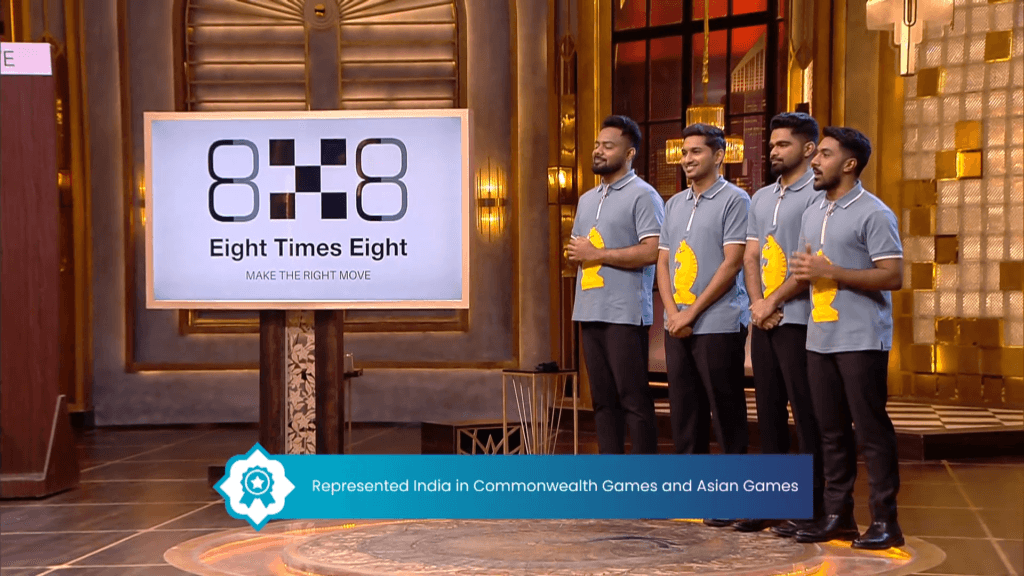
- The company was established by a group of six childhood friends and international chess players who transitioned from the board to the boardroom. The leadership team includes:
- Athul Krishna S: Co-Founder & CEO
- Abhijith Mohan: Co-Founder & Director
- Arijith Mohan: Co-Founder & COO
- Adesh Joshi: Co-Founder & Chief Sales Officer (CSO)
- Manu Manikandan: Co-Founder
- Chandar Raju: Co-Founder
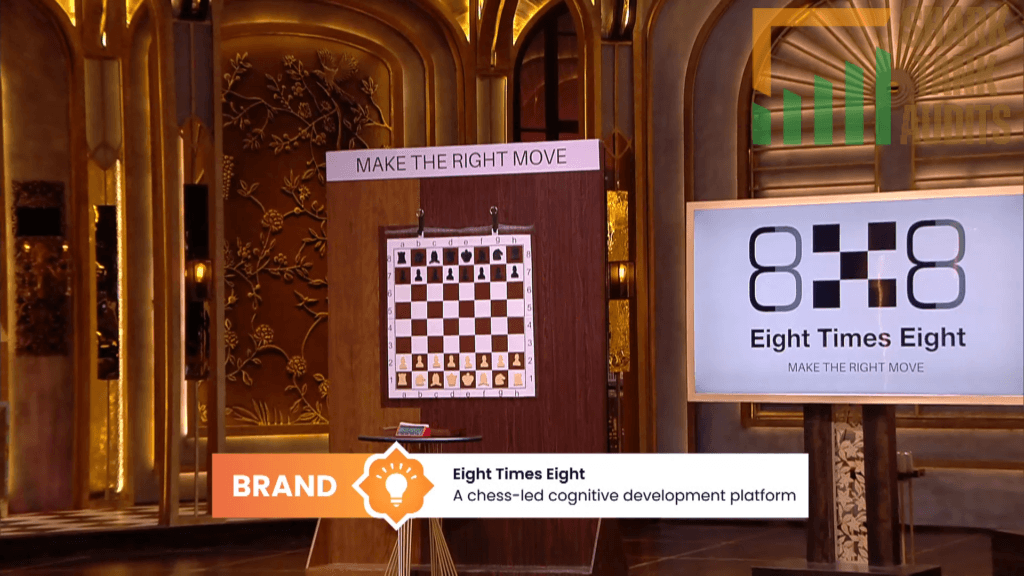
Brand Overview of Eight Times Eight
- Based in Cochin, Kerala, Eight Times Eight is an online global chess academy founded between 2021 and 2022.
- The brand operates as an EdTech platform specifically designed for children aged 5 to 15.
- Unlike traditional gaming platforms, it positions chess as a structured cognitive development tool.
- With a presence in over 30 countries, the brand bridges the gap between traditional sports coaching and modern digital education, utilizing a curriculum that ranges from beginner to advanced levels.
Shark Tank India Appearance and Ask of Eight Times Eight
- The founders appeared on Shark Tank India Season 5, Episode 28, which aired on February 11, 2026.
- They presented a pitch that reframed chess not just as a hobby, but as a “strategic chess move in EdTech.”
- The founders highlighted their impressive financial trajectory, growing from ₹18 Lakhs in FY 21-22 to a projected ₹2.7 Crores for FY 25-26.
- They sought to convince the Sharks that chess is a viable, mainstream tool for developing mental faculties in the modern education system.
Season and Episode Air Date
- Season: 05
- Episode: 28
- Episode Air Date: Wednesday, 11 February, 2026
Product Overview of Eight Times Eight
- The Eight Times Eight product is an interactive online platform offering structured chess lesson plans. The services are divided into two main formats:
- Group Classes: Small batches of 6 students to ensure peer learning and interaction.
- One-on-One Classes: Personalized coaching for intensive skill development. The curriculum is designed to be engaging and instructional, moving away from “memorization” and toward “strategic application.”
Investor Reactions to Eight Times Eight
The Sharks had varied but ultimately cautious reactions to the pitch:
- Varun Alagh: Declined based on his previous experience with the volatility and survival rates in the EdTech sector.
- Anupam Mittal: Expressed concern over the online-only model and the potential threat posed by AI-driven chess engines and competitors.
- Vineeta Singh: Could not identify a “unique element” on the website that clearly differentiated their cognitive training from other platforms.
- Namita Thapar: Advised the team to hire a co-founder with stronger business expertise to unlock their potential, citing a lack of confidence in the current team’s business acumen.
- Kunal Bahl: Raised concerns about the overall scalability of a niche chess-focused platform in a shifting market.
Customer Engagement Philosophy of Eight Times Eight
- The philosophy of Eight Times Eight centers on “Character and Cognitive Development.”
- They believe that chess naturally fosters patience, reasoning, focus, and problem-solving.
- Their engagement strategy focuses on long-term retention by convincing parents that chess is a methodical way to build life skills rather than a temporary extracurricular activity.
- Their global student split—71% India and 29% International—reflects their philosophy of making high-quality Indian chess expertise accessible to the world.
Product Highlights of Eight Times Eight
- Pricing Structure: Competitive tiers ranging from ₹7,000 for 3 months (group) to ₹24,000 for 27 classes (1-on-1).
- Global Community: A diverse learner base from over 30 countries.
- Retention: High student retention rates indicating long-term value for parents.
- Expert Tutors: Lessons delivered by international-level chess players.
Future Vision of Eight Times Eight
- The future vision for Eight Times Eight is to mainstream chess as a fundamental pillar of cognitive education.
- While they did not secure funding on the show, the brand intends to use the “Shark Tank effect” to boost credibility and client acquisition.
- Their goal is to refine their product distinctiveness and commercial positioning to reach a larger global audience, proving that the strategic thinking learned on an Eight Times Eight board translates directly to success in real life.
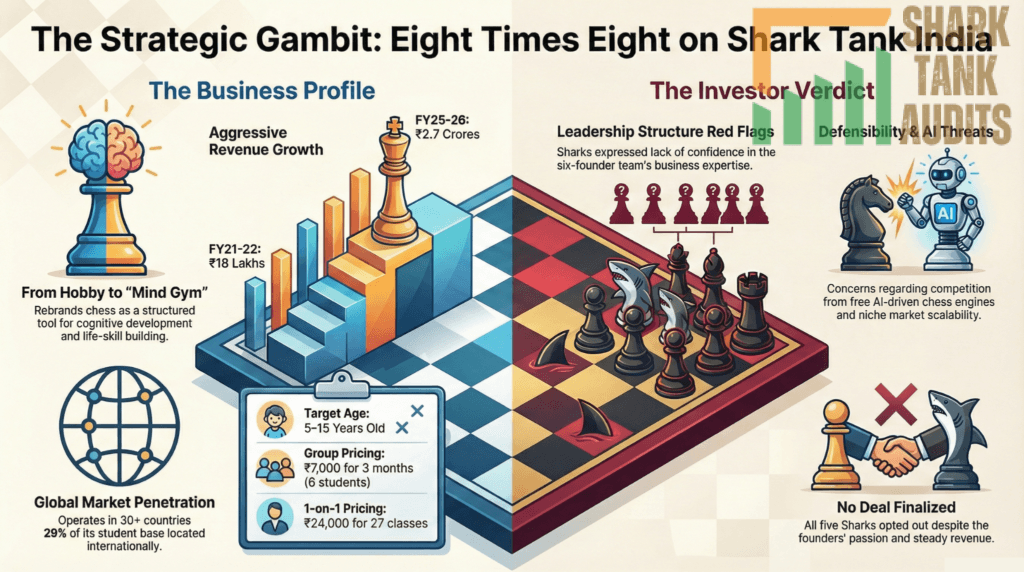
Deal Finalized or Not for Eight Times Eight
- No deal was finalized.
- Despite the founders’ passion and the company’s steady revenue growth, Eight Times Eight exited the Tank without an investment.
- The Sharks expressed several reservations regarding the business’s long-term defensibility and leadership structure, leading all five investors to opt out of making an offer.
| Parameter | Details |
|---|---|
| Website | Eight Times Eight |
| Website Technology | jQuery 3.7.0, SweetAlert2 11, OWL Carousel, Tiny Slider, core-js 3.32.2, Isotope, Masonry |
| SEO Performance | Average SEO Performance |
| Organic Traffic | 571 visitors per month |
| Headquarters | Cochin, Kerala |
| Founded | 2021–2022 |
| Founding Team Size | 6 Co-Founders |
| Co-Founder & CEO | Athul Krishna S |
| Co-Founder & Director | Abhijith Mohan |
| Co-Founder & COO | Arijith Mohan |
| Co-Founder & CSO | Adesh Joshi |
| Co-Founder | Manu Manikandan |
| Co-Founder | Chandar Raju |
| Industry | EdTech / Online Chess Academy |
| Target Age Group | 5–15 Years |
| Countries Served | 30+ Countries |
| India vs International Split | 71% India, 29% International |
| Shark Tank Season | Season 05 |
| Episode Number | Episode 28 |
| Episode Air Date | Wednesday, 11 February, 2026 |
| Revenue Growth | ₹18 Lakhs (FY21-22) → ₹2.7 Crores projected (FY25-26) |
| Business Model | Online structured chess curriculum |
| Service Formats | Group Classes (6 students) + One-on-One Coaching |
| Pricing (Group) | ₹7,000 for 3 months |
| Pricing (1-on-1) | ₹24,000 for 27 classes |
| Core Value Proposition | Chess as Cognitive & Character Development Tool |
| Key Positioning | “Brain Training” over hobby coaching |
| Shark Concern 1 | EdTech volatility (Varun Alagh) |
| Shark Concern 2 | AI competition risk (Anupam Mittal) |
| Shark Concern 3 | Lack of strong differentiation (Vineeta Singh) |
| Shark Concern 4 | Weak business leadership structure (Namita Thapar) |
| Shark Concern 5 | Scalability limits of niche model (Kunal Bahl) |
| Deal Status | No Deal |
| Customer Philosophy | Long-term cognitive development for children |
| Retention Strategy | Skill progression-based structured curriculum |
| Major Advantage 1 | Expert international-level tutors |
| Major Advantage 2 | High LTV (10+ year learning cycle) |
| Major Advantage 3 | High-margin digital model |
| Major Challenge 1 | AI-driven free chess engines |
| Major Challenge 2 | Fragmented coaching market |
| Major Challenge 3 | Brand differentiation |
| India Youth Population | 580 Million (Age 5–24) |
| India Internet Users | 900+ Million by 2026 |
| Global Online Chess Market | $270M (2026) → $860M (2035) |
| India EdTech Market | $33.31 Billion by 2034 |
| SOM (Premium Paid Learners) | 1.5–2 Million globally |
| Primary Target Audience | Urban parents (Age 30–45, SEC A/B+) |
| Secondary Target Audience | NRI parents (US, UK, Middle East) |
| Marketing Strategy | Position as “Mind Gym” |
| Growth Strategy | School partnerships (B2B2C model) |
| SEO Focus Keywords | “Best online chess academy India” |
| Performance Marketing | Meta & YouTube Ads targeting parents |
| Conversion Funnel | Free 30-min diagnostic session |
| Distribution | D2C Website + Institutional partnerships |
| AI Mitigation Strategy | Hybrid “Human + AI” performance analytics |
| Strategic Recommendation | Hire business-focused co-founder |
| Year 1 Goal | ₹5 Crores revenue |
| Year 2 Goal | Launch Masterclass (recorded content) |
| Year 3 Goal | Launch global tournament platform |
| Valuation Target | ₹50+ Crores by 2028 |
| Target Revenue Multiple | 5x–7x Revenue |
Eight Times Eight Shark Tank India Business Plan
Eight Times Eight: Business Potential in India
- Massive Youth Demographic: India possesses the world’s largest population in the 5–24 age bracket (580 million people), providing an inexhaustible pipeline for Eight Times Eight.
- Rising Middle-Class Aspirations: Indian parents are increasingly prioritizing “holistic development” over rote academics, creating high demand for skill-based EdTech like Eight Times Eight.
- The “Praggnanandhaa” Effect: The global success of Indian chess prodigies has turned chess into a aspirational “mind sport,” positioning Eight Times Eight at the forefront of a cultural trend.
- Digital Adoption: With over 900 million internet users in India by 2026, the barrier to accessing Eight Times Eight’s online platform has vanished, even in Tier 2 and Tier 3 cities.
Eight Times Eight: Total Addressable Market (TAM)
- Global Online Chess Market: The global online chess instruction and play market is valued at $270 million in 2026, projected to grow to $860 million by 2035 at a CAGR of 13.13%.
- India EdTech Market: The Indian EdTech sector is expected to reach $33.31 billion by 2034. Eight Times Eight sits within the high-growth K-12 segment, which accounts for 43% of this market.
- User Base: With over 10 million kids registered on major chess platforms globally, the Serviceable Obtainable Market (SOM) for Eight Times Eight is approximately 1.5 to 2 million paid learners in the premium instruction segment.
Eight Times Eight: Ideal Target Audience and Demographics
- Primary Audience: Parents (aged 30–45) in Urban/Metro cities (Delhi, Mumbai, Bangalore, Cochin) who are “Progressive Educators.”
- Secondary Audience: International NRI parents (US, UK, Middle East) seeking affordable yet high-quality Indian chess expertise.
- Student Demographic: Children aged 5–15 who show a preference for indoor activities, gaming, or high-focus tasks.
- Socio-Economic Group: SEC A and B+ (Monthly household income > ₹1 Lakh for domestic, Middle-income for international).
Eight Times Eight: Comprehensive Marketing Strategy
- Cognitive Branding: Move away from “Chess Coaching” to “Brain Training.” Eight Times Eight should be marketed as a gym for the mind.
- School Partnerships: B2B2C model by integrating Eight Times Eight modules into the “After School Program” (ASP) of premium private schools.
- Referral Loops: “Refer a Friend, Get a Grandmaster Session”—incentivizing current parents to become Eight Times Eight brand ambassadors.
Eight Times Eight: Content and Digital Marketing Strategy
- Search Engine Optimization (SEO): Aggressive targeting of long-tail keywords like “cognitive benefits of chess for kids” and “best online chess academy India” to improve current low organic traffic (571/month).
- Performance Marketing: Lead generation via Meta (Instagram/Facebook) and YouTube Ads targeting parents interested in “Byju’s,” “WhiteHat Jr,” and “Strategy Games.”
- Educational Content: Weekly YouTube/Instagram series: “How Chess Helped My Child in Math” featuring Eight Times Eight parent testimonials.
- Interactive Demos: Use a “Freemium” model where a 30-minute Eight Times Eight diagnostic session is free to assess the child’s current IQ/Logic levels.
Eight Times Eight: Distribution Strategy
- Direct-to-Consumer (D2C): Through the Eight Times Eight website and mobile app (built on modern JS libraries like jQuery and SweetAlert2).
- Institutional Sales: Partnering with physical sports academies and activity centers to offer Eight Times Eight as a digital-extension service.
- Global Play: Leveraging international EdTech marketplaces to list Eight Times Eight courses for the 29% international customer base.
Eight Times Eight: Advantages and Challenges
- Advantages: * Low CAC: Organic word-of-mouth in the chess community.
- High LTV: A child starting at age 5 can stay with Eight Times Eight for 10 years.
- High Margins: Digital delivery eliminates physical infrastructure costs.
- Challenges: * AI Competition: Advanced AI bots offer free learning, making it hard to justify premium Eight Times Eight fees.
- Market Fragmentation: Thousands of small, unorganized local coaches.
Eight Times Eight: Success Reasons and Mitigation Strategies
- Success Reason (Expert-Led): Six international players provide a level of credibility local tutors cannot match.
- Success Reason (Cognitive Focus): Positioning as “Development” rather than “Game” makes it a “must-have” for parents.
- Mitigation (AI Threat): Eight Times Eight must integrate AI-driven analytics that track a child’s focus and reasoning, providing “human + AI” insights that a bot alone cannot provide.
- Mitigation (Scalability): Hiring a “Business-focused” Co-Founder (as suggested by Namita Thapar) to professionalize sales and operations.
Eight Times Eight: Future Business and Valuation Roadmap
- Year 1 (Standardization): Scale revenue to ₹5 Crores by optimizing SEO and conversion funnels on the Eight Times Eight website.
- Year 2 (Productization): Launch Eight Times Eight “Masterclass”—recorded sessions by Grandmasters to create a passive, high-margin revenue stream.
- Year 3 (Gamification): Introduce a proprietary Eight Times Eight Tournament Platform to host global inter-school championships.
- Valuation Strategy: Aim for a 5x–7x Revenue Multiple by proving a 30% Year-over-Year (YoY) growth and high customer retention, targeting a Series A valuation of ₹50Cr+ by 2028.




Eight Times Eight Shark Tank India Episode Review