
Kalam Labs Shark Tank India Episode Review
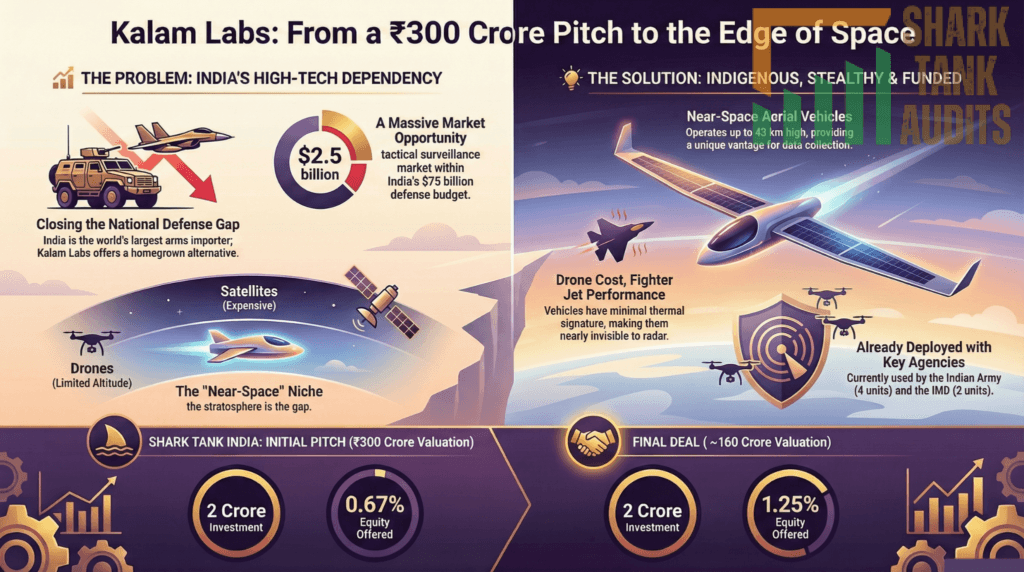
Kalam Labs appeared on Shark Tank India Season 5, Episode 3, seeking ₹2 Crore for 0.67% equity (₹300 Crore valuation). The BITS Pilani graduates—Ahmad Faraz, Sashakt Tripathi, and Harshit Awasthi—successfully closed a deal for ₹2 Crore for 1.25% equity (~₹160 Crore valuation) with Shark Aman Gupta.
Kalam Labs develops near-space aerial vehicles that reach the stratosphere (up to 43 km) for weather monitoring and military surveillance. After pivoting from a learning platform that generated ₹1.5 crore, the team has completed 60 launches in just 10 months, with 2 units deployed at IMD and 4 with the Indian Army. Their stealth vehicles feature minimal thermal signatures (nearly invisible to radar) while maintaining drone-level manufacturing costs with fighter jet performance. With a patent filed, ₹1 crore confirmed order, and ₹150 crore potential Army procurement, the founders chose nation-building over lucrative international jobs to support India’s “Make in India” defense initiative.
Kalam Labs Website Information
- Website:- Kalam Labs
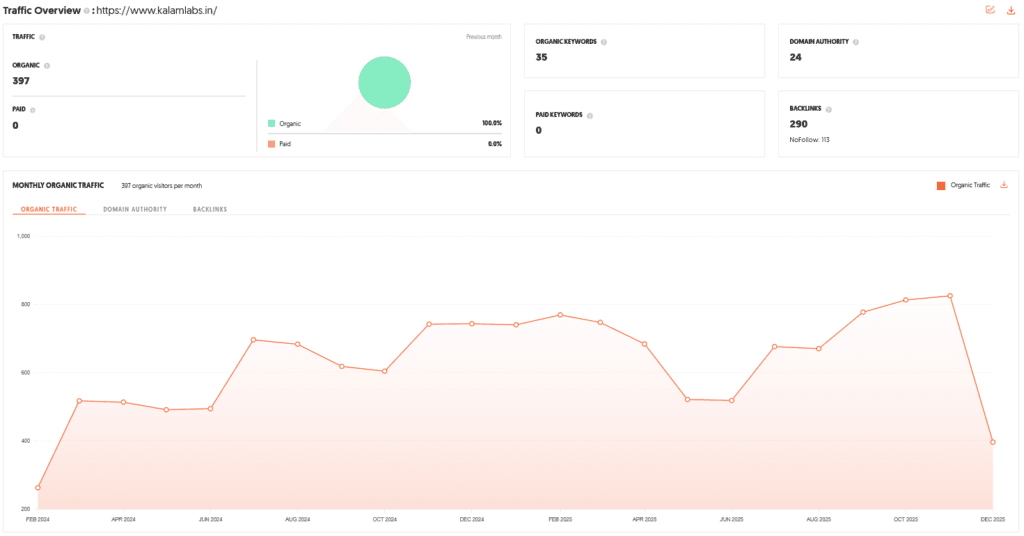
- Build on JavaScript frameworks Next.js 15.5.7 GSAP React
- Poor SEO Performance, SEO Improvement Needed.
- ORGANIC TRAFFIC: 397 visitor per month.
Kalam Labs Founders
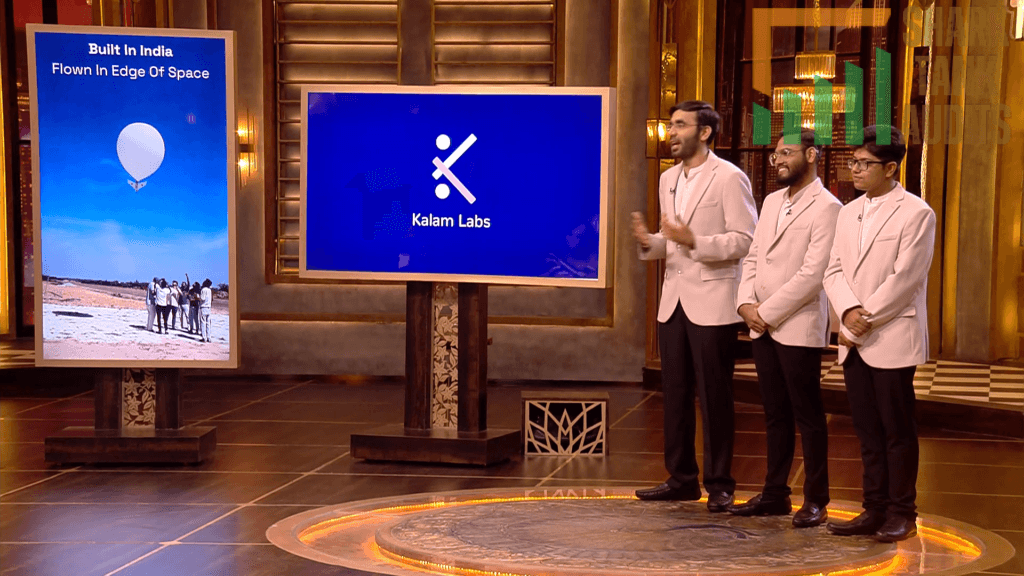
The brand was presented by three highly ambitious graduates from BITS Pilani:
The trio demonstrated strong camaraderie, having stayed together since their college days, with the founders prioritizing their venture over lucrative international job opportunities.
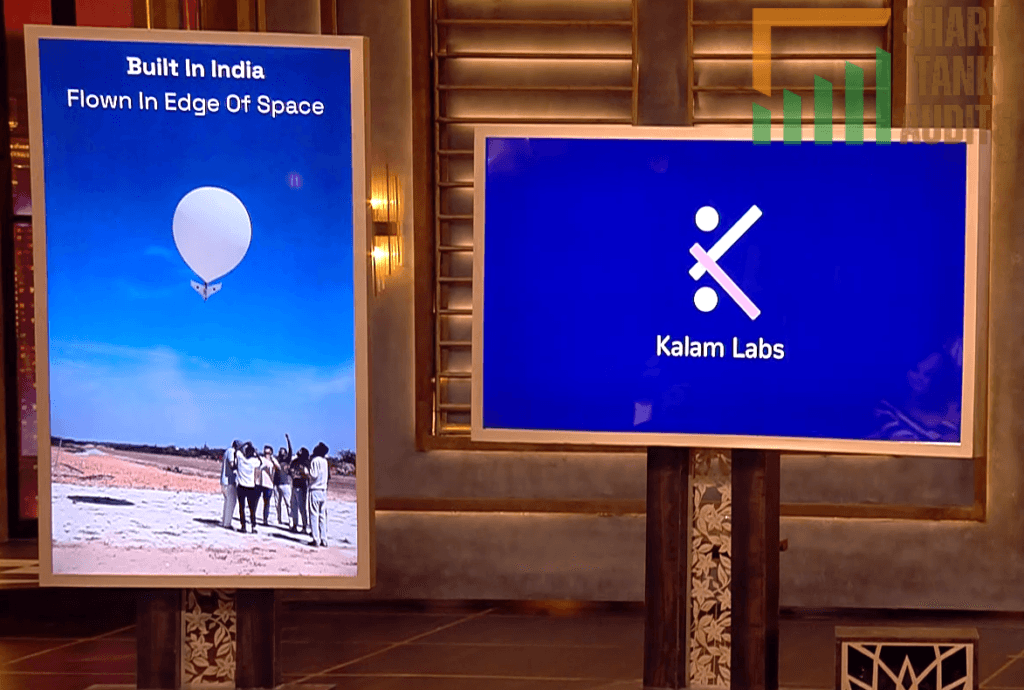
Kalam Labs Brand Overview
- Kalam Labs is a near-space aerial vehicle research lab based in India. Originally started as a space-focused learning platform (generating Rs 1.5 crore in revenue), the company pivoted to conducting high-altitude space missions.
- They focus on bridging the gap between drones and satellites by operating in the stratosphere.
Kalam Labs Shark Tank India Appearance & Ask
The founders appeared in Season 5 of Shark Tank India.
- Initial Ask: Rs 2 crore for 0.67% equity.
- Valuation: Rs 300 crore.
- The Sharks were initially stunned by the high valuation, considering the brand had only been operational in its current form for 10 months.
Kalam Labs Season and Episode Air Date
- Season: 05
- Episode: 03
- Episode Air Date: Wednesday, 07 January 2026
Kalam Labs Product Overview
Kalam Labs develops near-space air vehicles capable of reaching the stratosphere (up to 43 km above ground).
- Utility: These vehicles are used for weather monitoring and military surveillance.
- Current Deployment: They have completed 60 launches, with two units currently used by the IMD (India Meteorological Department) and four units deployed with the Indian Army.
- Cost-Efficiency: The manufacturing cost is comparable to a standard drone, but the performance rivals that of mini fighter jets.
Kalam Labs Investor Reactions
The Sharks had mixed reactions, primarily centered on the valuation:
- Mohit Yadav & Kunal Bahl: Both opted out early, citing a “disconnect” between the current reality and a valuation based on future projected sales.
- Namita Thapar: Initially interested and matched early offers, but opted out during the counter-offer stage.
- Anupam Mittal: Interested due to his previous space-tech investments but insisted on a condition that the company raise a $5 million investment round.
- Aman Gupta: Highly impressed by the founders’ commitment to “Make in India” and eventually won the deal by offering the best terms without heavy conditions.
Kalam Labs Customer Engagement Philosophy
The brand focuses on high-level institutional and governmental engagement rather than traditional retail. Their philosophy centers on:
- Frugal Innovation: Delivering space-grade technology at a fraction of the traditional cost.
- National Interest: Aiming to make the Indian military independent and technologically superior.
- Collaborative Marketing: They previously partnered with the Bollywood film Fighter to launch a space mission, showcasing their ability to merge tech with mainstream visibility.
Kalam Labs Product Highlights
- Stealth Capabilities: The vehicles have a minimal thermal signature, making them nearly invisible to radar and difficult to shoot down.
- High Altitude: Operates at the edge of space (stratosphere), providing a unique vantage point for data collection.
- Intellectual Property: A patent for their technology has already been filed.
- Proven Track Record: Already securing a Rs 1 crore order with potential procurement from the Army expected to reach Rs 150 crore.
Kalam Labs Future Vision
- The founders envision Kalam Labs as a cornerstone of Indian defense and atmospheric research.
- Their goal is to take India to the “edge of space” and provide the military with cost-effective, undetectable surveillance tools.
- With a massive procurement pipeline in sight, they aim to scale their operations to become a major player in the global aerospace and defense sector.
Kalam Labs Deal Finalized or Not
- Yes, a deal was finalized. After intense negotiations and several counter-offers between the Sharks, the founders accepted an offer from Aman Gupta.
- Final Deal: Rs 2 crore for 1.25% equity.
| Parameter | Details |
|---|---|
| Website | Kalam Labs |
| Website Technology | Next.js 15.5.7, React, GSAP |
| SEO Performance | Poor SEO performance, improvement required |
| Organic Traffic | 397 visitors per month |
| Founders | Ahmad Faraz, Sashakt Tripathi, Harshit Awasthi |
| Founder Background | BITS Pilani graduates |
| Founder Bond | College batchmates, long-term collaborators |
| Opportunity Cost | Chose startup over high-paying international jobs |
| Brand Type | Near-Space Aerial Vehicle Research Lab |
| Company Origin | Space-focused learning platform |
| Previous Revenue | ₹1.5 Crore (learning platform phase) |
| Pivot Strategy | Shifted to high-altitude near-space missions |
| Core Focus | Bridging the gap between drones and satellites |
| Operational Geography | India |
| Shark Tank Appearance | Season 5 |
| Episode Number | Episode 03 |
| Episode Air Date | Wednesday, 07 January 2026 |
| Initial Ask | ₹2 Crore for 0.67% equity |
| Initial Valuation | ₹300 Crore |
| Time in Current Business | ~10 months |
| Product Category | Aerospace / Defense Tech |
| Core Product | Near-space aerial vehicles |
| Operating Altitude | Up to 43 km (Stratosphere) |
| Product Utility | Weather monitoring & military surveillance |
| Launch Track Record | 60 successful launches |
| Government Usage | IMD (2 units), Indian Army (4 units) |
| Manufacturing Cost | Comparable to standard drones |
| Performance Benchmark | Comparable to mini fighter jets |
| Shark Initial Reaction | Shock at valuation |
| Mohit Yadav Reaction | Opted out early (valuation mismatch) |
| Kunal Bahl Reaction | Opted out early (future-based valuation) |
| Namita Thapar Reaction | Interested initially, exited during counter |
| Anupam Mittal Interest | Positive, conditional on $5M raise |
| Aman Gupta Reaction | Strongly impressed by Make in India vision |
| Winning Shark | Aman Gupta |
| Deal Finalized | Yes |
| Final Deal Amount | ₹2 Crore |
| Final Equity Given | 1.25% |
| Final Valuation | ~₹160 Crore |
| Customer Type | Institutional & Government |
| Customer Philosophy | Nation-first, mission-driven innovation |
| Engagement Model | B2G / High-level institutional contracts |
| Frugal Innovation | Space-grade tech at fraction of cost |
| National Alignment | Atmanirbhar Bharat & defense independence |
| Strategic Branding | Fighter movie space mission collaboration |
| Product Stealth Feature | Minimal thermal signature |
| Radar Visibility | Nearly invisible |
| Survivability | Difficult to shoot down |
| Data Advantage | Unique near-space vantage point |
| Intellectual Property | Patent filed |
| Proven Orders | ₹1 Crore confirmed order |
| Procurement Pipeline | ₹150 Crore potential Army order |
| Industry Gap Addressed | India’s dependence on imported defense tech |
| Indian Defense Budget | ~$75 Billion (2024–25) |
| Defense Surveillance TAM | ~$2.5 Billion |
| Earth Observation SAM | ~$600 Million |
| EO Market Growth | 15% CAGR |
| Global HAPS Market | ~$4 Billion by 2030 |
| Export Potential | High (developing nations) |
| Primary Clients | Indian Army, Indian Air Force |
| Government Agencies | IMD, ISRO |
| Secondary Clients | Telecom & Agri conglomerates |
| Decision-Maker Age Group | 30–55 years |
| Target Locations | Bengaluru, Hyderabad, Delhi-NCR |
| Marketing Philosophy | Authority & credibility over mass marketing |
| Content Strategy | Whitepapers & research publications |
| Visual Proof | Stratosphere launch videos |
| Brand Narrative | Learning platform → National security asset |
| SEO Opportunity | Near-space & defense-tech keywords |
| SEO Traffic Goal | 10k+ monthly visits |
| LinkedIn Strategy | ABM for defense officials |
| Technical Content | Interactive 3D vehicle models |
| Performance Ads | Defense & weather monitoring keywords |
| Distribution Model | Direct government procurement |
| Procurement Channel | GeM portal integration |
| Revenue Model | Data-as-a-Service (DaaS) |
| Ownership Model | Kalam Labs owns vehicles |
| Manufacturing Strategy | Hub-and-spoke near launch sites |
| Competitive Advantage | High entry barriers |
| Cost Advantage | Drone pricing, satellite-like output |
| Founder Strength | BITS Pilani technical pedigree |
| Regulatory Challenge | DGCA & ATC permissions |
| Sales Cycle Risk | 12–24 months |
| Valuation Pressure | High expectations post-show |
| Success Driver | Make in India defense mandate |
| Risk Mitigation | International diversification |
| R&D Strategy | Continuous innovation using funding |
| Phase 1 Goal | ₹150 Cr Army execution + SEO overhaul |
| Phase 2 Vision | Persistent near-space platforms |
| Phase 2 Valuation Target | ₹1,000 Cr+ |
| Phase 3 Expansion | Global defense exports |
| Long-Term Vision | Satellite replacement & 5G relay |
| Core Mission | Take India to the edge of space |
Kalam Labs Shark Tank India Business Plan
1. Business Potential of Kalam Labs in the Indian Market
- Kalam Labs Exploiting the Defense Gap: India is currently the world’s largest arms importer. Kalam Labs addresses the “Atmanirbhar Bharat” initiative by providing indigenous, low-cost alternatives to expensive foreign surveillance satellite imagery and high-altitude aircraft.
- Kalam Labs Space-Tech Growth: The Indian space economy is projected to reach $13 billion by 2025. Kalam Labs occupies the “Near-Space” niche, which is significantly cheaper than satellite deployment ($10k–$50k vs. millions of dollars).
- Kalam Labs Meteorological Impact: With the IMD seeking hyper-local weather data for disaster management, Kalam Labs vehicles offer a recurring service model for atmospheric data collection that drones cannot reach and satellites cannot pinpoint.
2. Kalam Labs Total Addressable Market (TAM) with Facts and Data
- Kalam Labs Defense TAM: The Indian Defense budget for 2024-25 is approximately $75 billion. Kalam Labs targets the tactical surveillance segment, estimated at $2.5 billion.
- Kalam Labs Satellite Services SAM: The Serviceable Addressable Market (SAM) for Earth Observation (EO) and weather data in India is growing at a CAGR of 15%, reaching roughly $600 million.
- Kalam Labs Global Reach: The global High-Altitude Pseudo-Satellite (HAPS) market is expected to hit $4 billion by 2030, giving Kalam Labs a massive export potential to developing nations.
3. Kalam Labs Ideal Target Audience and Demographics
- Kalam Labs Institutional Clients: The primary audience includes the Indian Armed Forces (Army, Air Force) and the Ministry of Defense.
- Kalam Labs Government Agencies: The India Meteorological Department (IMD) and ISRO for atmospheric research.
- Kalam Labs Corporate Demographics: Large-scale agricultural conglomerates and telecommunication companies (for potential signal relay) requiring high-altitude data.
- Kalam Labs B2B Stakeholders: Defense contractors and aerospace engineers aged 30–55 located in defense hubs like Bengaluru, Hyderabad, and Delhi-NCR.
4. Kalam Labs Marketing and Content Strategy
- Kalam Labs Authority Building: Focus on “Thought Leadership” content by publishing white papers on stratosphere research and stealth technology.
- Kalam Labs Visual Storytelling: High-definition video content of stratosphere launches (43 km altitude) to prove technical capability and “edge of space” positioning.
- Kalam Labs Strategic Partnerships: Leveraging the “Fighter” movie association to position Kalam Labs as a “cool,” patriotic, and high-tech Indian brand.
- Kalam Labs Narrative: Shifting from a “Learning Platform” legacy to a “National Security Asset” through documentary-style storytelling.
5. Kalam Labs Digital Marketing Strategy as per Ideal Audience
- Kalam Labs SEO Overhaul: Transitioning the Next.js site from 397 organic visitors to 10k+ by targeting keywords like “High Altitude Pseudo Satellites,” “Indian Defense Tech,” and “Near-Space Surveillance.”
- Kalam Labs LinkedIn Presence: Direct ABM (Account Based Marketing) campaigns targeting high-ranking defense officials and government procurement officers.
- Kalam Labs Technical Blogging: Utilizing the React/GSAP framework to create interactive 3D models of their aerial vehicles on the website to increase “Time on Page” and SEO authority.
- Kalam Labs Performance Marketing: Highly targeted Google Search ads for “Weather Monitoring Solutions” and “Border Surveillance Technology.”
6. Kalam Labs Distribution and Operational Strategy
- Kalam Labs Government Liaison: Establishing a dedicated unit for Government e-Marketplace (GeM) portal integration for seamless procurement.
- Kalam Labs Service-Based Model: Distributing hardware as a “Data-as-a-Service” (DaaS) model where Kalam Labs owns the vehicle and sells the data to IMD/Army.
- Kalam Labs Hub-and-Spoke Manufacturing: Setting up low-cost assembly units near launch sites to maintain the “drone-like manufacturing cost” mentioned on Shark Tank.
7. Kalam Labs Advantages and Challenges
- Kalam Labs Strategic Advantages:
- Low Thermal Signature: Nearly invisible to enemy radar.
- Cost Leadership: High-performance tech at drone-level pricing.
- BITS Pilani Pedigree: Strong technical foundation and founder chemistry.
- Kalam Labs Critical Challenges:
- Regulatory Hurdles: Navigating DGCA and Air Traffic Control for stratospheric flights.
- Long Sales Cycles: Government and Defense procurement can take 12–24 months.
- High Valuation Pressure: The Rs 300 Cr valuation requires rapid revenue scaling.
8. Kalam Labs Success Factors and Mitigation Strategies
- Why Kalam Labs Will Succeed: High barriers to entry in the aerospace sector and strong alignment with “Make in India” defense mandates.
- Kalam Labs Mitigation – Revenue Concentration: To avoid over-reliance on the Army, Kalam Labs should diversify into international disaster management and private climate-tech sectors.
- Kalam Labs Mitigation – Tech Obsolescence: Continuous R&D investment using the Rs 2 Crore Shark Tank funding to stay ahead of satellite imaging advancements.
9. Kalam Labs Future Business and Roadmap to Increase Valuation
- Kalam Labs Phase 1 (0-12 Months): Fulfilling the Rs 150 Cr Army procurement promise and fixing the digital SEO infrastructure to attract global investors.
- Kalam Labs Phase 2 (12-36 Months): Developing “Persistent Near-Space Platforms” that can stay in the air for weeks, increasing the valuation to Rs 1,000 Cr+.
- Kalam Labs Phase 3 (3-5 Years): Expanding to Global Defense Exports and potentially pivoting toward a “Satellite Replacement” constellation for 5G relay in remote areas.








Kalam Labs Shark Tank India Episode Review