
Shark Tank India Season 5 Episode 13 Review
Episode 13 of Shark Tank India Season 5 delivered one of the most dramatic and philosophically charged episodes of the season, featuring a rare direct competitor face-off in the fintech space that forced Sharks to articulate their investment thesis on AI versus human-led content platforms.
With two stock market research platforms pitching back-to-back—one profitable with massive organic traffic, the other AI-native with minimal traction—the episode became a referendum on the future of financial research: Should investors bet on experienced founders creating curated content, or AI-first platforms automating analysis at scale?
The stark contrast between the pitches—IIM-IIT credentials with ₹1.2 crore profit versus Super 30 graduate with 318 paid users—created one of the season’s most intense debates about scalability, defensibility, and the role of automation in professional services. Episode 13 will be remembered not for the deals made but for crystallizing the AI disruption debate in financial services, with Sharks taking opposite positions on identical market opportunities based purely on execution philosophy.
Episode Summary
Total Pitches: 2 (Unique format: Direct fintech competitor face-off)
Successful Deals: 1
Total Investment Made: ₹50 Lakh
Featured Sharks: Aman Gupta, Anupam Mittal, Kunal Bahl, and others
Pitch 1
Sovrenn Shark Tank India Episode Review
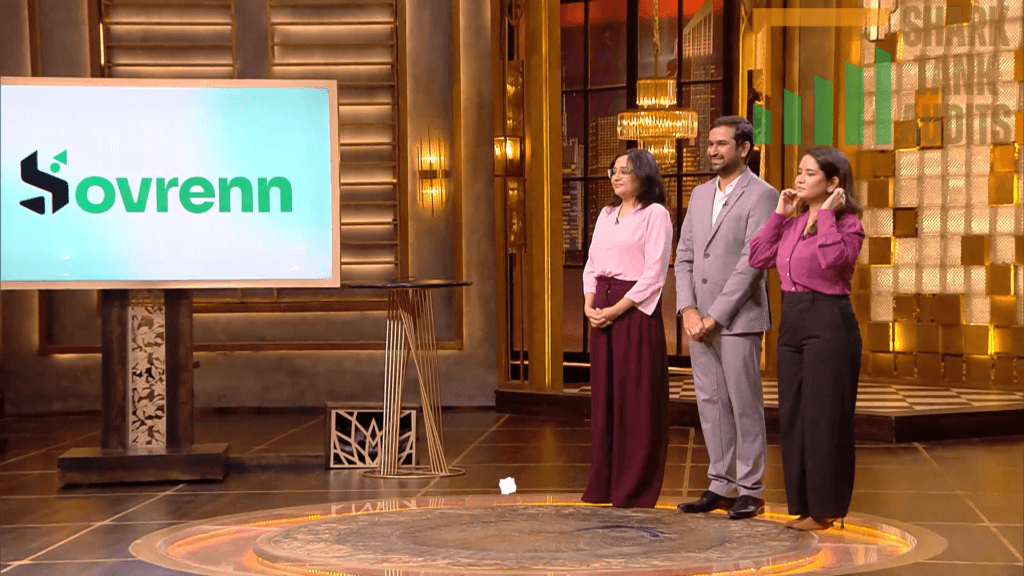
Sovrenn appeared on Shark Tank India Season 5, Episode 13, with co-founders Aditya Joshi (IIT Delhi Silver Medalist, IIM Calcutta, ex-VP Lenskart, ex-Senior VP Stanza Living), Akriti Swaroop (IIT Kharagpur, IIM Calcutta, CFA, ex-Credit Suisse/Deutsche Bank), and Apoorva Joshi (IIT Delhi, IIM Calcutta) seeking ₹1 Crore for 1% equity (₹100 Crore valuation) but left with no deal despite impressive profitability.
The Delhi-based fintech platform simplifies stock market research by transforming 1 crore pages of company filings into actionable insights through Sovrenn Discovery (logic-based stock finding), Pulse (AI-powered portfolio alerts), Education (₹10k-20k courses), and Prime (premium research). With 193,679 monthly organic visitors, 30,000+ daily active users, ₹1.2 Crore net profit on ₹4.5 Crore ARR, 40% IRR, and zero marketing spend, they achieved exceptional metrics. However, Sharks Anupam Mittal and Kunal Bahl questioned scalability of the manual “Founder-Led Content Play” versus AI competitors like Multibagg AI automating 90% of work, viewing it as lacking tech platform scalability without constant founder input. Operating in India’s exploding investor market (3 crore to 12 crore investors since 2019, 21.28 crore Demat accounts with 1 lakh daily openings, retail holding at 22-year high of 18.75% worth ₹83.6 trillion), Sovrenn targets Gen Z/millennials and experienced investors (50/50 split) in Tier 2/3 cities within $51.3 billion Indian fintech market projected for 2026.
Pitch 2
Multibagg AI Shark Tank India Episode Review
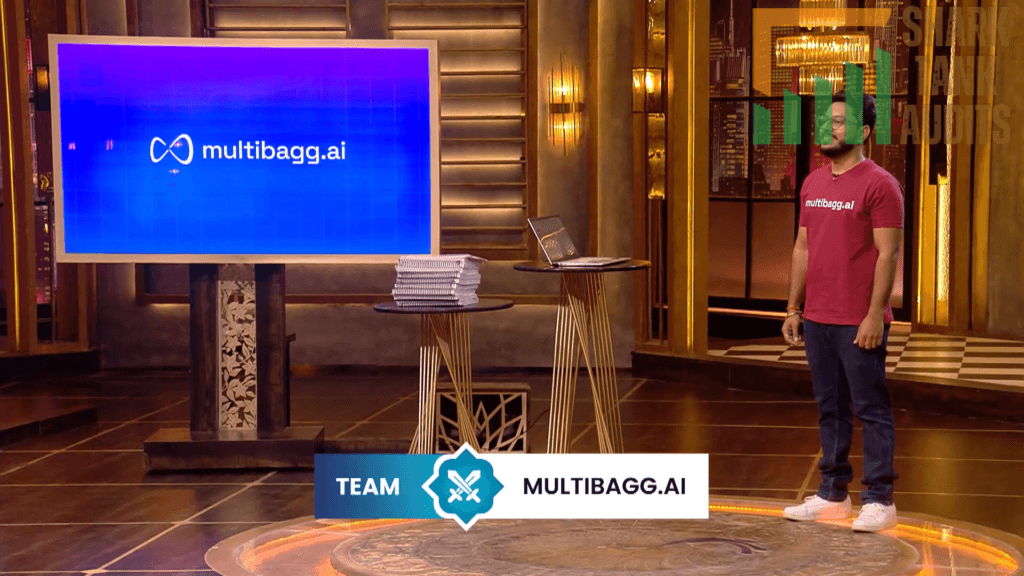
Multibagg AI appeared on Shark Tank India Season 5, Episode 13, with founder Aditya Anand from Munger, Bihar (Super 30 graduate under Anand Kumar, IIT Kanpur, American Express AI hackathon winner, ex-Goldman Sachs) seeking ₹50 lakh for 2% equity (₹25 Crore valuation) and successfully closed a deal for ₹50 lakh for 1% equity (₹50 Crore valuation, doubling his ask) with Shark Aman Gupta after a massive bidding war.
The Bengaluru-based AI-native stock market research platform launched in early 2024 uses machine learning to analyze millions of NSE/BSE documents, providing institutional-grade insights to retail investors through automated research and smart AI chatbot for verified company filing analysis, operated by just 3-person lean team with 318 premium paid users and 1,974 monthly organic visitors. Founder’s inspiring journey from family hardship (free education at mother’s school post-plague tragedy) to IIT Kanpur (topped district Class 12) to Goldman Sachs (resigned 2023) and prior funding rounds reaching ₹16.67 Crore valuation impressed Sharks who “clashed” over the opportunity. Operating in India’s booming investor market (21.28 crore Demat accounts up from 4 crore in 2020, retail holding 22-year high 18.75% of ₹84 lakh crore NSE market cap, Indian AI market at $22.85 billion with 38%+ CAGR to 2033), Multibagg targets 3.5 crore active monthly traders where 80% lose money from lack of research tools, aiming for 1 million premium users within 3 years toward ₹1,000 Crore valuation.
Episode Highlights:
- AI vs. Human debate: Direct competitor face-off forcing Sharks to choose execution philosophy
- Metrics paradox: Profitable business (₹1.2 Cr profit, 193K visitors) rejected; pre-revenue (318 users, 1,974 visitors) funded at 2x ask
- Valuation shock: Multibagg getting ₹50 Cr valuation vs Sovrenn’s rejected ₹100 Cr despite 61x less traffic
- Bidding war intensity: Massive Shark competition for AI-native platform
- Scalability thesis: Founder bandwidth limitations killing profitable business
- Inspiring founder story: Super 30 → IIT Kanpur → Goldman Sachs → AI entrepreneur
- Zero marketing achievement: Sovrenn’s 193K organic visitors with no ad spend (still insufficient)
- Platform vs. Content: Fundamental debate about what constitutes defensible fintech business
Key Lessons:
- Current profitability matters less than future scalability in tech investing
- AI automation potential valued higher than human expertise regardless of current metrics
- Founder-led content businesses face scalability skepticism even when profitable
- “Lean team” (3 people) viewed positively for AI vs. negatively implying founder dependency for content
- Organic traffic (193K) impressive but irrelevant if model doesn’t scale without founders
- Personal story (Super 30) + pedigree (IIT/Goldman) + AI timing creates investment frenzy
- Zero marketing spend paradoxically negative—suggests growth dependent on founder effort
- Automation > curation in Shark investment thesis for B2C fintech
The Great Scalability Debate:
This episode crystallized two fundamentally opposed views on scalable business models:
Content/Curation Model (Sovrenn – Rejected):
- Strengths: Proven traction (193K visitors), profitable (₹1.2 Cr), capital efficient (₹4.5 Cr ARR, 0 marketing), high IRR (40%)
- Weakness: Requires continuous founder input; content creation doesn’t scale without proportional human addition
- Shark concern: What happens when founders can’t personally create all content? Business growth caps at team capacity
- Analog: Media company, consulting firm, boutique research house
AI/Automation Model (Multibagg – Funded at 2x):
- Strengths: Scalable architecture (ML analyzing millions of documents), minimal team (3 people), infinite capacity without human scaling
- Weakness: Early traction (318 users), unproven revenue, competitive AI landscape
- Shark conviction: Can serve 1M users with same 3-person team; marginal cost near zero
- Analog: SaaS platform, true tech company, infrastructure business
Comparative Metrics Analysis:
The numbers told a shocking story:
| Metric | Sovrenn (Rejected) | Multibagg AI (Funded 2x) | Ratio |
|---|---|---|---|
| Monthly Visitors | 193,679 | 1,974 | 98x more |
| Daily Active Users | 30,000+ | Not disclosed | — |
| Paid Users | Not disclosed | 318 | — |
| Revenue | ₹4.5 Cr ARR | Minimal/none | — |
| Profit | ₹1.2 Cr | None | — |
| Marketing Spend | ₹0 | Not disclosed | — |
| Asking Valuation | ₹100 Cr | ₹25 Cr | 4x higher |
| Outcome | No deal | ₹50 Cr valuation (2x ask) | — |
The inversion: business with 98x more traffic, actual profit, and zero marketing got rejected at ₹100 Cr while business with minimal traction got funded at ₹50 Cr. This represents pure scalability premium.
Founder Credentials Comparison:
Sovrenn (3 co-founders):
- IIT Delhi Silver Medalist + IIM Calcutta
- IIT Kharagpur + IIM Calcutta + CFA + ex-Credit Suisse/Deutsche Bank
- IIT Delhi + IIM Calcutta
- Combined: Triple IIT-IIM, finance sector experience, proven execution
Multibagg AI (Solo founder):
- Super 30 (underprivileged genius program)
- IIT Kanpur (topped district)
- Goldman Sachs (AI focus)
- Narrative: Underdog overcoming adversity with AI expertise
Despite Sovrenn’s objectively superior credentials on paper, Multibagg’s combination of inspirational story + AI specialization + Goldman tech experience resonated more strongly with Sharks focused on automation potential.
Strategic Patterns:
- Automation Premium: AI scalability valued at infinite multiple over human scalability
- Current Metrics Discounted: Traction matters less than architecture when evaluating tech platforms
- Founder Dependency Risk: Multiple impressive founders viewed as risk if business requires their continuous input
- Lean Team Advantage: 3-person AI team > larger team for content, signaling efficiency
- Story + Timing: Super 30 narrative + AI moment > pure credentials
Market Context:
Both pitches operated in identical explosive market:
- Investor Growth: 3 Cr → 12 Cr investors since 2019 (4x in 5 years)
- Demat Accounts: 21.28 Cr with 1 lakh daily additions
- Retail Participation: 22-year high at 18.75% of ₹83.6 trillion (₹84 lakh Cr NSE market cap)
- Active Traders: 3.5 Cr monthly with 80% losing money (research gap)
- Fintech Market: $51.3B projected 2026
- AI Market: $22.85B with 38%+ CAGR to 2033
Both businesses addressed identical pain point (retail investors lacking institutional-grade research) in identical market (India’s democratizing stock market) with identical target (Gen Z/millennials + experienced investors). Only difference: execution philosophy (human curation vs. AI automation).
Philosophical Implications:
Episode 13 forced uncomfortable questions about future of professional services:
- Does expertise matter? Sovrenn’s CFA + IIT-IIM credentials lost to automation promise
- Is profitability premature? ₹1.2 Cr profit viewed as founder effort, not business success
- What defines “scalable”? Content requiring human input = not scalable despite digital delivery
- Should investors bet on now or later? Current performance (Sovrenn) vs. future potential (Multibagg)
- AI inevitability? Are content businesses dead if AI can approximate their output?
Episode Narrative Structure:
The episode’s power came from perfect sequencing: Sovrenn pitched first with impressive metrics, seemingly strong position, then Multibagg entered as David vs. Goliath—smaller metrics but bigger vision. The reversal of expectations (giant losing to underdog) created dramatic tension while illustrating harsh reality: in technology investing, current scale matters far less than scalability architecture.
Shark Psychology:
The bidding war for Multibagg revealed:
- Aman’s conviction: Led charge, won with 2x valuation offer
- Fear of missing out: Other Sharks competed aggressively despite minimal traction
- Narrative power: Super 30 story + Goldman pedigree created emotional connection
- AI FOMO: Sharks don’t want to miss “the next big AI platform”
- Scalability obsession: Automation potential overcame all concerns about current stage
Comparative Face-Off Outcomes This Season:
| Episode | Category | Result |
|---|---|---|
| 5 | Lab-grown diamonds | Winner-take-all (Emori funded) |
| 6 | Pet care | Both funded (different niches) |
| 13 | Fintech research | Winner-take-all (Multibagg funded) |
Episode 13 matched Episode 5’s pattern: direct substitutes (stock research platforms) resulted in Sharks choosing clear winner, while complementary approaches (Episode 6 pet care) allowed both to secure funding.
Future Implications:
- Content businesses under threat: Founder-led curation models may struggle for VC regardless of profitability
- AI premium established: Automation architecture commands valuation multiples over manual processes
- Traction discounted: Early-stage AI platforms can secure funding despite minimal users
- Lean team positive signal: Small teams for tech platforms viewed as efficiency, not limitation
- Goldman/IIT pedigree valuable: Technical backgrounds from elite institutions still matter for credibility
Episode Significance:
Episode 13 will be remembered as the episode where Shark Tank India explicitly chose AI’s future over human expertise’s present. The rejection of profitable, high-traffic Sovrenn in favor of minimal-traction Multibagg AI at higher valuation marked a watershed moment: Sharks signaling that in fintech and likely other sectors, businesses requiring proportional human scaling—no matter how profitable or well-executed—face structural investment challenges compared to automation-first alternatives. This represents fundamental shift from “prove it first” to “show us how it scales infinitely.”
The Sovrenn Tragedy:
From founders’ perspective, Sovrenn’s rejection was particularly painful:
- Built profitable business (rare achievement)
- Generated massive organic traffic (193K monthly, zero marketing)
- Achieved strong IRR (40%)
- Had impeccable credentials (triple IIT-IIM team)
- Served real market need (30K+ daily active users)
Yet walked away with nothing while AI competitor with 1/98th their traffic got funded at half their asking valuation. The lesson: execution excellence in “wrong” architecture (content/curation) loses to minimal traction in “right” architecture (AI/automation).
Closing Reflection:
Episode 13 taught the harshest lesson of Season 5: Current success means nothing if your business model doesn’t scale without you. Sovrenn’s founders likely assumed their profitability, traction, and credentials would overwhelm concerns. Instead, they discovered that Sharks evaluate not what you’ve built but what the business can become without founder dependency. Meanwhile, Multibagg’s Aditya Anand—with dramatically inferior metrics but superior scalability story—secured investment at 2x his asking valuation, proving that in the AI age, investors would rather bet on automated potential than manual proof. The episode crystallized a difficult truth: sometimes building the “right” business at the “right” time matters more than building the best business measured by traditional metrics.


Leave feedback about this
You must be logged in to post a comment.