
Shark Tank India Season 5 Episode 28 Review
Episode 28 of Shark Tank India Season 5 delivered one of the season’s most dramatic episodes, featuring the largest single-deal offer in show history, critical “red flag” warnings about brand names and business models, and passionate debates about defensibility in crowded markets. From India’s leading private theater celebration brand sparking an ₹8 crore bidding war to a blockchain real estate platform facing harsh criticism about FTX name association and regulatory grey areas, and childhood chess champions struggling to articulate unique differentiation, this episode showcased entrepreneurship navigating the delicate balance between rapid growth execution and fundamental business defensibility.
The episode raised critical questions about when excessive dilution becomes unacceptable despite massive capital offers, whether blockchain/fractional real estate creates value or exploits regulatory arbitrage, and if passion for a domain (chess) combined with technical skill (international players) can substitute for business acumen when scaling. With ₹2 crore total deployment despite an ₹8 crore mega-offer rejection and multiple complete declines, Episode 28 proved that founders increasingly prioritize ownership retention over maximum capital, trust concerns can kill deals regardless of market opportunity, and defensive moats matter more than founder credentials in commoditizable categories.
Episode Summary
Total Pitches: 3
Successful Deals: 1
Total Investment Made: ₹2 Crore (₹1 Crore equity + ₹1 Crore debt)
Featured Sharks: Varun Alagh, Anupam Mittal, Vineeta Singh, Namita Thapar, Kunal Bahl
Pitch 1
The Binge Town Shark Tank India Episode Review
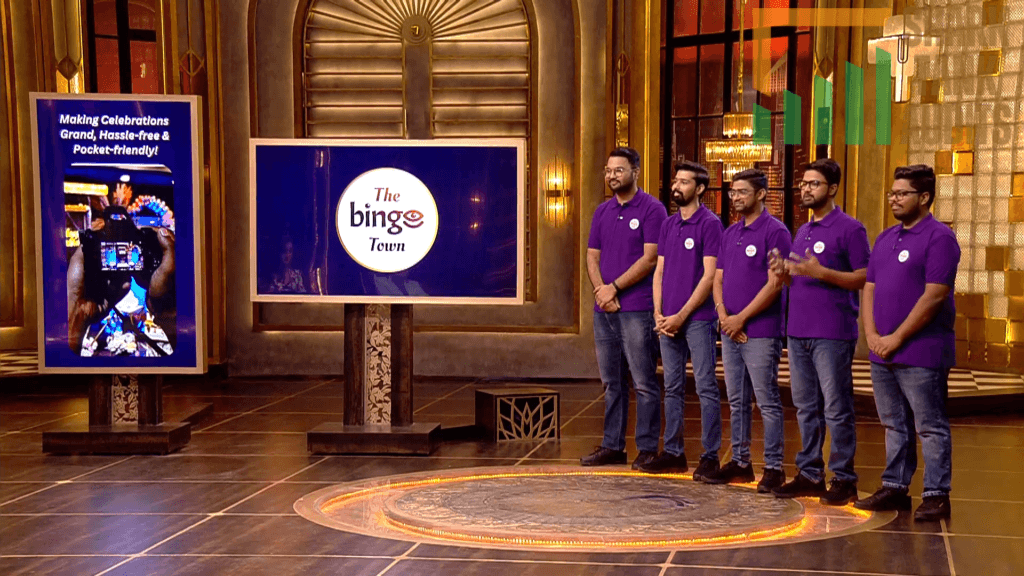
The Binge Town appeared on Shark Tank India Season 5, Episode 28, with five co-founders—Chetan Agrawal (ex-McKinsey, IIT Madras MBA, NIT Rourkela B.Tech), Yash Agarwal (BTU Cottbus M.Sc, operations/expansion), Sanketh Jain (Jain University B.Tech, customer experience), Bishnu Sahu (IIIT Allahabad B.Tech, tech integration), and Soumay Bansal (IIT Madras MBA, Delhi University BA Economics, investor relations)—seeking ₹2 Crore for 2% equity (₹100 Crore valuation) and successfully closed a deal for ₹1 Crore for 2.5% equity + ₹1 Crore debt at 15% interest for 4 years (₹40 Crore valuation) with Shark Varun Alagh after declining Anupam Mittal’s season-highest bid of ₹8 Crore for 26% equity (₹30.77 Crore valuation) citing excessive dilution.
Founded 2022 in Bengaluru, India’s leading private theater celebration brand offers intimate premium spaces for OTT content on large screens for birthdays (70% bookings), anniversaries (15%), and special occasions with packages starting ₹1,999 for 4 people (5-hour slot, decorations, snacks, 60+ menu items, themed décor), scaling from ₹60 lakh bootstrapped investment to 17 locations/64 theaters across India maintaining exceptional 82% fill rate and 15% EBITDA, growing from ₹44 lakh (FY 22-23) to ₹21.3 Crore (FY 24-25) projecting ₹27+ Crore current fiscal with ₹3 Crore expansion funded from profits and remarkable 68,665 monthly organic visitors. Sharks reacted variably—Anupam highly impressed calling them “big players” noting Shaadi.com synergy making massive strategic offer refusing equity negotiation, Vineeta compared to restaurant business citing declining repeat rates and operational heaviness concerns, Namita backed out over quality control/security standards in franchise model, Kunal praised niche-spotting but declined citing limited market size and differentiation difficulty.
Operating in India’s ₹4.3 lakh crore entertainment/media industry (2026, 8.8% CAGR) with immersive entertainment market growing 31.3% CAGR through 2033, Indian OTT market projected at $22.1 billion by 2032, and social events segment fastest-growing in ₹6.15 billion event/exhibition market (2026), The Binge Town targets Gen Z/millennials (18-35) in Tier 1/2 cities prioritizing “Instagrammable” privacy/convenience over traditional public cinemas—couples (30% base), friend groups (4-10 people), and tech-savvy individuals—within 150 million urban theater-goers (median age 27.5) amid cultural shift from material possessions to “experience-driven” memories, planning expansion to 100 theaters across 10+ cities, launching Binge Town Lite (budget-friendly) and Grand (boutique weddings/corporate events), and introducing subscription “Celebration Club” targeting 25% repeat rate aiming ₹400-500 Crore Series A valuation by 2028.
Pitch 2
PropFTX Shark Tank India Episode Review
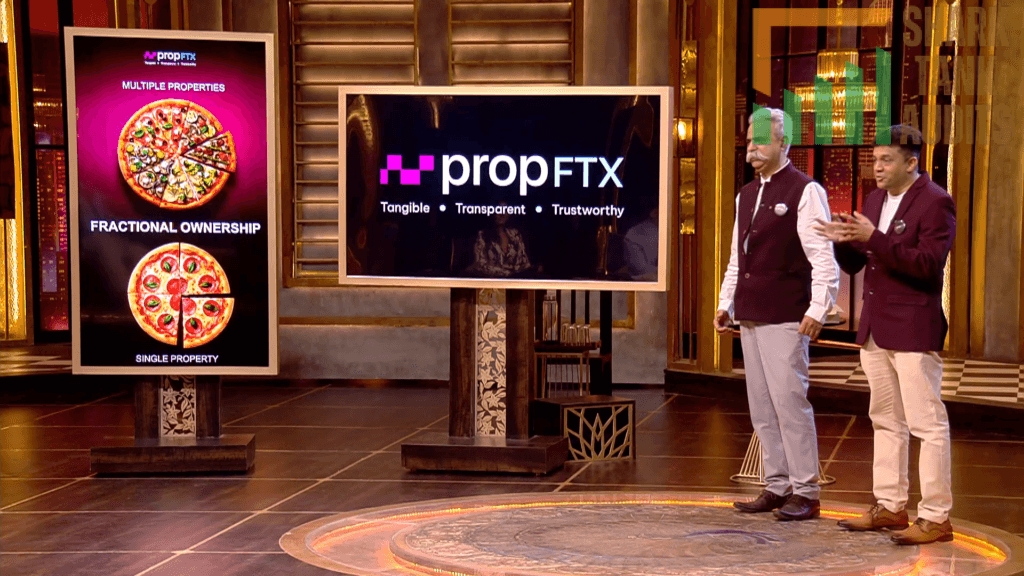
PropFTX appeared on Shark Tank India Season 5, Episode 28, with founders Rajeev Kumar Chhabra (Founder & CEO, 40 years real estate experience) and Varun Singhi (Co-Founder, 20 years Tech/Web3 expertise) alongside co-founders Sathiyanarayanan Mahadevan and Vishal Singh Rajput seeking ₹1 Crore for 1.5% equity (₹66 Crore valuation) but left with no deal after all five Sharks declined citing critical “red flags.”
Established March 2024 as Propftx Ifsc International Private Limited, the digital marketplace for fractional real estate investment uses blockchain/AI to “tokenize” property allowing individuals to own legal shares (maximum 200 fractions per regulations) of high-value assets through SPV structure earning via builder onboarding/success fees (4%) and platform/interest fees from buyers (5.5%), with AI-powered tool claiming 92% valuation accuracy (Bangalore) and 99% (Dubai), having onboarded 5 builders listing ₹66 Crore properties across 5 cities with 0 organic visitors requiring SEO improvement. Sharks raised harsh concerns—Kunal heavily criticized “PropFTX” name association with infamous FTX crypto scam creating immediate trust deficit noting refusal to rebrand suggests lack of customer-orientation/safety focus, Anupam/Namita argued Indian investors not ready for complex alternative investments lacking liquidity/secondary market, Anupam pointed out conflict of interest where primary revenue from builders incentivizes selling “overhang” (rejected) inventory versus protecting investors, and Varun noted “playing around regulations” in space lacking clear legal frameworks.
Operating in Indian real estate sector projected at $1 trillion by 2030 (13% GDP contribution by 2025-2026) with fractional segment reaching $5 billion by 2030 (25-30% CAGR) amid SEBI’s SM REIT framework (2024-2025) formalizing pooled investments ₹50-500 crore and 10 million annual urban migrants driving demand, PropFTX targets millennial wealth builders (28-42, metro cities, ₹50,000+ monthly surplus), aspirational investors affording ₹50,000-₹5 lakh “pizza-slice” ownership versus ₹2 Crore flats, NRIs (US/UAE/UK seeking blockchain-verified Indian investment), and conservative diversifiers (50+ seeking 6-9% commercial rental yields beating FDs) within $200 billion Grade-A commercial/luxury residential TAM and $10 billion “overhang” inventory/mid-sized commercial assets ($5M-$50M), planning 1 million square feet onboarding, expansion into Dubai/Singapore, AR/VR property tours, ₹1,000 Crore AUM target, and SM REIT license aiming ₹500+ Crore valuation by 2028.
Pitch 3
Eight Times Eight Shark Tank India Episode Review
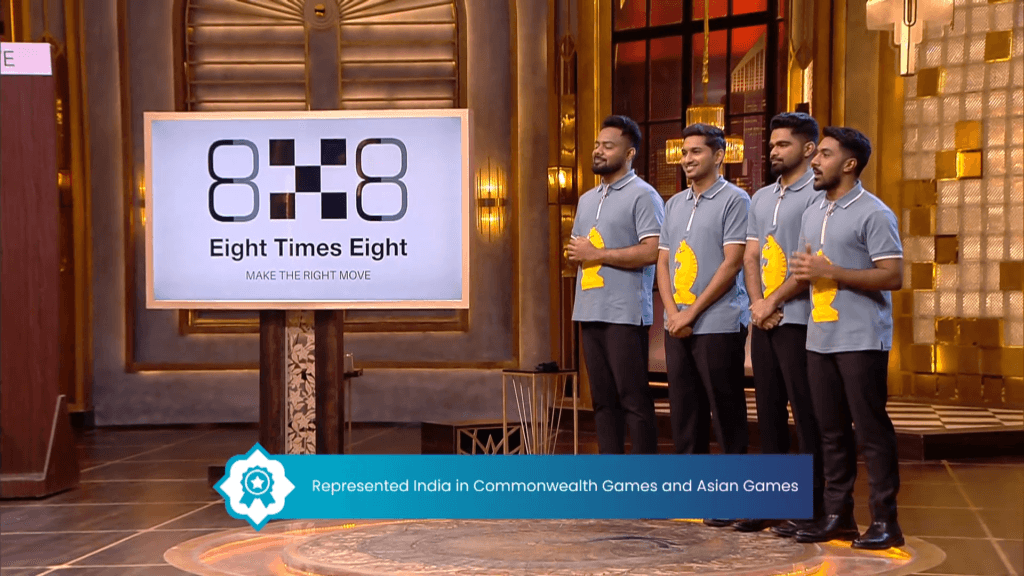
Eight Times Eight appeared on Shark Tank India Season 5, Episode 28, with six childhood friends and international chess players—Athul Krishna S (CEO), Abhijith Mohan (Director), Arijith Mohan (COO), Adesh Joshi (Chief Sales Officer), Manu Manikandan, and Chandar Raju—seeking investment but left with no deal after all five Sharks opted out citing business defensibility and leadership structure concerns.
Founded 2021-2022 in Cochin, Kerala, the online global chess academy EdTech platform for children ages 5-15 offers structured cognitive development through group classes (6 students, ₹7,000 for 3 months) and one-on-one coaching (₹24,000 for 27 classes) moving away from memorization toward strategic application, growing from ₹18 lakh (FY 21-22) to projected ₹2.7 Crore (FY 25-26) with presence in 30+ countries (71% India, 29% international) and 571 monthly organic visitors requiring SEO improvement. Sharks reacted cautiously—Varun declined based on EdTech sector volatility/survival rates experience, Anupam expressed concerns over online-only model and AI-driven chess engine/competitor threats, Vineeta couldn’t identify “unique element” differentiating cognitive training from other platforms, Namita advised hiring co-founder with stronger business expertise citing lack of confidence in current team’s acumen, and Kunal raised scalability concerns for niche chess-focused platform in shifting market.
Operating in global online chess instruction market valued at $270 million (2026) projected to reach $860 million by 2035 (13.13% CAGR) within Indian EdTech sector expected at $33.31 billion by 2034 (K-12 segment 43%) and 10 million kids registered on major chess platforms globally (1.5-2 million paid learners in premium instruction SOM), Eight Times Eight targets progressive educator parents (30-45, urban/metro cities, ₹1 lakh+ monthly household income), NRI parents (US/UK/Middle East seeking affordable Indian chess expertise), and children (5-15) preferring indoor/high-focus activities within India’s 580 million youth demographic (5-24 age bracket) and 900 million internet users amid rising middle-class prioritizing holistic development over rote academics and “Praggnanandhaa Effect” making chess aspirational “mind sport,” planning school partnerships B2B2C integration, AI-driven analytics tracking child focus/reasoning providing “human + AI” insights, proprietary tournament platform hosting global inter-school championships, and ₹50 Crore+ Series A valuation by 2028.
Episode Highlights:
- Season’s largest offer: Anupam’s ₹8 Cr for 26% (₹30.77 Cr valuation) rejected by founders
- Ownership over capital: Founders choosing ₹2 Cr at ₹40 Cr valuation over ₹8 Cr at ₹30.77 Cr
- FTX name controversy: Kunal’s harsh criticism of PropFTX brand association with crypto scandal
- Red flag unanimous rejection: All five Sharks declining despite $5B fractional real estate market
- Conflict of interest exposed: Builder revenue incentives questioned for investor protection
- Business acumen criticism: Namita advising to hire business co-founder despite chess expertise
- 82% fill rate: The Binge Town’s exceptional theater occupancy demonstrating demand validation
- 68,665 organic visitors: Among season’s highest proving word-of-mouth virality
Key Lessons:
- Founders increasingly refusing excessive dilution (26%) despite massive capital offers (₹8 Cr)
- Brand names must avoid negative associations (FTX scandal) regardless of unrelated business
- Conflict of interest (builder revenue vs. investor protection) kills trust instantly
- Domain expertise (chess champions) cannot substitute for business execution capability
- Online-only EdTech facing defensibility challenges from AI and platform commoditization
- 82% fill rate + 15% EBITDA proves private theater celebration category viability
- Regulatory grey areas (fractional real estate) facing intense Shark skepticism
- Experience economy (celebrations) outperforming traditional entertainment in Tier 1/2 cities
Deal Structure Analysis:
The Binge Town:
- Asked: ₹2 Cr for 2% (₹100 Cr valuation)
- Anupam’s Offer: ₹8 Cr for 26% (₹30.77 Cr valuation, non-negotiable)
- Got (Varun): ₹1 Cr equity for 2.5% + ₹1 Cr debt at 15% for 4 years (₹40 Cr valuation)
- Decision: Rejected ₹8 Cr to maintain ownership (2.5% vs. 26% dilution)
- Rationale: Long-term value creation > short-term capital maximization
- Validation: ₹21.3 Cr revenue, 82% fill rate, 15% EBITDA, 68,665 organic visitors
PropFTX:
- Asked: ₹1 Cr for 1.5% (₹66 Cr valuation)
- Got: No deal
- Reasons: FTX name trust deficit, builder conflict of interest, regulatory uncertainty, investor unreadiness, refusal to rebrand signaling customer-orientation failure
- Fatal Flaw: Revenue from builders creating incentive to sell bad inventory to investors
Eight Times Eight:
- Asked: [Investment amount not specified for equity %]
- Got: No deal
- Reasons: EdTech volatility, AI/competitor threats, no unique differentiation, business acumen concerns, scalability doubts in niche market
- Missing: Defensible moat beyond founder chess credentials
Strategic Patterns:
- Ownership Primacy: Founders rejecting 4x capital (₹8 Cr vs. ₹2 Cr) to avoid 10x dilution (26% vs. 2.5%)
- Trust Trumps Opportunity: FTX name association destroying $5B market opportunity
- Conflict of Interest Fatal: Revenue incentives misaligned with customer protection = rejection
- Domain Expertise Insufficient: Chess champions needing business co-founder to be fundable
- Physical Execution Valued: The Binge Town’s 17 locations/82% fill rate > PropFTX’s 0 visitors
Market Context:
- Entertainment/Media: ₹4.3L Cr (2026) at 8.8% CAGR
- Immersive Entertainment: 31.3% CAGR through 2033
- OTT Market: $22.1B by 2032 (India)
- Social Events: Fastest-growing in ₹6.15B event/exhibition market
- Urban Theater-Goers: 150M (median age 27.5)
- Real Estate: $1T by 2030 (13% GDP contribution)
- Fractional Real Estate: $5B by 2030 (25-30% CAGR)
- SM REIT Framework: ₹50-500 Cr pooled investments (SEBI 2024-2025)
- Urban Migration: 10M annually driving housing demand
- Online Chess Instruction: $270M (2026) → $860M (2035) at 13.13% CAGR
- Indian EdTech: $33.31B by 2034 (K-12 segment 43%)
The ₹8 Crore Rejection Analysis:
The Binge Town’s decision to refuse season’s largest offer revealing founder priorities:
Anupam’s Logic (₹8 Cr for 26%):
- Massive capital injection (4x asking amount)
- Strategic Shaadi.com synergy (celebrations overlap)
- Accelerated expansion to 100 theaters immediately
- Market dominance before competitors emerge
- Validation from experienced investor
Founders’ Counter-Logic (₹2 Cr for 2.5%):
- Maintain 97.5% ownership vs. 74% (26% dilution)
- Business already profitable + capital efficient (₹3 Cr expansion from profits)
- Don’t need ₹8 Cr immediately—can raise later at higher valuation
- Future Series A at ₹400-500 Cr makes 26% today existential mistake
- Control preservation more valuable than capital acceleration
The Math:
- Anupam’s Deal: 26% of ₹400 Cr (future) = ₹104 Cr investor value, founders keep 74% = ₹296 Cr
- Varun’s Deal: 2.5% of ₹400 Cr (future) = ₹10 Cr investor value, founders keep 97.5% = ₹390 Cr
- Difference: Founders gain ₹94 Cr in future value by refusing ₹7 Cr extra capital today
Lesson: When business is already profitable and capital-efficient, founders can optimize for ownership over capital, betting on future value creation exceeding immediate dilution cost.
The FTX Name Disaster:
PropFTX’s refusal to rebrand exposing fundamental business judgment failure:
The Association:
- FTX cryptocurrency exchange collapsed 2022 spectacularly
- Founder Sam Bankman-Fried convicted of fraud
- Billions in customer funds stolen/lost
- Global symbol of crypto scam and investor betrayal
PropFTX’s Similarity:
- Nearly identical name (PropFTX)
- Also involves tokenization/blockchain
- Also targeting retail investors
- Creates subconscious fraud association
Kunal’s Critique:
- Immediate trust deficit before even evaluating business
- Signaling problem: Refusing rebrand suggests ego over customer safety
- Customer-first company would change name immediately
- Stubbornness on brand despite red flag = poor judgment
What Founders Should Have Done:
- Acknowledged unfortunate timing and similarity
- Committed to rebrand before seeking investment
- Shown customer-orientation over attachment to name
- Demonstrated learning from feedback
Reality: Staying “PropFTX” despite FTX scandal = automatic disqualification regardless of business model quality.
The Builder Conflict of Interest:
Anupam exposing structural misalignment in PropFTX’s revenue model:
The Problem:
- PropFTX earns 4% onboarding fees from builders
- Primary revenue = getting builders to list properties
- Success when builders offload inventory, not when investors profit
The Incentive Misalignment:
- Builders bring “overhang” inventory (properties they couldn’t sell)
- Platform incentivized to accept these listings (4% commission)
- Investors buying fractionalized rejected properties
- Platform profits from volume, not investment quality
Proper Alignment:
- Revenue from investor returns (performance fees)
- Success fees only on profitable investor exits
- Charging investors, not builders (aligns interests)
- Platform wins when investors win
Why It Kills Trust:
- Investors need advocate protecting their interests
- PropFTX structured as builder advocate maximizing listings
- Classic principal-agent problem favoring wrong party
- No amount of blockchain/AI fixes incentive corruption
The Business Acumen Gap:
Eight Times Eight’s chess champions facing brutal reality check:
What They Had:
- Six international chess players (domain expertise)
- Childhood friends (team cohesion)
- 30+ country presence (geographic diversification)
- ₹18L → ₹2.7 Cr growth (15x revenue increase)
- Cognitive development mission (noble purpose)
What They Lacked (Namita’s Verdict):
- Business acumen (commercial strategy thinking)
- Differentiation articulation (unique value proposition)
- Defensibility against AI/platforms (competitive moat)
- Scalability roadmap beyond chess niche
- Execution confidence inspiring investor trust
Namita’s Advice:
- Hire co-founder with strong business expertise
- Admits lack of confidence in current team’s commercial capability
- Technical skill (chess) ≠ business building skill
- Need commercial complement to technical foundation
The Harsh Reality:
- Being great at chess doesn’t make you great at building chess businesses
- Domain passion cannot substitute for business execution
- Founding teams need balance: domain experts + commercial operators
- Six chess players = too much overlap, not enough diversity
Episode Thematic Coherence:
All three pitches tested different value creation hypotheses:
- The Binge Town: Experience economy (physical spaces for digital content consumption)
- PropFTX: Technology enablement (blockchain democratizing real estate access)
- Eight Times Eight: Expertise monetization (chess champions teaching online)
Success pattern: Physical execution with proven demand (Binge Town’s 82% fill rate) beats technology arbitrage with structural flaws (PropFTX’s conflicts) and expertise without business acumen (chess champions lacking commercial capability).
Comparative Episode Analysis:
Episode 28’s 33% deal rate and ₹2 Cr deployment ranks among season’s weakest:
- Matches Episodes 4, 9, 11, 26 for lowest success rate
- Features season’s largest offer (₹8 Cr) being rejected
- First pitch with 0 organic visitors (PropFTX) since very early season
- Most co-founders in single episode (5 + 4 + 6 = 15 total)
- Clearest conflict-of-interest exposure (builder vs. investor incentives)
Future Implications:
- Ownership Preservation: Founders increasingly refusing dilution despite capital offers (trend accelerating)
- Brand Name Scrutiny: Negative associations (FTX) becoming automatic disqualifiers
- Conflict Transparency: Revenue model alignment with customer interests under microscope
- EdTech Defensibility: Online education platforms needing moats beyond content delivery
- Experience Economy: Physical celebration spaces validating as category despite operational complexity
Episode Significance:
Episode 28 will be remembered for two defining moments: founders confidently rejecting ₹8 crore to maintain ownership (signaling maturation of Indian entrepreneur mindset prioritizing long-term value over short-term capital), and unanimous harsh rejection of PropFTX despite $5 billion market opportunity due to trust concerns, conflicts of interest, and regulatory uncertainty (demonstrating Sharks won’t compromise on structural integrity regardless of TAM size). The Binge Town’s decision to choose ₹2 crore at ₹40 crore valuation over ₹8 crore at ₹30.77 crore valuation represented fundamental shift in power dynamics—profitable, capital-efficient businesses can dictate terms rather than accept any capital offered. Conversely, PropFTX’s complete rejection despite experienced founders and massive market proved that no amount of Web3 buzzwords, blockchain technology, or fractional real estate hype can overcome fundamental trust deficits (FTX name), structural conflicts (builder revenue incentives), and regulatory grey areas (unclear legal frameworks). Most significantly, Eight Times Eight’s rejection despite international chess credentials taught that domain expertise alone cannot secure investment—businesses need defensible moats, unique differentiation, and most critically, founding teams with commercial acumen complementing technical passion. The episode crystallized that venture capital flows to ownership-protective profitable execution (Binge Town), rejects trust-compromised regulatory arbitrage (PropFTX), and dismisses passion without business capability (Eight Times Eight).
Closing Reflection:
Episode 28 taught three critical lessons about modern entrepreneurship and investment: First, capital is abundant but ownership is finite—The Binge Town’s ₹8 crore rejection demonstrated that profitable businesses can prioritize equity preservation over capital maximization, betting that maintaining 97.5% ownership of future ₹400 crore company exceeds short-term ₹7 crore difference. Second, trust is non-negotiable and brand names matter—PropFTX’s FTX association created insurmountable trust deficit regardless of business model quality, teaching that unfortunate naming choices can destroy billion-dollar opportunities when refusal to rebrand signals fundamental customer-orientation failure. Third, domain expertise without business acumen equals unfundable passion project—Eight Times Eight’s six international chess players learned brutal reality that being great at chess doesn’t make you great at building chess businesses, with Namita’s advice to hire business co-founder exposing the gap between technical mastery and commercial execution capability.
The episode demolished romantic notions that investors always seek maximum ownership (Anupam would rather have 26% than nothing) or that passionate founders with credentials automatically deserve funding (chess champions rejected). Instead, it revealed mature markets where profitable founders dictate terms (choosing dilution levels), investors demand structural integrity beyond opportunity size (PropFTX’s conflicts killing $5B market), and founding teams require balanced expertise (technical + commercial) to inspire execution confidence. The harsh lesson: Build profitable before raising so you can choose terms, ensure revenue incentives align with customer protection regardless of short-term optimization, and balance domain passion with business acumen because expertise monetization requires commercial capability. The Binge Town won by executing profitably first then raising on their terms. PropFTX lost by prioritizing builder revenue over investor protection. Eight Times Eight lost by having six chess experts but zero business strategists. Success requires knowing when to refuse capital, how to align incentives properly, and why balanced founding teams beat passionate specialists every time.






Leave feedback about this
You must be logged in to post a comment.