
Shark Tank India Season 5 Episode 35 Review
Aired on Friday, February 20, 2026, Episode 35 of Shark Tank India Season 5—aptly titled “Ideas That Speak Volumes”—presented a fascinating look at how technology is being harnessed to solve some of our most intimate and complex human challenges. From medical-grade tools for neurodivergent children to AI agents that claim to build software in a matter of days, the Tank was a battleground for “mission-driven” vs. “venture-scalable” philosophies.
The episode brought together a panel of Sharks—Anupam Mittal, Ritesh Agarwal, Aman Gupta, Namita Thapar, and Amit Jain—who were forced to balance their empathy for noble causes against the cold reality of business moats and medical accuracy. It was a night where a “poster child for women in tech” earned a standing ovation and a massive deal, while an “AI cry translator” faced a blunt reality check on the essence of parental intuition.
Pitch 1
SpeechGears Shark Tank India Episode Review
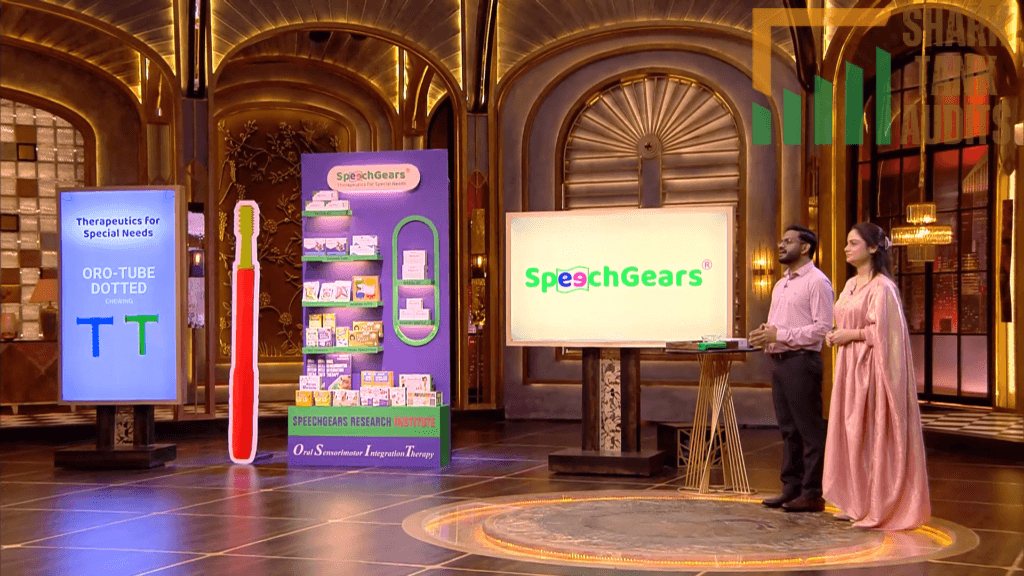
SpeechGears appeared on Shark Tank India Season 5, Episode 35, with husband-wife founders Bharat Bhushan Chandra (electronics/telecommunication engineer) and Leena Chandra (post-graduate commerce) from India (established 2022) driven by personal experience as parents of neurodiverse son Laksh seeking ₹2 Crore for 3% equity (high-valuation ask, pitch dialogue mentioned 20% but formal record indicates ₹2 Crore ask) but left with no deal though Sharks offered high praise for social impact.
The technology-enabled therapeutics platform and “Make in India” medical-grade tool manufacturer specializes in products for children with Autism Spectrum Disorder (ASD), ADHD, and speech delays offering 30+ specialized Oral Placement Therapy (OPT) tools addressing speech’s physical “hardware” (sensory tools like “Vibes”/”V-Pen” providing gentle vibration for under-sensitive muscles, jaw/tongue tools including Chewy Tubes/Grabbers for stability and Tongue Tip Tools for lateralization, feeding/oral motor tools like “Hiki-Hiki” safely opening mouths and specialized straws correcting tongue thrust, plus digital therapy kits for home use) through SpeechGears Research Institute ensuring scientific validation/world-class assessment tools with 1,513 monthly organic visitors requiring SEO improvement and recognition as frontrunner at “Make in India Legends” event. Sharks reacted with immense respect but financial caution acknowledging “mission-driven” versus “venture-scalable” business—noting therapeutic market at ~₹2,500 Crore but hardware portion remains small fraction, one offered to become customer through philanthropic initiatives declining equity, and most felt unable to align with valuation based on family-run manufacturing business projected growth.
Operating in India speech therapy services market projected at ₹21,000 Crore ($2.5 billion) by 2030 with pediatric speech/language disorder holding 38.9% share and oral-motor hardware/assistive technology segment at ₹800-1,200 Crore annually within ASD treatment market growing 9.5% CAGR amid 1-in-68 Indian children diagnosed with ASD (4+ million affected, <10% accessing structured therapeutic care) and post-pandemic 6.5% CAGR home-care therapy shift, SpeechGears targets parents of children (2-12 with ASD/ADHD/speech delay, ₹8 lakh+ household income, urban/semi-urban tech-savvy families), speech-language pathologists (SLPs), special educators, and rehabilitation centers through Integrated Therapy Model prioritizing parents as active partners via Early Intervention focus, home-based activity modules, and progress tracking replicating professional therapy exercises safely reducing child anxiety increasing practice frequency, planning SEO improvement targeting long-tail keywords (“how to use vibrating pen for speech therapy,” “best oral motor tools autism India”), “How-to” video guides reducing parent anxiety, Shark Tank Episode 35 appearance leveraging in ads establishing trust/authority, “SpeechGears Parents Circle” WhatsApp/Facebook community with in-house therapist moderation, omnichannel hybrid expansion (Amazon Medical Supplies, Apollo/MedPlus pharmacy chains), B2B institutional sales partnering 500+ therapy clinics (Tier 1/2 cities) stocking kits as “recommended home-care,” global Middle East exports (Qatar/UAE where ASD prevalence 1-in-36, therapy costs 10x higher versus India) utilizing “Make in India” tag with 60-70% cost advantage versus imported US/UK equivalents, SpeechGears AI Diagnostic App launch identifying speech delays early via voice analysis adding tech-multiplier, and “Integrated Therapeutics Ecosystem” transition (Hardware + SaaS + Research) pivoting from family business to venture-scale ₹200+ Crore valuation targeting ₹50+ Crore revenue (Year 5) with APAC/MENA expansion.
Pitch 2
Heizen Shark Tank India Episode Review
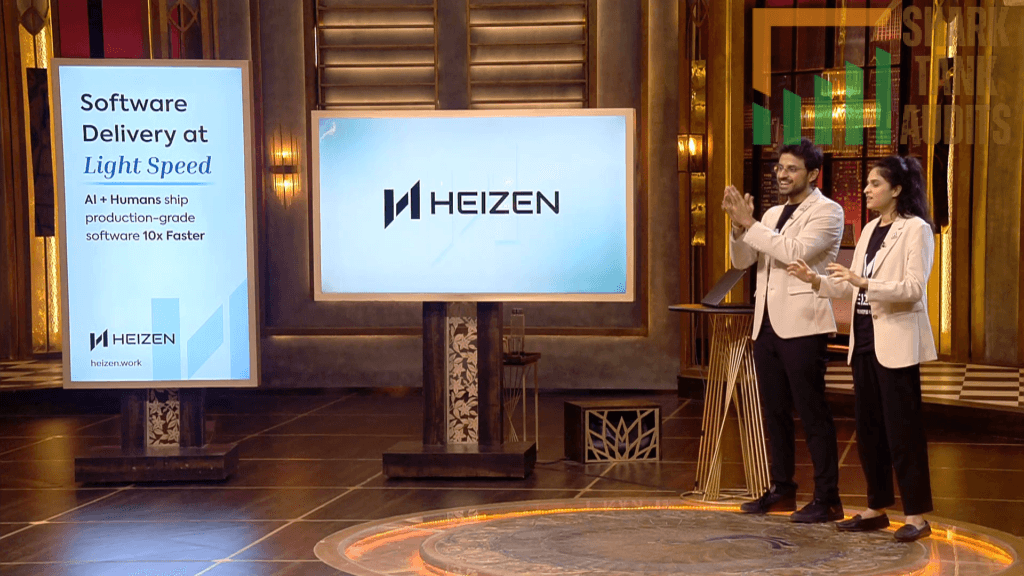
Heizen appeared on Shark Tank India Season 5, Episode 35, with Hyderabad-based founders Aman Arora and Abhilasha Mohania (female CTO commended by Sharks as potential “poster child” for women in technology, established 2024) seeking ₹90 lakh for 1% equity (₹90 Crore valuation) and successfully closed a deal for ₹90 lakh for 2% equity (₹45 Crore valuation) with Shark Amit Jain after competitive bidding war with Anupam Mittal.
The AI-powered software services/delivery platform revolutionizes traditional software development lifecycle integrating Large Language Model (LLM) driven AI agents with human engineers claiming 10x faster website/software development and 20% cost-effectiveness through “platform-driven” service model replacing slow waterfall with weekly sprint cycles offering custom MVP development (rapidly building Minimum Viable Products for startups), internal tools/automation (dashboards/productivity apps), and AI-first solutions (predictive features/intelligent automation for enterprise software), growing from ₹75 lakh (FY 24-25) to projected ₹8 Crore current year close with stellar 33% PAT, 48% EBITDA margins, 83% first-month retention rate, 20% monthly growth rate, 50+ clients since inception, 66.67% USA revenue (high LTV) with only 2% marketing spend showing strong organic demand but 335 monthly organic visitors requiring SEO improvement. Sharks reacted polarized on competitive “moat”—Aman opted out fearing talent not sustainable moat as competitors easily outbid skilled engineers, Ritesh withdrew citing margin squeeze as players replicate AI-human hybrid, Namita declined citing small average customer size and unproven long-term value, while Amit/Anupam impressed by profitability both offered identical revised deals.
Operating in India’s IT sector projected at $350 billion by late 2026 (10% national GDP) with AI market expected to reach $45 billion by 2031 and global software outsourcing growing 7.54% CAGR (AI-specific services 42% CAGR in India) within $1.5 trillion global IT services TAM and $158 billion Indian software export SAM where India accounts for 17.58% global outsourcing market, Heizen targets early/mid-stage USA/India startups requiring rapid MVP development and enterprise CTOs seeking internal tool automation reducing operational overhead among decision makers (CTOs/founders/product managers 25-45) in fintech/healthcare/e-commerce with 100,000 MSMEs embracing digitalization offering cost-effective high-speed bridge for smaller firms competing with tech giants, planning SEO improvement with Server-Side Rendering (SSR)/Metadata API integration fixing poor ratings, “Build-in-Public” case studies showcasing 6-month-to-6-week development time reduction, LinkedIn B2B thought leadership and X (Twitter) global AI developer community engagement, US incubator/VC partnerships as “Preferred Tech Partner” for portfolio companies, SaaS-Plus-Service model with proprietary Heizen Dashboard tracking weekly sprints, “Client-Get-Client” incentive referral program leveraging 83% retention, equity/ESOP program for core engineers mitigating talent loss addressing competitive market, patent/proprietary-label internal LLM-driven workflows turning “process” into “product moat” against big players like Infosys launching “Agentic AI Foundries,” proprietary “Heizen AI Agent” library subscription launch transitioning to SaaS revenue, high-compliance sector expansion (healthcare/finance) leveraging Amit Jain expertise justifying 10x-15x revenue multiple targeting ₹100+ Crore valuation.
Pitch 3
Pukaar.ai Shark Tank India Episode Review
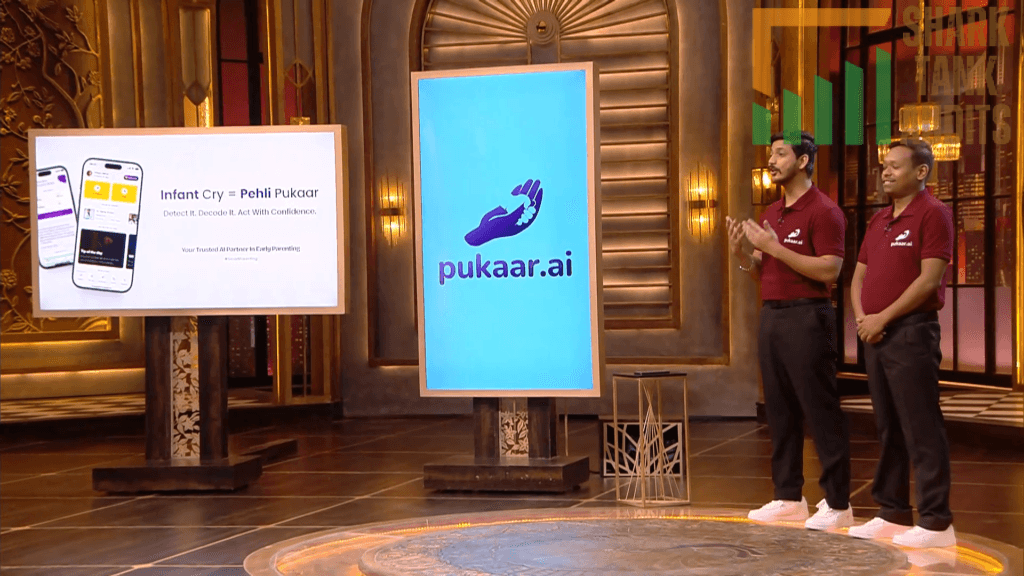
Pukaar.ai appeared on Shark Tank India Season 5, Episode 35, with Patiala-based founders Karan Birpali and Akash Dangee (IT background motivated by addressing 40% of 10 lakh Indian infant deaths due to lack of timely medical understanding) seeking ₹48 lakh for 1.5% equity (₹32 Crore valuation) but left with no deal after Sharks collectively felt business model “not investible” due to lack of scientific depth, monetization clarity, and medical trust.
The pre-revenue health-tech/parenting AI-powered assistant bridges communication gap between infants and parents through flagship AI cry decoder algorithm claiming to identify specific needs (hunger/colic/discomfort), monitoring suite tracking feeding patterns/growth/daily activities providing personalized advice, and medical integration generating weekly health reports for professional doctor review, achieving 50,000+ total app downloads (18,000+ Android, 5-star ratings on Apple App Store in small sample) trained on 80,000 augmented cry samples from MIT/BITS Mesra but only 1 monthly organic visitor requiring SEO improvement focusing on data collection/model training versus commercial sales. Sharks reacted harshly—Aman expressed deep “trust issues” suggesting founders built app simply from IT background versus solving verified problem, Namita challenged claim mothers don’t understand cries for year stating they figure it out within 15-30 days dismissing model as “very weak,” Anupam delivered harsh critique labeling “copycat model” warning adding “AI” to basic app fails in real world where medical accuracy is life-critical, Amit suggested hardware-based approach (heart rate monitors) would be more scientific, and Ritesh saw no clear “core competence” or monetization path.
Operating in global baby tech market projected at $18 billion by 2030 with Indian parenting market at $10-12 billion within 25 million annual births (world’s largest infant care market) and increasing nuclear families in urban India lacking traditional elder support creating massive demand for AI-guided reassurance amid 650+ million smartphone users providing infrastructure reaching Tier 2/3 cities where pediatricians scarce, Pukaar.ai targets first-time parents (24-35, Metro/Tier 1 cities Mumbai/Bangalore/Delhi/Patiala, ₹75,000+ monthly household income NCCS A/B) who are tech-optimists and “anxious” working couples seeking data-driven validation and pediatricians/clinics seeking digital journaling tool for remote patient monitoring within 30-40 million digital-savvy urban households targeting 5% new urban parents annually (1.25 million users) for premium subscription, planning SEO overhaul targeting long-tail keywords (“Why is my 3-month-old crying at night,” “Infant colic symptoms”), momfluencer/pediatrician Instagram partnerships building trust factor, educational short-form videos explaining augmented cry sample science, App Store Optimization leveraging 50,000+ downloads improving “Baby Cry Translator/Parenting AI” keyword rankings, B2B2C maternity hospital partnerships (Cloudnine/Apollo Cradle) including in discharge kits, e-commerce bundling with FirstCry/Mamaearth offering premium subscriptions with baby purchases, clinical validation with 95%+ accuracy rate publishing white paper/peer-reviewed medical journal study countering “weak model” critique, hardware integration with wearable heart-rate monitors adding “hard data” to cry data, Chief Medical Officer hire leading “Pediatrician Library” development, Pukaar.ai Pro subscription launch integrating 24/7 telemedicine pediatric access, smart cribs/wearables hardware creating “core competence” justifying ₹32 Crore valuation attracting Series A funding, and global expansion into South East Asia/MENA markets with similar parenting pain points.
The Episode Verdicts
Episode 35 showcased the high highs and low lows of the startup world. While one brand proved that a combination of deep technical talent and massive profitability is irresistible to the Sharks, others learned that noble intent isn’t enough to secure a cheque if the business model feels fragile or unscientific.
| Pitch | Brand | Ask | Deal Status | Shark(s) Involved |
| Pitch 1 | SpeechGears | ₹2 Cr for 3% | No Deal | Sharks lauded the social impact but felt the valuation was too high for the sector. |
| Pitch 2 | Heizen | ₹90 Lakh for 1% | ₹90 Lakh for 2% | Amit Jain won a bidding war against Anupam Mittal. |
| Pitch 3 | Pukaar.ai | ₹48 Lakh for 1.5% | No Deal | Sharks criticized the lack of medical depth and trust in the “cry decoding” model. |
Key Takeaways from the Tank
- The “Women in Tech” Triumph: Heizen was the clear standout. CTO Abhilasha Mohania was hailed as a role model, and the company’s 48% EBITDA margins led to an intense bidding war. Ultimately, the founders chose Amit Jain for his strategic experience in software services.
- The Mission vs. Multiples Dilemma: SpeechGears touched the hearts of everyone in the Tank. While the Sharks offered support and even clinical partnerships, they couldn’t justify the ₹66 Crore valuation for what they perceived as a family-run hardware business with limited venture scalability.
- The Trust Barrier: Pukaar.ai served as a cautionary tale for “AI-first” solutions in life-critical sectors. Namita and Aman were particularly skeptical, arguing that maternal intuition develops faster than any algorithm and that medical journaling without hardware data (like heart rates) lacks scientific weight.
Leave feedback about this
You must be logged in to post a comment.