
9DXR Labs Shark Tank India Episode Review
In the Shark Tank India Season 5 (Episode 16), 9DXR Labs, an immersive EdTech startup founded by Ajay Jain and Amit Shrivastava, presented their vision for the future of education. The founders sought an investment of ₹1 Crore for 4% equity to scale their “Extended Reality” (XR) platform, which uses VR headsets and advanced hand-tracking technology to provide hands-on science labs for K–12 schools. Despite a high-tech pitch featuring Meta Quest 3 devices, the startup did not secure a deal.
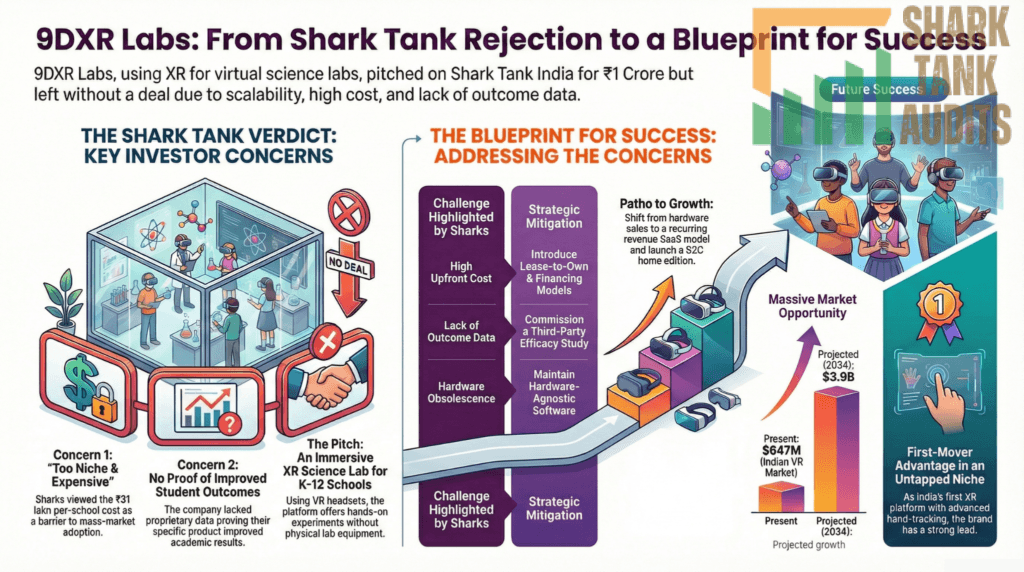
The Sharks, including Namita Thapar and Amit Jain, expressed significant concerns regarding the difficulty of scaling within the Indian school system, the high cost of implementation (₹31 lakh per school), and the lack of proprietary data proving improved student outcomes. Ultimately, while the technology was praised, the business model was deemed too niche for a mass-market investment.
9DXR Labs Website Information
- Website:- 9DXR Labs
- Build on WIX ECOMMERCE
- Poor SEO Performance, SEO Improvement Needed.
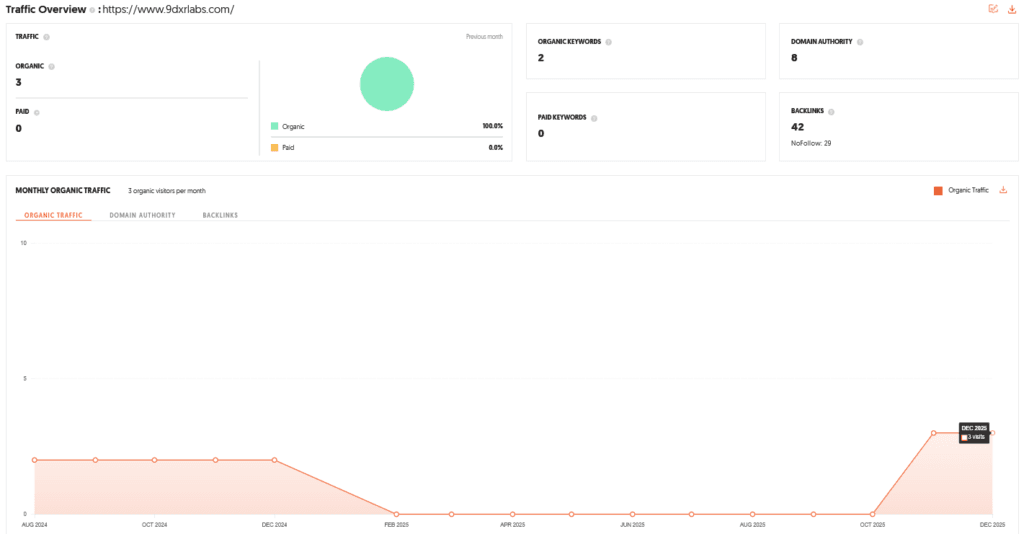
- ORGANIC TRAFFIC: 03 visitor per month.
9DXR Labs Founders
The company was founded by Ajay Jain (CEO) and Amit Shrivastava.
- Ajay Jain: An alumnus of NIT Jaipur with over 18 years of experience in technology and network transformation (formerly with Telenor).
- Amit Shrivastava: An engineering graduate from Varanasi with a background in R&D and product development at a multinational corporation.
9DXR Labs Brand Overview
- Company Name: 9DXR Labs (Developed by Drishta Technology Private Limited).
- 9DXR Labs is an innovative EdTech startup focused on transforming traditional classroom learning into an immersive, hands-on experience using India’s first Extended Reality (XR) platform.
- By leveraging VR and hand-tracking technology, the company aims to move education away from passive memorization toward active experimentation.
- Headquarters: Gurugram, India.
- Mission: To create a “future-ready” digital learning ecosystem in Indian schools by replacing limited lab equipment with fully immersive digital spaces.
- Model: A B2B solution targeting K–12 education.
9DXR Labs Shark Tank India Appearance & Ask
- Season & Episode: Season 5, Episode 16 (Aired: 27 January 2026).
- Initial Ask: ₹1 Crore for 4% equity.
- Pitch Focus: Demonstrating the use of Meta Quest 3 devices to explore human anatomy and perform science experiments using hand-tracking technology.
9DXR Labs Season and Episode Air Date
- Season: 05
- Episode: 16
- Episode Air Date: Monday, 26 January 2026
9DXR Labs Product Overview
9DXR Labs provides a “VR Lab” for schools consisting of:
- Hardware: VR headsets (currently using Meta Quest 3).
- Software: AI-guided, curriculum-aligned content for Physics, Chemistry, and Biology.
- Key Technology: Advanced Hand-Tracking (6DoF) and AI, allowing students to manipulate virtual objects without physical controllers.
9DXR Labs Investor Reactions
The Sharks expressed several critical concerns despite being impressed by the technology:
- Scalability (Namita Thapar): Noted that any model depending on school space, school staff, and the Indian school mindset is notoriously difficult to scale.
- Addressable Market (Amit Jain): Disputed the founder’s claim that 30,000 schools could afford the ₹31 lakh commitment, viewing it as a niche premium product rather than a mass-market solution.
- Outcome Data (Anupam Mittal): Criticized the lack of proprietary data proving that their specific product improves student results, rather than relying on general VR studies.
- Hardware Obsolescence (Aman Gupta): Questioned the longevity of bulky VR headsets in the face of upcoming lighter AR glasses.
9DXR Labs Customer Engagement Philosophy
- The brand operates on an “Experiential Learning Model.”
- Their philosophy is that students should not just be passive observers but “confident learners” who understand concepts through muscle memory and direct interaction.
- They focus on providing a safe, distraction-free environment where complex molecular structures or space travel can be explored firsthand.
9DXR Labs Product Highlights
- Controller-free Learning: Uses natural hand movements to mix chemicals or explore organs.
- Curriculum Aligned: Content is specifically designed to match the Indian school curriculum.
- Safety: Allows for dangerous chemistry experiments to be performed in a risk-free virtual environment.
- High Engagement: Significant increase in student involvement compared to traditional textbooks.
9DXR Labs Future Vision
9DXR Labs aims to mainstream experiential learning across India.
- Content Expansion: Growing the library to 300+ activities by next year.
- Growth Targets: Partnering with 80 more schools to reach a revenue goal of ₹10 Crores.
- Hardware Agnostic: Ensuring their platform remains compatible with evolving hardware, including upcoming devices from Samsung and Apple.
9DXR Labs Deal Finalized or Not
- No Deal.
- The founders walked out empty-handed as none of the Sharks were ready to invest in the business model at its current valuation and scale.
| Category | Details |
|---|---|
| Brand Name | 9DXR Labs |
| Company Name | Drishta Technology Private Limited |
| Website | 9DXR Labs |
| Website Platform | WIX Ecommerce |
| SEO Performance | Poor – major SEO improvement required |
| Organic Traffic | 3 visitors/month |
| Industry | EdTech / XR (Extended Reality) |
| Business Model | B2B (K–12 Schools) |
| Headquarters | Gurugram, India |
| Founders | Ajay Jain (CEO), Amit Shrivastava |
| Founder Background | Ajay Jain: NIT Jaipur alumnus, 18+ years in telecom & network transformation (ex-Telenor) |
| Co-Founder Background | Amit Shrivastava: Engineering graduate from Varanasi, R&D & product development experience |
| Mission | Build a future-ready digital learning ecosystem using immersive XR labs |
| Core Problem Solved | Lack of physical labs & passive rote learning in Indian schools |
| Core Offering | XR-based Virtual Science Labs |
| Hardware | VR Headsets (Meta Quest 3) |
| Software | AI-guided, curriculum-aligned XR content |
| Subjects Covered | Physics, Chemistry, Biology |
| Key Technology | VR, AI, 6DoF Hand-Tracking |
| Unique Feature | Controller-free learning using natural hand movements |
| Learning Philosophy | Experiential learning through muscle memory & interaction |
| Shark Tank Season | Season 5 |
| Episode Number | Episode 16 |
| Episode Air Date | Monday, 26 January 2026 |
| Initial Ask | ₹1 Crore for 4% equity |
| Implied Valuation | ₹25 Crores |
| Pitch Highlight | Live demo of human anatomy & chemistry experiments using XR |
| Cost per School | ₹31 Lakhs (multi-year setup) |
| Investor Interest | Technology appreciated, business model questioned |
| Namita Thapar’s Concern | Difficult scalability within Indian school systems |
| Amit Jain’s Concern | Addressable market too small for premium pricing |
| Anupam Mittal’s Concern | No proprietary data proving improved learning outcomes |
| Aman Gupta’s Concern | Risk of VR hardware becoming obsolete vs AR glasses |
| Deal Status | ❌ No Deal |
| Current Customers | Limited partner schools (exact count undisclosed) |
| Customer Engagement Model | Experiential, distraction-free immersive learning |
| Product Highlights | Risk-free experiments, curriculum-aligned, high engagement |
| Safety Advantage | No chemical or lab accident risks |
| Indian Market Opportunity | VR market: $647.6M (2025) → $3.9B by 2034 |
| Policy Tailwind | NEP 2020 supports experiential & tech-integrated learning |
| Infrastructure Gap | Thousands of schools lack physical lab facilities |
| TAM | ~1.5 million K-12 schools in India |
| SAM | ~400,000 private unaided schools |
| SOM | ~30,000 premium schools (fees ₹50k+/year) |
| Target Decision Makers | School principals, trustees, directors |
| End Users | Students aged 10–18 (Grades 6–12) |
| Parent Influence | High-income, tech-aware parents |
| Ideal Geography | Tier-1 & Tier-2 cities (NCR, Mumbai, Bengaluru, Hyderabad) |
| SEO Strategy Needed | Keywords like “VR Science Lab for Schools”, “XR Education India” |
| Content Strategy | Demo videos, case studies, webinars |
| Sales Strategy | High-touch B2B sales aligned with school budget cycles |
| Distribution Model | Hub-and-spoke demo centers + direct sales |
| Competitive Advantage | First-mover in hand-tracking XR education |
| Long-Term Cost Advantage | Cheaper than maintaining physical labs over 4 years |
| Key Challenges | High upfront cost, teacher resistance, outcome data |
| Mitigation Strategy | Leasing models, hardware-agnostic platform, certified teacher training |
| Short-Term Goal | Partner with 80 schools |
| Revenue Target | ₹10 Crores |
| Content Roadmap | Expand from 200 to 500+ modules |
| Future Expansion | B2C Home Edition + global markets |
| Valuation Growth Driver | Shift from hardware sales to SaaS licensing |
| Long-Term Vision | Make experiential XR learning mainstream in Indian education |
9DXR Labs Shark Tank India Business Plan

Business Potential in India: 9DXR Labs
The Indian EdTech market is witnessing a “Phygital” shift, where physical infrastructure is being enhanced by digital layers.
- Market Boom: The Indian Virtual Reality market was valued at $647.6 Million in 2025 and is projected to explode to $3.9 Billion by 2034, growing at a CAGR of 22.26%.
- Education Spend: With over 250 million students in India, the government’s National Education Policy (NEP) 2020 explicitly advocates for experiential and tech-integrated learning, providing a strong tailwind for 9DXR Labs.
- Infrastructure Gap: Thousands of Indian schools lack the budget for physical labs (chemicals, specialized glassware, anatomical models). 9DXR Labs solves this by providing 200+ experiments in a one-time hardware setup.
Total Addressable Market (TAM): 9DXR Labs
To validate 9DXR Labs’ potential, we break down the market:
- Total Addressable Market (TAM): ~1.5 Million schools in India (Total K-12).
- Serviceable Addressable Market (SAM): ~400,000 Private Unaided Schools.
- Target Market (SOM): The top-tier segment of 30,000+ schools that charge fees above ₹50,000/annum.
- Fact: Urban private school fees in India have risen by 169% in the last decade, indicating a high willingness of parents to pay for “premium” tech-enabled education.
Ideal Target Audience & Demographics: 9DXR Labs
The 9DXR Labs model involves a complex B2B2C sales cycle:
- Primary Decision Makers: School Principals, Trust Chairpersons, and Directors of private K-12 schools (Tier 1 & Tier 2 cities).
- Primary Users: Students aged 10–18 (Grades 6–12) who require hands-on science practice for competitive exams (JEE/NEET).
- Influencers: Tech-savvy parents (Ages 30–50) looking for safe, high-tech extracurricular value-adds.
- Demographics: High-income households ($15k+ annual income) in metropolitan hubs like Delhi-NCR, Bengaluru, Mumbai, and Hyderabad.
Marketing & Digital Strategy: 9DXR Labs
Currently, 9DXR Labs has a “poor” organic footprint (3 visitors/month). The following strategy is required:
Digital Marketing Strategy for 9DXR Labs
- SEO Overhaul: Target high-intent keywords like “VR Science Lab for Schools,” “XR Education India,” and “Virtual Chemistry Experiments.”
- LinkedIn Thought Leadership: Founders must leverage their 18+ years of tech experience to publish white papers on “The ROI of VR in Indian Classrooms.”
- Performance Marketing: Run Geo-fenced LinkedIn and Meta ads targeting “School Administrators” and “Science HODs” within a 20km radius of elite schools.
Content Strategy for 9DXR Labs
- “See it to Believe it” Videos: Short-form reels showing students interacting with 3D human lungs or mixing virtual chemicals without goggles/gloves.
- Case Studies: Video testimonials from the 7 current partner schools highlighting improved test scores.
- Webinars: Monthly “EdTech Transformation” sessions for school owners to lower the “barrier of fear” regarding VR hardware.
Distribution & Sales Strategy: 9DXR Labs
- The Hub-and-Spoke Model: Establish demo centers in major educational hubs (Kota, Bengaluru) where school boards can experience the 9DXR Labs platform.
- Direct Sales Force: High-touch B2B sales team focused on annual school budget cycles (Jan–March).
- Channel Partners: Collaborate with school furniture and book distributors who already have “feet on the ground” in 1,000+ schools.
Advantages & Success Factors: 9DXR Labs
- First-Mover Advantage: Being India’s first XR platform with advanced hand-tracking gives 9DXR Labs a significant lead in brand recall.
- Cost Efficiency (Long-term): A ₹31 lakh 4-year commitment is often cheaper than maintaining physical labs with recurring chemical/equipment costs for 2,000+ students.
- Safety: Zero risk of chemical burns or laboratory accidents, allowing for more “audacious” experimentation.
Challenges & Mitigation Strategies: 9DXR Labs
| Challenge for 9DXR Labs | Mitigation Strategy for 9DXR Labs |
| High Upfront Cost (₹13.5L) | Introduce a Lease-to-Own model or partner with NBFCs for “Education Tech Loans.” |
| Hardware Obsolescence | Maintain a Hardware-Agnostic software layer that works on Meta, Apple, or Samsung devices. |
| Teacher Resistance | Provide 9DXR Labs Certified Training and an “Auto-Pilot” mode where the AI guides the student. |
| Lack of Outcome Data | Commission a Third-Party Efficacy Study with a recognized Indian university (e.g., IIT or NIEPA). |
Future Roadmap & Valuation Growth: 9DXR Labs
To increase valuation and address the “Shark” concerns, 9DXR Labs must follow this path:
- Phase 1 (Year 1): Focus on Content. Expand from 200 to 500+ modules, covering regional boards beyond CBSE/ICSE.
- Phase 2 (Year 2): Launch 9DXR Labs Home Edition. A subscription-based app for students who own personal VR headsets, shifting from pure B2B to B2C.
- Phase 3 (Year 3): Global Expansion. Localize content for the Middle East and SE Asia markets where educational infrastructure spending is high.
- Valuation Driver: Move from “Hardware Sales” to SaaS (Software as a Service). Aim for a 70% recurring revenue mix through content licenses.





9DXR Labs Shark Tank India Episode Review