
Indian School of Calisthenics Shark Tank India Episode Review
Indian School of Calisthenics appeared on Shark Tank India Season 5, Episode 23, with co-founders Shubham Mishra (7+ years experience, mentored 150 elite athletes, trained 5,000+ individuals) and Joel Prince (extreme endurance feats like 3,000 push-ups in 2.5 hours, coached 2,000+ students including celebrities) seeking ₹75 lakh for 5% equity (₹15 Crore valuation) but left with no deal after all Sharks backed out citing multiple concerns.
Established 2022 in Mumbai, the specialized bodyweight-only training academy focuses on functional strength, mobility, balance, and body control versus machine-based workouts, offering membership-based professional coaching (silver/gold/platinum/annual tiers ₹7,000-₹75,000) at Goregaon/Malad centers with structured progression plans, injury prevention personalization, and community workshops, scaling from ₹24 lakh (FY 22-23) to projected ₹1.68 Crore (FY 25-26) maintaining healthy 35% EBITDA with 8,362 monthly organic visitors. Sharks criticized extensively—Aman felt branding too narrow/confused viewing it as local gym versus massive vision, Anupam pointed out structural risks of high rental costs for expanding physical centers, Namita questioned marketing quality and niche presentation, and Kanika couldn’t justify high valuation.
Operating in Indian fitness market growing from ₹16,200 Crore ($1.9B, 2024) to ₹37,700 Crore ($4.5B) by 2030 (15% CAGR) with boutique studios (calisthenics/HIIT) fastest-growing segment at 18.8% annually and virtual fitness expected to reach $2.8 billion by 2030, Indian School targets Gen Z/millennials (18-35, 65% of gym memberships preferring aesthetic/skill-based workouts) and working professionals (30-50 seeking longevity/functional mobility) within 12.3 million fitness facility members concentrated in Top-10 cities amid low 0.15-0.8% penetration rate offering massive “blue ocean” opportunity.
Website Information
- Website:- Indian School of Calisthenics
- Build on WordPress
- Good SEO Performance, SEO Improvement Needed.
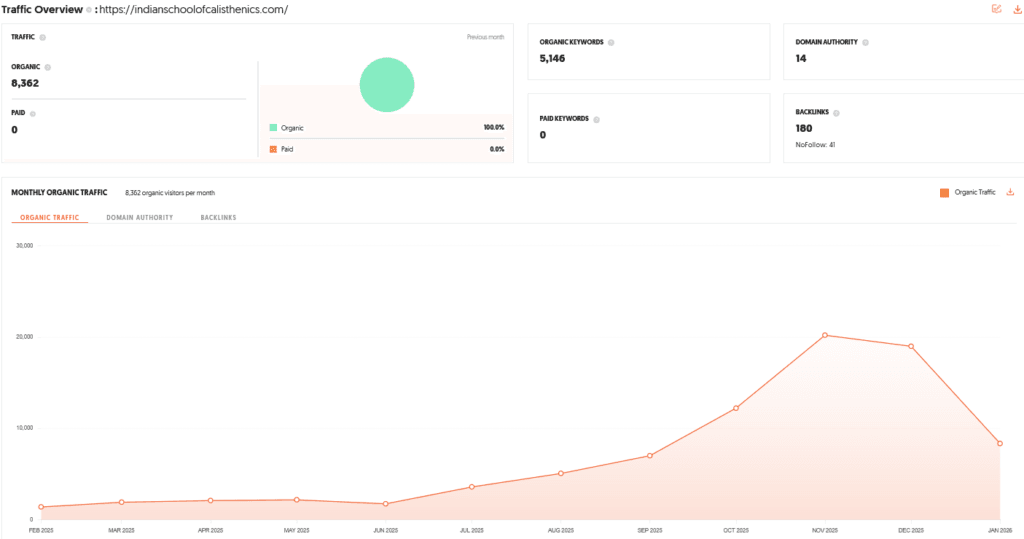
- ORGANIC TRAFFIC: 8362 visitors per month
Founders of Indian School of Calisthenics
- The Indian School of Calisthenics was co-founded by Shubham Mishra and Joel Prince.
- Both founders are seasoned fitness professionals with over seven years of experience in the field.
- Shubham Mishra has mentored over 150 elite athletes and trained more than 5,000 individuals, while Joel Prince, known for his extreme endurance feats like 3,000 push-ups in 2.5 hours, has coached over 2,000 students, including high-profile celebrities.
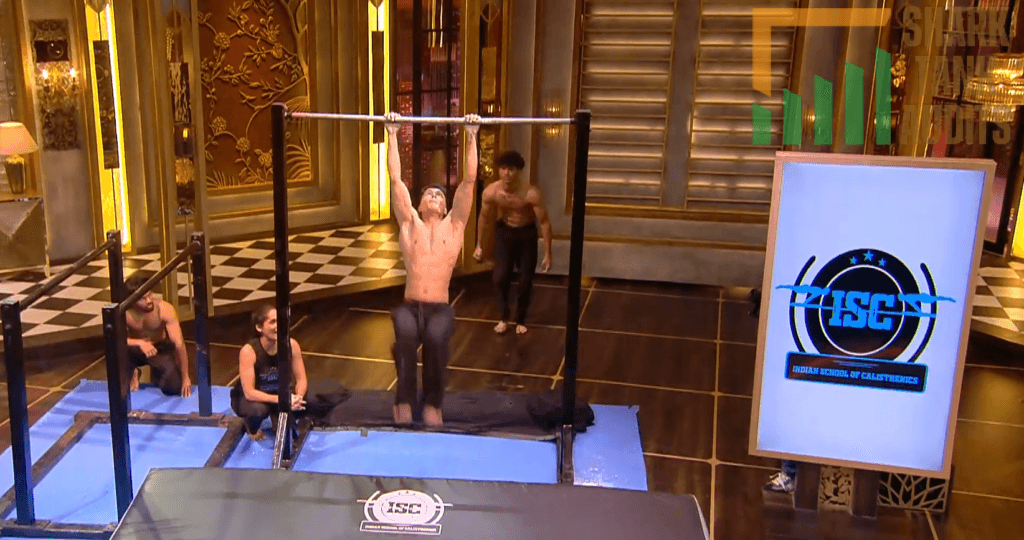
Brand Overview: Indian School of Calisthenics
- Established in 2022 and headquartered in Mumbai, the Indian School of Calisthenics is a specialized fitness academy dedicated to bodyweight-only training.
- Unlike traditional gyms that rely heavily on weight machines, the brand focuses on functional strength, mobility, balance, and body control.
- The academy aims to bridge the gap in the fragmented Indian fitness market by providing professional, structured guidance for calisthenics practitioners of all levels.
Shark Tank India Appearance & Ask: Indian School of Calisthenics
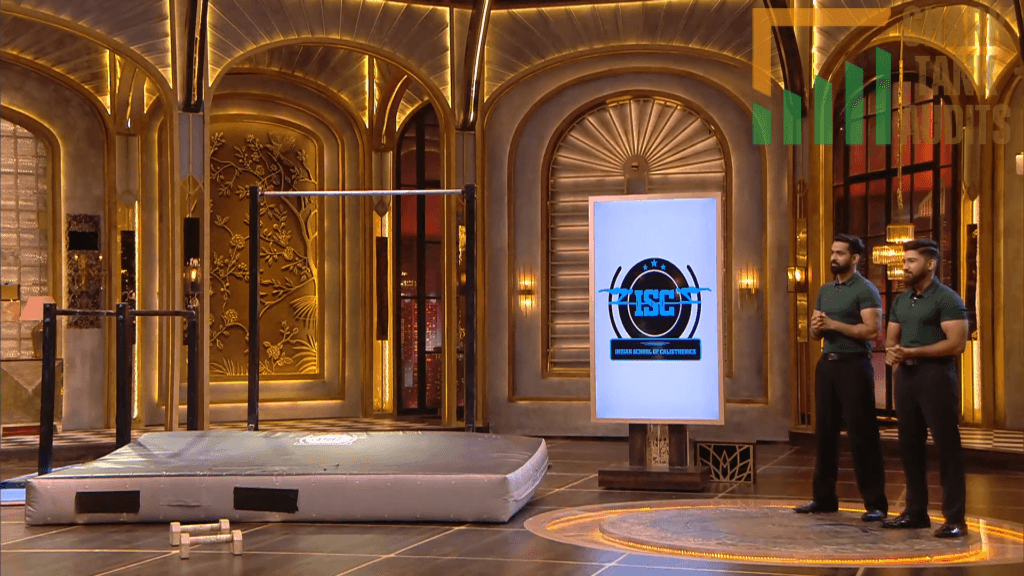
- The founders of the Indian School of Calisthenics appeared in Season 5, Episode 23, seeking an investment of ₹75 Lakhs for 5% equity, valuing the company at ₹15 Crores.
- During their pitch, they highlighted the limitations of machine-based workouts and showcased how their training methodology creates a more sustainable and holistic approach to fitness.
Season and Episode Air Date
- Season: 05
- Episode: 23
- Episode Air Date: Wednesday, 04 February, 2026
Product Overview: Indian School of Calisthenics
- The primary service of the Indian School of Calisthenics is its membership-based professional coaching.
- They offer structured progression plans, personalized training to prevent injuries, and community-driven workshops.
- The brand operates physical centers in Goregaon and Malad, providing silver, gold, platinum, and annual membership tiers ranging from ₹7,000 to ₹75,000.
Investor Reactions: Indian School of Calisthenics
The Sharks expressed several concerns regarding the Indian School of Calisthenics:
- Aman Gupta: Felt the branding was too narrow and “confused,” viewing it more as a local gym than a brand with a massive vision.
- Anupam Mittal: Pointed out structural risks, specifically the high rental costs associated with expanding physical centers across multiple cities.
- Namita Thapar: Questioned the marketing quality and how the niche was being presented.
- Kanika Mann: Could not justify the high ₹15 Crore valuation and chose to back out.
Customer Engagement Philosophy: Indian School of Calisthenics
- The Indian School of Calisthenics operates on a philosophy of “Calisthenics for All.” They prioritize building a community-driven environment where camaraderie and accountability drive results.
- By hosting championships and events, the brand fosters a movement rather than just a training session, ensuring high customer retention through emotional and physical engagement.
Product Highlights: Indian School of Calisthenics
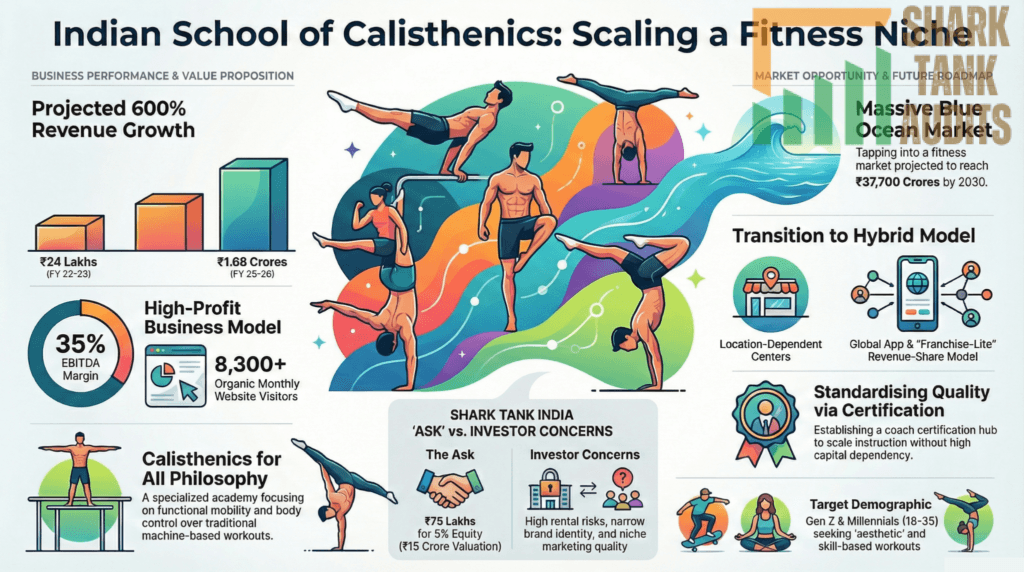
- Rapid Revenue Growth: Scaled from ₹24 Lakhs in FY 22-23 to a projected ₹1.68 Crores for FY 25-26.
- Profitability: Maintains a healthy 35% EBITDA.
- Scalable Curriculum: Offers a systemized approach to bodyweight training that caters to beginners and pro athletes alike.
- Proven Results: A track record of training thousands of students and producing national-level calisthenics athletes.
Future Vision: Indian School of Calisthenics
- The Indian School of Calisthenics aims to evolve from a location-dependent model into a pan-India fitness authority.
- Their roadmap includes launching virtual training platforms, creating a coach certification program to standardize calisthenics instruction, and expanding their offline presence through a more system-driven, scalable model to reduce capital dependency.
Deal Status: Indian School of Calisthenics
- No deal was finalized.
- Despite a strong presentation and impressive growth figures, the Indian School of Calisthenics failed to secure an investment from the Sharks.
- The founders walked away without a deal as the investors remained skeptical about the business’s current structure and valuation.
| Category | Details |
|---|---|
| Website | Indian School of Calisthenics |
| Website Platform | WordPress |
| SEO Performance | Good SEO performance; further improvement needed |
| Organic Traffic | ~8,362 visitors/month |
| Founded Year | 2022 |
| Headquarters | Mumbai, India |
| Founders | Shubham Mishra & Joel Prince |
| Founder Expertise | 7+ years in professional fitness & calisthenics |
| Shubham Mishra Background | Mentored 150+ elite athletes; trained 5,000+ individuals |
| Joel Prince Background | Extreme endurance athlete (3,000 push-ups in 2.5 hrs); coached 2,000+ students & celebrities |
| Brand Positioning | Professional bodyweight-only fitness academy |
| Core Differentiator | Functional strength without machines |
| Training Focus | Strength, mobility, balance, body control |
| Market Gap Addressed | Lack of structured, professional calisthenics guidance in India |
| Business Model | Membership-based professional coaching |
| Offline Centers | Goregaon & Malad (Mumbai) |
| Membership Tiers | Silver, Gold, Platinum, Annual |
| Pricing Range | ₹7,000 – ₹75,000 |
| Shark Tank Season | Season 05 |
| Episode Number | Episode 23 |
| Episode Air Date | Wednesday, 04 February 2026 |
| Shark Tank Ask | ₹75 Lakhs for 5% equity |
| Implied Valuation | ₹15 Crores |
| Pitch Theme | Limitations of machine-based gyms |
| Primary Service Offering | Structured calisthenics coaching |
| Training Methodology | Progressive plans with injury prevention |
| Community Element | Workshops, championships & events |
| Customer Philosophy | “Calisthenics for All” |
| Retention Strategy | Community bonding + skill mastery |
| Revenue FY 22–23 | ₹24 Lakhs |
| Projected Revenue FY 25–26 | ₹1.68 Crores |
| Revenue Growth | ~7x growth in 3 years |
| Profitability | ~35% EBITDA |
| Scalability Advantage | Systemized curriculum |
| Proven Results | Thousands trained; national-level athletes produced |
| Aman Gupta’s Concern | Confused branding; feels like a local gym |
| Anupam Mittal’s Concern | High rental & expansion costs |
| Namita Thapar’s Concern | Weak marketing presentation |
| Kanika Tekriwal’s Concern | Valuation too high |
| Shark Verdict | All Sharks opted out |
| Deal Status | ❌ No Deal |
| Indian Fitness Market Size (2024) | ₹16,200 Crores |
| Projected Market Size (2030) | ₹37,700 Crores |
| Fitness Market CAGR | ~15% |
| Boutique Fitness CAGR | ~18.8% |
| Fitness Penetration in India | 0.15% – 0.8% |
| Virtual Fitness Market (2030) | ~$2.8 Billion |
| TAM | India’s active population (18–62): ~956 million |
| SAM | ~12.3 million active gym members (Top-10 cities) |
| SOM Target | 1–2% of boutique fitness seekers |
| Primary Target Audience | Gen Z & Millennials (18–35 yrs) |
| Secondary Audience | Working professionals (30–50 yrs) |
| Elite Segment | Advanced athletes & calisthenics enthusiasts |
| Geographic Focus | Tier-1 cities (Mumbai, Pune, Bangalore) |
| Content Strategy | Founder challenges & endurance feats |
| SEO Strategy | Long-tail local fitness keywords |
| Influencer Strategy | Hybrid athletes & functional fitness creators |
| Performance Marketing | Retargeting free trial workshop seekers |
| Operating Model (Future) | Hybrid offline + virtual |
| Expansion Strategy | App-based training |
| Franchise-Lite Model | Revenue-share ISC Zones in partner gyms |
| Corporate Wellness | Mobility & desk-fitness programs |
| Key Strength | High EBITDA + high retention |
| Founder Credibility | 7,000+ people trained |
| Key Challenge | High expansion capex |
| Branding Challenge | Identity confusion |
| Mitigation – Expansion | Coach certification model |
| Mitigation – Branding | Position as “Premium Movement Academy” |
| Quality Control Strategy | ISC Playbook & standardized coaching |
| Phase 1 Goal | Reach ₹1.68 Cr revenue |
| Phase 2 Goal | Launch ISC App |
| Phase 3 Goal | National coach certification authority |
| Long-Term Valuation Goal | $5M–$10M in next funding round |
Indian School of Calisthenics Shark Tank India Business Plan
1. Market Potential in India: Indian School of Calisthenics
- Rapid Industry Growth: The Indian fitness market is projected to grow from ₹16,200 Crores ($1.9B) in 2024 to ₹37,700 Crores ($4.5B) by 2030, a 15% CAGR. This provides a massive tailwind for the Indian School of Calisthenics.
- Boutique Fitness Surge: Boutique studios focusing on niche formats like calisthenics and HIIT are the fastest-growing segment, expected to grow at 18.8% annually through 2030.
- Low Penetration Opportunity: With fitness membership penetration in India at only 0.15% to 0.8%, there is significant “blue ocean” space for the Indian School of Calisthenics to capture first-time gym-goers.
- Digital Adoption: The Indian virtual fitness market is expected to reach $2.8 Billion by 2030, making the digital roadmap of the Indian School of Calisthenics highly viable.
2. Total Addressable Market (TAM): Indian School of Calisthenics
- TAM (Total Addressable Market): India’s active population (ages 18–62) is 956 million. The Indian School of Calisthenics targets the portion willing to pay for premium services.
- SAM (Serviceable Addressable Market): Approximately 12.3 million current fitness facility members in India, concentrated in Top-10 cities (Mumbai, Delhi, Bangalore), where the Indian School of Calisthenics currently operates.
- SOM (Serviceable Obtainable Market): The Indian School of Calisthenics aims to capture 1-2% of the boutique fitness seekers in Tier-1 cities and the global Indian diaspora via virtual training.
3. Ideal Target Audience & Demographics: Indian School of Calisthenics
- Primary Demographic: Gen Z and Millennials (Ages 18–35) who account for 65% of all gym memberships and prefer “aesthetic” and skill-based workouts.
- Secondary Demographic: Working professionals (Ages 30–50) seeking “Longevity Fitness” and functional mobility to counter sedentary office lifestyles.
- Elite Segment: Athletes and fitness enthusiasts looking to master advanced skills like the Planche or Muscle-up under the Indian School of Calisthenics expert coaches.
- Geographic Focus: Initially Tier-1 metros (Mumbai, Pune, Bangalore) where high disposable income allows for membership tiers of ₹7,000 to ₹75,000.
4. Digital Marketing & Content Strategy: Indian School of Calisthenics
- Social Proof & Virality: Utilize the founders’ records (e.g., 3,000 push-ups) to create “Challenge” content on Instagram/YouTube, driving organic traffic to the Indian School of Calisthenics website (currently at 8,362 visitors/mo).
- Educational SEO: Improve WordPress SEO by targeting “Long-tail” keywords like “Calisthenics for beginners in Mumbai” or “Functional strength vs gym” to boost Indian School of Calisthenics organic reach.
- Influencer Collaboration: Partner with “Hybrid Athletes” and lifestyle influencers to showcase the “No Equipment” lifestyle of the Indian School of Calisthenics.
- Retargeting Ads: Use Meta and Google Ads to target users who have searched for “weight loss” or “mobility” in Mumbai, leading them to free trial workshops at the Indian School of Calisthenics.
5. Distribution & Operations Strategy: Indian School of Calisthenics
- Hybrid Model: Combine physical centers (Goregaon/Malad) for high-ticket personal coaching with a global Indian School of Calisthenics App for affordable, on-demand virtual training.
- Franchise-Lite: To mitigate the high rental costs mentioned by Shark Anupam Mittal, the Indian School of Calisthenics can use a “Revenue Share” model with existing gyms to set up “ISC Zones” without full studio overhead.
- Corporate Wellness: Offer the Indian School of Calisthenics bodyweight training as a desk-friendly “Corporate Mobility” program for large MNCs.
6. Advantages & Success Factors: Indian School of Calisthenics
- Healthy EBITDA: Operating at a 35% EBITDA proves the business model is inherently profitable.
- High Retention: Specialized “Skill-based” training at the Indian School of Calisthenics leads to 2x higher retention compared to traditional gyms, as members stay to master specific movements.
- Founder Expertise: With over 7,000 students trained collectively, the Indian School of Calisthenics founders provide a level of credibility that is hard to replicate.
7. Challenges & Mitigation Strategies: Indian School of Calisthenics
- Challenge: High Expansion Costs.
- Mitigation: Shift toward a system-driven “Trainer Certification” program to allow the Indian School of Calisthenics to scale via certified partners rather than owned real estate.
- Challenge: Brand Identity Confusion (Aman Gupta’s concern).
- Mitigation: Re-position the Indian School of Calisthenics as a “Premium Movement Academy” rather than just a gym to justify higher valuations.
- Challenge: Scaling Quality Coaching.
- Mitigation: Create a digital “ISC Playbook” for standardized coaching to maintain quality across all future Indian School of Calisthenics branches.
8. Roadmap to Increase Valuation: Indian School of Calisthenics
- Phase 1 (Revenue Focus): Scale from the current ₹1.05 Cr to the projected ₹1.68 Cr (FY 25-26) by optimizing current Mumbai branches.
- Phase 2 (Tech Integration): Launch the Indian School of Calisthenics App with AI-led progression tracking to convert the current 8,000+ monthly web visitors into paying subscribers.
- Phase 3 (Certification Hub): Establish the Indian School of Calisthenics as the official certifying body for Calisthenics coaches in India, creating a B2B revenue stream.
- Phase 4 (Exit/Series A): With a hybrid digital-physical model and a proven nationwide coaching network, the Indian School of Calisthenics could target a $5M–$10M valuation for its next funding round.




Indian School of Calisthenics Shark Tank India Episode Review