
Panda’s Box Shark Tank India Episode Review
In Shark Tank India Season 5, Episode 26 (aired Monday, February 9, 2026), the Delhi-based early learning startup Panda’s Box delivered a compelling pitch centered on “Screen-Free” cultural education. Founders Sukriti and Rajat Mendiratta presented their mission to revive Indian traditions through toys like mantra-chanting plushies and interactive spiritual books.
Despite initial skepticism from Sharks like Anupam Mittal regarding the brand’s low repeat rates, the founders’ strong operational background and impressive growth (projected at ₹14 Crores for FY 25-26) led to a high-stakes negotiation. Ultimately, they secured a significant ₹1.2 Crore joint deal with Aman Gupta and Namita Thapar, albeit with a unique condition from Aman to re-evaluate the brand’s name to better align with its Indian heritage.
Website Information
- Website:- Panda’s Box
- Build on Shopify
- Great SEO Performance
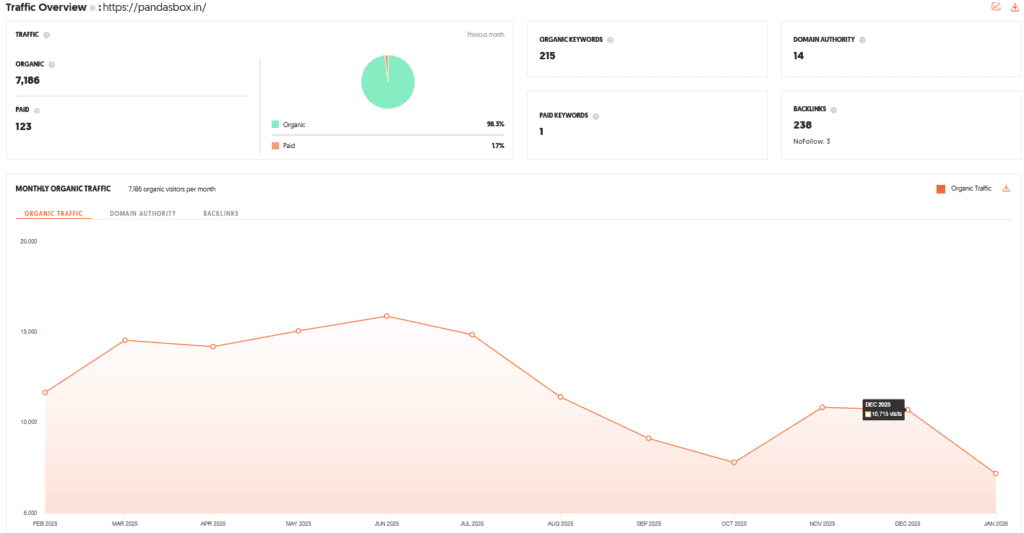
- ORGANIC TRAFFIC: 7186 visitors per month.
Founders of Panda’s Box
- Panda’s Box was established by a husband-and-wife duo who bring a blend of marketing and operational expertise to the brand:
- Sukriti Mendiratta: A seasoned marketing professional with over 12 years of experience working with major brands like Revlon and Hyundai. She leads product development, HR, and brand communications.
- Rajat Mendiratta: An engineer and MBA graduate who joined the business full-time in 2024 to lead operations, bringing 15 years of experience, including a previous stint as a COO.
Brand Overview of Panda’s Box
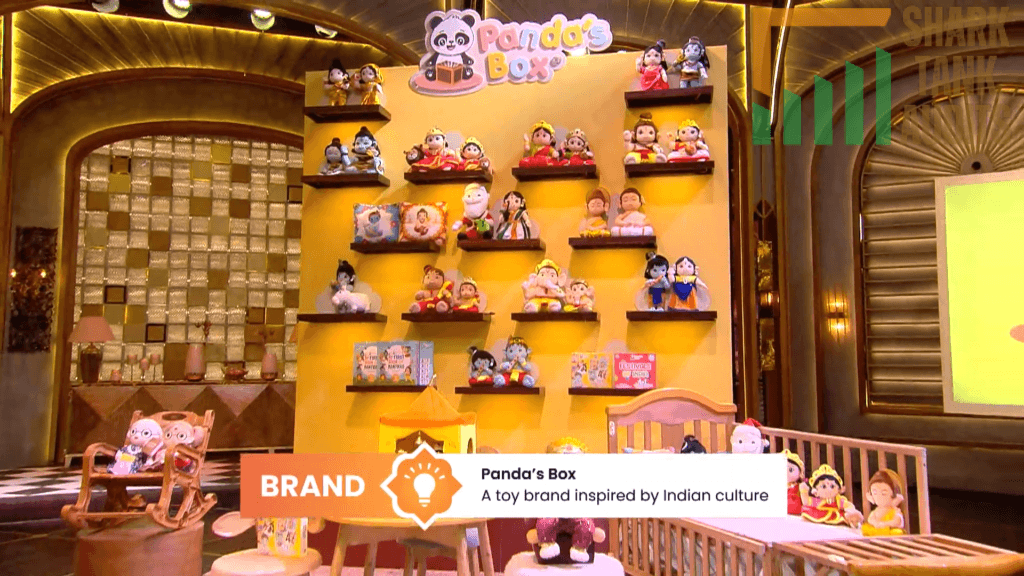
- Founded in 2022, Panda’s Box is an early learning startup that operates in the screen-free education space.
- The brand targets children aged 0 to 6 years, aiming to provide a mindful alternative to digital dependency.
- By offering products rooted in Indian culture and heritage, Panda’s Box seeks to revive the tradition of grandmother’s tales and spiritual mantras through modern, high-quality playthings.
Shark Tank India Appearance & Ask for Panda’s Box
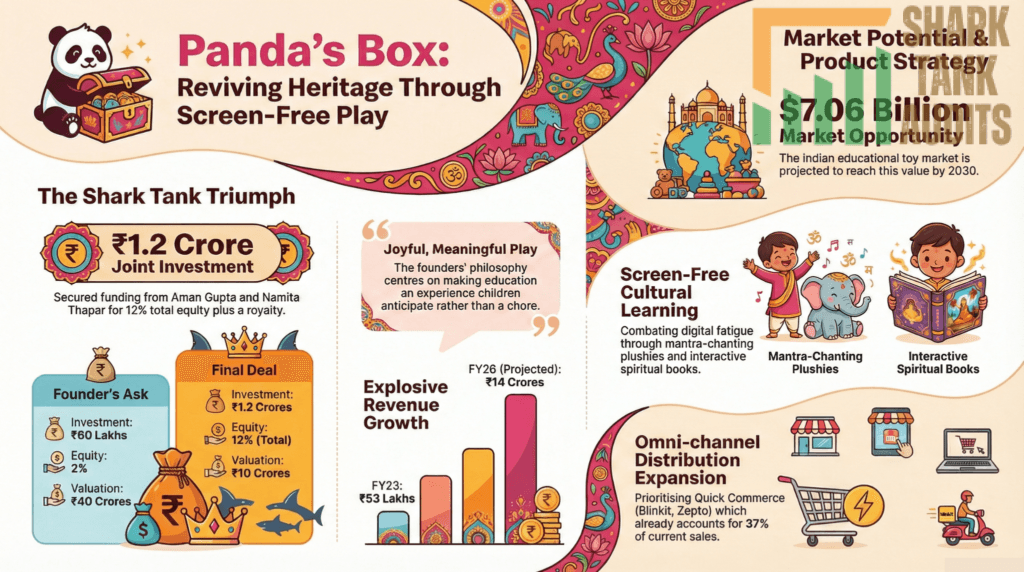
- During their appearance on Shark Tank India Season 5, the founders of Panda’s Box initially sought an investment of ₹80 Lakhs for 2% equity, valuing the company at ₹40 Crores.
- They pitched the brand as a vital link between nostalgia and contemporary parenting, highlighting their impressive sales growth from ₹53 Lakhs in FY 22-23 to a projected ₹14 Crores for FY 25-26.
Season and Episode Air Date
- Season: 05
- Episode: 26
- Episode Air Date: Monday, 09 February, 2026
Product Overview of Panda’s Box
The Panda’s Box product line is diverse, covering over 40 categories of toys and learning tools. Key offerings include:
- Mantra-Chanting Plush Toys: Soft toys that recite sacred Indian mantras.
- Interactive Books: Musical and storytelling tools that introduce kids to Indian values.
- STEM & DIY Kits: Activity-based kits focusing on Science, Technology, Engineering, and Math.
- Educational Puzzles: Tools designed to enhance cognitive and motor skills.
Investor Reactions to Panda’s Box
The Sharks had mixed reactions regarding the scalability of Panda’s Box:
- Anupam Mittal: Expressed concern that the business might not be sustainable due to low repeat purchase rates, viewing it more as a “gifting option.”
- Kunal Bahl: Praised the distribution but felt the brand identity was not yet strong enough.
- Shaily Mehrotra: Questioned the long-term scalability and customer retention.
- Aman Gupta: Was critical of the brand name but saw potential in the founders and the niche market.
Customer Engagement Philosophy of Panda’s Box
- The core philosophy of Panda’s Box is centered on “joyful, meaningful play.”
- The brand believes that education should be an experience children anticipate rather than a forced chore.
- By focusing on hands-on, screen-free engagement, Panda’s Box fosters a bond between parents and children through shared cultural stories and physical activities that improve concentration and patience.
Product Highlights of Panda’s Box
- Screen-Free Learning: Reduces mobile and tablet dependency, benefiting children’s mental health.
- Cultural Roots: Connects the new generation to Indian deities, mantras, and ancient wisdom.
- Holistic Development: Balances cognitive, sensory, and emotional growth.
- Practicality: Focuses on “learning by doing” through experiments and creative tasks rather than just theory.
Future Vision for Panda’s Box
- The future vision for Panda’s Box involves using the fresh capital to accelerate product development and expand distribution channels, particularly across quick-commerce and digital platforms.
- The startup aims to become a dominant player in the Indian early learning ecosystem by filling the gap for culturally relevant, screen-free educational tools that prepare children for the future while keeping them grounded in their heritage.
Deal Finalized or Not for Panda’s Box
- Yes, a deal was finalized. After intense negotiations, the founders of Panda’s Box accepted a joint offer from Aman Gupta and Namita Thapar.
- The final agreement consisted of:
- Total Investment: ₹1.2 Crores.
- Equity Split: ₹80 Lakhs for 8% equity (Aman Gupta) + ₹40 Lakhs for 4% equity (Namita Thapar).
- Royalty: 2% royalty until ₹1.2 Crores is recouped.
- Condition: Shark Aman Gupta suggested a brand name change as a condition for his mentorship.
| Parameter | Details |
|---|---|
| Website | Panda’s Box |
| Platform | Shopify |
| SEO Status | Great SEO Performance |
| Organic Traffic | 7,186 visitors per month |
| Founders | Sukriti Mendiratta and Rajat Mendiratta |
| Founder Background (Sukriti) | 12+ years marketing experience (Revlon, Hyundai); leads product, HR & brand |
| Founder Background (Rajat) | Engineer & MBA; 15 years experience; former COO; leads operations |
| Year Founded | 2022 |
| Brand Category | Early Learning / Screen-Free Education |
| Target Age Group | 0–6 years |
| Brand Positioning | Screen-free, culturally rooted educational toys |
| Shark Tank Season | Season 05 |
| Episode Number | Episode 26 |
| Episode Air Date | Monday, 09 February, 2026 |
| Initial Ask | ₹80 Lakhs for 2% equity |
| Initial Valuation | ₹40 Crores |
| FY 22-23 Revenue | ₹53 Lakhs |
| FY 25-26 Projected Revenue | ₹14 Crores |
| Core Products | Mantra plush toys, interactive books, STEM kits, educational puzzles |
| Product Categories | 40+ categories |
| Unique Product | Mantra-chanting plush toys |
| Learning Model | Joyful, meaningful, hands-on play |
| Cultural Focus | Indian deities, mantras, heritage-based storytelling |
| Development Focus | Cognitive, sensory & emotional growth |
| Distribution Split | Website (33%), Quick Commerce (37%), Amazon (25%) |
| Shark Concern 1 | Low repeat purchase rate (12–15%) |
| Shark Concern 2 | Brand identity strength |
| Shark Concern 3 | Long-term scalability |
| Shark Observation | Seen partly as gifting product |
| Deal Status | Deal finalized |
| Total Investment | ₹1.2 Crores |
| Equity Given | 12% total (8% Aman + 4% Namita) |
| Royalty Clause | 2% royalty until ₹1.2 Crores recouped |
| Condition | Suggested brand name change |
| Mission | Promote screen-free, culturally connected learning |
| Market Size (Edu Toys India 2024) | $3.22 Billion |
| Projected Market Size (2030) | $7.06 Billion |
| Market Growth Rate | 14% CAGR |
| TAM | 300+ million children (0–14 years) |
| Toy Market Projection 2034 | $4.74 Billion |
| SAM Growth Rate | 15.7% CAGR |
| Monthly Run Rate | ₹1.5 Crores |
| Primary Target Audience | Parents aged 25–40 in Tier 1 & 2 cities |
| Income Segment | ₹75,000+ monthly household income |
| Key Consumer Insight | 65% urban parents prefer purposeful play |
| Marketing Strategy | Nostalgia storytelling & mom-fluencer collaborations |
| SEO Focus | Keywords like “Mantra toys for kids” & “Screen-free activities” |
| Community Strategy | Panda’s Parent Circle (WhatsApp/Telegram) |
| Institutional Plan | Preschool partnerships (Kidzee, EuroKids) |
| Key Advantage 1 | First-mover in mantra plush category |
| Key Advantage 2 | Strong marketing + operations founding team |
| Key Advantage 3 | Strategic Shark mentorship |
| Key Challenge | Low repeat rate |
| Repeat Rate | 12–15% |
| Mitigation Strategy 1 | Launch subscription boxes |
| Mitigation Strategy 2 | Brand rebranding for cultural alignment |
| Phase 1 Goal | Expand SKUs to 60; ₹14 Cr sales target |
| Phase 2 Goal | International expansion (US, UK, UAE diaspora) |
| Phase 3 Goal | AR/Audio tech integration |
| Long-Term Vision | Become global cultural early learning platform |
| Valuation Target | ₹100+ Crores by 2028 |
Panda’s Box Shark Tank India Business Plan
1. Business Potential in India for Panda’s Box
- Rapid Sector Growth: The Indian educational toys market is valued at $3.22 Billion in 2024 and is projected to reach $7.06 Billion by 2030, growing at a CAGR of 14%.
- Cultural Resurgence: There is a massive shift toward “Indigenous Toys” and cultural education, supported by the National Education Policy (NEP) guidelines emphasizing play-based learning for children aged 3–6.
- Parental Shift: Over 65% of urban Indian parents now prioritize “purposeful play” over simple entertainment, creating a massive opening for Panda’s Box.
2. Total Addressable Market (TAM) for Panda’s Box
- TAM (Total Addressable Market): India has the world’s largest child population, with over 300 million children aged 0–14. The total toy market in India is projected to hit $4.74 Billion by 2034.
- SAM (Serviceable Addressable Market): Urban parents (approx. 461 million people) looking for early childhood development (0–6 years). This segment is growing at 15.7% CAGR.
- SOM (Serviceable Obtainable Market): The premium “Screen-Free & Cultural” niche. With a monthly run rate of ₹1.5 Crores, Panda’s Box is currently capturing a high-growth slice of the $1.4 Billion baby toy market.
3. Ideal Target Audience & Demographics for Panda’s Box
- Primary Demographic: Parents aged 25–40 (Millennials and Gen Z) living in Tier 1 and Tier 2 cities (notably Maharashtra, which leads with 20% market share).
- Socio-Economic Profile: Dual-income households with a monthly income of ₹75,000+ who value “mindful parenting.”
- Psychographics: Parents concerned about “Digital Fatigue” and those who want their children to stay connected to Indian heritage, mantras, and values.
4. Marketing & Digital Strategy for Panda’s Box
- Content Marketing: Create “Nostalgia-Driven” storytelling campaigns. Use videos of grandmothers interacting with children using Panda’s Box toys to bridge the generational gap.
- Influencer Strategy: Partner with “Mom-fluencers” and child psychologists to validate the cognitive benefits of screen-free play.
- SEO & Digital Presence: Optimize for high-intent keywords like “Mantra toys for kids” and “Screen-free activities for 3-year-olds.” (Current organic traffic: 7,186 visitors/month).
- Community Building: Launch a “Panda’s Parent Circle” on WhatsApp/Telegram to share weekly cultural stories and DIY activity ideas.
5. Distribution Strategy for Panda’s Box
- Omni-channel Approach: Currently split between Website (33%), Quick Commerce (37%), and Amazon (25%).
- Quick Commerce Expansion: Heavily leverage Blinkit, Zepto, and Swiggy Instamart, as these are the fastest-growing channels for toy purchases in 2026.
- Institutional Partnerships: Partner with premium preschool chains (like Kidzee or EuroKids) for “Experience Zones” where kids can interact with Panda’s Box products.
6. Advantages & Challenges for Panda’s Box
- Advantages of Panda’s Box:
- Unique Value Proposition: First-mover advantage in “Mantra-chanting” plush toys.
- Strong Founders: Blend of marketing (Sukriti) and operations (Rajat).
- Strategic Backing: Mentorship from Aman Gupta (Brand building) and Namita Thapar (Distribution/Pharma networks).
- Challenges for Panda’s Box:
- Low Repeat Rate: Currently at 12–15%. Toys are often seen as one-time gifts.
- Brand Name: Shark Aman Gupta noted the name may not fully reflect the “Cultural/Indian” essence.
7. Success Factors & Mitigation Strategies for Panda’s Box
- Why it will Succeed: The brand solves a “pain point” (Screen addiction) and fulfills a “desire” (Cultural connection).
- Mitigation for Low Repeat Rates: Introduce Subscription Boxes (Panda’s Monthly Box) to ensure recurring revenue and long-term customer engagement.
- Mitigation for Brand Identity: Execute the Brand Rebranding (as suggested by Aman Gupta) to better align the name with Indian heritage.
8. Future Business & Roadmap to Valuation for Panda’s Box
- Phase 1 (0–6 Months): Rebranding and expanding the SKU count from 40 to 60. Target Sales: ₹14 Crores (FY 25-26).
- Phase 2 (6–18 Months): International expansion to the Indian Diaspora in the US, UK, and UAE—a market with high willingness to pay for cultural connection.
- Phase 3 (18–36 Months): Tech Integration (AR/Audio). Use Augmented Reality to tell stories without requiring the child to look at the screen for long (Audio-first AR).
- Valuation Goal: By diversifying into “Cultural Content” (YouTube/Apps) alongside physical toys, Panda’s Box can pivot from a toy brand to a Global Early Learning Platform, aiming for a ₹100 Crore+ valuation by 2028.



Panda’s Box Shark Tank India Episode Review