
Pukaar.ai Shark Tank India Episode Review
Pukaar.ai appeared on Shark Tank India Season 5, Episode 35, with Patiala-based founders Karan Birpali and Akash Dangee (IT background motivated by addressing 40% of 10 lakh Indian infant deaths due to lack of timely medical understanding) seeking ₹48 lakh for 1.5% equity (₹32 Crore valuation) but left with no deal after Sharks collectively felt business model “not investible” due to lack of scientific depth, monetization clarity, and medical trust.
The pre-revenue health-tech/parenting AI-powered assistant bridges communication gap between infants and parents through flagship AI cry decoder algorithm claiming to identify specific needs (hunger/colic/discomfort), monitoring suite tracking feeding patterns/growth/daily activities providing personalized advice, and medical integration generating weekly health reports for professional doctor review, achieving 50,000+ total app downloads (18,000+ Android, 5-star ratings on Apple App Store in small sample) trained on 80,000 augmented cry samples from MIT/BITS Mesra but only 1 monthly organic visitor requiring SEO improvement focusing on data collection/model training versus commercial sales. Sharks reacted harshly—Aman expressed deep “trust issues” suggesting founders built app simply from IT background versus solving verified problem, Namita challenged claim mothers don’t understand cries for year stating they figure it out within 15-30 days dismissing model as “very weak,” Anupam delivered harsh critique labeling “copycat model” warning adding “AI” to basic app fails in real world where medical accuracy is life-critical, Amit suggested hardware-based approach (heart rate monitors) would be more scientific, and Ritesh saw no clear “core competence” or monetization path.
Operating in global baby tech market projected at $18 billion by 2030 with Indian parenting market at $10-12 billion within 25 million annual births (world’s largest infant care market) and increasing nuclear families in urban India lacking traditional elder support creating massive demand for AI-guided reassurance amid 650+ million smartphone users providing infrastructure reaching Tier 2/3 cities where pediatricians scarce, Pukaar.ai targets first-time parents (24-35, Metro/Tier 1 cities Mumbai/Bangalore/Delhi/Patiala, ₹75,000+ monthly household income NCCS A/B) who are tech-optimists and “anxious” working couples seeking data-driven validation and pediatricians/clinics seeking digital journaling tool for remote patient monitoring within 30-40 million digital-savvy urban households targeting 5% new urban parents annually (1.25 million users) for premium subscription, planning SEO overhaul targeting long-tail keywords (“Why is my 3-month-old crying at night,” “Infant colic symptoms”), momfluencer/pediatrician Instagram partnerships building trust factor, educational short-form videos explaining augmented cry sample science, App Store Optimization leveraging 50,000+ downloads improving “Baby Cry Translator/Parenting AI” keyword rankings, B2B2C maternity hospital partnerships (Cloudnine/Apollo Cradle) including in discharge kits, e-commerce bundling with FirstCry/Mamaearth offering premium subscriptions with baby purchases, clinical validation with 95%+ accuracy rate publishing white paper/peer-reviewed medical journal study countering “weak model” critique, hardware integration with wearable heart-rate monitors adding “hard data” to cry data, Chief Medical Officer hire leading “Pediatrician Library” development, Pukaar.ai Pro subscription launch integrating 24/7 telemedicine pediatric access, smart cribs/wearables hardware creating “core competence” justifying ₹32 Crore valuation attracting Series A funding, and global expansion into South East Asia/MENA markets with similar parenting pain points.
Website Information
- Website:- Pukaar.ai
- Build on JavaScript frameworks React Router 7.13.0 React
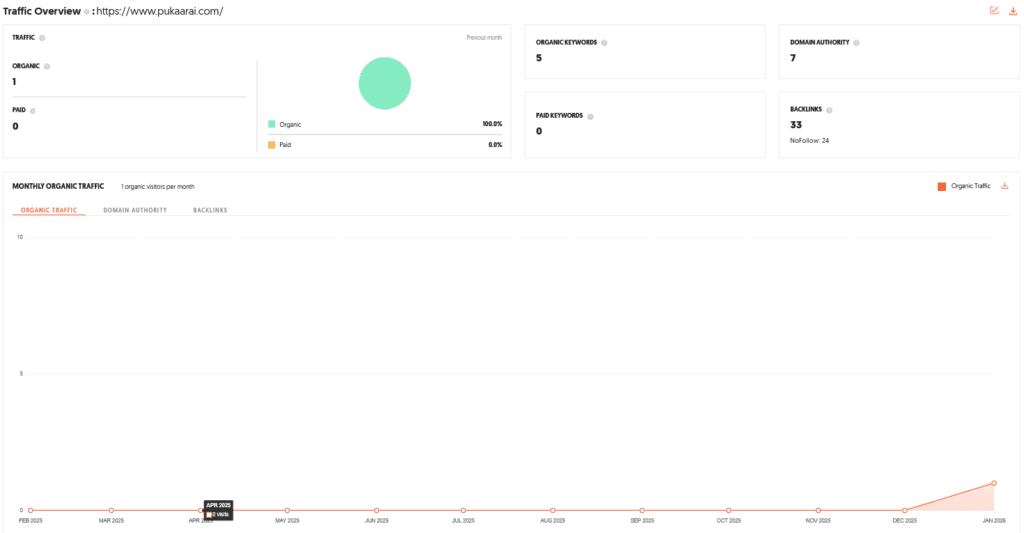
- Poor SEO Performance, SEO Improvement Needed.
- ORGANIC TRAFFIC: 1 visitors per month.
- 50K+ total app downloads across Android / iOS.
- 18 k+ Android downloads (Google Play / aggregators)
- 5★ User ratings in a small sample on Apple App Store)
Founders of Pukaar.ai
- Karan Birpali and Akash Dangee: The entrepreneurial duo behind the venture hails from Patiala.
- Background: Both founders come from an IT background, which heavily influenced their decision to build a tech-driven solution for parenting.
- Motivation: They aimed to address the issue of delayed diagnosis in infants, claiming that 40% of the 10 lakh infant deaths in India are due to a lack of timely medical understanding.
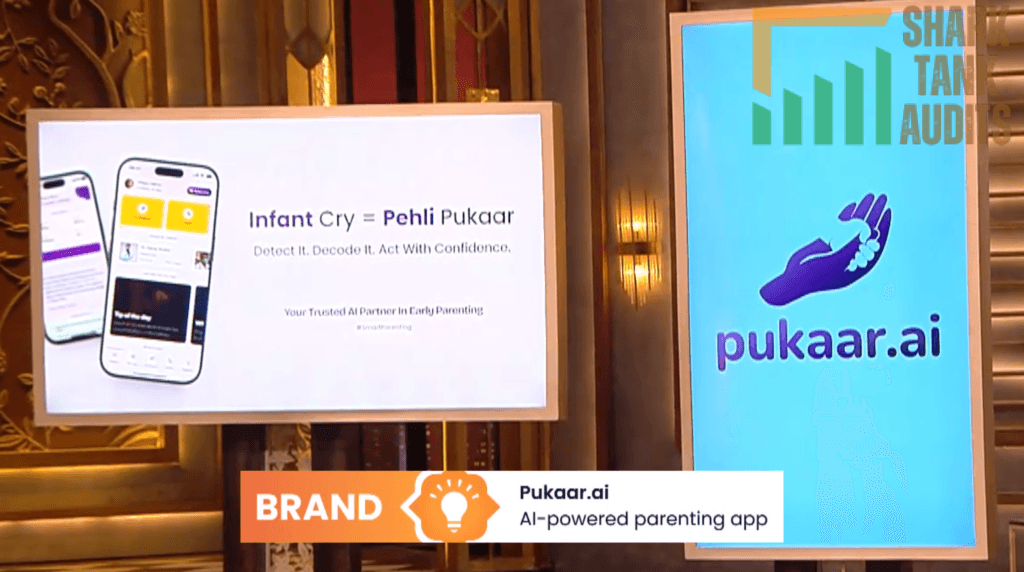
Brand Overview of Pukaar.ai
- Sector: Pukaar.ai operates in the Health-Tech and Parenting space.
- Core Mission: The brand positions itself as an AI-powered assistant designed to bridge the communication gap between infants and parents.
- Current Status: At the time of the pitch, the company was pre-revenue, focusing primarily on data collection and model training rather than commercial sales.
Shark Tank India Appearance & Ask for Pukaar.ai
- Episode Details: The pitch aired during Season 5, Episode 35.
- The Ask: The founders sought an investment of ₹48 lakhs for 1.5% equity.
- Valuation: The ask placed the company’s post-money valuation at a significant ₹32 crores.
Season and Episode Air Date
- Season: 05
- Episode: 35
- Episode Air Date: Friday, 20 February, 2026
Product Overview of Pukaar.ai
- AI Cry Decoder: The flagship feature is an algorithm that claims to decode an infant’s cry to identify specific needs like hunger, colic, or discomfort.
- Monitoring Suite: The app tracks feeding patterns, growth, and daily activities to provide personalized advice.
- Medical Integration: It generates weekly health reports intended to be sent to doctors for professional review.
Investor Reactions to Pukaar.ai
- Aman Gupta: Expressed deep “trust issues,” suggesting the founders built the app simply because they were from an IT background, rather than solving a verified problem.
- Namita Thapar: Challenged the founders’ claim that mothers don’t understand cries for a year, stating mothers usually figure it out within 15 to 30 days. She dismissed the model as “very weak.”
- Anupam Mittal: Delivered a harsh critique, labeling it a “copycat model.” He warned that adding “AI” to a basic app is a trend that fails in the real world where medical accuracy is life-critical.
- Amit Jain & Ritesh Agarwal: Amit suggested a hardware-based approach (like heart rate monitors) would be more scientific, while Ritesh saw no clear “core competence” or path to monetization.
Customer Engagement Philosophy of Pukaar.ai
- Data-Driven Personalization: The founders believe in gathering massive amounts of data in the early stages (0–1 years) to build a highly personalized AI for the future.
- Doctor-Parent Ecosystem: Their philosophy relies on a revenue-sharing model with pediatricians, intending to make the app a legitimate bridge between home care and professional medical advice.
Product Highlights of Pukaar.ai
- Large Dataset: The founders claimed to have trained their AI on 80,000 augmented cry samples sourced from prestigious institutes like MIT and BITS Mesra.
- Focus on Diagnostics: A key highlight was the attempt to reduce infant mortality through early detection of distress signals.
- Journaling Feature: The app includes a digital log for tracking a baby’s daily vitals and activities.
Future Vision for Pukaar.ai
- Evolution to Pediatric Tool: The founders aim to transition Pukaar.ai from a general parenting app into a specialized pediatric diagnostic tool.
- Library of Care: They envision creating a comprehensive “pediatrician library” to provide instant, AI-driven medical insights for every household.
- Global Disruption: Despite the skepticism, the founders maintain a vision of using AI to disrupt the global healthcare market by providing a voice to those who cannot speak.
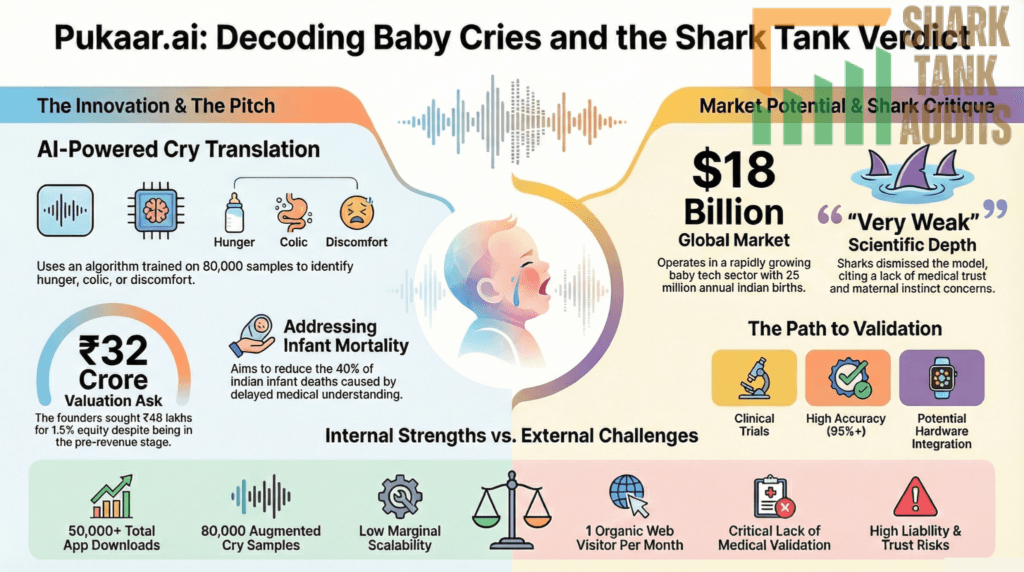
Deal Finalized or Not for Pukaar.ai
- Outcome: No Deal.
- The founders left the tank without an investment.
- The Sharks collectively felt the business model was “not investible” due to a lack of scientific depth, monetization clarity, and medical trust.
| Category | Details |
|---|---|
| Business Name | Pukaar.ai |
| Sector | Health-Tech & Parenting |
| Tech Stack | JavaScript Frameworks (React Router 7.13.0, React) |
| SEO Performance | Poor SEO performance; improvement needed |
| Organic Traffic | 1 visitor per month |
| App Downloads | 50K+ total downloads (Android + iOS) |
| Android Downloads | 18K+ (Google Play & aggregators) |
| Apple App Rating | 5★ (small sample size) |
| Founders | Karan Birpali & Akash Dangee |
| Founders’ Hometown | Patiala, India |
| Founder Background | IT background |
| Core Motivation | Address delayed infant diagnosis (claim: 40% of 10 lakh infant deaths due to delayed understanding) |
| Current Status at Pitch | Pre-revenue (focused on data collection & AI training) |
| Shark Tank Season | 05 |
| Shark Tank Episode | 35 |
| Episode Air Date | Friday, 20 February 2026 |
| Investment Ask | ₹48 Lakhs for 1.5% Equity |
| Valuation (Post-Money) | ₹32 Crores |
| Final Outcome | No Deal |
| Flagship Product | AI Cry Decoder (identifies hunger, colic, discomfort) |
| Monitoring Features | Feeding patterns, growth tracking, daily activity logs |
| Medical Integration | Weekly health reports for pediatricians |
| Dataset Claim | 80,000 augmented cry samples (MIT & BITS Mesra referenced) |
| Core Philosophy | Doctor–Parent AI bridge ecosystem |
| Revenue Vision | Revenue-sharing model with pediatricians |
| Target Audience | First-time parents (24–35 years), NCCS A & B |
| Secondary Audience | Pediatricians & Clinics |
| India Births Annually | ~25 million births |
| Smartphone Penetration | 650M+ users |
| Global Baby Tech Market (2030) | $18 Billion (Projected) |
| India Parenting Market | $10–12 Billion |
| TAM | Global baby tech market ($18B by 2030) |
| SAM | 30–40M digital urban parents |
| SOM | 1.25M new parents annually (5% target) |
| Distribution Strategy | B2C App Stores + B2B2C Hospital Partnerships |
| Potential Hospital Partners | Cloudnine, Apollo Cradle |
| E-commerce Partnerships (Vision) | FirstCry, Mamaearth |
| Advantages | First-mover AI cry decoder in India |
| Data Moat | 80K cry samples |
| Scalability | Low marginal cost app model |
| Key Challenges | Medical trust, liability risk, monetization clarity |
| Shark Concern | “Trust issues”, weak scientific depth, copycat AI model |
| Suggested Pivot | Hardware integration (wearables, heart-rate monitors) |
| Success Factor | 95%+ clinically validated accuracy |
| Phase 1 Goal | Clinical validation + 200K downloads |
| Phase 2 Goal | Launch subscription (Pukaar.ai Pro + Telemedicine) |
| Phase 3 Goal | Hardware integration (Smart cribs/wearables) |
| Phase 4 Goal | Global expansion (SEA & MENA markets) |
| Long-Term Vision | Become pediatric AI diagnostic assistant globally |
Pukaar.ai Shark Tank India Episode Review
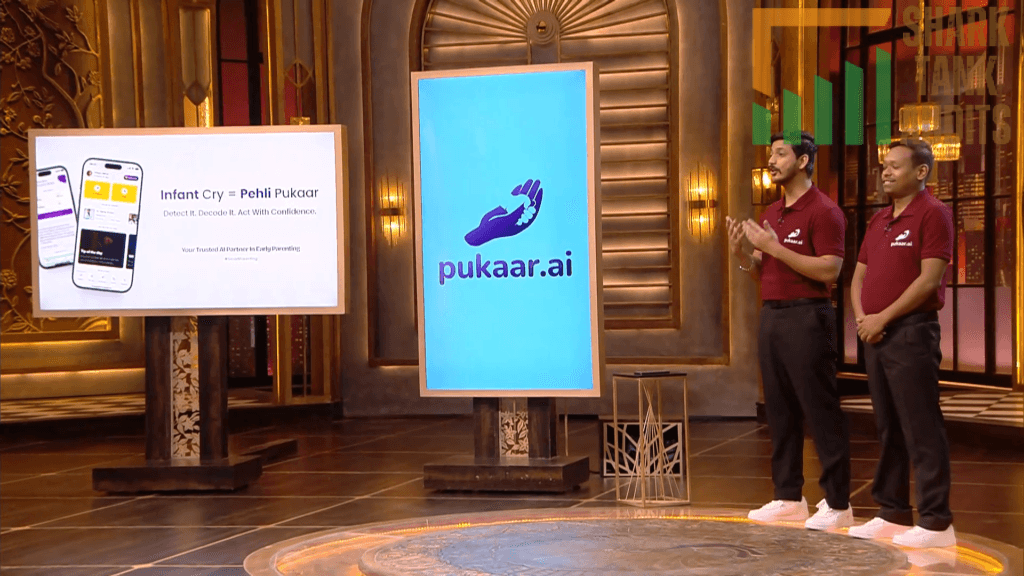
1. Business Potential of Pukaar.ai in India
- India’s Birth Rate Reality: With approximately 25 million births annually, India is the world’s largest market for parenting and infant care solutions.
- The “First-Time Parent” Surge: Increasing nuclear families in urban India mean parents lack traditional elder support, creating a massive demand for Pukaar.ai’s AI-guided reassurance.
- The Diagnostic Gap: As per the founders, 40% of infant deaths are due to delayed diagnosis. Pukaar.ai addresses this critical ₹5,000+ crore preventive healthcare niche.
- Smartphone Penetration: With over 650 million smartphone users, Pukaar.ai has the infrastructure to reach Tier 2 and Tier 3 cities where pediatricians are scarce.
2. Total Addressable Market (TAM) for Pukaar.ai
- TAM (Total Addressable Market): The global baby tech market is projected to reach $18 billion by 2030. In India, the parenting market is valued at approx. $10-12 billion.
- SAM (Serviceable Addressable Market): Digital-savvy urban parents (approx. 30-40 million households) willing to pay for premium health monitoring via Pukaar.ai.
- SOM (Serviceable Obtainable Market): Targeting 5% of new urban parents annually (approx. 1.25 million users) for Pukaar.ai’s premium subscription model.
3. Ideal Target Audience and Demographics for Pukaar.ai
- Primary Persona: First-time parents (Ages 24–35) in Metro and Tier 1 cities (Mumbai, Bangalore, Delhi, Patiala).
- Socio-Economic Category: NCCS A & B (Monthly household income >₹75,000).
- Psychographics: Tech-optimists, “anxious” parents seeking data-driven validation, and working couples with limited time.
- Secondary Audience: Pediatricians and clinics looking for a digital “journaling” tool like Pukaar.ai to monitor patients remotely.
4. Digital Marketing & Content Strategy for Pukaar.ai
- SEO Overhaul: Pivot from “1 organic visitor” by targeting long-tail keywords like “Why is my 3-month-old crying at night?” or “Infant colic symptoms” to drive Pukaar.ai web traffic.
- Influencer Marketing: Partner with “Momfluencers” and pediatricians on Instagram to build the “Trust” factor that the Sharks found lacking.
- Educational Content: Create short-form videos (Reels/YouTube Shorts) explaining the science behind “augmented cry samples” used by Pukaar.ai.
- App Store Optimization (ASO): Leverage the existing 50K+ downloads to improve keyword rankings for “Baby Cry Translator” and “Parenting AI.”
5. Distribution Strategy for Pukaar.ai
- B2C (Direct to Consumer): High-velocity downloads via Google Play and Apple App Store.
- B2B2C (Medical Integration): Partner with maternity hospitals (e.g., Cloudnine, Apollo Cradle) to include Pukaar.ai in their “discharge kits.”
- E-commerce Bundling: Partner with brands like FirstCry or Mamaearth to offer Pukaar.ai premium subscriptions with baby product purchases.
6. Advantages and Challenges for Pukaar.ai
| Advantages of Pukaar.ai | Challenges for Pukaar.ai |
| First Mover Advantage: Few AI cry-decoders exist in the Indian local context. | Medical Skepticism: Sharks noted “trust issues” regarding AI’s accuracy vs. maternal instinct. |
| Scalability: Low marginal cost for adding new users to the app. | Monetization: Transitioning from free downloads to a paid subscription model. |
| Data Moat: 80,000 samples provide a baseline for a “defensible” AI model. | Liability: Potential legal risks if the AI misinterprets a critical medical emergency. |
7. Success Factors and Mitigation Strategies for Pukaar.ai
- Reason for Success: If Pukaar.ai can prove a 95%+ accuracy rate in clinical trials, it becomes an essential “safety net” for every new parent.
- Mitigation (Scientific Validation): To counter Namita Thapar’s “weak model” critique, Pukaar.ai must publish a white paper or peer-reviewed study in a medical journal.
- Mitigation (Hardware Pivot): As suggested by Amit Jain, Pukaar.ai could integrate with wearable heart-rate monitors to add “hard data” to the “cry data.”
- Mitigation (Expert Onboarding): Hire a Chief Medical Officer (CMO) to lead the “Pediatrician Library” development for Pukaar.ai.
8. Future Business Roadmap to Increase Valuation of Pukaar.ai
- Phase 1 (Months 0-6): Clinical validation and SEO overhaul. Goal: Reach 200k downloads and 10k MAU (Monthly Active Users).
- Phase 2 (Months 6-12): Launch Pukaar.ai Pro (Subscription). Integrate telemedicine features for 24/7 pediatric access.
- Phase 3 (Months 12-24): Hardware integration (Smart Cribs/Wearables). This “Core Competence” will justify the ₹32 Crore valuation and attract Series A funding.
- Phase 4 (24 Months+): Global expansion into SEA (South East Asia) and MENA markets where parenting pain points are similar to India’s.







Pukaar.ai Shark Tank India Episode Review