
TBFO Shark Tank India Episode Review
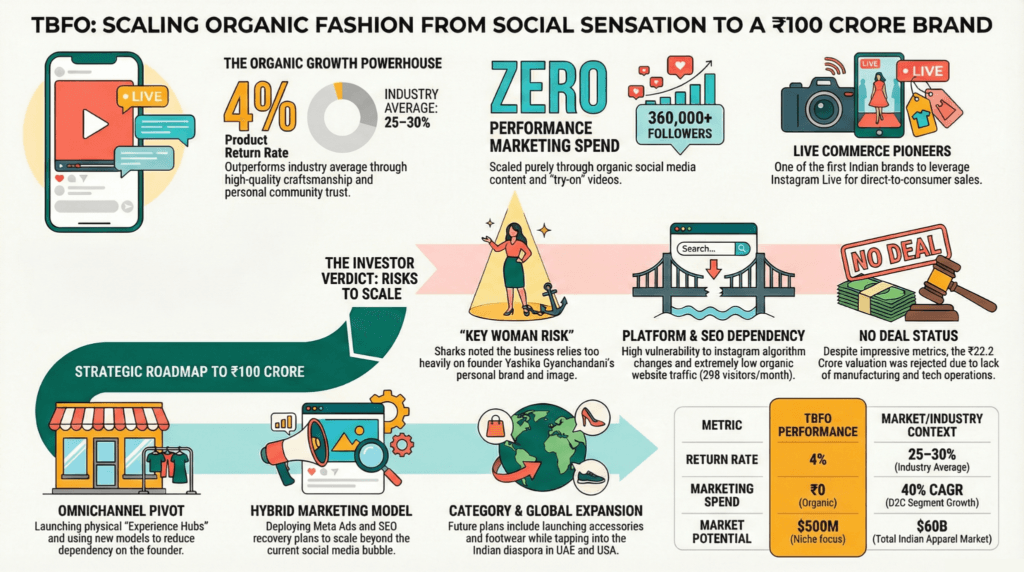
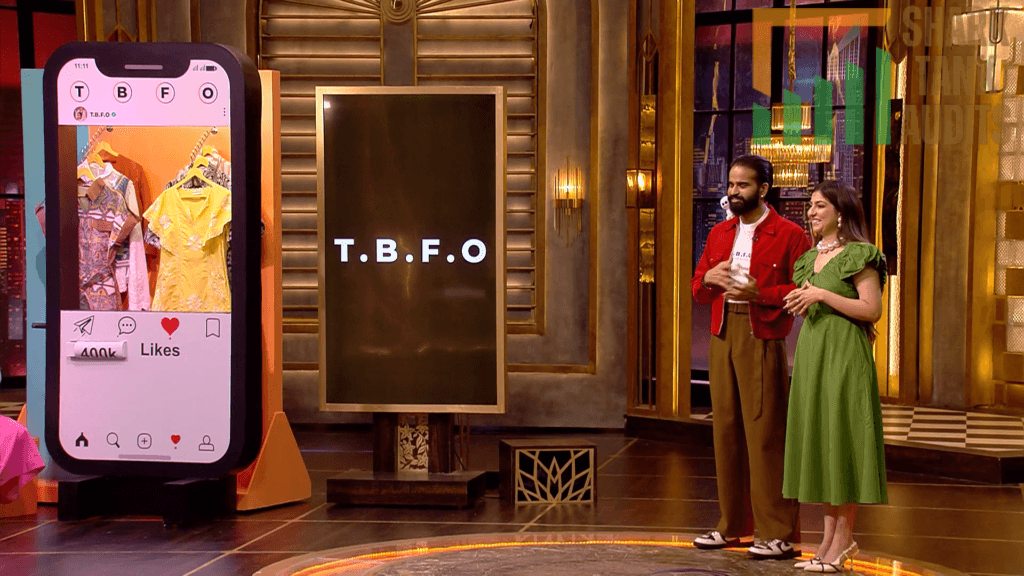
TBFO (The Branded Factory Outlet) appeared on Shark Tank India Season 5, Episode 10, with founders Yashika Gyanchandani (content creator/model) and Avnish Sharma (husband, Creative Director from construction background) seeking ₹1 Crore for 4.5% equity (₹22.2 Crore valuation) but left with no deal despite impressive metrics. The Bhopal-based luxury-accessible women’s fashion brand grew from a single-room try-on video operation to 360,000+ social media followers with zero performance marketing spend, doubling revenue year-on-year and achieving exceptional 4% return rate (vs. 25-30% industry average).
Pioneering Instagram Live commerce in India, they target women aged 25-35 (60% of customers) seeking modest yet stylish western wear with Korean-inspired outfits and elegant dresses. While Kunal praised low returns and live commerce adoption, Vineeta feared Instagram algorithm dependency, Namita highlighted “Key Woman Risk” with over-reliance on Yashika’s personal brand, Varun questioned scalability without paid marketing, and Viraj advised staying independent, even offering Yashika a brand endorsement for his own brand Viva. Operating in India’s $60 billion apparel market with D2C brands growing at 40% CAGR and live commerce projected at $5 billion by 2025, TBFO focuses on $10-12 billion women’s western wear segment with 298 monthly organic visitors requiring SEO improvement.
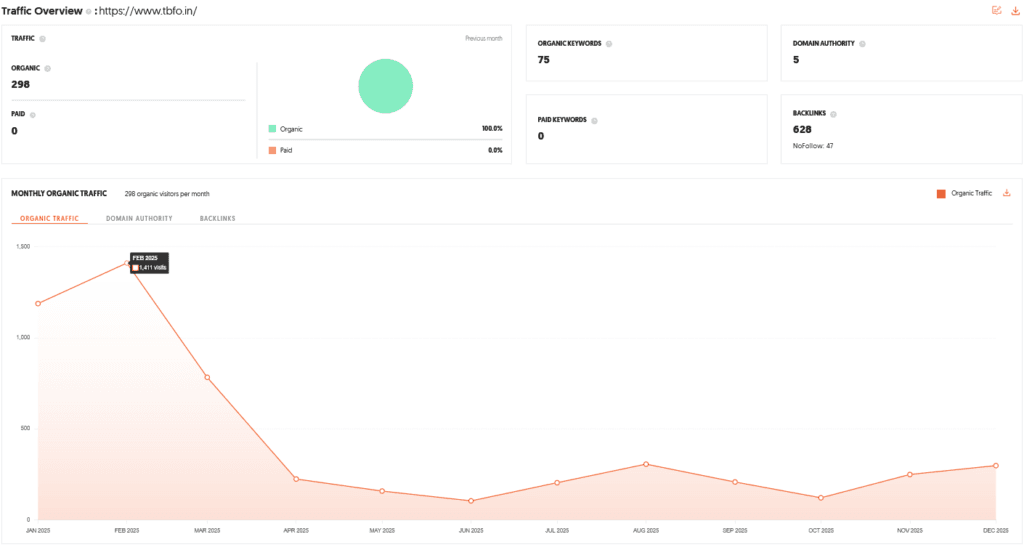
TBFO Website Information
- Website:- TBFO
- Build on Shopify
- Poor SEO Performance, SEO Improvement Needed.
- ORGANIC TRAFFIC: 298 visitor per month.
TBFO Founders
- Yashika Gyanchandani: The face of the brand, a popular content creator, and the primary model for all collections.
- Avnish Sharma: Yashika’s husband and the Creative Director. He describes himself as a “street-smart” individual who discovered his passion for fashion after moving away from his father’s construction business.
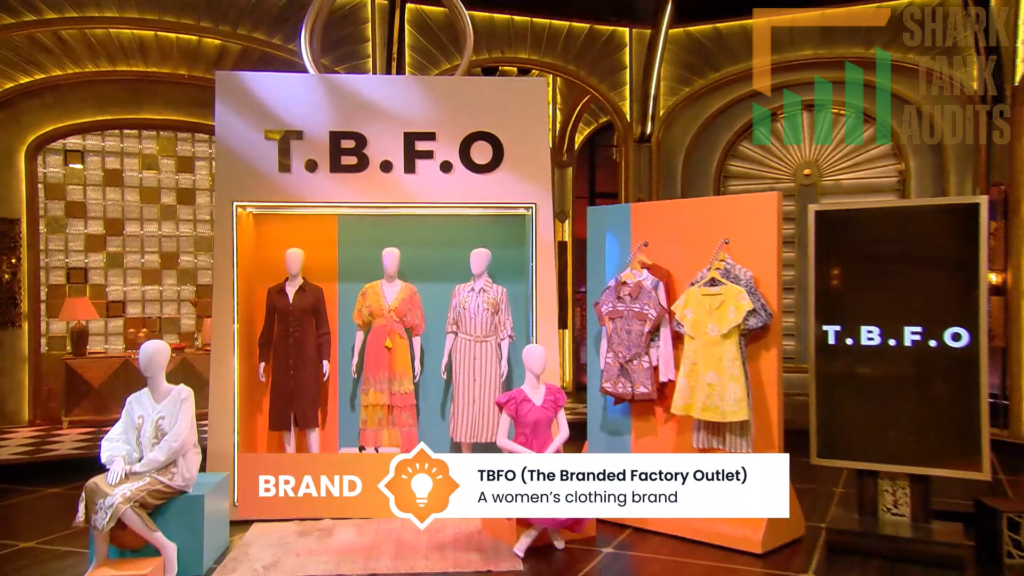
TBFO Brand Overview
- Name: The Branded Factory Outlet (TBFO).
- Location: Based in Bhopal, Madhya Pradesh.
- Origin: Started as a small operation in a single room where Yashika made “try-on” videos for social media.
- Growth: Transformed from a reselling business into a social media sensation with over 360,000 followers.
TBFO Shark Tank India Appearance & Ask
- Season: Season 5, Episode 10 (Aired January 2026).
- The Ask: ₹1 Crore for 4.5% equity.
- Goal: To find a “celebrity shark” who could act as a brand ambassador and help scale the business into a national powerhouse.
TBFO Season and Episode Air Date
- Season: 05
- Episode: 10
- Episode Air Date: Friday, 16 January 2026
TBFO Product Overview
- Category: Luxury-accessible fashion for women.
- Style: A blend of contemporary fashion and Indian elegance, focusing on modest yet stylish western wear (e.g., rompers, Korean-inspired outfits, and elegant dresses).
- Target Audience: 60% of customers are aged 25–35, specifically targeting women who seek comfort and style after marriage or as they progress in their careers.
TBFO Investor Reactions
- Kunal Bahl: Praised their 4% return rate (exceptionally low for fashion) and their early adoption of live commerce but felt they should stay independent rather than answer to investors.
- Vineeta Singh: Impressed by the zero performance marketing and year-on-year doubling of revenue, but feared the business was too dependent on the ever-changing Instagram algorithm.
- Namita Thapar: Highlighted “Key Woman Risk,” noting that the business relies too heavily on Yashika’s personal brand and lacks operational expertise in manufacturing and technology.
- Viraj Bahl: Advised them not to take investment to avoid losing their “smile” and authenticity, even offering Yashika a brand endorsement deal for his own brand, Viva.
- Varun Alagh: Concerned about scalability issues arising from the refusal to use paid performance marketing.
TBFO Customer Engagement Philosophy
- Live Commerce Pioneers: TBFO was one of the first Indian brands to leverage Instagram Live for direct sales, similar to the massive live-commerce trends in China.
- Personal Connection: The founders prioritize a “Brand Family” feel. They even embarked on a road trip from Bhopal to Amritsar to meet customers personally and take selfies, treating their community as more than just buyers.
TBFO Product Highlights
- Quality & Craftsmanship: Focus on premium fabrics, exceptional stitching, and unique designs.
- Practicality: Use of lightweight, breathable fabrics suitable for the Indian climate.
- Affordability: Positioned as “exclusive luxury” at prices that “surprise” the consumer.
- Low Friction: Boasts an incredibly low return rate of 4%, signifying high customer satisfaction with fit and quality.
TBFO Future Vision
- Modern Indian Identity: To define confidence and timeless style for the modern woman who wants to balance Indian aesthetics with modern silhouettes.
- Expansion: Plans to introduce more Gen Z-focused collections, such as Korean-inspired outfits, and potentially explore offline expansion to mitigate the risks of being purely digital.
- Scale: Aiming to transition from a social media-led boutique to a ₹100 crore luxury fashion house.
TBFO Deal Finalized or Not
- Status: No Deal.
- Despite being impressed by the founders’ passion and the brand’s organic growth, the Sharks collectively decided not to invest due to concerns regarding scalability and dependency on a single individual.
| Item | Details |
|---|---|
| Website | TBFO |
| Platform | Built on Shopify |
| SEO Performance | Poor SEO performance, improvement needed |
| Organic Traffic | 298 visitors per month |
| Founder | Yashika Gyanchandani |
| Co-Founder | Avnish Sharma |
| Founder Role | Face of the brand and primary model |
| Co-Founder Role | Creative Director |
| Founder Background | Content creator with strong social media influence |
| Co-Founder Background | Street-smart creative, transitioned from construction business |
| Brand Name | The Branded Factory Outlet (TBFO) |
| Brand Location | Bhopal, Madhya Pradesh |
| Brand Origin | Started from a single room with try-on videos |
| Initial Business Model | Reselling fashion products |
| Growth Journey | Evolved into a social media-led D2C brand |
| Social Media Following | 360,000+ followers |
| Shark Tank Season | Season 5 |
| Episode Number | Episode 10 |
| Episode Air Date | Friday, 16 January 2026 |
| Investment Ask | ₹1 crore for 4.5% equity |
| Founder Goal | Celebrity shark as brand ambassador |
| Product Category | Luxury-accessible women’s fashion |
| Fashion Style | Modest western wear with Indian elegance |
| Product Types | Rompers, dresses, Korean-inspired outfits |
| Target Audience Age | 25–35 years |
| Core Customer Base | Married women and working professionals |
| Secondary Audience | Gen Z women aged 18–24 |
| Customer Geography | Tier 1 and Tier 2 cities |
| High Affinity Regions | Punjab, Delhi, Madhya Pradesh |
| Unique Selling Point | Live commerce-led fashion sales |
| Live Commerce Status | Early pioneer in Instagram Live selling |
| Customer Engagement | Strong personal founder-led connection |
| Community Strategy | Brand family approach |
| Offline Engagement | Founder road trips to meet customers |
| Fabric Quality | Premium and breathable fabrics |
| Stitching Quality | High attention to fit and finishing |
| Climate Suitability | Designed for Indian weather |
| Pricing Strategy | Affordable luxury |
| Return Rate | 4% |
| Industry Avg Return Rate | 25–30% |
| Kunal Bahl Feedback | Praised low returns and live commerce |
| Vineeta Singh Feedback | Impressed by organic growth |
| Namita Thapar Feedback | Raised key woman risk concern |
| Viraj Bahl Feedback | Advised against taking investment |
| Varun Alagh Feedback | Questioned scalability without ads |
| Key Business Risk | Dependency on Yashika’s personal brand |
| Platform Risk | Heavy reliance on Instagram |
| Performance Marketing | Zero paid ads till date |
| Customer Acquisition Cost | Extremely low |
| Brand Trust Factor | High due to transparency |
| Future Brand Vision | Modern Indian confidence and elegance |
| Product Expansion Plan | Gen Z-focused collections |
| Offline Strategy | Pop-up stores and experience hubs |
| Scale Ambition | ₹100 crore fashion house |
| Deal Status | No deal |
| Reason for No Deal | Scalability and key person dependency |
| Market Opportunity | India e-retail fashion boom |
| Apparel Market Size | $60 billion |
| D2C Growth Rate | 40% CAGR |
| Live Commerce Market | $5 billion by 2025 |
| TAM | $60 billion |
| SAM | $10–12 billion |
| SOM | $500 million |
| Primary Psychographic | Modest yet fashionable consumers |
| SEO Challenge | Low organic visibility |
| SEO Keywords Focus | Luxury western wear India |
| Content Strategy | Storytelling and community content |
| Community Channels | WhatsApp and Telegram |
| Paid Ads Plan | Retargeting and lookalike audiences |
| Shopify Optimization | AI-based size recommendations |
| Omnichannel Plan | Pop-up experience hubs |
| Supply Chain Shift | From boutique to batch production |
| Competitive Advantage | Trust-led commerce |
| CAC Advantage | Zero ad spend historically |
| Risk Mitigation | TBFO style icons |
| Data Ownership Strategy | Email, SMS, WhatsApp |
| Phase 1 Plan | SEO and operations hiring |
| Phase 2 Plan | Accessories and footwear launch |
| Phase 3 Plan | International expansion |
| Revenue Target | ₹100 crore run rate |
| Valuation Goal | 4x–6x revenue multiple |
TBFO Shark Tank India Business Plan
1. TBFO Business Potential in the Indian Fashion Market
- TBFO and the Indian E-commerce Boom: India’s e-retail market is expected to reach $160 billion by 2028. Fashion is the largest category, and TBFO is positioned in the fastest-growing sub-segment: Women’s Western Wear.
- TBFO and the D2C Surge: D2C brands in India are growing at a CAGR of 40%. TBFO benefits from the “Bharat” story, operating out of Bhopal but serving a pan-India audience.
- TBFO Live Commerce Edge: With live commerce in India projected to be a $5 billion market by 2025, TBFO’s early-mover advantage in Instagram Live sales puts it ahead of traditional retailers.
2. TBFO Total Addressable Market (TAM) Analysis
- TBFO Total Addressable Market (TAM): The Indian apparel market is valued at $60 billion.
- TBFO Serviceable Addressable Market (SAM): The organized women’s western wear segment is roughly $10–12 billion, where TBFO competes with both mass-market and premium labels.
- TBFO Serviceable Obtainable Market (SOM): Targeting the mid-premium “Affordable Luxury” segment, TBFO aims for a niche worth $500 million, focusing on the 25–35 age demographic.
3. TBFO Ideal Target Audience and Demographics
- TBFO Primary Demographic: Women aged 25–35 (60% of current base).
- TBFO Psychographics: Professionals, newlyweds, and young mothers seeking “Modest Western” styles that balance comfort with high-fashion aesthetics.
- TBFO Geographic Reach: Tier 1 and Tier 2 cities; high resonance in regions like Punjab, Delhi, and Madhya Pradesh where the “Yashika” brand persona is strong.
- TBFO Secondary Audience: Gen Z (18–24) looking for Korean-inspired and trendy “Instagrammable” outfits.
4. TBFO Marketing, Content, and Digital Strategy
- TBFO “Community First” Content: Transitioning from “Try-on videos” to high-production storytelling. Utilizing Yashika’s influence to build a “Inner Circle” via WhatsApp and Telegram groups.
- TBFO SEO Recovery Plan: Since TBFO currently has only 298 organic visitors, the strategy involves:
- Optimizing Shopify metadata with keywords like “Luxury Western Wear India” and “Affordable Designer Dresses.”
- Starting a TBFO Fashion Blog to rank for style guides.
- TBFO Performance Marketing Shift: Implementing a “Hybrid Model.” While 100% organic growth is impressive, TBFO will deploy Meta Ads focusing on Retargeting (LAL – Lookalike Audiences) to scale beyond Yashika’s current followers.
5. TBFO Distribution and Operational Strategy
- TBFO Digital Storefront: Enhancing the Shopify experience with AI-led size recommenders to maintain the ultra-low 4% return rate.
- TBFO Omnichannel Pivot: Launching “TBFO Experience Hubs” (Pop-up stores) in high-affinity cities like Jaipur and Delhi to mitigate “Key Woman Risk.”
- TBFO Supply Chain: Moving from boutique manufacturing to Standardized Batch Production to handle 2,000+ pre-orders per design without quality drops.
6. TBFO Competitive Advantages and Challenges
- TBFO Key Advantages:
- High Trust: Personal connection with 360,000+ followers.
- Low CAC: Zero spent on performance marketing to date.
- Low Returns: A 4% return rate vs. industry average of 25–30%.
- TBFO Critical Challenges:
- Key Woman Risk: The brand is overly dependent on Yashika’s presence.
- Platform Dependency: High risk if Instagram’s algorithm shifts.
- SEO Weakness: Low website discoverability.
7. TBFO Success Factors and Risk Mitigation
- Why TBFO can succeed: It solves the “Trust Deficit” in Indian online shopping through transparency and live interaction.
- TBFO Risk Mitigation (Key Woman Risk): Introduce “TBFO Style Icons”—a group of micro-influencers and real customers who model the clothes, shifting the spotlight from Yashika alone.
- TBFO Risk Mitigation (Algorithm Risk): Aggressively building an Email/SMS/WhatsApp database to own the customer data and reduce reliance on Instagram.
8. TBFO Future Roadmap to Increase Valuation
- Phase 1 (Months 1-6): TBFO Systems Audit: Upgrade SEO, hire a Head of Operations, and automate inventory management on Shopify.
- Phase 2 (Months 6-12): TBFO Category Expansion: Launching TBFO Accessories and Footwear to increase Average Order Value (AOV).
- Phase 3 (Year 2): TBFO Global Reach: Tapping into the Indian Diaspora in UAE and USA via international shipping.
- TBFO Valuation Goal: By professionalizing the supply chain and diversifying marketing, TBFO aims for a ₹100 crore revenue run rate, targeting a 4x–6x revenue multiple valuation for a future Series A round.





TBFO Shark Tank India Episode Review