
Twin Shark Tank India Episode Review
Twin Shop AI appeared on Shark Tank India Season 5, Episode 15, with founder Aseem Khanduja (IIT Delhi alumnus from Gurgaon) seeking ₹60 lakh for 1% equity (₹60 Crore valuation) and successfully closed a deal for ₹80 lakh for 2% equity (₹40 Crore valuation) with Shark Aman Gupta after competing offers from Anupam Mittal and Kanika Tekriwal.
The fashion-tech platform revolutionizes e-commerce through AI-powered virtual try-on technology creating digital avatars from 3 selfies and 2 full-body photos, allowing users to test thousands of apparel items, shoes, and accessories across multiple brands in an “Endless Wardrobe” interface including external links from Instagram. Targeting 1 million users in 6 months and 5 million within a year with 125 monthly organic visitors requiring SEO improvement, Twin addresses India’s e-commerce return crisis (15-20% overall, 35-50% in apparel) where fit/sizing issues cause 53% of global returns.
Operating in Indian fashion retail market valued at $70-$80 billion (₹6.18-6.86 lakh crore, 24%+ e-commerce CAGR) with virtual try-on market growing 25.8% CAGR globally (30%+ India, fastest Asia-Pacific region), Twin targets Gen Z/millennials (18-35, 40% of e-retail shoppers) in Tier 1/2 cities with 950 million broadband users and 85%+ smartphone penetration, as 71% of consumers shop more with AR-integrated brands within India’s $9.85 billion luxury fashion market.
Twin Website Information
- Website:- Twin
- Build on JavaScript frameworks Next.js 16.1.4 React
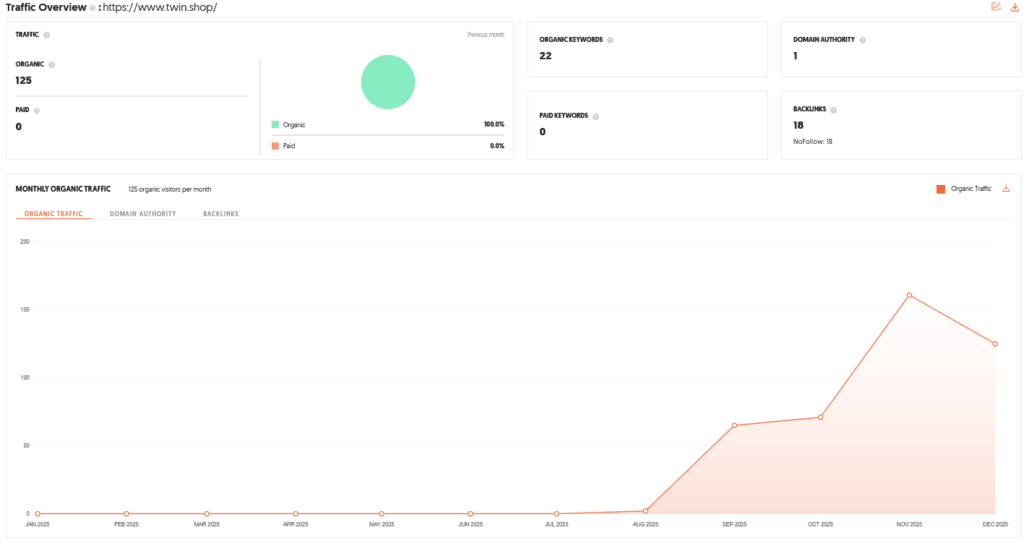
- Poor SEO Performance, SEO Improvement Needed.
- ORGANIC TRAFFIC: 125 visitor per month.
Twin Founder
- The startup was founded by Aseem Khanduja, an alumnus of IIT Delhi based in Gurgaon.
- His technical background from one of India’s premier institutes provided the foundation for developing the complex AI algorithms used in the platform.
Twin Brand Overview
- Twin Shop AI is a cutting-edge fashion-tech platform that seeks to revolutionize the traditional e-commerce experience.
- By shifting the focus from static product images to personalized virtual experiences, the brand addresses the “uncertainty gap” in online shopping—specifically regarding how clothes look on different body types.
Twin Shark Tank India Appearance & Ask
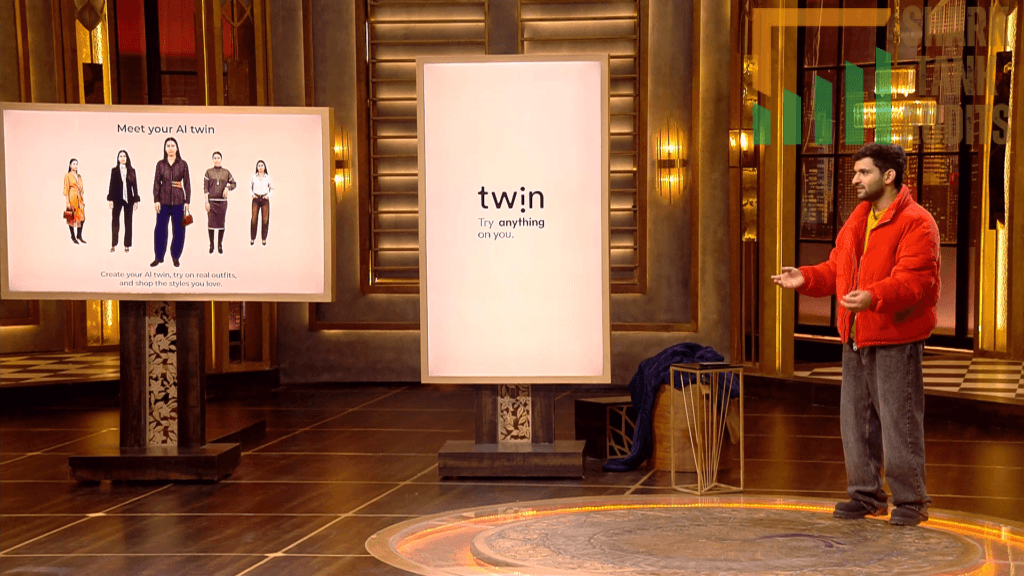
Aseem appeared in Season 5 of Shark Tank India to pitch his “Virtual Try-On” technology.
- Original Ask: ₹60 Lakhs for 1% Equity.
- Initial Valuation: ₹60 Crores.
Twin Season and Episode Air Date
- Season: 05
- Episode: 15
- Episode Air Date: Friday, 23 January 2026
Twin Product Overview
- The core of the business is the AI Twin technology, an AI-powered software that creates a digital avatar of the user.
- By uploading three selfies and two full-body photos, the system generates a realistic “Twin” that replicates the user’s body type, skin tone, and appearance.
- Unlike static filters, this avatar is optimized to show a realistic fit for apparel, shoes, and accessories.
Twin Investor Reactions
- The Sharks were impressed by the commercial potential of the “Endless Wardrobe” concept.
- They noted that the ability to offer multi-brand access on a single interface is a significant market opportunity.
- Shark Aman Gupta, in particular, saw the value in how the tech handles external product links from platforms like Instagram, allowing users to “test” outfits they see on social media before purchasing.
Twin Customer Engagement Philosophy
- Twin Shop AI operates on a philosophy of confidence-driven shopping. The brand aims to make online purchasing a self-assured and customized experience.
- By allowing users to “Mix & Match” clothing from various brands for different occasions (like brunch or parties), the app encourages creative freedom and reduces the “guesswork” associated with size and fit.
Twin Product Highlights
- Virtual Try-On: Users can view thousands of items on their digital avatar without physical contact.
- Reduced Returns: By providing an accurate preview of size and look, the tech directly solves the high-return problem in e-commerce.
- External Product Testing: Users can share links or screenshots from other platforms to see those items on their AI Twin.
- Time Efficiency: The ability to try on hundreds of outfits in seconds makes it a powerful utility tool for busy shoppers.
Twin Future Vision
- The brand has set ambitious user growth targets, aiming for 1 million users in the next 6 months and 5 million users within a year.
- The long-term vision is for Twin Shop AI to evolve into a customer intelligence tool for major brands, using AI-driven insights into user behavior and style preferences to dominate the global fashion-tech market.
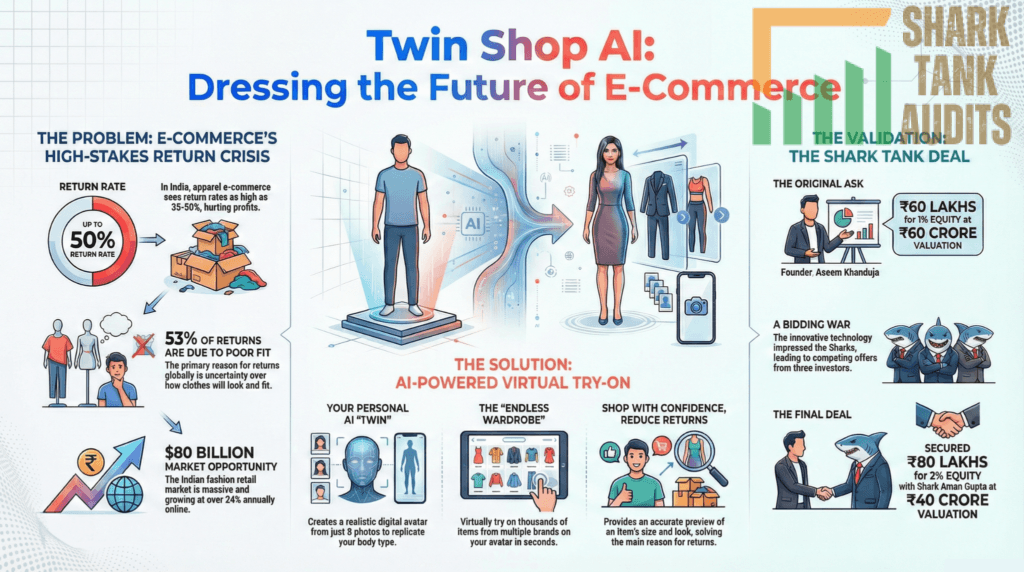
Twin Deal Finalized or Not
- Yes, a deal was finalized.
- After receiving competing offers from Sharks Aman Gupta, Anupam Mittal, and Kanika Tekriwal, the founder engaged in a negotiation that resulted in a revised valuation.
- Final Deal: ₹80 Lakhs for 2% Equity with Shark Aman Gupta at a ₹40 Crores Valuation.
| Category | Parameter | Details |
|---|---|---|
| Website & Tech | Website | Twin (Twin Shop AI) |
| Tech Stack | Next.js 16.1.4, React (JavaScript Frameworks) | |
| SEO Performance | Poor – SEO improvement needed | |
| Monthly Organic Traffic | ~125 visitors | |
| Founder | Founder Name | Aseem Khanduja |
| Background | IIT Delhi alumnus | |
| Location | Gurgaon, India | |
| Core Strength | Strong technical & AI engineering expertise | |
| Brand Overview | Brand Type | Fashion-Tech / AI Commerce Platform |
| Core Problem Solved | Online shopping uncertainty (fit & look) | |
| Core Idea | Personalized virtual try-on via AI avatars | |
| Shark Tank India | Season | 05 |
| Episode | 15 | |
| Episode Air Date | Friday, 23 January 2026 | |
| Original Ask | ₹60 Lakhs for 1% equity | |
| Initial Valuation | ₹60 Crores | |
| Product Overview | Core Technology | AI Twin (Digital Avatar) |
| Avatar Creation | 3 selfies + 2 full-body photos | |
| Capabilities | Replicates body type, skin tone & fit | |
| Use Cases | Apparel, shoes & accessories try-on | |
| Product Highlights | Virtual Try-On | Realistic outfit preview on AI Twin |
| Returns Reduction | Solves sizing & fit-related returns | |
| External Links | Try outfits from Instagram & other platforms | |
| Time Saving | Hundreds of outfits in seconds | |
| Investor Reactions | Shark Sentiment | Strong interest in commercial potential |
| Key Insight | “Endless Wardrobe” multi-brand opportunity | |
| Notable Shark | Aman Gupta highlighted social commerce use | |
| Customer Philosophy | Shopping Mindset | Confidence-driven & personalized |
| Core Feature | Mix & Match across brands | |
| Emotional Benefit | Removes guesswork & sizing anxiety | |
| Deal Outcome | Deal Status | ✅ Deal Closed |
| Final Investor | Aman Gupta | |
| Final Deal | ₹80 Lakhs for 2% equity | |
| Final Valuation | ₹40 Crores | |
| Market Potential | Indian Fashion Market | $70–$80 Billion (2025–26) |
| Fashion E-commerce CAGR | 24%+ | |
| Return Rate Issue | 15–20% avg; up to 50% in apparel | |
| TAM Breakdown | TAM – Fashion E-commerce | $35 Billion by 2026 |
| SAM – Virtual Try-On Market | Global CAGR 25.8% | |
| Target Segment | Luxury & Premium Fashion ($9.85B) | |
| Target Audience | Age Group | 18–35 years |
| Geography | Tier 1 & Tier 2 cities | |
| User Type | Gen Z & Millennials | |
| Psychographics | Trend-first, social-media driven | |
| Marketing Strategy | Influencer Campaigns | “Twin Challenges” (Real vs AI Twin) |
| UGC Strategy | Share virtual try-on screenshots | |
| Education Content | Explaining avatar creation process | |
| Digital Strategy | SEO Fix | Implement SSR on Next.js |
| Keyword Focus | Virtual try-on, personalized fashion | |
| Social Commerce | WhatsApp & Instagram mini-apps | |
| Distribution Strategy | B2B SaaS | Integration with Myntra, Ajio, Nykaa |
| D2C App | Multi-brand endless wardrobe | |
| Offline | AI-powered smart mirrors | |
| Advantages | Technology | Proprietary IIT-led AI algorithms |
| Market Edge | First-mover in Indian social VTO | |
| Operations | Reduces logistics & returns | |
| Challenges | AI Costs | High computing & R&D expenses |
| Trust | Initial skepticism around accuracy | |
| Privacy | Facial & body data protection | |
| Risk Mitigation | Data Security | ISO encryption, DPDP Act compliance |
| Accuracy Control | User-driven avatar fine-tuning | |
| Future Vision | User Growth Target | 1M users in 6 months |
| 1-Year Goal | 5M users | |
| Platform Evolution | B2B fashion intelligence tool | |
| Valuation Roadmap | Phase 1 | Shark Tank momentum + influencers |
| Phase 2 | “Twin Intelligence” data monetization | |
| Phase 3 | Middle East & SE Asia expansion | |
| Long-Term Goal | Platform (PaaS) valuation expansion |
Twin Shark Tank India Business Plan
1. Twin Shop AI: Business Potential in India
The Indian fashion market is undergoing a seismic shift toward digitalization and “Trend-first” commerce. Twin Shop AI enters a landscape where technology is no longer a luxury but a necessity for e-commerce survival.
- Rapid Growth: The Indian fashion retail market is valued at approximately $70–$80 billion (₹6.18–₹6.86 Lakh Crore) in 2025-26, with e-commerce growing at a staggering CAGR of over 24%.
- The Return Crisis: Indian e-commerce faces a high return rate of 15–20%, peaking at 35–50% in specific apparel categories. Twin Shop AI directly addresses the primary cause: fit and sizing issues, which account for 53% of all returns globally.
- Digital Adoption: With over 950 million broadband users and a smartphone penetration rate exceeding 85%, the infrastructure for Twin Shop AI’s high-fidelity 3D rendering is now mainstream.
2. Twin Shop AI: Total Addressable Market (TAM)
Twin Shop AI operates at the intersection of three explosive markets:
- Fashion E-commerce (TAM): Projected to reach $35 billion by 2026. This represents the total pool of online fashion transactions.
- Virtual Try-On (VTO) Market (SAM): The global VTO market is growing at a CAGR of 25.8%, with India being the fastest-growing region in Asia-Pacific (over 30% growth).
- Luxury & Premium Segment (Target Market): The Indian luxury fashion market is valued at $9.85 billion. Given that 71% of consumers shop more with brands integrating AR, Twin Shop AI has a captured audience in high-ticket segments.
3. Twin Shop AI: Ideal Target Audience & Demographics
The success of Twin Shop AI hinges on the most active and experimental digital cohort:
- Primary Audience (Gen Z & Millennials): These groups represent 40% of India’s e-retail shoppers. They are “experimental,” spend 3x more on insurgent brands, and are heavily influenced by social media discovery.
- Demographic Profile: * Age: 18–35 years.
- Location: Tier-1 and Tier-2 cities (Delhi-NCR, Mumbai, Bangalore, Pune, Chandigarh).
- Income: Middle to High disposable income (Affluent India cohort growing to 100 million by 2027).
- Psychographics: Value-conscious but brand-driven; high social media usage (Instagram/TikTok/YouTube); prefers UPI payments.
4. Twin Shop AI: Marketing & Content Strategy
To overcome the current 125 monthly organic visitors, Twin Shop AI must pivot toward a community-driven approach:
- Influencer-Led “Twin Challenges”: Collaborate with fashion influencers to show a “Real vs. AI Twin” comparison. This builds trust in the technology’s accuracy.
- UGC (User Generated Content): Encourage users to share their “Virtual Try-On” screenshots on Instagram Stories with a direct purchase link.
- Educational Content: Use short-form videos (Reels/Shorts) to demonstrate how only 5 photos (3 selfies + 2 full-body) create a digital double.
- SEO & Tech Stack Improvement: Leverage the existing Next.js and React framework to implement server-side rendering (SSR) for faster indexing and better technical SEO to capture “virtual try-on” and “personalized fashion” keywords.
5. Twin Shop AI: Digital Marketing Strategy
- Hyper-Personalization: Use AI-driven ad creatives that change based on the user’s city (e.g., ethnic wear for North India, trendy Western wear for Bangalore).
- Social Commerce Integration: Since 46% of consumers now buy directly through social platforms, Twin Shop AI must integrate its VTO engine as a “mini-app” inside WhatsApp and Instagram.
- Predictive Ad Spend: Utilize AI bidding algorithms to shift budget toward high-conversion windows (e.g., 8 PM to 11 PM for urban professionals).
6. Twin Shop AI: Distribution Strategy
- B2B SaaS Integration: Partner with major e-commerce players like Myntra, Ajio, and Nykaa Fashion to integrate the Twin Shop AI engine directly onto their product pages.
- Direct-to-Consumer (D2C) App: A standalone marketplace where users can try on “Endless Wardrobes” from multiple brands in one session.
- In-Store “Magic Mirrors”: Deploy the Twin Shop AI software in physical retail hubs to provide a contactless, fast-fitting experience in malls.
7. Twin Shop AI: Advantages & Challenges
| Feature | Twin Shop AI Advantage | Twin Shop AI Challenge |
| Technology | IIT Delhi-founded proprietary AI algorithms. | High cost of AI computing and R&D. |
| Market | First-mover advantage in Indian “Social VTO.” | Low digital trust in AI accuracy initially. |
| Operations | Drastically reduces logistics/return costs. | Integration hurdles with legacy brand websites. |
| User Experience | Instant “Mix & Match” across brands. | Data privacy concerns (facial/body data). |
8. Twin Shop AI: Success Factors & Mitigation Strategies
- Reason for Success: Aman Gupta’s (boAt) mentorship provides the retail muscle and marketing “cool factor” needed to reach mass-market Gen Z.
- Mitigation (Data Privacy): Implement ISO-certified data encryption and clear “Right to be Forgotten” policies to comply with India’s DPDP Act 2023.
- Mitigation (Accuracy): Use a feedback loop where users can “fine-tune” their avatar’s measurements to ensure the 3D drape matches reality.
9. Twin Shop AI: Future Business & Roadmap to Valuation
To reach the ambitious goal of 5 million users in 12 months and increase the valuation beyond ₹40 Crores:
- Phase 1 (Month 1-6): Scale from 125 visitors to 1M users via aggressive Shark Tank momentum and influencer partnerships.
- Phase 2 (Month 7-12): Launch “Twin Intelligence”—selling user style data and fit trends back to brands as a B2B insights tool.
- Phase 3 (Year 2+): International expansion into the Middle East and SE Asia, where e-commerce return rates are similarly high.
- Valuation Driver: Transition from a “feature” to a “Platform” (PaaS) where brands pay a subscription to be part of the Twin Shop AI Endless Wardrobe



Twin Shark Tank India Episode Review