
Nootie Shark Tank India Episode Review
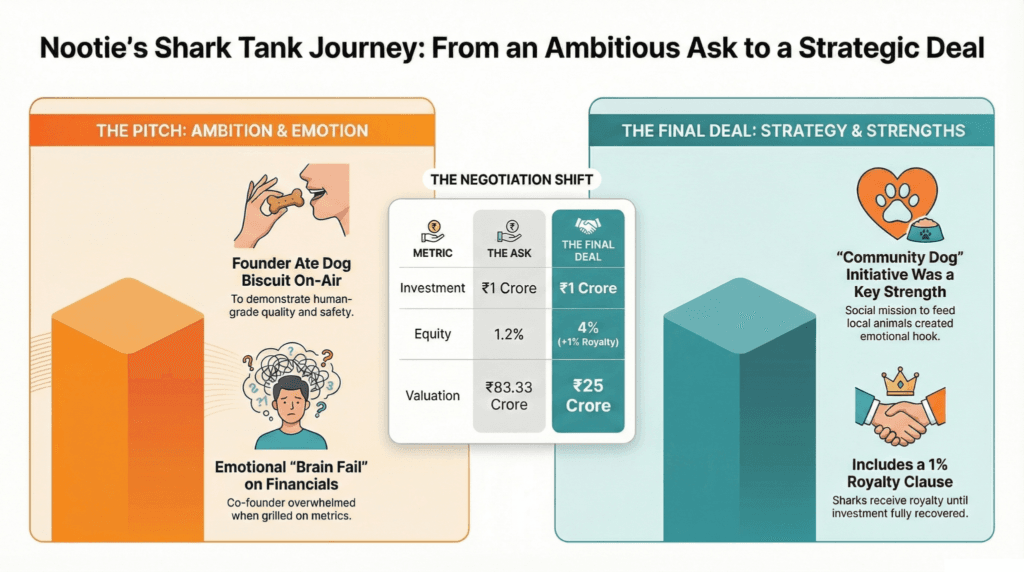
Nootie appeared on Shark Tank India Season 5, Episode 6, in a “Face-Off” against Smylo, with founders Akshay, Karan, and Anil Mahendru seeking ₹1 Crore for 1.2% equity (₹83.33 Crore valuation). After an emotional pitch where Akshay struggled with financial metrics, they closed a deal for ₹1 Crore for 4% equity with 1% royalty until recovered (₹25 Crore valuation) with Sharks Namita Thapar and Anupam Mittal.
Nootie Website Information
- Website:- Nootie
- Build on Shopify
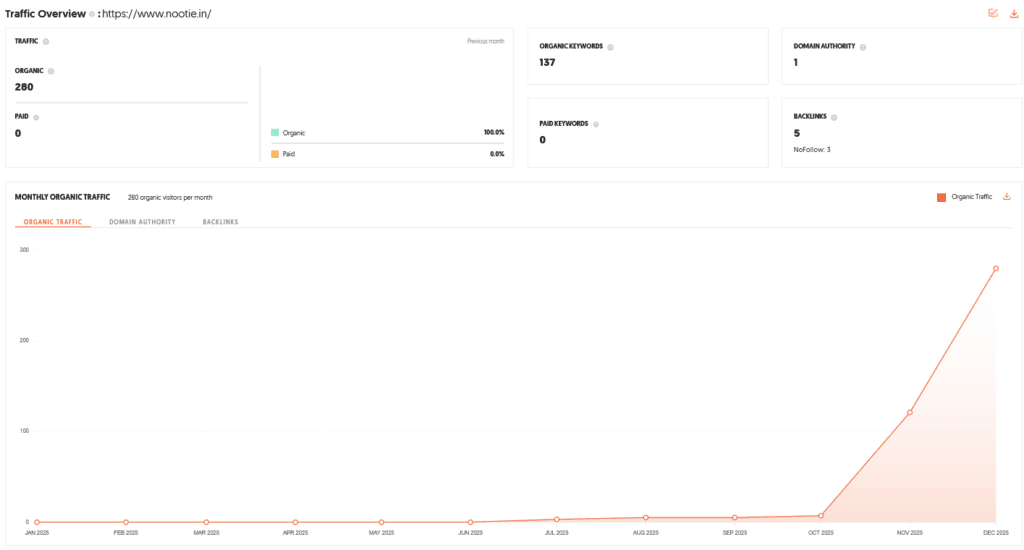
- Poor SEO Performance, SEO Improvement Needed.
- ORGANIC TRAFFIC: 280 visitor per month.
Nootie Founder
- The brand is a family-led venture founded by Akshay Mahendru, Karan Mahendru, and Anil Mahendru.
- During the pitch, Akshay took the lead in defending the brand’s vision.
- He displayed a deeply personal connection to the business, describing himself as a “mama’s boy” and becoming visibly emotional due to the high stakes of the platform and his passion for the pet care industry.
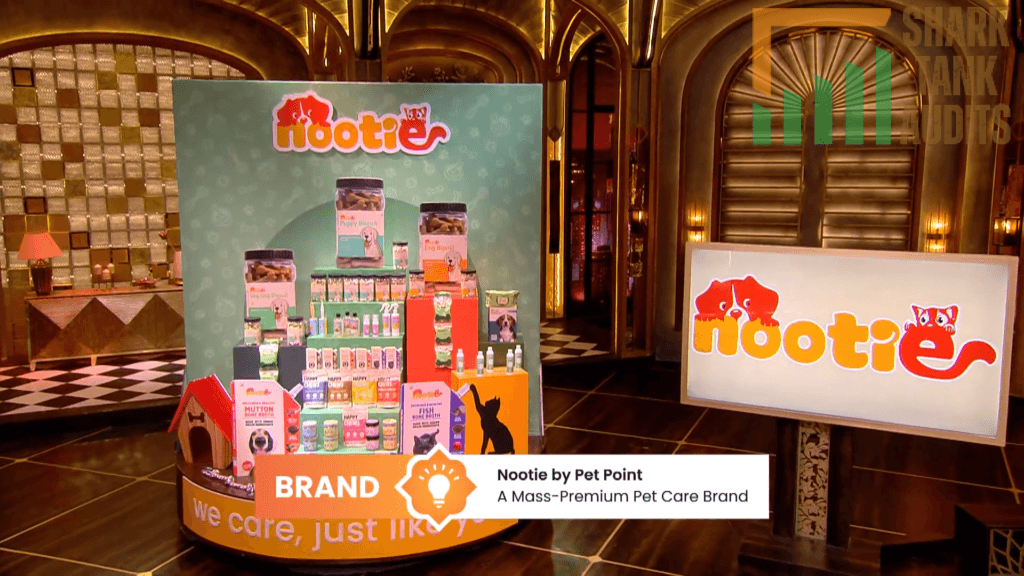
Nootie Brand Overview
- Nootie is a Delhi-based pet care brand that operates as a “house of brands.”
- Unlike many modern startups that focus solely on e-commerce, Nootie is built on a foundation of eight physical retail stores across Delhi that were operational before the brand’s inception.
- They aim to provide an all-encompassing solution for pet owners, ranging from food to hygiene.
Nootie Shark Tank India Appearance & Ask
The founders presented their business to Sharks Anupam Mittal, Namita Thapar, Vineeta Singh, Kunal Bahl, and Varun Alagh.
- The Ask: Rs 1 crore for 1.2% equity.
- Valuation Sought: Rs 83.33 crore.
- Key Moment: The pitch became high-intensity when the founders were grilled on their financial metrics, leading to an emotional “brain fail” for Akshay.
Nootie Season and Episode Air Date
- Season: 05
- Episode: 06
- Episode Air Date: Monday, 12 January 2026
Nootie Product Overview
- Nootie offers an extensive catalog of pet products designed to be affordable and high-quality.
- To demonstrate the safety of their “human-grade” ingredients, one of the founders actually ate a portion of their dog biscuit during the pitch.
- Their inventory includes everything from nutritional meals to grooming accessories, heavily influenced by demand trends on quick-commerce platforms.
Nootie Investor Reactions
The Sharks had mixed reactions to the business model:
- Strategic Concerns: Varun Alagh was critical of the founders’ admission that they were “not good marketers” and that they added products simply because quick-commerce apps requested them.
- Empathy: When Akshay became overwhelmed by the numbers, Anupam Mittal and Varun Alagh offered comfort, acknowledging the pressure of the environment.
- Admiration: Namita Thapar was particularly impressed by their social consciousness regarding stray animal welfare.
Nootie Customer Engagement Philosophy
- The founders follow a philosophy of “community care.”
- They strictly refer to street animals as “community dogs” rather than strays, arguing that these animals are integral parts of the neighborhoods they live in.
- Their engagement is built on empathy and accessibility, ensuring that even those with limited means can afford to feed local animals.
Nootie Product Highlights
- Community Dog Biscuits: A standout product priced at Rs 10 (sold via Swiggy Instamart), specifically designed for feeding community dogs without a high profit motive.
- Pricing Advantage: Their primary differentiator is a low-price point, which they achieve despite not manufacturing the goods themselves.
- Omnichannel Reach: A rare combination of legacy brick-and-mortar stores and modern quick-commerce distribution.
Nootie Future Vision
- The Mahendru family envisions Nootie becoming a household name in pet care by maintaining their “house of brands” strategy.
- While the Sharks advised them to be more selective to build a stronger brand identity, the founders aim to continue scaling by listening to market demands and providing “human-grade” nutrition at prices the average Indian consumer can afford.
Nootie Deal Finalized or Not
- Yes, a deal was finalized. While the Sharks initially pushed back on the valuation and the lack of brand focus, two Sharks saw potential in the founders’ grit and sales figures.
- Final Deal: Rs 1 crore for 4% equity with Shark Namita Thapar & Anupam Mittal.
- Royalty: 1% royalty until the investment amount is recovered.
- Final Valuation: Rs 25 crore.
| Particular | Details |
|---|---|
| Website | Nootie |
| Organic Monthly Traffic | 280 |
| Founders | Akshay Mahendru, Karan Mahendru, Anil Mahendru |
| Founder Background | Family-led venture |
| Pitch Lead | Akshay Mahendru |
| Founder Personality Highlight | Described himself as a “mama’s boy” |
| Emotional Moment | Akshay became emotional during the pitch |
| Brand Location | Delhi, India |
| Business Model | House of brands |
| Retail Presence | 8 physical retail stores across Delhi |
| Pre-brand Foundation | Stores were operational before brand inception |
| Core Offering | End-to-end pet care solutions |
| Product Range | Pet food, hygiene, grooming, accessories |
| Shark Tank India Sharks | Anupam Mittal, Namita Thapar, Vineeta Singh, Kunal Bahl, Varun Alagh |
| Initial Ask | ₹1 crore |
| Equity Asked | 1.2% |
| Valuation Sought | ₹83.33 crore |
| Key Pitch Moment | High-intensity financial questioning |
| Pitch Challenge | Founder faced a “brain fail” on numbers |
| Product Positioning | Affordable and high-quality pet products |
| Ingredient Claim | Human-grade ingredients |
| Product Demonstration | Founder ate dog biscuit on-air |
| Product Development Driver | Quick-commerce demand trends |
| Investor Reaction Type | Mixed reactions |
| Strategic Concern | Weak marketing capability |
| Concern Raised By | Varun Alagh |
| Marketing Approach Criticism | Products added based on quick-commerce requests |
| Emotional Support By | Anupam Mittal and Varun Alagh |
| Social Impact Appreciation | Focus on stray animal welfare |
| Appreciation By | Namita Thapar |
| Customer Philosophy | Community care |
| Terminology Used | “Community dogs” instead of strays |
| Social Belief | Community dogs are part of neighborhoods |
| Accessibility Focus | Affordable feeding options for all |
| Highlight Product | Community Dog Biscuits |
| Highlight Product Price | ₹10 |
| Sales Channel | Swiggy Instamart |
| Profit Motive | Low-profit, social-driven |
| Pricing Advantage | Low price point |
| Manufacturing Model | Third-party manufacturing |
| Distribution Strength | Omnichannel presence |
| Offline Channel | Legacy brick-and-mortar stores |
| Online Channel | Quick-commerce platforms |
| Future Brand Vision | Become a household pet care name |
| Long-term Strategy | Continue house of brands approach |
| Shark Advice | Be more selective with products |
| Scaling Approach | Listen to market demand |
| Nutrition Focus | Human-grade nutrition |
| Deal Status | Deal finalized |
| Initial Shark Pushback | Valuation and brand focus |
| Investing Sharks | Namita Thapar and Anupam Mittal |
| Final Investment | ₹1 crore |
| Final Equity Given | 4% |
| Royalty Clause | 1% until investment recovery |
| Final Valuation | ₹25 crore |
| Industry Trend | Pet humanization |
| Market Size Projection | $7 billion by 2028 |
| Industry Growth Rate | ~20% CAGR |
| Competitive Edge | Legacy retail experience |
| Pet Population Projection | 58.7 million by 2028 |
| India Pet Market Value | ₹35,000 crore |
| Target Segment | Urban mid-premium |
| SAM Share | ~70% of pet food sales |
| SOM Target | 5–8% of organized urban market |
| Primary Audience | Urban Millennials and Gen Z |
| Pet Perception | Pets viewed as children |
| Income Target | ₹10L+ annual household income |
| Geography Focus | Tier 1 and Tier 2 cities |
| Community Segment | Local feeders and animal lovers |
| Content Strategy | Educational empathy |
| Video Content Focus | Ingredient testing |
| Social Proof Strategy | User-generated content |
| Performance Marketing | Meta & Google Ads |
| Target Keywords | Affordable dog food, grain-free treats |
| Influencer Strategy | Pet influencers and rescue activists |
| Distribution Model | Omnichannel flywheel |
| Offline Usage | Experience centers and micro-fulfillment |
| Quick Commerce Platforms | Blinkit, Zepto, Instamart |
| Delivery Promise | 10-minute delivery |
| D2C Strategy | Subscription-based repeat purchases |
| Key Advantage | Retail data and experience |
| Pricing Strength | Affordable quality products |
| Emotional Brand Hook | Community dog initiative |
| Major Challenge | Market saturation |
| Big Competitors | Nestlé Purina, Reliance |
| Brand Risk | Commodity perception |
| Supply Chain Risk | Third-party dependency |
| Success Driver | Emotional storytelling + sales volume |
| Financial Mitigation | Hire CFO / Shark guidance |
| Strategic Mitigation | Core brand with extensions |
| Valuation Growth Goal | ₹100 crore+ |
| Phase 1 Plan | Supply chain optimization |
| Phase 1 Timeline | 0–12 months |
| Phase 2 Expansion | Mumbai and Bangalore |
| Phase 2 Timeline | 12–24 months |
| Phase 3 Innovation | Pet-tech and subscriptions |
| Phase 3 Timeline | 24–36 months |
Nootie Shark Tank India Business Plan
1. Business Potential in India for Nootie
The Indian pet care market is currently undergoing a “humanization” revolution.
- Market Growth: The industry is projected to reach $7 billion by 2028, growing at a CAGR of ~20%.
- The “Nootie” Edge: As a family-led venture with eight legacy stores, Nootie is uniquely positioned to capture the shift from unbranded home-cooked meals to packaged nutrition.
- Quick Commerce Explosion: With platforms like Swiggy Instamart and Zepto growing at 95% YoY, Nootie’s early adoption of these channels provides a massive first-mover advantage.
2. Total Addressable Market (TAM) for Nootie
- TAM (Total Addressable Market): India’s pet population is expected to reach 58.7 million by 2028. The total market value for pet products and services is estimated at ₹35,000 crore ($4.2B) in 2026.
- SAM (Serviceable Addressable Market): Nootie targets the urban mid-premium segment, which accounts for ~70% of total pet food sales.
- SOM (Serviceable Obtainable Market): By focusing on the Delhi-NCR region initially and expanding via e-commerce, Nootie can realistically target 5–8% of the urban organized pet care market.
3. Ideal Target Audience and Demographics for Nootie
- Primary Audience: Urban Millennials (33%) and Gen Z (16%) who view pets as “children” rather than “animals.”
- Income Bracket: Households with an annual income of ₹10L+, primarily residing in Tier 1 and Tier 2 cities.
- The “Community Care” Segment: Socially conscious individuals and local feeders who purchase Nootie’s Rs 10 community dog biscuits.
4. Marketing & Content Strategy for Nootie
- Content Strategy:Nootie should focus on “Educational Empathy.”
- Short-form Video: Behind-the-scenes of “human-grade” ingredient testing.
- Social Proof: User-generated content of pets enjoying Nootie treats.
- Digital Marketing Strategy: * Performance Marketing: Targeted Meta/Google ads for keywords like “affordable dog food” and “grain-free pet treats.”
- Influencer Outreach: Partnering with “Pet-fluencers” and animal rescue activists to build brand trust.
5. Distribution Strategy for Nootie
Nootie employs an omnichannel “Flywheel” model:
- Offline Hubs: Using its 8 existing Delhi stores as experience centers and micro-fulfillment hubs.
- Quick Commerce: Aggressive stocking on Blinkit, Zepto, and Instamart for 10-minute delivery.
- D2C Website: Offering subscription models for repeat purchases of Nootie staples.
6. Advantages and Challenges for Nootie
| Advantages of Nootie | Challenges for Nootie |
| Legacy Knowledge: Years of retail data from physical stores. | Market Saturation: Fierce competition from giants like Nestlé (Purina) and Reliance. |
| Pricing Power: High-quality products at an affordable entry point. | Brand Identity: Risk of being seen as a “commodity” rather than a premium brand. |
| Social Credit: Strong emotional hook with “community dog” initiatives. | Supply Chain: Dependence on third-party manufacturing. |
7. Success Factors and Mitigation Strategies for Nootie
- Why Nootie will succeed: The blend of high sales volume and emotional brand storytelling (the “mama’s boy” founder and community focus) creates a “sticky” brand.
- Mitigation for “Brain Fail” (Financials): Nootie must hire a dedicated CFO or utilize the expertise of Sharks Anupam and Namita to streamline unit economics and reporting.
- Mitigation for Strategy Focus: Move from a “House of Brands” to a “Core Brand with Extensions” to prevent resource dilution.
8. Future Vision and Roadmap to Increase Valuation for Nootie
To move from a Rs 25 crore valuation to Rs 100 crore+, Nootie should follow this roadmap:
- Phase 1 (0-12 Months): Optimize the Nootie supply chain and launch 3 “hero” products to build brand recall.
- Phase 2 (12-24 Months): Geographical expansion into Mumbai and Bangalore markets using a “dark store” model.
- Phase 3 (24-36 Months): Integrate Pet-Tech (tracking health via app) and subscription services to build high-margin recurring revenue.

Nootie Shark Tank India Episode Review