
Shark Tank India Season 5 Episode 25 Review
Episode 25 of Shark Tank India Season 5 delivered one of the season’s most philosophically diverse episodes, exploring the intersection of AI creativity, culinary convenience, and human connection in the digital age. From a New York-based generative AI music platform democratizing studio-quality production to clean-label marination mixes solving the “what to cook” dilemma, and a social networking platform combating swipe culture through curated in-person meetups, this episode showcased entrepreneurship addressing fundamental human needs—creative expression, time-starved meal preparation, and authentic relationship building.
The episode raised critical questions about AI startup mortality risks, repeat purchase economics in food-tech, and whether offline dating events can scale profitably while managing safety concerns. With ₹2.35 crore total investment despite harsh rejections and scalability skepticism, Episode 25 proved that some business models attract capital through technological promise (AI music) or premium positioning (clean-label food) while others face insurmountable Shark concerns about safety liability and demographic maturity regardless of market opportunity.
Episode Summary
Total Pitches: 3
Successful Deals: 2
Total Investment Made: ₹2.35 Crore equity (both deals subject to conditions)
Featured Sharks: Namita Thapar, Anupam Mittal, Kunal Bahl, Aman Gupta, Shaily (guest Shark)
Pitch 1
Soundverse AI Shark Tank India Episode Review
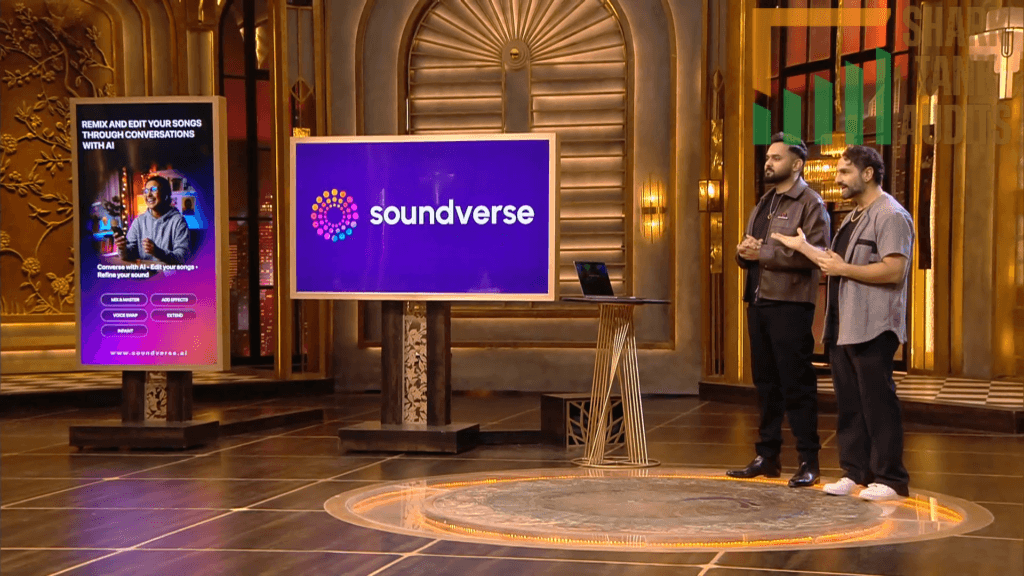
In Shark Tank India Season 5, Episode 25 (aired Friday, February 6, 2026), Soundverse AI, a New York-based music tech startup—showcased its “democratization of creativity” through a generative AI music studio. Founded by Sourabh Pateriya, Riley Williams, and Ash Pournouri, the platform allows users to create studio-quality music, lyrics, and vocals from simple text prompts.
The founders entered the Tank seeking ₹1.35 crore for 1.5% equity (₹90 crore valuation), but faced skepticism from most Sharks regarding the rapid “mortality” risk of AI startups and the lack of human “stickiness.” However, Namita Thapar chose to bet on the technology’s ethical foundation and enterprise potential, closing a deal for ₹1.35 crore for 5% equity, effectively valuing the company at ₹27 crore.
Pitch 2
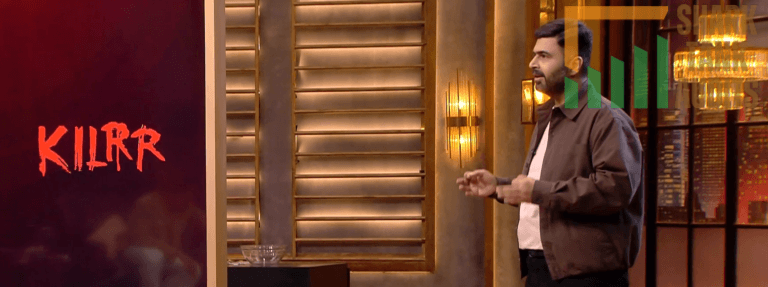
Kilrr Shark Tank India Episode Review
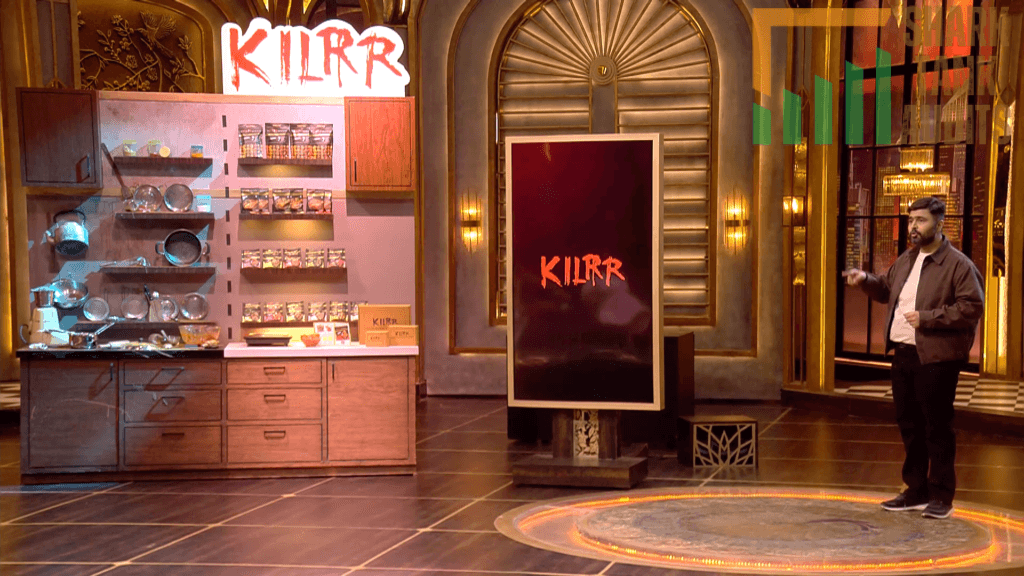
KILRR appeared on Shark Tank India Season 5, Episode 25, with founder Hitesh Bhagia (Delhi entrepreneur, MBA 2009, ex-Citibank/Indian Express, viral social media cooking content creator) seeking ₹1 Crore for 1% equity (₹100 Crore valuation) and successfully closed a deal for ₹1 Crore for 1.06% equity (₹94.3 Crore valuation, matching previous round) with Shark Anupam Mittal subject to “customer-love” due diligence after beating Kunal Bahl’s ₹1 Crore for 2% offer.
Launched December 2023 in Mumbai, the food-tech brand specializes in “zero-fuss” clean-label marination/spice mixes (11 flavors, 26 ingredients each, no preservatives/artificial colors) for non-vegetarian cooking (chicken, mutton, fish, eggs) requiring only water and ghee, achieving 2,983 monthly organic visitors with 6-month shelf life and 65% gross margins though critical 1% repeat purchase rate and 51% marketing spend creating thin net margins. Sharks reacted mixed—Namita/Shaily flagged shelf life and thin quick-commerce margins, Aman liked product but felt 1% equity too low to move needle, Kunal urged staying niche (avoiding “Aloo Paneer”) but was outbid on valuation.
Operating in Indian meat market valued at $60 billion (2025) projected to reach $124.2 billion by 2034 with 70% population non-vegetarian within spice/seasoning market at ₹2,21,832 Crore ($26.5 billion, 2026) and blended spices/non-veg masala segment growing 10.14% CAGR, KILRR targets ₹15,000 Crore urban premium ready-to-cook marinade niche among busy professionals (25-40, Tier 1 cities, 50+ work hours), health-conscious parents seeking clean-label protein options, and Gen Z explorers influenced by social media food trends, planning expansion into Biryani Masala, Egg Bhurji Mix, Regional Gravies, and international exports (Middle East/UK/US diaspora) projecting ₹13 Crore annual revenue.
Pitch 3
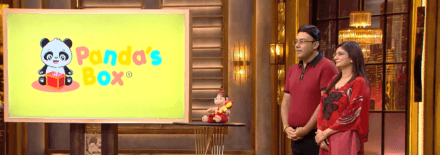
Offline by Happy Hour Shark Tank India Episode Review
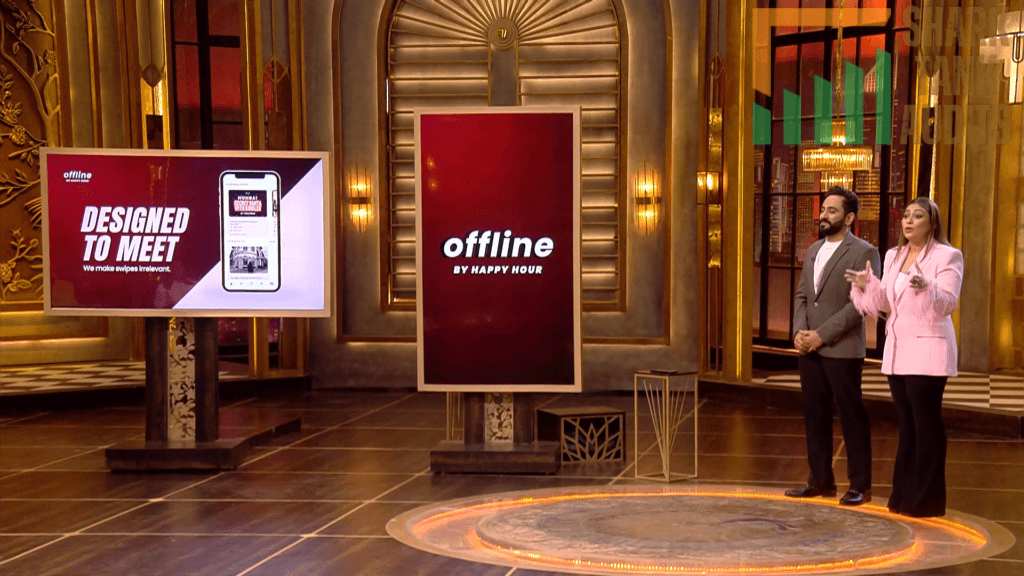
Offline by Happy Hour appeared on Shark Tank India Season 5, Episode 25, with co-founders Tanay Baweja and Aastha Sethi (recently married couple who met at Delhi bus stand) seeking ₹50 lakh for 5% equity (₹10 Crore valuation) but left with no deal after all five Sharks opted out citing scalability concerns and safety risks.
The Gurugram-based social networking platform for singles combats “swipe culture” and digital burnout through curated in-person events (mixers, fests, themed dinners for 10-12 attendees with equal gender ratios) at reputable public venues (bars, restaurants, never private spaces), growing from ₹25 lakh (FY 23-24) to ₹51 lakh (FY 24-25) organizing 300+ meetups across 15 cities with recently launched app enabling users to attend/host gatherings with 1,166 monthly organic visitors. Sharks reacted harshly—Anupam joked business started because founder couldn’t get a date arguing dating is “numbers game” and offline methods are inefficient noting real issue is making “good men” more desirable which app doesn’t solve, Namita felt model lacked required scalability, Aman warned business “just one kaand (scandal) away” from disruption citing safety concerns, and Shaily questioned lack of sincerity/maturity in Indian youth demographic.
Operating amid India’s loneliness epidemic (17-21% youth 13-29 reporting loneliness) with online dating market projected at $1.42 billion by 2030 facing user burnout and organized live event segment surpassing ₹12,000 Crore (2024, 19% CAGR), Offline targets Gen-Z/millennials (22-35) in Tier 1 cities (Bengaluru, Mumbai, Delhi-NCR) spending ₹20,000+ annually on social activities—”Introverted Seekers” and “Digital Burnout” victims within 100+ million urban single population and 25-30 million serviceable market across top 15 metros.
Episode Highlights:
- AI mortality risk: First pitch explicitly addressing whether AI startups survive rapid technology evolution
- Bidding war victory: KILRR securing premium ₹94.3 Cr valuation despite 1% repeat rate concerns
- Harshest social commentary: Anupam’s “couldn’t get a date” joke and “good men” societal critique
- Conditional deals: Both successful investments subject to verification (customer-love, due diligence)
- “One kaand away”: Aman’s warning about single incident destroying safety-dependent business
- Clean-label premium: Food-tech commanding ₹100 Cr valuation in crowded spice market
- Creator economy validation: Viral cooking content creator (Hitesh) monetizing audience through products
- Scalability wall: Offline events model rejected despite market need and personal founder story
Key Lessons:
- AI startups face “mortality risk” requiring massive equity dilution (1.5% → 5%) for funding
- Repeat purchase rate (1%) more concerning than gross margins (65%) in food-tech
- Viral content creation credentials translate to business credibility and premium valuations
- Safety liability businesses (“one kaand away”) face fundamental investability questions
- Dating/relationships entrepreneurship challenged on whether problem is even solvable
- Ethical AI positioning (artist compensation, licensing) can overcome technology uncertainty
- “Customer-love” conditions protect investors against concerning early metrics
- Niche premium positioning (non-veg marinades) preferred over mass-market expansion
Deal Structure Analysis:
Soundverse AI:
- Asked: ₹1.35 Cr for 1.5% (₹90 Cr valuation)
- Got: ₹1.35 Cr for 5% (₹27 Cr valuation)
- Equity increase: 3.33x (1.5% → 5%)
- Valuation: 70% reduction (₹90 Cr → ₹27 Cr)
- Rationale: AI mortality risk + lack of stickiness requiring large equity for meaningful returns
- Investor: Namita (betting on ethical foundation + enterprise B2B potential)
KILRR:
- Asked: ₹1 Cr for 1% (₹100 Cr valuation)
- Got: ₹1 Cr for 1.06% (₹94.3 Cr valuation, matching previous round)
- Equity increase: Minimal (1% → 1.06%, just 6% dilution)
- Valuation: Maintained premium (₹94.3 Cr vs. ₹100 Cr ask)
- Condition: Subject to “customer-love” due diligence verification
- Rationale: Creator credibility + clean-label positioning + bidding war = premium maintained
- Investor: Anupam (outbid Kunal’s 2% offer to maintain founder valuation)
Offline by Happy Hour:
- Asked: ₹50L for 5% (₹10 Cr valuation)
- Got: No deal
- Reasons: Scalability concerns, safety liability (“one kaand away”), societal unsolvability, demographic immaturity
Strategic Patterns:
- AI Uncertainty Tax: Generative AI startups facing 3x+ equity dilution despite technology promise
- Creator Economy Monetization: Viral content following translating to business credibility (Hitesh’s social media)
- Repeat Rate Critical: 1% repeat purchase trumping 65% gross margins in investor priority
- Safety Liability Killer: Businesses dependent on physical safety facing “one incident” existential risk
- Conditional Deals Normalizing: Investors protecting downside through verification requirements
Market Context:
- AI Music Generation: Emerging category with rapid technology evolution risk
- Indian Meat Market: $60B (2025) → $124.2B (2034) with 70% population non-vegetarian
- Spice/Seasoning Market: ₹2,21,832 Cr ($26.5B, 2026) with 10.14% CAGR blended spices
- Premium Marinade Niche: ₹15,000 Cr urban ready-to-cook segment
- Online Dating Market: $1.42B by 2030 facing user burnout
- Loneliness Epidemic: 17-21% Indian youth (13-29) reporting loneliness
- Live Events: ₹12,000+ Cr organized segment (19% CAGR, 2024)
- Urban Singles: 100M+ population with 25-30M serviceable across top 15 metros
The AI Mortality Risk Debate:
Soundverse AI facing fundamental venture capital concern about AI infrastructure:
The Mortality Thesis:
- AI models evolve every 6-12 months (GPT-3 → GPT-4 → GPT-5)
- Today’s cutting-edge becomes tomorrow’s commodity feature
- Tech giants (OpenAI, Google, Meta) releasing superior tools constantly
- Startups build features, giants integrate into platforms
- Defensibility unclear: What prevents obsolescence?
Soundverse’s Counter-Arguments:
- Ethical foundation (artist licensing, compensation) as moat
- Enterprise B2B relationships stickier than consumer
- Domain expertise in music vs. general AI
- Community and workflow integration create switching costs
- Speed-to-market advantage before giants enter niche
Namita’s Bet:
- Team quality and mission alignment matter
- Ethical positioning differentiates from pure technology play
- Enterprise potential provides recurring revenue
- Large equity stake (5%) required if successful compensates for mortality risk
Outcome: AI startups fundable but at severe valuation discounts (70% reduction) and equity dilution (3.33x) reflecting technology uncertainty.
The Repeat Purchase Economics Problem:
KILRR’s 1% repeat rate exposing fundamental food-tech challenge:
Why It Matters:
- Customer acquisition cost (51% of revenue on marketing) sustainable only with repeat purchases
- 99% trying once and not returning = broken unit economics
- Gross margins (65%) meaningless without retention
- Lifetime value calculation requires multiple purchases
Possible Explanations:
- Product doesn’t deliver on taste/convenience promise
- Shelf life (6 months) too long, customers forget brand
- Pricing premium not justified by experience
- Use case too occasional (special dinners not daily cooking)
- Competition from fresh ingredients or restaurants
Anupam’s “Customer-Love” Condition:
- Smart protection: Won’t finalize until verified customers actually love it
- Gives KILRR time to improve product/messaging
- Tests whether 1% is early-stage artifact or fundamental flaw
- If customers genuinely satisfied, repeat rates should improve
Kunal’s Strategic Advice:
- Stay niche (non-veg premium) vs. expand to mass market (veg options)
- Better to own 80% of small premium segment than 2% of large commodity market
- “Aloo Paneer” caution: Don’t dilute premium positioning for volume
The “One Kaand Away” Analysis:
Aman Gupta’s brutal honesty about safety-dependent businesses:
The Risk:
- Single assault, harassment, or dangerous incident at event
- Social media amplification of scandal
- Brand reputation destroyed overnight
- Legal liability potential
- No amount of vetting prevents all bad actors
Historical Precedents:
- Ride-sharing platforms facing safety incidents
- Dating apps dealing with assault cases
- Event platforms managing dangerous situations
- Each requiring massive PR resources and structural changes
Why It Kills Investment:
- Existential risk no business model can eliminate
- Insurance/legal costs potentially exceeding revenue
- Brand perception permanently damaged by single event
- Scalability impossible with intensive safety vetting
- Venture returns require fast growth, but safety requires slow careful expansion
Offline’s Safety Measures (Insufficient):
- Public venues only (bars, restaurants)
- Equal gender ratios
- 10-12 person group settings
- Curated attendee screening
Shark Perspective: Even best precautions can’t eliminate “one kaand” risk making business uninvestable regardless of market size.
The “Good Men” Problem:
Anupam’s devastating societal critique exposing limits of entrepreneurship:
The Argument:
- Real dating problem: Not enough “good men” women want to date
- Meeting format irrelevant if underlying desirability imbalance exists
- Apps enable women to filter thousands of profiles quickly
- Offline events still face same issue: Limited “good men” availability
- Entrepreneurship can’t solve societal gender dynamics
The Numbers Game:
- Online: See 1,000 profiles, filter to top 50, match with 10
- Offline: Meet 5-6 people per event, most not compatible
- Efficiency: Digital > Physical for initial filtering
- Offline adds value only AFTER digital screening
Where Offline Could Work:
- Not as alternative to apps but as complement
- Post-match activity: “We matched on app, let’s meet at event”
- Building on digital connections versus replacing them
- Community for people already in dating pool
The Founders’ Response:
- Didn’t adequately counter Anupam’s efficiency argument
- Failed to articulate unique value beyond “apps bad, offline good”
- Couldn’t explain how their events solve “good men” supply issue
Episode Thematic Coherence:
All three pitches addressed democratization/accessibility:
- Soundverse AI: Democratizing music creation (removing technical barriers)
- KILRR: Democratizing gourmet cooking (removing skill/time barriers)
- Offline: Democratizing dating (removing digital fatigue barriers)
Success pattern: Democratization through product (AI tools, premade mixes) beats democratization through curation (event selection) when scalability matters.
The Creator Economy Monetization:
Hitesh Bhagia exemplifying content-to-commerce pathway:
The Journey:
- Build social media cooking content following
- Establish credibility and taste authority
- Identify audience pain point (time-consuming marination)
- Create product solving pain point
- Monetize existing trust through commerce
Advantages:
- Built-in distribution (existing followers)
- Pre-validated demand (audience already cooking)
- Content continues marketing product organically
- Personal brand transfers to product credibility
KILRR’s Success:
- Hitesh’s viral content creating qualified audience
- Cooking demonstrations showcasing product usage
- Trust built through free content monetized through paid products
- Premium pricing justified by creator endorsement
Broader Trend: Creator economy enabling product businesses where influence becomes unfair competitive advantage over traditional brands without audience relationships.
Comparative Episode Analysis:
Episode 25’s 67% deal rate and ₹2.35 Cr equity ranks moderately:
- Matches Episodes 2, 6, 10, 12, 14, 15, 16, 20 for success rate
- Lower investment than recent episodes (15-16 deployed ₹2.3-4.6 Cr)
- Features seventh and eighth conditional/protected deals (customer-love verification)
- First AI music generation platform pitch
- Harshest social commentary on dating/relationships entrepreneurship
Future Implications:
- AI Startup Valuation: Generative AI businesses facing 60-70% valuation cuts as standard
- Repeat Rate Scrutiny: Food-tech businesses requiring demonstrated retention before full investment
- Safety Liability: Physical event/meetup businesses facing fundamental investability questions
- Creator Monetization: Viral content following becoming business credibility signal
- Conditional Deals: “Subject to verification” structures protecting investors against concerning metrics
Episode Significance:
Episode 25 will be remembered for exposing the limits of entrepreneurship in solving certain human problems—AI technology mortality, customer retention in commoditized food, and fundamental societal dynamics in dating/relationships. Soundverse AI’s 70% valuation cut despite technological promise showed that even revolutionary innovations face severe discounts when defending against rapid obsolescence. KILRR’s conditional deal despite premium valuation proved that impressive gross margins cannot overcome 1% repeat rates without investor protection. Most significantly, Offline by Happy Hour’s complete rejection with brutal social commentary (“couldn’t get a date,” “one kaand away,” “good men problem”) demonstrated that some business opportunities—no matter how large the market or genuine the need—remain unfundable when combining scalability limits, safety liability risks, and societal problems entrepreneurship cannot solve. The episode taught that venture capital flows to democratization through scalable products (AI tools, premade spices) but rejects democratization through labor-intensive curation (event hosting) when fundamental risks (technology mortality, safety liability, societal unsolvability) outweigh potential returns.
Closing Reflection:
Episode 25 taught that the most exciting opportunities often hide the most fundamental challenges. Soundverse AI’s music democratization vision faced AI mortality concerns requiring 3x equity dilution. KILRR’s clean-label convenience faced retention economics questioning whether customers actually love the product enough to buy repeatedly. Offline by Happy Hour’s authentic connection mission faced brutal reality that dating inefficiency, safety liability, and “good men” supply can’t be solved through curated events regardless of loneliness epidemic or market size. The episode demolished romantic notions that solving real problems automatically creates fundable businesses—demonstrating that execution risk (AI obsolescence), unit economics (1% repeat rate), and existential liability (“one kaand away”) can render even the most needed solutions uninvestable. The harsh lesson: Entrepreneurship works best solving problems through infinitely scalable products, not finite human curation; through reducing friction, not managing risk; through technology leverage, not labor intensity. Build AI tools that millions use independently (Soundverse’s potential), create products customers genuinely love repeatedly (KILRR’s challenge), but avoid businesses where growth inherently increases catastrophic risk exposure (Offline’s fatal flaw). The difference between fundable and unfundable often isn’t market size or founder passion but whether the business model’s fundamental structure allows venture-scale returns without venture-scale liability.

Leave feedback about this
You must be logged in to post a comment.